ISO Standard Plastic Card Thickness: 30 Mil vs 20 Mil
Table of Contents []
- What Card Thickness Actually Means for Your Business - Plastic Card ID
- The ISO 7810 Standard and Why 30 Mil Is the Benchmark
- The Legitimate Case for 20 Mil Cards
- Blank CR80 Cards as the Foundation of In-House Programs
- Advanced Card Technologies: Beyond the Basics
- Choosing the Right Card Printer for Your Thickness and Volume
- Making the Right Choice for Your Program - Plastic Card ID
What Card Thickness Actually Means for Your Business - Plastic Card ID
Walk into any serious card program conversation and thickness comes up fast. Not because it sounds technical, but because it genuinely changes how a card performs in a wallet, a printer, a reader, and in the hands of a customer who forms an instant impression the moment they touch it. Two numbers dominate the discussion: 30 mil and 20 mil - and understanding the difference is not optional when you're building a card program that needs to work.
Plastic card thickness is measured in mils - one mil equals one-thousandth of an inch. Sounds tiny. The gap between a 30 mil card and a 20 mil card is literally 0.010 inches. Yet that fraction separates the standard from the secondary in real-world card applications, and CPE has seen firsthand how that choice plays out across tens of thousands of client programs over more than 25 years.
This guide breaks it down without the fluff. You will understand the ISO standard, when 30 mil is the right call, when 20 mil has a legitimate place, and how to match card thickness to your actual use case - whether you are issuing employee badges, running a retail loyalty program, managing access control, or launching a gift card initiative at scale.
| Feature | 30 Mil (CR80 Standard) | 20 Mil (Thin) |
|---|---|---|
| ISO Standard | ISO 7810 Compliant | Non-standard |
| Typical Applications | ID badges, loyalty, access, gift cards | Mailers, combo cards, inserts |
| Card Printer Compatibility | Universal across all major printers | Limited - check specs |
| Durability | High - wallet, reader, badge clip wear | Moderate - better for single-use |
| Perceived Value | Premium, professional | Lightweight, utilitarian |
| Cost Per Card | Slightly higher material cost | Lower per-unit cost |
| Magnetic Stripe Support | Full HiCo and LoCo options | Limited availability |
The ISO 7810 Standard and Why 30 Mil Is the Benchmark
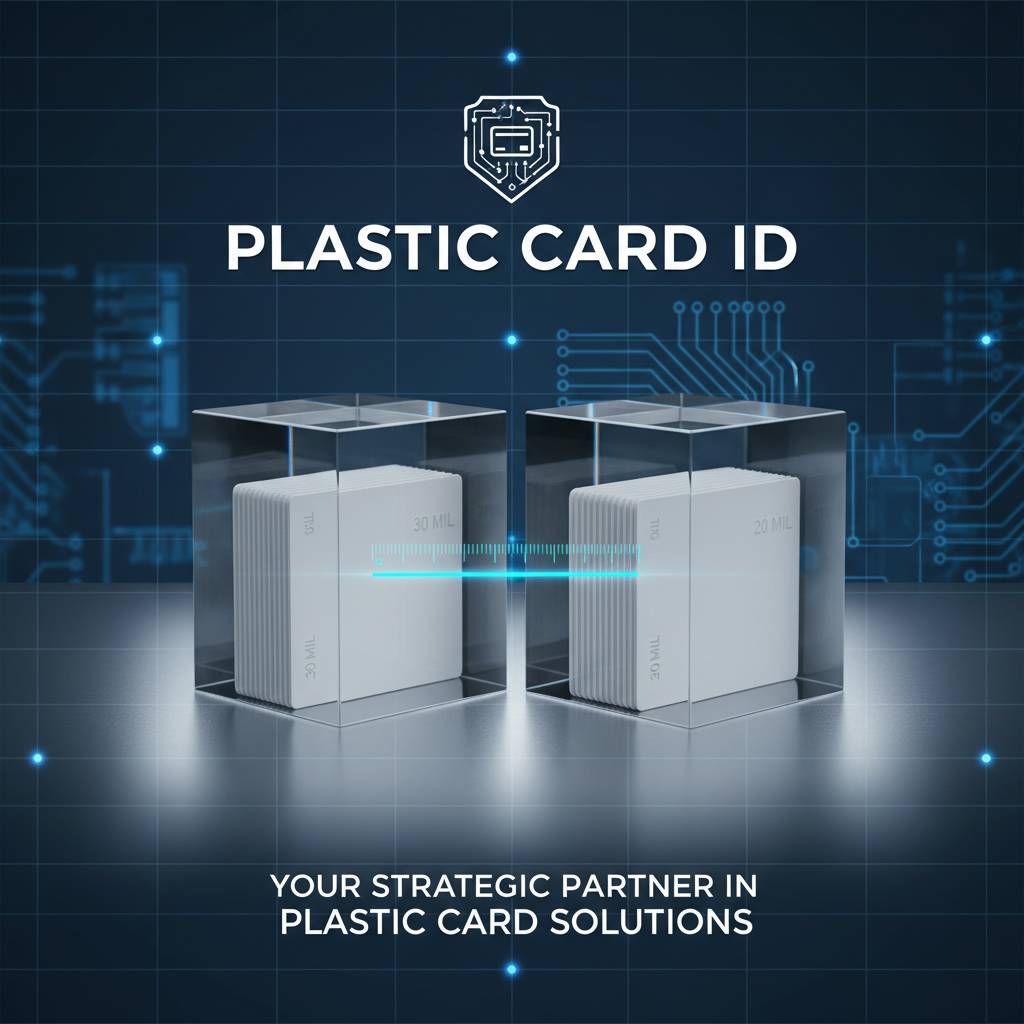 ISO 7810 is the international standard that defines the physical characteristics of identification cards. It specifies dimensions, flexibility, and yes - thickness. The standard CR80 card measures 3.375 inches by 2.125 inches at exactly 0.030 inches thick - 30 mil. That is the same size as a credit card, a driver's license, a hotel key card. It did not happen by accident. Decades of global industry consensus landed on that thickness because it balances rigidity, flexibility, printability, and reader compatibility in a way no thinner card can reliably replicate.
When CPE talks to new clients who are wondering why 30 mil cards cost slightly more than thinner alternatives, the ISO standard becomes the most important part of the conversation. Compliance with that standard means your cards will work in badge holders, card printers, magnetic stripe readers, and RFID readers without guesswork. It means replacements are interchangeable. It means your program scales without compatibility headaches.
What ISO 7810 Actually Specifies
Beyond thickness, ISO 7810 covers flatness tolerances, minimum bend radius, and surface quality. A card that meets this standard resists warping under normal conditions, maintains consistent print quality across its surface, and feeds reliably through card printers. These are not cosmetic details - they directly affect print yield, reader accuracy, and daily usability.
For organizations running high-volume in-house card programs, compliance with ISO 7810 translates into fewer rejected print jobs, fewer jammed cards, and longer printer ribbon life. Every out-of-spec card that jams a Fargo HDP5000 or a Zebra ZXP costs real money in time and wasted consumables. Starting with ISO-compliant 30 mil stock eliminates that variable entirely.
Why Card Printers Are Calibrated for 30 Mil
Evolis, Zebra, and Fargo - three of the most respected names in card printing - engineer their printers around the CR80 30 mil standard. The card feed mechanisms, pressure rollers, and print head gap settings are all tuned for that specific thickness. When you run a 20 mil card through a printer designed for 30 mil stock, you introduce variables: inconsistent print pressure, potential for skew, and in some cases, void on your printer warranty.
That is not a sales pitch - it is a mechanical reality. Card printer manufacturers publish approved card specifications in their documentation, and the default specification is always 30 mil CR80. Choosing the right card thickness from the start protects your printer investment and your print quality simultaneously. For businesses running Evolis Primacy or Zebra ZC300 printers purchased through CPE, this is standard onboarding advice.
Industries That Depend on the 30 Mil Standard
Consider the industries where card reliability is non-negotiable. Healthcare organizations issuing patient ID cards. Corporations deploying access control badges across multi-site campuses. Retailers launching gift card programs where a failed card swipe at the register is an unacceptable customer experience. Every one of these use cases demands 30 mil compliance.
Hotels rely on 30 mil PVC for key cards that must survive repeated insertions into door lock readers. Casinos issue player cards in 30 mil format because those cards travel through sophisticated reader systems and need to last months of daily use. Event venues printing admission credentials on-site depend on 30 mil stock feeding cleanly through desktop printers under pressure. The pattern is clear: where cards work hard, 30 mil is the answer.
| Use Case | Recommended Thickness | Notes |
|---|---|---|
| Employee ID Badge | 30 mil | Badge clip wear, daily handling |
| Retail Gift Card | 30 mil | POS reader compatibility critical |
| Direct Mail Insert | 20 mil | Postage savings, single activation |
| Loyalty Card | 30 mil | Wallet durability, long-term use |
| Event Credential (single day) | 20 mil or 30 mil | Depends on reader type used |
| Access Control / RFID Card | 30 mil | Antenna placement requires standard thickness |
The Legitimate Case for 20 Mil Cards
Here is where many card conversations get one-sided. The instinct is to push 30 mil as universally superior and 20 mil as an inferior compromise. That is an oversimplification that does not serve buyers well. Twenty mil cards have genuine, well-defined applications where they outperform their thicker counterparts - not in durability, but in form factor suitability and cost efficiency at scale.
Direct mail programs are the clearest example. When a card is being affixed to a mailer, inserted into a magazine, or dropped into an envelope for a promotional campaign, the thickness of a 30 mil card can push the mailing into a higher postage tier. A 20 mil card in that context is a rational, deliberate cost decision - not a quality compromise. The card was never meant to live in a wallet for three years. It was meant to be activated once and possibly replaced with a standard card afterward.
Direct Mail and Combo Card Applications
The combo card format - where a 20 mil card is punched or perforated within a larger carrier - is a staple of direct marketing campaigns. The thinner card peels away cleanly from the carrier without the stiffness that would make a 30 mil card awkward to detach. CPE works with clients running these programs regularly, pairing the right card stock with card affixing and mailing services for a complete fulfillment solution.
Postcard mailers with affixed plastic cards have consistently higher response rates than paper-only mailers. The tactile presence of a plastic card - even a thinner 20 mil card - signals value and drives action. The card itself becomes a physical call to action that sits on a counter or gets tucked into a wallet until the recipient is ready to use it. The goal of the mail piece determines whether 20 mil is acceptable - and often, it is.
When Cost Per Card Drives the Decision
For organizations ordering in high volumes - tens of thousands of cards per campaign - the per-card cost differential between 20 mil and 30 mil stock becomes meaningful. A loyalty program launching into a new market with 50,000 introductory cards might calculate that 20 mil makes sense for the acquisition wave, transitioning customers to a full 30 mil card upon their first redemption or account activation. This tiered approach is a legitimate strategy that balances economics with customer experience.
The key question to ask is: what will happen to this card after it reaches the recipient? If the answer involves repeated use, badge clips, card readers, or long-term wallet storage, 30 mil is the right investment. If the card serves a single-use or short-cycle purpose, 20 mil is worth evaluating. That distinction drives better purchasing decisions than a blanket preference for either thickness.
Printer Compatibility Considerations for 20 Mil Stock
Before committing to 20 mil cards for any program that requires on-demand printing, check your printer specifications carefully. Most desktop card printers - including popular Evolis and Zebra models - are designed primarily for 30 mil stock. Some can handle 20 mil with adjusted settings; others will flag an error or produce inconsistent output. Running the wrong card stock through a printer is one of the most common causes of avoidable print failures.
If your program requires printed 20 mil cards, confirm compatibility with the specific printer model before ordering card stock in bulk. Calling 800.835.7919 to discuss your printer model and intended card stock before placing a large order is one of the simplest ways to avoid a costly mismatch. The team at CPE can cross-reference card specifications with printer tolerances and give you a straight answer.
Blank CR80 Cards as the Foundation of In-House Programs
 Blank 30 mil PVC cards are, without question, the workhorse of in-house card programs across the United States. The simplicity is the point. A blank card is a canvas. What gets printed or encoded onto it determines its function - and that function can be changed, updated, or repurposed without ordering new card stock. For organizations that need flexibility and volume efficiency, blank CR80 cards are the starting point for everything.
An employee hired on a Monday can have a printed badge by Monday afternoon. An event organizer can print credentials the morning of the event. A gym can issue a new membership card the moment a member signs up. In-house printing powered by blank CR80 stock gives organizations control over timing, content, and cost that pre-printed cards from outside vendors simply cannot match at the operational level.
Design Control and Program Flexibility
When a business designs and prints its own cards in-house, every element - logo placement, color scheme, variable data, employee photo, access tier - is controlled internally. There is no minimum order per design revision. A security update that changes badge color to indicate clearance level can be implemented the same day the decision is made. That kind of operational agility is only possible with an in-house printing setup built on blank card stock.
Organizations with multiple departments, locations, or card types benefit enormously from this model. A university can print student IDs, faculty badges, visitor passes, and event credentials from the same supply of blank cards, with different designs applied at the printer. A single card type, purchased in volume, serves many use cases - and the per-card cost drops with every case ordered.
Magnetic Stripe and RFID Options on Blank Stock
Blank does not mean basic. CPE supplies blank PVC cards pre-loaded with HiCo or LoCo magnetic stripes, proximity chips, MIFARE DESFire contactless technology, and other encodings - ready to print on. The encoding is in the card before it goes into the printer, so the printed card comes out ready for immediate deployment in access control systems, loyalty platforms, or hotel door lock systems.
HiCo magnetic stripe cards (2750 Oersteds) are the standard for applications requiring data durability - gift cards, loyalty cards, and access credentials that will be swiped repeatedly over months or years. LoCo cards (300 Oersteds) are suited for shorter-lifecycle applications like hotel key cards and event credentials. Matching the stripe coercivity to the application is a detail that protects your system's reliability. Both options are available in standard 30 mil CR80 format.
Volume Pricing and Inventory Strategy
One of the clearest financial advantages of blank card programs is volume pricing. Ordering a case of 500 blank cards costs significantly less per card than ordering 50. Organizations that can forecast their monthly card needs - even loosely - benefit from ordering in larger quantities and maintaining a working inventory. The per-card savings compound quickly at scale. A loyalty program issuing 200 cards per month saves meaningfully by ordering quarterly rather than monthly.
- Start with a 30-day usage estimate and multiply by 3-6 months to determine a baseline order quantity.
- Store blank cards in a cool, dry environment away from direct sunlight to maintain print quality.
- Order magnetic stripe cards by coercivity type matched to your specific reader equipment.
- Combine card stock orders with ribbon and cleaning kit orders to consolidate shipping costs.
- Review your card program quarterly to adjust quantities as your volume grows or shifts.
Advanced Card Technologies: Beyond the Basics
Not every card program starts and ends with a blank white card and a magnetic stripe. As programs mature and security requirements evolve, the card technology needed to support them grows more sophisticated. Smart cards, RFID cards, and specialty formats open capabilities that standard magnetic stripe cards simply cannot provide - and understanding where those technologies fit is essential for program directors planning at a multi-year horizon.
RFID and proximity cards communicate wirelessly with readers without requiring physical contact. A cardholder taps or waves the card near a reader and access is granted in milliseconds. For high-traffic entry points - office building lobbies, parking garages, manufacturing floors - this is not a luxury feature. It is a throughput and security necessity that contactless technology was purpose-built to address.
RFID and Proximity Card Specifications
Proximity cards typically operate at 125 kHz and are used in standard access control environments. RFID smart cards - including MIFARE DESFire variants - operate at 13.56 MHz and support encrypted, multi-application functionality. The difference matters when you are choosing between a basic door access system and a platform that might also manage parking, cafeteria payments, or time and attendance in a single card. All of these options are available in standard 30 mil CR80 format from CPE.
MIFARE DESFire in particular has become the standard for high-security applications in corporate campuses, transit systems, and government facilities because of its encryption architecture. When a card program needs to grow into multi-function capability, starting with DESFire-compatible infrastructure avoids a costly system replacement later. Planning for that scalability at the card selection stage is smart program design.
Casino Player Cards and Hotel Key Cards
These two card types represent specialized applications that demand 30 mil durability and precision encoding. Casino player cards cycle through reader hardware hundreds of times per card lifetime, carrying loyalty point data and player tier information that directly affects the guest experience. A card that wears out prematurely or encodes inconsistently creates customer service problems at the worst possible moment.
Hotel key cards face a different challenge: they must survive casual handling, exposure to wallets packed with credit cards and cash, and proximity to magnetic fields from phones - all while maintaining reliable door lock operation. The combination of 30 mil durability, precise LoCo encoding, and consistent card surface flatness is what makes hotel key card programs work reliably across thousands of rooms and check-in cycles every year.
Clear, Frosted, and Specialty Format Cards
Clear and frosted PVC cards occupy a growing niche in premium membership programs, VIP credentials, and brand-forward loyalty applications. When a standard white card will not make the brand impression a client is looking for, a clear or frosted base opens design possibilities - especially for full-bleed artwork that uses the card's translucency as a design element. These are still 30 mil CR80 format; the substrate changes, not the standard.
For the highest tier of card programs, luxury metal cards in stainless steel, brass, and gold represent the ultimate in perceived value and brand statement. These are not novelty items - they are deliberate positioning tools used by membership clubs, premium loyalty tiers, and executive credential programs where the physical weight and finish of the card is itself part of the member experience.
Choosing the Right Card Printer for Your Thickness and Volume
Card thickness selection does not happen in isolation from printer selection. The two decisions are linked. A printer that handles 30 mil stock reliably at 200 cards per day is a different machine than one designed for high-volume runs of 2,000 cards per day. Getting both decisions right - card thickness and printer capability - is what separates programs that run smoothly from ones that create constant operational friction.
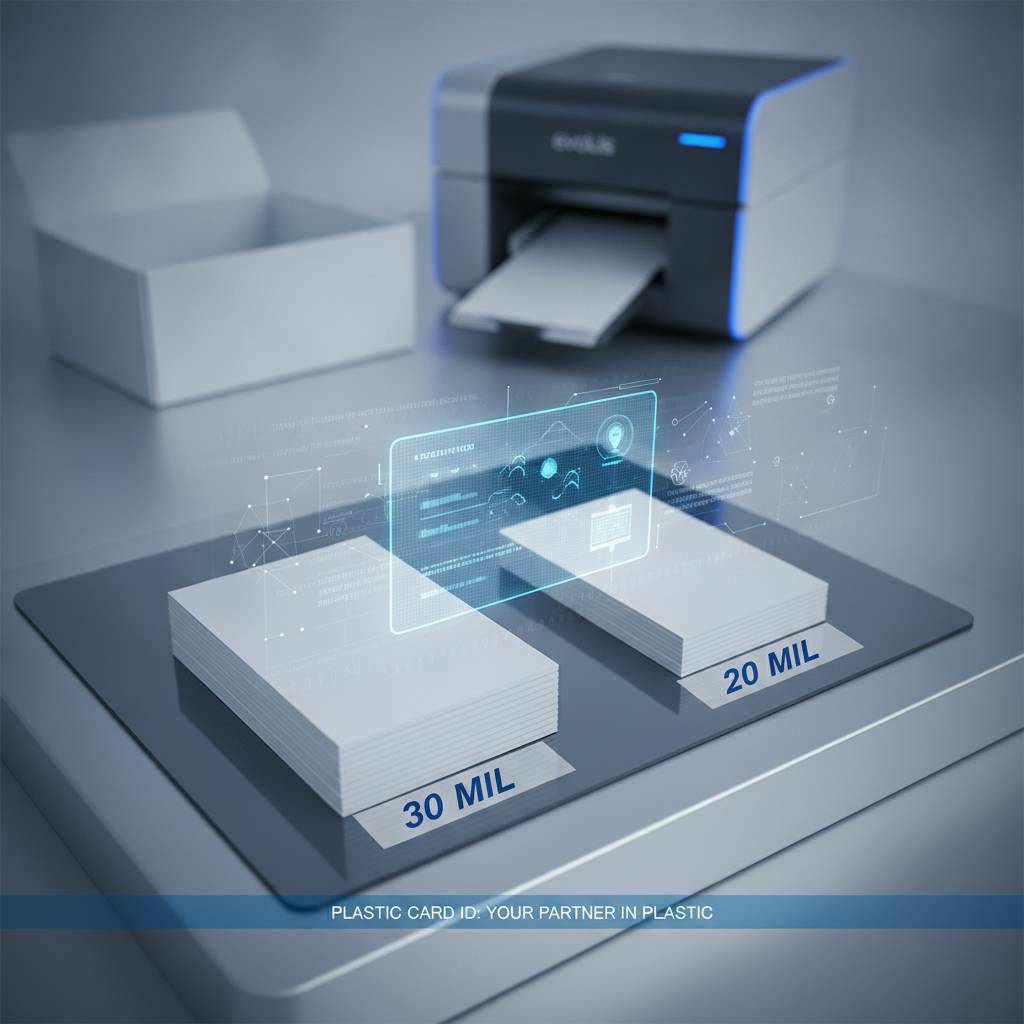
CPE supplies card printers from three of the industry's most respected manufacturers: Evolis, Zebra, and Fargo. Each brand has a range that spans entry-level single-sided desktop units to high-volume dual-sided retransfer printers. Matching the printer to the card program volume and card type is as important as matching the card to the application.
Entry-Level vs. Mid-Range vs. High-Volume Printers
Entry-level printers like the Evolis Badgy and Zebra ZC100 are designed for organizations printing fewer than 500 cards per month. They are compact, affordable, and reliable when used with standard 30 mil CR80 cards. For organizations printing between 500 and 3,000 cards per month, mid-range options like the Evolis Primacy or Zebra ZC300 offer faster throughput and more encoding options without requiring an industrial-scale investment.
High-volume programs - those running 3,000 or more cards monthly - benefit from retransfer printers like the Fargo HDP5000, which prints over the entire card surface including the edge, producing sharper images and better durability on finished cards. Retransfer technology also handles specialty card substrates - including clear and frosted cards - more reliably than direct-to-card printing. If your program is growing toward that volume, planning for the right printer now avoids a painful mid-program upgrade.
Ribbons, Cleaning Kits, and Consumables
A printer is only as good as its consumables. Using off-brand ribbons in an Evolis or Zebra printer risks print quality degradation and can void the manufacturer warranty. CPE supplies OEM-matched ribbons for every printer in its lineup - YMCKO, YMCK, monochrome, and overlay panels for programs with specific output requirements. Pairing the right ribbon with the right card stock is how consistent print quality is maintained across thousands of cards. Call 800.835.7919 for consumables specific to your printer model.
Cleaning kits are not optional maintenance - they are scheduled maintenance that directly affects print head longevity and card output quality. Most card printer manufacturers recommend cleaning every 250-500 cards, using cleaning cards and swabs designed for the specific printer model. Programs that skip cleaning cycles experience print head failures that cost far more to repair or replace than the cleaning supplies would have cost over the life of the printer. This is one of the most cost-effective operational habits in any card program.
Card Carriers, Sleeves, and Mailing Services
Once cards are printed, they need to reach their destination - whether that is an employee's hands, a customer's mailbox, or a retail display. Card carriers present credentials professionally at point of issuance. Sleeves protect printed surfaces during mailing and storage. Card affixing services - where CPE physically affixes cards to mailers or carriers - are available for programs that need a complete fulfillment solution without managing the mechanical process in-house.
For direct mail campaigns in particular, the combination of 20 mil cards, professional affixing, and organized mailing creates a turnkey outreach program that requires minimal internal resources. The full-service model is especially valuable for organizations launching new card programs or running seasonal promotions that spike card volume beyond normal in-house capacity. Having a single vendor handle card stock, printing support, and mailing logistics simplifies program management considerably.
Making the Right Choice for Your Program - Plastic Card ID
The 30 mil versus 20 mil decision comes down to a clear framework. Ask what the card will do, where it will live, how long it needs to last, and what systems it needs to work with. Ninety percent of card programs - loyalty, access, membership, ID, gift cards, event credentials - belong on 30 mil ISO-standard stock. The remaining ten percent have legitimate, well-defined cases for 20 mil, primarily in direct mail and single-use promotional formats.
What no program should do is default to 20 mil because it is cheaper without evaluating the true cost of compatibility issues, increased card replacement rates, and the customer experience gap created by a card that feels underbuilt. The savings per card are real; the downstream costs of the wrong choice are also real. The right thickness is the one that fits the application - not the one with the lowest unit cost.
With more than 50 million cards delivered to over 100,000 customers across the United States, CPE has seen every version of this decision play out. The guidance is consistent: invest in the right card for the job. Build your program on ISO-compliant 30 mil stock for every application that demands it. Use 20 mil strategically where it genuinely fits. And take advantage of the full product and service ecosystem - printers, ribbons, cleaning kits, carriers, and mailing - to run a program that works reliably from day one.
Ready to build your card program on the right foundation? Contact Plastic Card ID today at 800.835.7919 - your strategic partner for ISO-standard plastic cards, card printers, and complete in-house card program solutions across the United States.
Previous Page