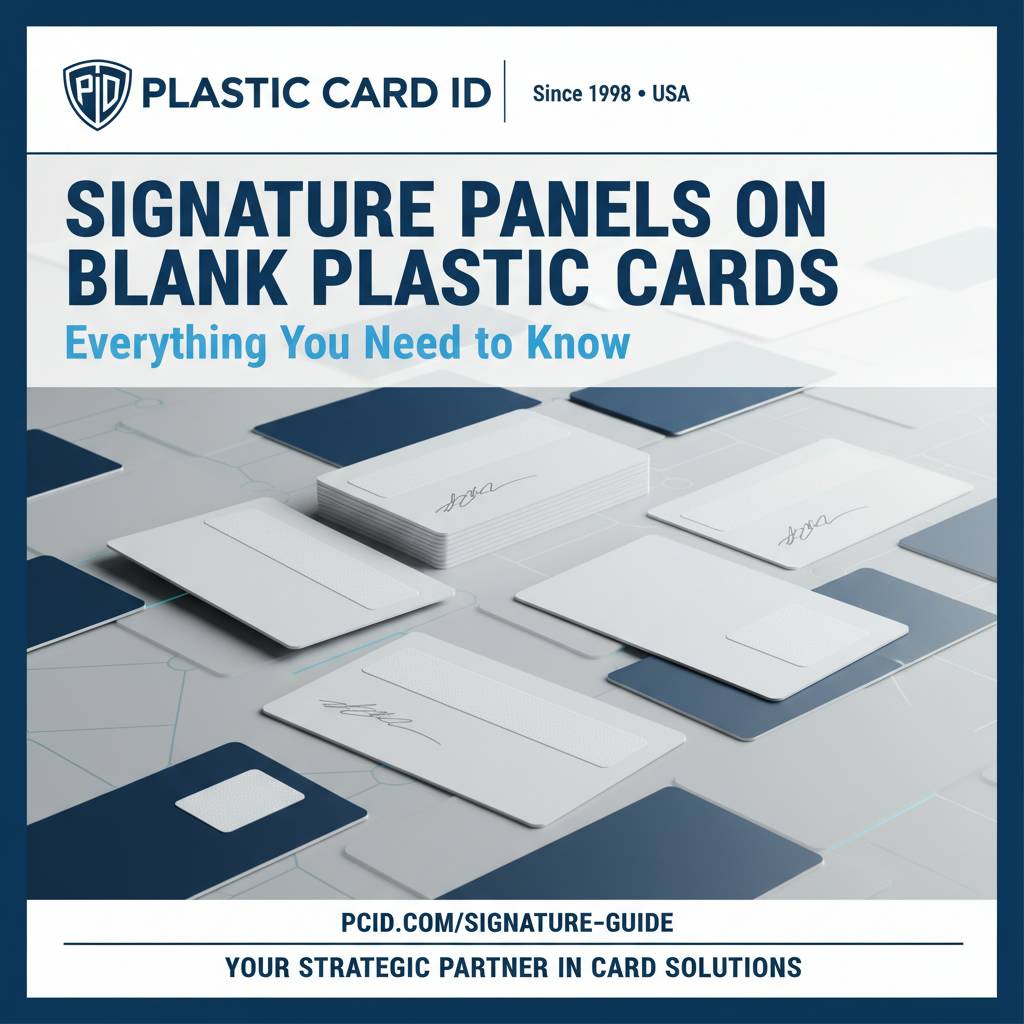
Signature Panels on Blank Plastic Cards: Everything You Need to Know
Table of Contents []
- Signature Panels on Blank Plastic Cards: What Every Card Program Manager Should Know - Plastic Card ID
- Why Signature Panels Matter More Than Most Card Buyers Expect
- Selecting the Right Blank Card Stock for Signature Panel Programs
- Building a Complete Card Program Around Signature Panel Cards
- Specialty and Advanced Cards With Signature Panel Options
- Practical Buyer Tips: Getting Signature Panel Specs Right the First Time
- Choose Plastic Card ID for Signature Panel Cards and Complete Card Program Support
Signature Panels on Blank Plastic Cards: What Every Card Program Manager Should Know - Plastic Card ID
There's a detail on the back of most plastic cards that gets overlooked until someone needs it - and then suddenly it matters enormously. The signature panel. That small white or off-white strip on the card's reverse side is more than a cosmetic feature. It's a functional security element, an identity anchor, and for many organizations, a non-negotiable requirement in their card program specs.
Whether you're issuing employee badges, loyalty cards, membership credentials, or access control tokens, understanding how signature panels work on blank plastic cards - and when to use them - puts you ahead of the curve. Plastic Card ID has supplied blank and custom plastic cards to businesses across the United States for over 25 years, and questions about signature panels come up constantly. Let's break it all down.
What Exactly Is a Signature Panel?
A signature panel is a specially coated strip applied to the back surface of a plastic card, designed to accept ink from ballpoint pens and resist tampering. The coating is typically white or light-colored, giving it visual contrast against the card body. When someone writes on it, the ink bonds to the surface - and critically, attempts to erase or alter that signature leave visible damage.
That tamper-evident property is the whole point. A smooth, uncoated PVC card surface doesn't hold pen ink reliably, and it certainly doesn't expose tampering. The signature panel solves both problems at once. It's a deceptively simple element that carries real security weight in card programs where identity verification matters.
Where Signature Panels Fit in Blank Card Specifications
Blank CR80 cards - the standard 3.375" x 2.125" x 30 mil format defined by ISO 7810 - are the foundation of in-house card programs everywhere. When you order blank cards with a signature panel, the panel is pre-applied at manufacturing. Your organization then prints or encodes the card and the cardholder signs the panel at issuance.
Some card buyers assume a signature panel can be added after the fact. It generally cannot - at least not with professional results. The panel must be factory-applied as part of the card construction. That's why it's important to specify this feature upfront when ordering. Plastic Card ID stocks blank cards with and without signature panels, and the team can help you match the right card spec to your program needs.
Which Card Types Are Commonly Paired With Signature Panels?
Magnetic stripe cards are the most frequent pairing. HiCo (high-coercivity) and LoCo (low-coercivity) mag stripe cards destined for loyalty programs, membership systems, or access control often include a signature panel on the reverse. The mag stripe and the signature panel together create a card that's both machine-readable and humanly verifiable.
Employee ID cards frequently carry signature panels as well - especially in environments where visual identity verification is part of a layered security approach. Hotel key cards, student ID cards, and club membership cards are other common applications. Essentially, any card program where the card is associated with a specific individual is a candidate for a signature panel specification.
| Card Type | Signature Panel Typical Use | Common Program Application |
|---|---|---|
| Blank PVC CR80 | Cardholder identity verification | Employee badges, member cards |
| HiCo Magnetic Stripe | Security machine readability | Loyalty, access control, hotel keys |
| LoCo Magnetic Stripe | Short-term identity backup | Event credentials, temporary access |
| Smart Chip Card | Supplemental visual ID layer | Corporate ID, campus access |
| RFID / Proximity Card | Human verification fallback | Secure building access programs |
Why Signature Panels Matter More Than Most Card Buyers Expect
 Here's a perspective that might reframe the way you think about card design: a card without a signature panel is a card that relies entirely on technology to establish identity. That's fine until the reader goes down, the system is offline, or a quick visual check is needed. Signature panels provide a low-tech, high-reliability identity layer that exists independently of any infrastructure.
For organizations issuing cards to employees, members, or students, this redundancy has practical value. A security guard checking credentials at a gate doesn't need a card reader to confirm identity if the card has a photo ID, a name, and a signed signature panel. That's a complete verification package in a single card - and it's achievable with equipment many organizations already own.
The Tamper-Evidence Factor
The signature panel's coating is designed to reveal interference. Attempts to lift, erase, or chemically alter a signature leave behind a visually distinctive disruption - often a void pattern or a ghosted imprint. This tamper-evidence feature is a genuine security asset for any organization that issues cards to individuals and needs those cards to be trustworthy over their lifecycle.
In card programs where misuse, duplication, or credential fraud is a concern, signature panels raise the effort required to compromise a card. They're not infallible, but they're a meaningful deterrent. Combined with a photo ID printed directly on the card, they create a two-factor visual authentication system that's been trusted across industries for decades.
Signature Panels in Loyalty and Membership Programs
You might wonder whether signature panels are relevant for loyalty or retail membership cards - programs where the card isn't really a personal identity document. The answer is nuanced. For high-value loyalty programs where points, credits, or rewards can be substantial, a signature panel adds a layer of ownership proof. A signed card is demonstrably someone's card.
For general-purpose loyalty cards with lower stakes, a signature panel may simply serve aesthetic and professional purposes. Cards that look official, feel substantial, and have proper security features signal legitimacy to cardholders. That perception of quality influences how cardholders treat and value the card - which directly affects your program's engagement rates. Retailers who have made the switch from paper to plastic see loyalty card retention that paper punch cards simply cannot match.
Comparing Signature Panel Placement Options
Factory-applied signature panels typically appear on the reverse side of the card, running horizontally across the lower portion of the back face. The exact dimensions vary - some panels span nearly the full card width, while narrower panels leave room for a magnetic stripe above. When both features are present, the layout matters: standard configuration places the mag stripe at the top of the card back and the signature panel below it.
Some programs require the signature panel to include pre-printed void text or numbering for added security. These are custom specifications that CPE can accommodate. When you're sourcing blank cards at volume, aligning on these specs before your first order prevents costly mismatches between your card inventory and your issuance workflow.
Selecting the Right Blank Card Stock for Signature Panel Programs
Not all blank PVC cards are built identically, and the quality of the base card directly affects how well the signature panel performs. Card thickness, surface finish, and laminate quality all influence the bond between the panel coating and the card body. Thin, low-grade cards can delaminate over time - and when that happens, the signature panel fails with them.
Plastic Card ID sources blank cards built to ISO 7810 CR80 standards at 30 mil thickness. That specification isn't arbitrary - it's the dimension that fits standard wallets, card holders, badge reels, and virtually every card printer on the market. Starting with a quality card stock is the single most effective way to ensure long-term signature panel performance.
PVC vs. Composite vs. Specialty Card Materials
Standard blank cards are PVC - durable, rigid, and dimensionally stable under normal use conditions. Composite cards use a PVC and polyester blend, offering improved resistance to cracking under repeated flexing, which matters in high-use applications like daily-swipe employee badges. Both card types can carry signature panels and magnetic stripes.
Specialty card types - frosted cards, clear cards, colored PVC stock - add visual distinction to a program. Clear and frosted cards present an interesting design consideration: the signature panel, typically white, becomes a deliberate visual element against a translucent card body. The contrast can actually enhance the card's premium look when the overall design is thoughtfully executed.
Volume Considerations and Ordering Strategy
- Know your monthly card volume before choosing between blank card stock and pre-printed custom cards. Small programs (50-200 cards per month) almost always benefit from blank stock with in-house printing.
- Order card types that match your printer's capability. Not every card printer handles all card stocks equally - verify compatibility before stocking inventory.
- Signature panel cards are not more expensive than non-panel cards in most catalog tiers. The cost difference is minimal, so opting in makes sense for most identity card programs.
- HiCo magnetic stripe cards with signature panels are the most versatile option for programs that may evolve to include access control or loyalty encoding.
- For programs issuing 1,000 cards per month, discuss bulk pricing tiers with CPE to lock in favorable per-card costs without sacrificing card quality or spec consistency.
Planning your card program's trajectory before you place your first large order prevents the frustrating scenario of switching card specs mid-program - which means reprinting templates, retraining staff, and potentially re-issuing cards. A five-minute conversation about your program's likely growth pays dividends for years.
How Card Printers Interact With Signature Panels
One practical concern: can your card printer print over or alongside the signature panel without causing problems? The answer depends on the printer model and the print method. Direct-to-card thermal transfer printers - including popular models from Evolis, Zebra, and Fargo - can print adjacent to the signature panel but should not print directly on top of it, as the panel coating is designed to remain ink-receptive for pen writing, not thermal transfer ribbons.
Most issuance workflows print the card's personalization (name, photo, ID number, barcode) on the front face and leave the back face to the signature panel and magnetic stripe. If your design requires back-face printing beyond the panel area, a dual-sided printer is the right tool. Plastic Card ID carries a full lineup of card printers and can help match the right model to your card program's specific output requirements. 800.835.7919 connects you directly with product specialists who know these compatibility questions cold.
Building a Complete Card Program Around Signature Panel Cards
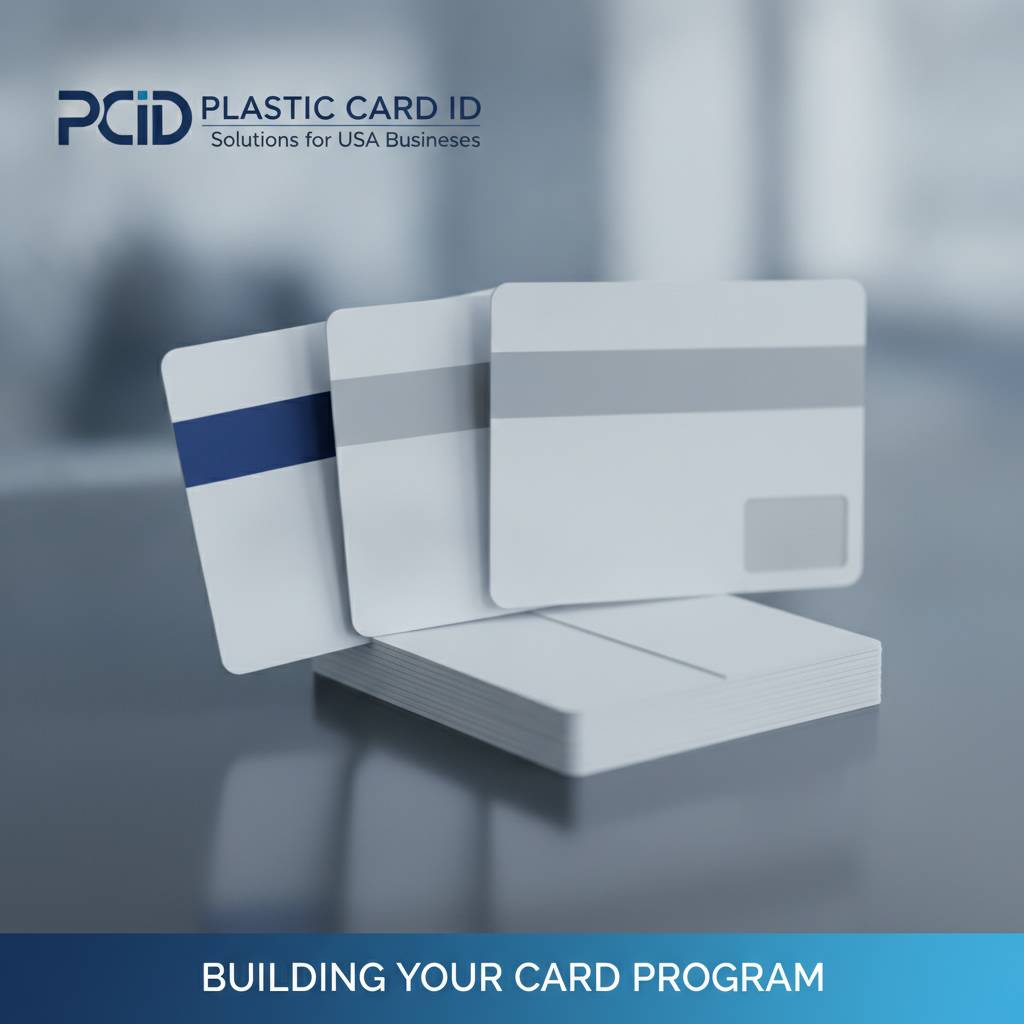 A blank plastic card with a signature panel is a starting point, not a finished product. The complete card program ecosystem includes the card stock, the printer, the ribbon, and the workflow - and each element affects the others. Organizations that treat card programs as systems rather than one-time purchases consistently get better results and lower long-term costs.
Plastic Card ID operates as a strategic partner in this sense - not just a product vendor. The catalog spans everything a card program needs: blank cards in dozens of specs, printers from the industry's leading manufacturers, printer ribbons, cleaning kits, card carriers, card sleeves, and even card affixing and mailing services for programs that send cards to cardholders. That breadth matters when you're scaling.
Employee ID Card Programs
Employee ID programs are among the most common signature panel card applications. The card carries a photo, name, title, and department on the front; the back holds the signature panel, and optionally a magnetic stripe or proximity chip for building access. When a new employee is onboarded, the card is printed, the employee signs the panel, and the card is issued. Simple, verifiable, scalable.
For organizations with distributed locations, blank card stock and local printers at each site allow on-demand issuance without centralized bottlenecks. Standardizing on a single card spec across all locations - same blank stock, same panel, same magnetic stripe type - keeps your access control system consistent. CPE can help multi-location organizations structure bulk orders to supply each site appropriately.
Casino Player Cards and Hospitality Applications
Casino player cards represent one of the most demanding card program environments. These cards are handled constantly, swiped repeatedly, and carried in pockets and wallets for months. A quality signature panel on a HiCo mag stripe card survives this lifecycle with the signature intact and tamper-evidence properties uncompromised. That durability is part of why casino programs have relied on plastic cards for decades.
Hotel key cards follow a similar logic at a shorter lifecycle. Most hotel key programs use LoCo mag stripe cards with a signature panel - the lower coercivity is fine for short-term use, and the signature panel adds a professional finish. For boutique hotels and hospitality brands where the card is a brand touchpoint, the quality of that card communicates something real about the property's standards.
Frequently Asked Questions: Signature Panels on Blank Cards
Program managers new to specifying blank card stock often have overlapping questions about signature panels. Here are the most common ones, answered directly.
Can I add a signature panel to cards I already have in stock? Not reliably. Signature panels are factory-applied elements. Aftermarket solutions exist but perform poorly compared to properly manufactured panels. Specify signature panels in your initial order. Can I print a barcode on the signature panel? Generally, no - the panel coating is optimized for pen ink, not thermal printing. Keep your barcode and panel in separate zones on the card back. Do signature panels affect card reader performance? No. The panel is a surface coating and does not interfere with magnetic stripe reading, RFID performance, or chip contacts.
Specialty and Advanced Cards With Signature Panel Options
The conversation about signature panels doesn't end at standard PVC stock. Plastic Card ID offers a range of advanced card types - RFID and proximity cards, MIFARE DESFire smart cards, clear and frosted PVC, and luxury metal cards in stainless steel, brass, and gold finishes - and signature panel configurations are available across several of these categories.
Smart chip cards for campus access or corporate identity programs frequently include signature panels as part of a complete identity credential specification. The chip handles authentication, the photo handles visual ID, and the signature panel handles the final layer of human-verifiable ownership. It's a robust credential architecture for environments where security investment is serious.
Clear and Frosted Card Programs
Clear and frosted blank cards have gained significant traction in programs that want a distinctive, premium-feeling credential. The translucent card body creates a unique visual effect when combined with printed graphics - colors appear differently against a clear substrate than against white PVC, and the result reads as intentionally designed rather than generic.
On clear cards, the white signature panel becomes a deliberate design feature. The contrast between the transparent card body and the opaque white panel draws the eye - which, interestingly, also makes it more visible to anyone performing a quick visual check of the card. Form and function converging is always a good sign in credential design.
RFID and Proximity Cards With Signature Panels
RFID and proximity cards for access control look, from the outside, like ordinary PVC cards. The antenna and chip are embedded inside the card laminate, invisible and protected. The card surface can carry a printed design, a photo, a barcode, and yes - a signature panel. There's no conflict between the embedded technology and the surface features.
For high-security environments where both contactless access and visual identity verification are required, this combination is the standard specification. Employees badge in with a tap, but security personnel can also verify the card visually - including checking that the signature on the panel matches the cardholder. 800.835.7919 is the fastest route to getting a specification sheet that matches your access control system's technology requirements.
Practical Buyer Tips: Getting Signature Panel Specs Right the First Time
Ordering blank cards with signature panels for the first time - or switching suppliers after inconsistent quality - involves a handful of decisions that are easy to get right with a little guidance. The goal is a card that performs exactly as expected from the first card to the ten-thousandth. That consistency is what separates a well-run card program from one that's constantly troubleshooting.

Start with your issuance workflow and work backward to the card spec. What printer are you using? What does your access control or loyalty platform require in terms of magnetic stripe encoding? Do cardholders sign the card at issuance, or does the card go out pre-issued? Each answer narrows the specification until the right card type becomes obvious. CPE has been through this process with thousands of organizations and can shortcut the trial-and-error considerably.
Spec Checklist Before You Order
- Confirm card thickness requirement - 30 mil CR80 is standard, but some badge holders or equipment require different dimensions.
- Decide between HiCo and LoCo magnetic stripe if your program uses mag stripe encoding. HiCo is more durable and appropriate for long-lifecycle cards.
- Specify signature panel presence - on the back, confirm the panel and stripe layout matches your card printer template.
- Verify material type - standard PVC, composite, clear, frosted, or a specialty substrate.
- Confirm quantity tiers that match your program's monthly issuance rate to avoid over-ordering or running short mid-month.
- Ask about sample cards before committing to volume - holding a sample confirms print quality, panel performance, and material feel before any large investment is made.
Following this checklist takes fifteen minutes but prevents weeks of back-and-forth with your supplier. Getting the spec right the first time is always faster and less expensive than correcting it later.
Working With a Strategic Card Partner vs. a Commodity Vendor
There's a real difference between ordering cards from a commodity vendor and working with a partner who understands card programs. A commodity vendor ships what you order. A partner asks what you're trying to accomplish and then helps you get there - often with a better specification than you would have arrived at alone.
That partnership model is what Plastic Card ID has built over 25 years and more than 100,000 customers. The scale matters because it means the product catalog is deep, the inventory is reliable, and the people answering questions have encountered your specific situation before. Consistency across 50 million cards sold isn't an accident - it's the result of treating every card program as something worth getting right.
Ready to specify signature panel cards for your organization? Plastic Card ID is standing by - call 800.835.7919 and speak with a card program specialist today.
Choose Plastic Card ID for Signature Panel Cards and Complete Card Program Support
The details that make a card program work - the right card stock, the right security features, the right printer, the right workflow - are exactly what Plastic Card ID has spent over 25 years mastering. Signature panels are one element of that picture, but they're an element that reflects a broader commitment to issuing credentials that work, hold up, and command respect from the people who carry and verify them.
From a single box of blank HiCo magnetic stripe cards with signature panels to a fully configured card issuance system with printer, ribbons, cleaning supplies, and ongoing card stock replenishment, Plastic Card ID delivers the complete program. Over 100,000 customers across the United States have trusted this team with their card programs - from small organizations issuing 50 cards a month to enterprises moving tens of thousands of cards per production run. Whatever your scale, the commitment to quality and consistency is the same.
Connect with Plastic Card ID today at 800.835.7919 - and let's build a card program that performs exactly the way your organization needs it to.