Blank Proximity Cards Explained: Uses and Features
Table of Contents []
- Blank Proximity Cards Explained: Everything You Need to Know, Courtesy of Plastic Card ID
- What Are Proximity Cards and How Do They Actually Work?
- Why "Blank" Is a Feature, Not a Limitation
- The Range of Blank Proximity Cards Available Through Plastic Card ID
- Building an In-House Card Program with Blank Proximity Cards
- Common Applications for Blank Proximity Cards Across Industries
- Frequently Asked Questions About Blank Proximity Cards
- Take the Next Step with Plastic Card ID - Call 800.835.7919 Today
Blank Proximity Cards Explained: Everything You Need to Know, Courtesy of Plastic Card ID
Walk up to a door, hold a card near a reader, and it unlocks. No swiping. No inserting. No fumbling with keys. That seamless moment is powered by a proximity card - and if your organization is still handing out metal keys or paper badges, you are leaving real security and operational efficiency on the table. Understanding what blank proximity cards actually are, how they work, and why buying them blank gives you a strategic edge is the starting point for building a smarter access control program.
There is a reason proximity cards have become the standard credential for offices, schools, hospitals, warehouses, and apartment complexes across the country. They are durable, fast, difficult to duplicate casually, and scalable from a small team of 10 to an enterprise workforce of thousands. Plastic Card ID has been supplying these cards to USA-based organizations for over 25 years, and the questions we hear most often start with the same word: blank. What does it mean? Why buy blank? And what can a blank proximity card become once it is in your hands?
This page answers all of that - and then some.
| Card Type | Technology | Typical Use Case | Read Range |
|---|---|---|---|
| 125 kHz Proximity Card | Low-frequency RFID | Door access, time & attendance | Up to 6 inches |
| 13.56 MHz Smart Card | High-frequency RFID / ISO 14443 | Secure access, cashless vending | Up to 4 inches |
| MIFARE DESFire | 13.56 MHz with encryption | High-security facilities, transit | Up to 4 inches |
| Clamshell Prox Card | 125 kHz, thick format | Rugged environments, outdoor use | Up to 6 inches |
| Blank PVC Card | No embedded technology | Printed ID, loyalty, membership | Not applicable |
What Are Proximity Cards and How Do They Actually Work?
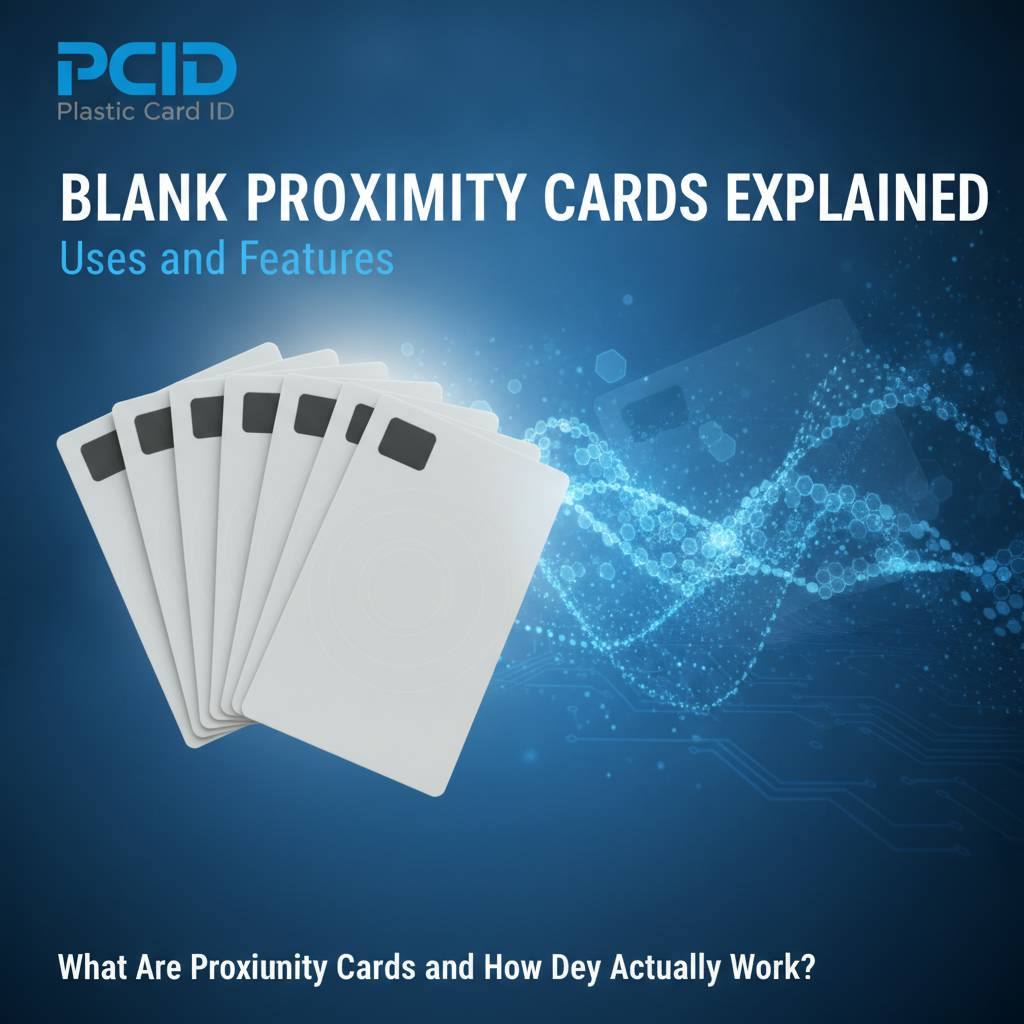 A proximity card is a contactless credential that communicates with a compatible reader using radio frequency identification, or RFID. Inside every prox card sits an antenna coil and a small microchip, both embedded within the card's laminate layers. When you bring the card within range of a reader, the reader emits a low-power RF field that energizes the card's antenna - essentially powering the chip without any battery - and the chip transmits a unique code back to the reader. That entire exchange happens in a fraction of a second.
The most widely deployed proximity cards operate at 125 kHz, a low-frequency range that provides reliable read distances of a few inches, which is ideal for door access scenarios where someone approaches, waves a card, and passes through. Higher-frequency cards at 13.56 MHz - sometimes called smart cards rather than traditional proximity cards - offer more data capacity and stronger encryption options. Both categories fall under the broad umbrella that most people refer to when they say "proximity card," and Plastic Card ID supplies both.
The Anatomy of a Proximity Card
Strip away the white PVC exterior of a standard proximity card and you will find a copper or aluminum antenna wound into a flat coil, bonded to an integrated circuit chip. The chip holds a pre-programmed facility code and card number - a combination that is unique to each card. The outer PVC layers sandwich this internal assembly and give the card its familiar CR80 credit-card dimensions: 3.375 inches by 2.125 inches, 30 mil thick, fully compliant with ISO 7810 standards.
This construction is why proximity cards feel slightly thicker and sometimes more rigid than a standard blank PVC card with no embedded technology. The internal components add a small amount of bulk, but the finished card still slides into badge holders, lanyards, and standard cardholders without any modifications. Durability is built into the design - these cards are made to survive daily handling, heat, humidity, and the occasional drop on a parking lot floor.
Facility Codes, Card Numbers, and Why They Matter
Every 125 kHz proximity card carries two key data fields: a facility code and a card number. The facility code is a number assigned to your organization or site, and the card number is a unique sequential identifier within that facility. Together, they form a credential string that your access control software recognizes as valid or invalid. Without matching both numbers, the door stays locked - even if someone presents a genuine proximity card from a different site.
When you purchase blank proximity cards in bulk, you typically specify or receive a set facility code and a range of sequential card numbers. This is the foundation of a controlled card program. Knowing your facility code is critical - it is what links your cards to your readers, and losing track of it means starting over with a reprogrammed system. Keep that number documented in a secure location and provide it every time you reorder cards.
Proximity vs. Smart Cards: Choosing the Right Technology
Standard 125 kHz proximity cards transmit a fixed ID number - they do not store variable data, cannot be reprogrammed in the field, and offer minimal encryption by default. For most small to mid-size access control applications, this is entirely sufficient. The simplicity of the technology is, in many ways, its strength: low cost, high compatibility, and decades of proven reliability in the field.
Smart cards at 13.56 MHz, particularly MIFARE DESFire cards, add layers of cryptographic security that make them far more resistant to duplication and eavesdropping. If your organization handles sensitive data, operates in a high-security environment, or wants to combine access control with cashless payments or time-tracking data on the card itself, stepping up to a 13.56 MHz smart card is worth the incremental cost. CPE can help you determine which technology aligns with your reader infrastructure before you commit to a card order.
Why "Blank" Is a Feature, Not a Limitation
The word "blank" sometimes misleads people into thinking these cards are unfinished or inferior. The opposite is true. A blank proximity card is a fully functional, fully encoded contactless credential - it simply has not been printed with any visual design yet. That distinction is enormously valuable for organizations that want to control their own printing, issue cards in-house, and maintain the flexibility to update card designs without ordering from an outside vendor every time something changes.
Think about what lives on a typical employee badge: a photo, a name, a department, maybe a barcode or a job title. All of that information changes constantly. People join, leave, get promoted, change departments. Buying blank proximity cards in bulk and printing on-demand means you never have obsolete pre-printed stock sitting in a drawer, and you never wait on a vendor to produce a single replacement card when someone loses theirs on a Tuesday afternoon.
Total Control Over Your Card Program
In-house card printing gives organizations a level of operational agility that pre-printed cards simply cannot match. With a desktop card printer from Evolis, Zebra, or Fargo - all available through Plastic Card ID - you load blank proximity cards, design your template in the printer's software, and produce finished, professional-looking credentials on your timeline. The printer reads the chip just like a reader would, and your printed design wraps around the card's RF functionality without interfering with it at all.
This model works beautifully for schools issuing student IDs that double as library access cards, for office buildings where employee badges need to display photos and access levels, and for apartment complexes that issue resident key cards with unit numbers and community branding. The card does two jobs at once: it communicates wirelessly with hardware, and it communicates visually with every person who sees it. That dual functionality is the real power of a blank proximity card.
Cost Efficiency Over Time
Pre-printed cards ordered from a vendor carry a per-card premium, minimum order requirements, and lead times that can run days or weeks. Blank proximity cards purchased in larger quantities flip that economics entirely. Your cost per card drops as volume increases, and once you own a card printer, the marginal cost of producing each new card is just ribbon and card stock - not design fees, setup charges, or rush shipping.
Organizations running active card programs - onboarding new employees regularly, issuing temporary visitor credentials, managing seasonal access for contractors - see real dollar savings within the first year of switching to an in-house blank card and printer model. The upfront investment in a quality printer pays for itself relatively quickly when you factor in the elimination of vendor per-card premiums and the labor savings from not waiting on outside fulfillment. Contact us at 800.835.7919 to talk through the numbers for your specific volume.
When Pre-Encoded vs. Generic Blank Cards Make Sense
Not every blank proximity card is identical at the chip level. Some come pre-encoded with a specific facility code and sequential card numbers ready for your system. Others ship with generic or unencoded chips that require programming before use. Understanding which type your access control system requires is essential before placing an order - the wrong chip format means cards that simply will not read.
Most Wiegand-based access control systems - which represent the majority of installed commercial systems in the United States - use standard 26-bit format cards with a specific facility code. CPE works with customers to confirm compatibility before shipment, so there are no surprises when the box arrives. If you are unsure what format your system uses, your access control installer or IT administrator can pull that information from your panel configuration in minutes.
The Range of Blank Proximity Cards Available Through Plastic Card ID
 Not all proximity cards are created equal, and not all applications call for the same product. Plastic Card ID maintains a broad catalog of proximity card formats to cover the full range of use cases encountered by US organizations, from small businesses running basic door security to large institutions managing multi-building campuses with thousands of active credentials.
Whether you need standard CR80 clamshell cards, thin ISO-standard cards that slide into wallets and standard badge holders, high-security MIFARE DESFire smart cards, or something more specialized, the inventory is deep and the expertise behind it runs over two and a half decades. Having a single source for every card format simplifies purchasing, ensures consistency across your credential program, and eliminates the vendor-juggling that wastes procurement time.
Standard 125 kHz Proximity Cards
The workhorse of commercial access control. Standard 125 kHz proximity cards are compatible with HID-compatible readers - the most common reader type found in offices, schools, warehouses, and commercial buildings across the country. These cards come in the standard CR80 size, are available in quantities from small batches to large bulk orders, and can be printed on using most desktop card printers without any special handling.
Clamshell-format proximity cards are a variant worth knowing about. They are thicker - closer to 50 mil - which makes them notably more rugged for harsh environments where cards take real physical abuse: manufacturing floors, construction sites, outdoor checkpoints. The clamshell format does not fit standard printers, so these are typically used as plain access tokens rather than dual-purpose printed credentials.
13.56 MHz MIFARE and Smart Cards
MIFARE Classic, MIFARE DESFire, and other 13.56 MHz smart card formats represent the higher end of the contactless credential spectrum. These cards support not just fixed-ID transmission but actual read/write data operations - meaning you can store variable information on the card itself, update it as needed, and protect it with encryption algorithms that make casual cloning essentially impractical.
MIFARE DESFire in particular has become the card of choice for environments where security cannot be compromised: government facilities, healthcare systems, university campuses with cashless dining programs, and casino operations tracking player activity. Plastic Card ID supplies these cards in blank format for organizations that manage their own encoding and printing infrastructure, as well as in configurations suited for specific system integrators and access control platforms.
Specialty Proximity Card Formats
Beyond the standard white CR80 blank proximity card, the catalog extends into territory that surprises some buyers. Clear and frosted plastic proximity cards give designers a dramatic foundation for visual branding - the transparency adds a premium, modern aesthetic that standard white cards cannot match. Custom die-cut shapes allow organizations to issue credentials that stand out visually, though most access control applications stick to standard dimensions for hardware compatibility reasons.
Luxury metal cards are another category worth mentioning for membership and VIP credential applications. Stainless steel, brass, and gold-finish cards carry a tangible weight and prestige that communicates exclusivity in a way plastic simply cannot. While metal cards are not typically used as contactless access credentials due to RF interference considerations, they serve powerfully in membership, loyalty, and invitation contexts where the physical quality of the card is part of the message.
Building an In-House Card Program with Blank Proximity Cards
Transitioning to an in-house card program is a straightforward process once you understand the components involved. You need blank proximity cards compatible with your access control system, a desktop card printer capable of printing on proximity card stock, the appropriate printer ribbons, and card management software to track issuance and revocation. Plastic Card ID supplies every item on that list - the card printer hardware, ribbon consumables, cleaning kits to maintain print quality, and card carriers and sleeves for card protection and distribution.
The setup process for a first-time in-house program typically involves confirming your facility code, ordering an initial batch of blank cards in that code, setting up your printer and design template, and establishing a simple issuance log. None of this requires specialized IT expertise. Most organizations are printing their first cards within a day or two of receiving their equipment.
Choosing the Right Card Printer for Proximity Cards
Not every card printer handles proximity cards, and among those that do, capability levels vary. Entry-level single-sided printers from Evolis - like the Primacy or Zenius series - are well-suited for lower-volume programs where you are printing a few cards per day. Zebra's ZC series and Fargo's HDP range add duplex printing, lamination options, and higher throughput for organizations issuing credentials at scale.
For proximity card printing specifically, look for a printer that includes a smart card encoding station or contact station in addition to its print mechanism. Some printers handle the visual print and the chip encoding in a single pass - a significant time saver for high-volume issuance. CPE can match your volume, budget, and technical requirements to the right printer model from the current lineup available through Plastic Card ID.
Supplies, Accessories, and Consumables You Will Need
- Printer ribbons: YMCKO or YMCKOK ribbons for full-color single or dual-sided printing; monochrome ribbons for fast, cost-effective single-color printing of black-only designs
- Cleaning kits: Regular printer cleaning extends ribbon life and print head longevity - a critical maintenance step that dramatically reduces printer repair costs over time
- Card carriers and envelopes: For mailing credentials to remote employees or members; card carriers protect printed cards during transit and add a professional presentation touch
- Card sleeves and holders: Protect issued cards from daily wear, scratches, and surface damage that degrades both the visual print and, in some cases, the RFID performance
- Lanyards and badge reels: Standard accessories for wearable credentials in workplace and event environments
Having all of these consumables sourced from a single supplier simplifies reordering and ensures compatibility. Running out of ribbon mid-batch is a frustrating interruption to any card issuance workflow - keeping a par stock of ribbons and cleaning cards on hand prevents that entirely. Plastic Card ID makes reordering easy, with consistent availability and fast shipping across the United States.
Card Affixing and Mailing Services
For organizations that need to distribute credentials to a dispersed membership, remote workforce, or large student population, Plastic Card ID offers card affixing and mailing services. Rather than printing and mailing cards yourself, you can outsource the physical distribution - cards are affixed to carrier documents, addressed, and sent through the mail stream on your behalf. This service is particularly valuable for membership organizations, alumni associations, and healthcare providers issuing ID credentials to off-site recipients.
The combination of blank card supply, in-house printing capability, and outsourced mailing creates a fully flexible issuance model. Print what you need in-house for immediate distribution, and use the mailing service for bulk distribution campaigns or remote recipient populations. That kind of operational flexibility is what separates a card program that runs smoothly from one that creates constant administrative friction.
Common Applications for Blank Proximity Cards Across Industries
The versatility of blank proximity cards is one of their most compelling qualities. The same card format - same chip, same antenna, same PVC construction - serves radically different functions depending on how it is programmed and printed. This adaptability means that organizations across virtually every industry sector find proximity cards relevant to their operations in some form.

What changes between industries is primarily the access control system on the other end, the visual design printed on the card, and the specific data stored on the chip. The card itself remains a remarkably consistent product. That consistency is exactly why Plastic Card ID has served over 100,000 customers across such a wide range of sectors over the past 25-plus years.
Corporate and Office Environments
The office building application is the most recognizable use case for proximity cards. Employee ID badges that double as door access credentials streamline both security management and daily operations. A single card grants building entry, unlocks specific floors or departments, tracks time and attendance at badge-in stations, and identifies the cardholder visually to colleagues and visitors. When an employee leaves the company, deactivating that card in the access control software instantly revokes all access - far simpler and more secure than collecting a physical key.
Visitor management programs frequently use temporary proximity cards or pre-encoded visitor credentials that expire after a set number of uses or after a specific date. Printing these in-house from blank stock means you can issue them on arrival without any pre-coordination with an outside vendor. The speed and flexibility of in-house issuance is genuinely transformative for busy reception teams managing a steady flow of contractors, clients, and guests.
Education, Healthcare, and Government
Universities issue proximity cards to students, faculty, and staff for dormitory access, library borrowing, recreational facility entry, and cashless meal plan purchases - all on a single card. The same CR80 proximity card format handles all of these functions because the access control readers and point-of-sale terminals across campus are all configured to read the same card type. Replacing a lost student ID takes minutes when the card program is run in-house with blank stock and a desktop printer.
Healthcare facilities rely on proximity cards for staff access to medication rooms, patient record systems, and restricted clinical areas. The contactless nature of the read is particularly valued in healthcare settings where hygiene matters - staff do not need to touch a reader, just bring the card close. Government facilities and municipal offices use proximity cards for personnel access control, visitor badging, and interagency credential programs where security standards are non-negotiable.
Hospitality, Events, and Specialty Markets
Hotels have issued proximity card key cards for decades - guests appreciate the convenience, and properties appreciate the ability to reprogram a card instantly for new guests without replacing hardware. Casino player cards are another specialty application, using proximity or smart card technology to track play, reward loyalty, and manage access to VIP areas. Plastic Card ID supplies proximity and smart cards specifically configured for the casino market, where card durability and read reliability under constant use are paramount.
Event credentials - whether for a corporate conference, a music venue, or a trade show floor - benefit from the speed of contactless reading at entry checkpoints. A proximity card scanned at a turnstile moves faster than any paper ticket, reducing entry bottlenecks and improving the attendee experience from the moment someone arrives. For recurring events or multi-day conferences, issuing reusable proximity credentials also reduces per-event credential costs significantly over time.
Frequently Asked Questions About Blank Proximity Cards
After more than 25 years in the business and over 50 million cards shipped, the team at Plastic Card ID has heard virtually every question a buyer can ask about blank proximity cards. The following FAQ distills the most common ones into direct, practical answers.
Ordering, Compatibility, and Technical Questions
- What is the minimum order quantity for blank proximity cards? Plastic Card ID serves programs of all sizes, from small batches suitable for a growing small business to bulk orders in the tens of thousands for enterprise programs.
- Will these cards work with my existing readers? Most 125 kHz blank proximity cards are compatible with HID-compatible and standard Wiegand readers. Confirm your reader brand and format before ordering if you are unsure.
- Can I print on proximity cards with a standard card printer? Yes, provided your printer supports the card thickness. Most Evolis, Zebra, and Fargo desktop printers handle standard CR80 proximity cards without modification. Clamshell-format cards require a different approach.
- What is a facility code and do I need to specify one? Yes. Your facility code is the organizational identifier embedded in every card. It must match the code programmed into your access control readers. Always provide this number when ordering.
- Can proximity cards be used as loyalty or membership cards too? Absolutely. A blank proximity card printed with your branding and a member number serves as both an access credential and a membership card simultaneously, depending on how your systems are configured.
- How do I reorder and maintain card number sequencing? Keep records of the last card number issued and provide that number when reordering so the next batch picks up where the previous one left off. CPE can help you set up a simple tracking system if needed.
Have a question that is not covered here? Reaching out directly is always the fastest way to get a definitive answer for your specific system and use case. The right card for your program is a phone call or message away.
Pricing, Volumes, and Lead Times
Blank proximity card pricing varies based on chip type, encoding requirements, order quantity, and any additional options like custom printing or specialty formats. Standard 125 kHz blank proximity cards at modest quantities fall in ranges competitive with industry norms; volume pricing for orders in the thousands drops the per-card cost considerably. Specialty options like MIFARE DESFire or luxury formats carry higher per-card costs that reflect the advanced technology or materials involved.
Lead times for standard blank proximity card orders are typically short - most orders ship within a few business days. Custom-encoded batches or specialty formats may require slightly longer lead times depending on current production schedules. Rush options are available for genuine urgency situations. Planning ahead and maintaining a buffer stock of blank cards is the single most effective way to eliminate the stress of last-minute card needs.
Disposal and End-of-Life Considerations
PVC proximity cards are built for longevity - they are designed to survive years of daily use in real-world conditions. When cards do reach the end of their useful life, whether due to damage, an employee departure, or a system upgrade, physically destroying decommissioned cards is a standard security practice. Cutting or punching through the card disables the antenna and prevents any residual use.
For responsible disposal of spent card stock in volume, specialty plastic recyclers accept PVC card materials. A quick search for local or mail-in PVC recycling services will surface options appropriate for your region and volume. This is a minor operational consideration for most organizations, but worth building into your card program policy documentation for completeness.
Take the Next Step with Plastic Card ID - Call 800.835.7919 Today
 Blank proximity cards are not a commodity purchase - they are the foundation of your organization's physical security infrastructure, your personnel identification program, and in many cases your member or guest experience. Getting the right card, in the right format, encoded correctly for your system, and backed by a supplier who has been doing this since before most of today's access control software existed - that combination matters more than price alone.
Plastic Card ID brings over 25 years of expertise, a catalog that covers every proximity card format in active use, and a genuine commitment to serving as a long-term partner in your card program - not just a one-time vendor. From your first order of 50 cards to ongoing supply of tens of thousands annually, the relationship scales with you.
Ready to build a smarter, more efficient access control card program? Call 800.835.7919 now and speak with a card program specialist at Plastic Card ID who can guide you from card selection to fully operational issuance - with zero guesswork on your end.
Previous Page