Blank Plastic Cards Made in the USA: Your Complete Source
Table of Contents []
- Why Plastic Card ID Is the Trusted Name for Blank Plastic Cards Made in the USA
- The Full Spectrum of Blank Card Formats and Technologies
- Building an In-House Card Program: Equipment, Supplies, and Strategy
- Frequently Asked Questions About Blank Plastic Cards Made in the USA
- Identity, Access, Loyalty, and Membership: Real Applications for Blank PVC Cards
- Sourcing Blank Plastic Cards Made in the USA: What to Look for in a Supplier
- Partner With Plastic Card ID for Blank Plastic Cards Made in the USA
Why Plastic Card ID Is the Trusted Name for Blank Plastic Cards Made in the USA
Walk into almost any business that runs a card program and you will find a familiar challenge: the gap between what an organization needs and what a generic supplier actually delivers. That gap is exactly where Plastic Card ID has operated for over 25 years, quietly building something most suppliers never bother to create - a genuine partnership with the businesses they serve. More than 100,000 customers and 50 million cards later, the results speak for themselves.
Blank plastic cards made in the USA are not a commodity. They are the foundation of employee badge programs, loyalty systems, membership organizations, access control networks, and event credentialing. What looks like a simple white rectangle is actually a platform - one that becomes whatever your program needs it to be the moment it passes through a card printer or encoding station. Choosing the right supplier for that foundation matters more than most buyers initially realize.
This page covers everything you need to know about sourcing blank PVC cards, the formats and technologies available, the real business case for plastic over paper, and why partnering with CPE gives your program an edge from day one.
The Business Case for Blank Plastic Cards
Numbers rarely lie, and the numbers around plastic cards are compelling. Retailers who switch from paper gift certificates to plastic gift cards consistently report sales increases of 35 to 50 percent - not because plastic is magic, but because a card that lives in a wallet gets used. Paper gets folded, lost, or thrown away. Plastic stays.
Loyalty programs face the same dynamic. A punch card survives maybe a few weeks before it is forgotten at the bottom of a bag. A plastic loyalty card rides in the cardholder's wallet beside their credit cards, visible and accessible at every purchase. Membership organizations and professional associations see similar results: a plastic card signals legitimacy, permanence, and investment in a way that even the most beautifully printed paper credential simply cannot replicate.
The economics work in your favor too. Blank CR80 cards - the ISO 7810 standard size at 30 mil thickness - carry a lower per-card cost over time compared to outsourcing individual print jobs. When you control the printing in-house, you print what you need, when you need it, without minimum order delays or vendor lead times disrupting your program.
What Makes CR80 Cards the Workhorse of In-House Programs
CR80 is the technical designation for the standard credit-card-sized format: 3.375 inches by 2.125 inches, 30 mil thick. It is the size your customers' wallets already expect, the size every major card printer is designed to handle, and the format that gives you the most flexibility in application. One blank CR80 card can become an employee badge Monday, an event credential Tuesday, and an access token Wednesday - depending entirely on how it is printed and encoded.
The 30 mil thickness matters more than buyers often appreciate. Cards that are too thin feel cheap, flex awkwardly through printer rollers, and wear out faster. Standard 30 mil PVC delivers the satisfying rigidity and professional weight that communicates quality at the moment of handoff. When an employee receives their first ID badge or a new member gets their membership card, that tactile experience is part of your brand.
For organizations running programs at any scale - from 50 cards a month up to tens of thousands - the blank CR80 format is the most cost-efficient, flexible, and universally compatible foundation available. CPE stocks these in depth, ensuring your program is never held up by supply chain gaps.
Who Buys Blank Plastic Cards and Why
The customer list is broader than most people expect. Healthcare systems use blank PVC cards for patient ID and staff access. Schools and universities issue student IDs and library cards. Gyms, clubs, and recreational facilities run membership programs. Retailers build loyalty programs. Hotels manage guest access. Event organizers credential attendees. Security-conscious employers badge every person who enters their facility.
What these organizations share is a need for reliable, consistent card stock that performs flawlessly through their printers, encoding equipment, and lamination systems. Inconsistent card stock causes printer jams, poor print quality, and encoding errors - all of which cost time and money. Sourcing from a supplier with 25 years of expertise in card stock quality eliminates that risk entirely.
Government agencies, nonprofits, small businesses, and Fortune 500 companies all appear in CPE's customer base. The common thread is not company size - it is the decision to run a professional card program and the wisdom to source it from a supplier who treats that program as seriously as they do.
Reaching the Team That Knows Cards Best
Questions about card specifications, bulk pricing, or which stock works best with your printer model? The team at Plastic Card ID is available and ready to help you make the right call before you place an order. Reach them directly at 800.835.7919 - a conversation with a real expert costs nothing and frequently saves programs from costly specification mistakes.
Whether you are setting up your first card program or scaling an existing one, the guidance available at CPE goes well beyond what any product listing can provide. That depth of expertise, built over 25 years and across more than 100,000 customer relationships, is part of what you are buying when you source your blank cards here.
| Card Type | Common Applications | Key Feature |
|---|---|---|
| Blank PVC CR80 | ID cards, loyalty, membership | Universal compatibility, 30 mil |
| Magnetic Stripe HiCo | Access control, gift cards | High coercivity, long-term durability |
| Magnetic Stripe LoCo | Hotel keys, short-term credentials | Lower coercivity, cost-efficient |
| RFID / Proximity Cards | Door access, time and attendance | Contactless, fast and secure |
| Smart Chip Cards | Secure ID, campus systems | On-card data storage, MIFARE DESFire |
| Clear / Frosted PVC | VIP cards, specialty programs | Premium visual impact |
The Full Spectrum of Blank Card Formats and Technologies
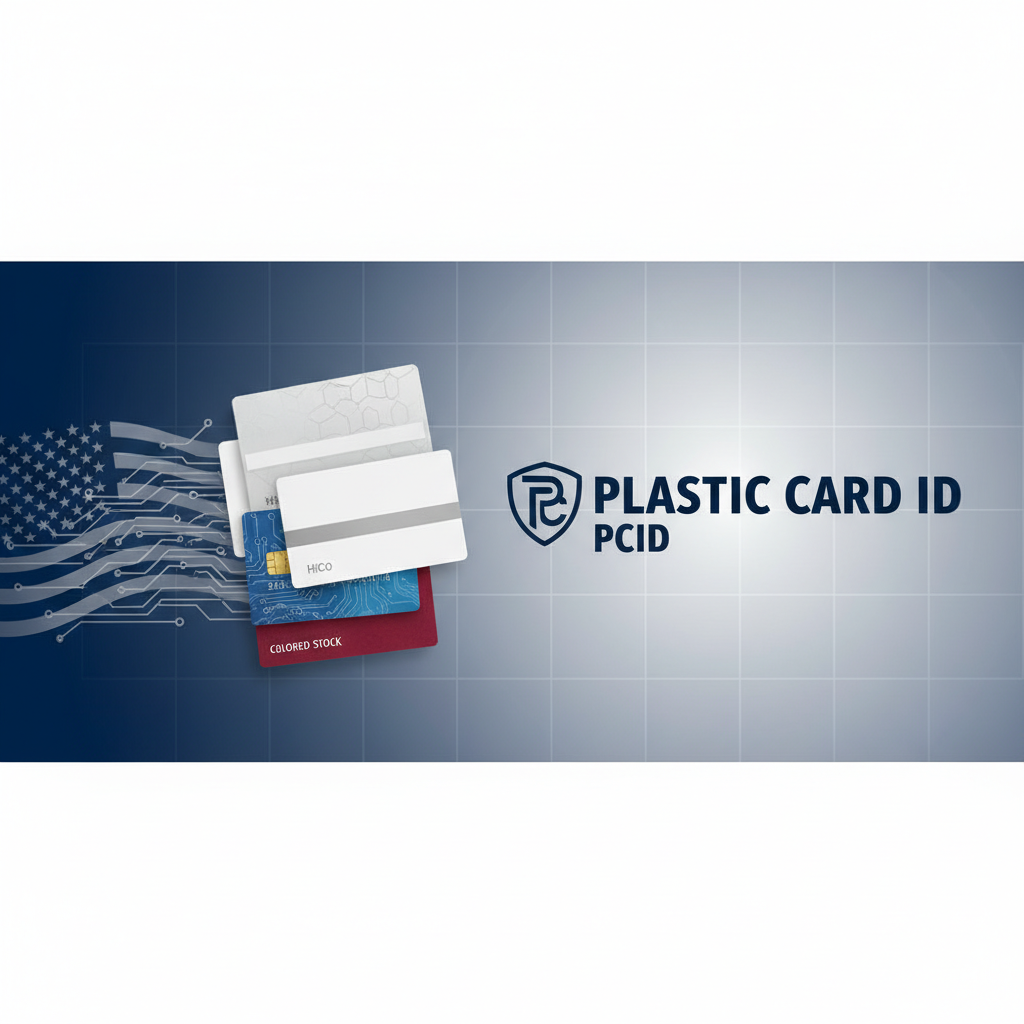 Sourcing blank plastic cards is rarely a one-size-fits-all decision. The right format depends on your application, your encoding needs, your printer capabilities, and the experience you want to create for your cardholders. CPE stocks a catalog that covers every meaningful format - which means you can build or expand any program without juggling multiple vendors.
Understanding the differences between card types saves programs from expensive mistakes. A hotel that orders LoCo magnetic stripe cards for a permanent employee badge program will find those cards demagnetize near strong magnetic fields far too easily. A retailer who orders plain PVC for a loyalty program that later needs magnetic encoding has to start over. Getting the specification right from the start is the kind of guidance CPE is built to provide.
Magnetic Stripe Cards: HiCo vs. LoCo Explained
Magnetic stripe cards split into two categories based on coercivity - the resistance of the stripe to being overwritten by external magnetic fields. High-coercivity (HiCo) cards are the gold standard for applications requiring long-term reliability: access control, loyalty programs, gift cards, and employee badges that will be used daily for months or years. The stripe holds data far more stubbornly against everyday magnetic interference.
Low-coercivity (LoCo) cards are appropriate for short-duration applications where the card will be encoded and used within a contained timeframe - hotel room keys being the classic example. They cost slightly less and encode at lower power, making them efficient for high-volume, short-term use cases. Using them in the wrong application, however, leads to field complaints and re-issue costs that quickly erase any savings.
Both HiCo and LoCo cards are available in standard CR80 format and are fully compatible with the card printer lineup CPE carries from Evolis, Zebra, and Fargo. Matching your card stock to your printer model matters - and the team can confirm compatibility before your first order ships.
RFID, Proximity, and Smart Chip Cards
Contactless card technology has moved from specialty to mainstream. RFID and proximity cards allow cardholders to tap or wave their credential near a reader rather than swiping or inserting - a faster, cleaner interaction for high-traffic access points. These cards are standard in corporate office access control, time-and-attendance systems, and campus environments where speed and throughput matter.
Smart chip cards take contactless technology further. Cards using MIFARE DESFire technology carry on-card encrypted data storage, making them appropriate for programs that require a higher level of security - secure facility access, multi-application campus cards, and government-adjacent ID programs. The intelligence is embedded in the card itself, not just referenced from a distant database.
Proximity access cards operate at 125 kHz and represent the most widely installed access control format in the United States. If your facility already uses proximity readers, sourcing compatible blank cards from CPE allows you to expand your credentialing without replacing existing infrastructure - a significant cost advantage for growing organizations.
Specialty Formats: Clear, Frosted, Colored, and Die-Cut
Not every program calls for a standard white card. Clear and frosted PVC cards create an immediate visual distinction - particularly valuable for VIP programs, premium membership tiers, or any application where the card itself needs to communicate exclusivity. Printed artwork appears to float on a transparent substrate, an effect impossible to replicate with standard white stock.
Colored card stock in pre-tinted options gives programs a consistent color identity without relying entirely on printed color coverage. Custom die-cut shapes move beyond the rectangle entirely, producing cards that stand out physically - useful for marketing campaigns, event credentials, or brand activations where memorability is the goal.
For programs that want to make the strongest possible statement, luxury metal cards in stainless steel, brass, and gold deliver a weight and permanence that no plastic card can fully match. These are not novelties - they are serious credentials for serious programs, from casino VIP tiers to executive membership organizations.
Casino, Hotel, and Specialty Industry Cards
Certain industries have developed card requirements sophisticated enough to warrant dedicated solutions. Casino player cards must survive high-volume daily use in tracking systems while delivering a premium feel consistent with the guest experience. Hotel key cards must encode reliably, demagnetize cleanly at checkout, and reissue without friction - all while enduring the abuse of being stored next to smartphones and magnetic clasps.
Call Plastic Card ID at 800.835.7919 to discuss specialty card requirements for your industry. With 25 years of experience across these verticals, the team has seen nearly every application and can recommend the right card format before you commit to a program configuration.
Building an In-House Card Program: Equipment, Supplies, and Strategy
Blank cards are the starting point, but a functioning in-house card program requires more than card stock. The printer, the ribbon, the cleaning regimen, and the card management workflow all determine whether your program runs smoothly or generates constant frustration. CPE operates as a true one-stop shop precisely because piecemeal sourcing of these components creates gaps that hurt programs over time.
The decision to bring card production in-house - rather than outsourcing every print run - typically pays for itself within the first year for organizations issuing more than a few hundred cards annually. Control over timing, design changes, and individual card personalization are benefits that outsourced programs simply cannot match.
Choosing the Right Card Printer
The card printer market is dominated by three serious manufacturers: Evolis, Zebra, and Fargo. Each brand carries a lineup that spans entry-level single-sided desktop printers up to high-volume dual-sided systems with built-in lamination and encoding modules. The right choice depends on your monthly card volume, encoding requirements, and whether you need lamination for added durability.
Entry-level printers in the $500-$1,200 range are appropriate for organizations printing 50-200 cards per month without heavy encoding demands. Mid-range systems at $1,200-$3,500 handle dual-sided printing, magnetic stripe encoding, and higher monthly volumes. Enterprise-class systems above $3,500 add lamination, RFID encoding, and throughput rates suited to large institutions.
Buying a printer without accounting for ribbon cost is a common and expensive mistake. Ribbon yield - the number of cards printed per ribbon panel set - varies significantly between printer models and ribbon types. CPE stocks ribbons across all three supported printer brands and can help you calculate true cost-per-card before you commit to a printer purchase.
Ribbons, Cleaning Kits, and Maintenance
A card printer is only as good as the consumables running through it. Using off-brand ribbons in a name-brand printer is one of the fastest ways to void a warranty and degrade print quality. CPE stocks genuine ribbons for Evolis, Zebra, and Fargo printers - the same OEM consumables that keep warranties intact and print heads running cleanly.
Cleaning kits are the maintenance item most programs neglect until something goes wrong. Dust, debris, and ribbon residue accumulate on rollers and print heads over time, causing streaks, misregistration, and mechanical failures. Regular cleaning - typically every few hundred cards depending on the printer model - extends equipment life significantly and maintains the consistent print quality your program depends on.
Card carriers, sleeves, and badge holders round out the supplies picture. A beautifully printed ID card that arrives to its recipient scratched from poor handling, or that wears out within months from unprotected daily use, reflects poorly on the entire program. Protective sleeves and carriers are a low-cost investment in the longevity of every card you issue.
Card Affixing and Mailing Services
Not every organization has the internal capacity to stuff, seal, and mail cards at scale. CPE offers card affixing and mailing services that allow programs to offload the fulfillment side of card distribution entirely. Cards arrive to recipients already prepared - a significant operational relief for membership organizations, loyalty programs, and employee onboarding workflows running at volume.
This capability transforms CPE from a card supplier into a genuine program partner. Rather than managing a card stock vendor, a printer vendor, a ribbon vendor, and a fulfillment vendor separately, programs can consolidate behind a single relationship - reducing administrative overhead and ensuring that every component of the card program comes from a source with 25 years of expertise in making them work together.
Ready to simplify your card program? Contact Plastic Card ID today and let an expert help you build a setup that works from day one.
Frequently Asked Questions About Blank Plastic Cards Made in the USA
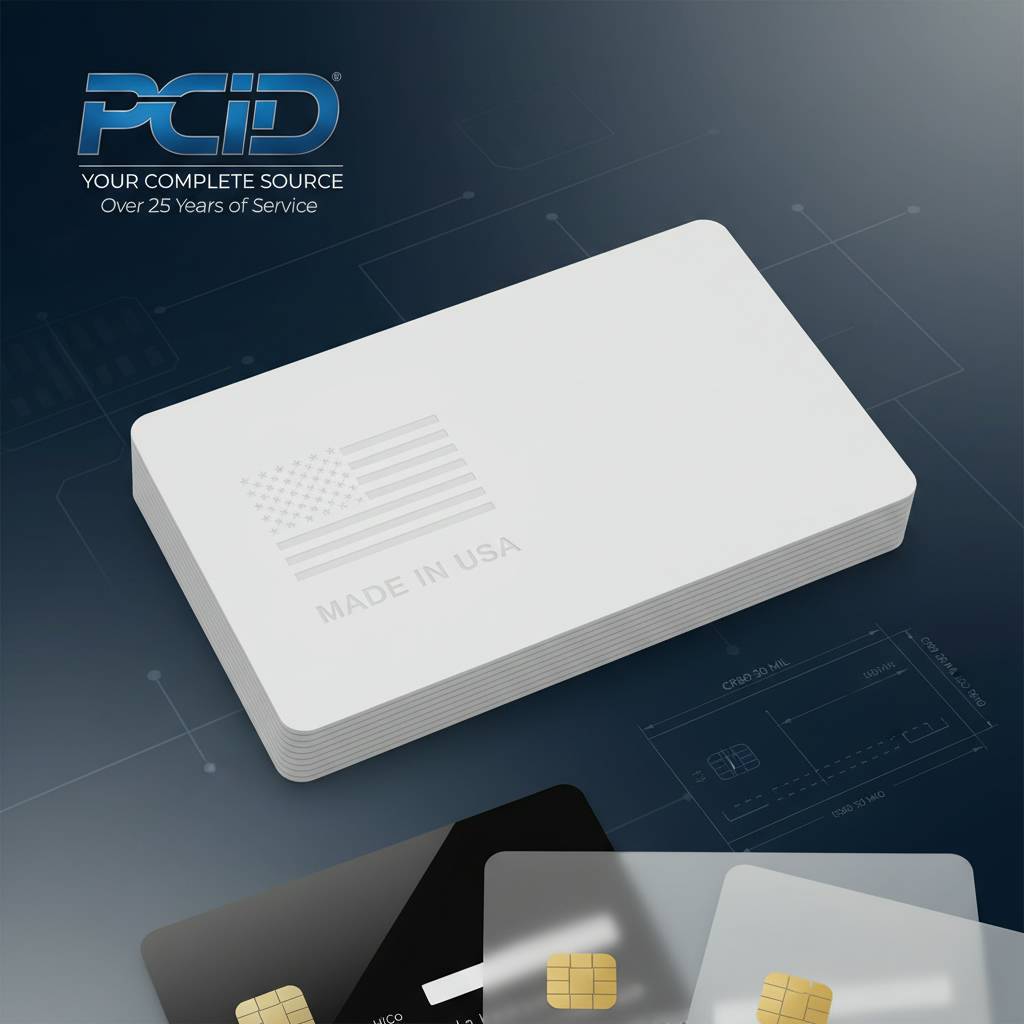 After 25 years and more than 100,000 customer relationships, certain questions come up consistently. The answers below address the most common points of confusion and concern for organizations at every stage of building or scaling a card program.
What Is the Minimum Order Quantity?
CPE serves programs of every scale - from small organizations ordering 50 cards a month to large enterprises producing tens of thousands. There is no single universal minimum that applies to every product, and pricing structures reflect the reality that bulk orders carry lower per-card costs. The best approach is to call and describe your actual volume needs rather than assuming a threshold applies.
Organizations that start with smaller orders often scale up as their programs grow - and having a supplier relationship already in place makes that transition seamless. Programs that wait until they need volume to establish a supplier relationship often face lead time surprises at the worst possible moment.
Do These Cards Work With Any Printer?
Standard CR80 30 mil PVC cards are compatible with virtually every major card printer on the market. However, specialty cards - RFID, smart chip, magnetic stripe - require printers with the corresponding encoding modules installed. Ordering RFID cards for a printer without an RFID module, or HiCo cards for a printer that only writes LoCo, produces non-functional credentials.
- Confirm your printer model before ordering specialty encoded card stock.
- Check module configuration - magnetic encoding, RFID, and smart chip modules are often optional add-ons.
- Verify ribbon compatibility with your card stock type - some laminates and overlaminates interact with certain card surfaces.
- Test a small batch when introducing a new card type to your existing printer setup.
- Contact CPE with your printer model number for a direct compatibility confirmation before placing a large order.
Compatibility questions are among the most common calls the team receives - and they are easy to resolve with the right information. A five-minute conversation prevents a frustrating and costly specification error.
How Are Blank Cards Different From Custom Printed Cards?
Blank cards ship without any printed design - they are white, clear, frosted, or colored stock that your organization prints on using an in-house card printer. Custom printed cards are produced with your design already applied before they arrive, typically through an offset or digital print run. Each approach has its place, and many organizations use both.
Blank cards give you maximum flexibility and speed - you can change designs, personalize individual cards, and print on demand without waiting for a vendor print run. Custom pre-printed cards make sense for high-volume programs where the design is fixed and per-card cost savings at scale outweigh the flexibility of in-house printing. CPE can supply both, and the team can help you determine which model fits your program economics.
| Factor | Blank Cards | Pre-Printed Cards |
|---|---|---|
| Design Flexibility | Full control, change anytime | Fixed at print run |
| Personalization | Individual card level | Requires variable print setup |
| Lead Time | Ship from stock | Production window required |
| Per-Card Cost at Volume | Higher (includes printer cost) | Lower at large scale |
Identity, Access, Loyalty, and Membership: Real Applications for Blank PVC Cards
Abstract discussions of card technology only go so far. What matters is how blank plastic cards solve real problems for real organizations. The applications below represent the most common use cases CPE supports - but the list is longer than any single page can cover, because a blank card is, by definition, an open platform.
Employee ID and Access Control Programs
Employee ID programs are often where organizations first discover the value of in-house card production. HR onboards a new employee, needs an ID badge within hours, and cannot afford to wait three days for an outsourced print run. An in-house setup with blank PVC cards and a capable printer produces a professional, personalized badge in minutes - complete with photo, name, department, and any encoding the facility requires.
Access control adds a layer of sophistication that paper credentials cannot approach. Whether using magnetic stripe, proximity, or smart chip technology, plastic cards integrate directly with building access systems, time-and-attendance platforms, and visitor management software. The card is not just identification - it is a functional key to the systems the cardholder is authorized to use.
Organizations with contractor or visitor populations benefit especially from blank card stock, because the ability to issue and revoke temporary credentials on demand is operationally critical. A contractor who arrives Monday and needs access through Friday requires a card that can be issued immediately and deactivated without ceremony at the end of the engagement.
Loyalty and Gift Card Programs for Retail
The evidence for plastic loyalty cards over paper alternatives is not anecdotal - it is consistent across retail categories. Cards that live in wallets generate repeat visits. Programs that issue plastic loyalty cards see higher redemption rates, longer customer retention periods, and stronger average transaction values compared to paper punch or stamp programs. The card itself acts as a constant reminder of the relationship between customer and brand.
Gift cards represent an even more direct revenue opportunity. Unlike paper gift certificates, plastic gift cards can be reloaded, tracked, and integrated with POS systems - making them a genuine financial instrument for the issuing retailer. The 35-50 percent sales lift retailers report when switching to plastic is driven not just by aesthetics but by functional improvements in how cards are redeemed and tracked.
Membership and Association Programs
Membership organizations - clubs, professional associations, recreational facilities, alumni groups - face a consistent credibility challenge: how to communicate that membership is real, valued, and meaningful. A plastic membership card accomplishes this in a way that an emailed PDF or paper certificate cannot. It is tangible, durable, and present in the member's wallet every day.
Contact Plastic Card ID at 800.835.7919 to discuss membership card programs at any scale. Whether you are issuing 200 cards per year or 20,000, the right card stock and program configuration can be designed around your actual needs.
Sourcing Blank Plastic Cards Made in the USA: What to Look for in a Supplier
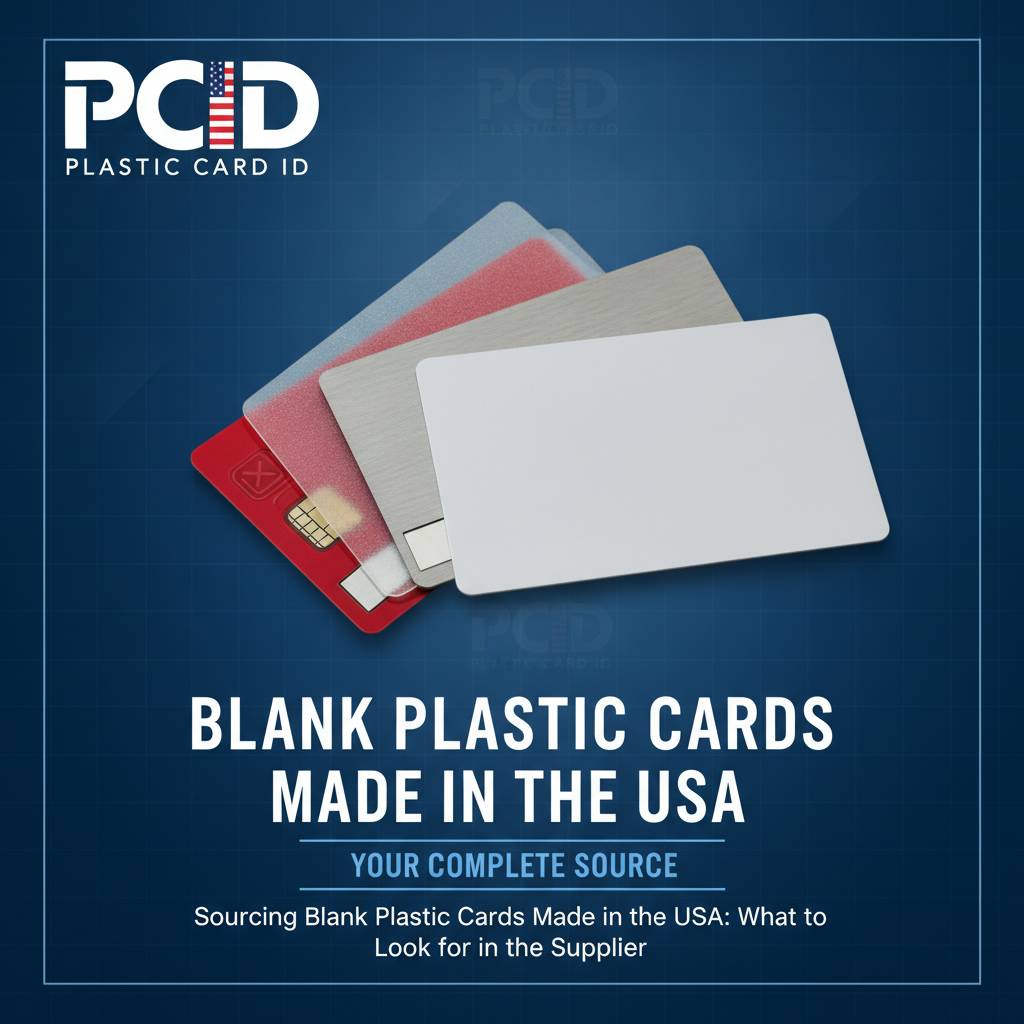
Not all card stock is created equal, and not all suppliers treat your program with the seriousness it deserves. After 25 years in this industry, CPE has watched programs struggle with suppliers who ship inconsistent card stock, miss lead times, provide no technical guidance, and disappear when problems arise. The criteria below are what separate a strategic card supplier from a card reseller.
Consistency and Quality Control
Card stock consistency matters enormously at the printer level. Cards that vary in thickness by even small fractions cause roller slippage, misregistration, and print head wear. Cards with surface inconsistencies produce visible print defects. Quality card stock from a serious supplier meets tight tolerances that keep your printer running cleanly and your cards looking professional across every batch.
Organizations that have experienced card stock quality issues know how disruptive they are. A printer jammed mid-run on a batch of 500 employee badges is not a minor inconvenience - it is a production crisis that has downstream consequences across the entire ID program. Sourcing from a supplier with 25 years of documented quality standards eliminates this category of risk.
Breadth of Product Availability
A supplier who stocks only one or two card formats is not a program partner - they are a narrow vendor. As programs grow and evolve, their card requirements evolve with them. A loyalty program that started with plain PVC may later need magnetic stripe encoding. An access control program may upgrade from proximity to smart chip. A membership organization may want to introduce a premium clear card tier.
Having a supplier who can accommodate those evolutions without requiring a vendor change is a meaningful operational advantage. CPE's catalog covers blank PVC, magnetic stripe in both HiCo and LoCo, RFID and proximity, smart chip including MIFARE DESFire, clear and frosted, colored stock, custom die-cut shapes, and luxury metal cards - everything a growing program could need.
Support That Goes Beyond the Order
Technical questions arise in every card program. Which card stock is compatible with this printer? What coercivity does this access control system require? How should cleaning intervals be adjusted for higher-volume production? These are not questions a product listing can answer - they require a team with genuine expertise and the willingness to engage with the specifics of your situation.
- Printer-to-card compatibility confirmation before orders ship.
- Ribbon yield calculations to help you forecast true cost-per-card.
- Encoding specification guidance for magnetic stripe, RFID, and smart chip applications.
- Program scaling advice as your card volumes grow.
- Fulfillment support through card affixing and mailing services.
That breadth of support is what CPE has built over 25 years - and what makes the difference between a supplier relationship and a program partnership.
Talk to the experts. Call Plastic Card ID at 800.835.7919 and discover what a real card program partnership looks like.
Partner With Plastic Card ID for Blank Plastic Cards Made in the USA
Twenty-five years. Over 100,000 customers. More than 50 million cards. These numbers are not marketing copy - they are the accumulated result of treating every program, at every scale, as worthy of serious attention and expert guidance. Whether you are launching your first 50-card employee badge program or scaling a loyalty card initiative to tens of thousands of members, the expertise and product depth at CPE are ready to support what you are building.
Blank plastic cards made in the USA are the foundation of programs that work - programs that last, programs that grow, programs whose cardholders actually use what they are issued. Getting the foundation right from the start is the single most important decision in a card program, and it begins with choosing the right supplier.
Plastic Card ID is that supplier. Call 800.835.7919 today and let a team with 25 years of expertise help you build a card program that performs from the very first card to the fifty millionth.
Previous Page