Smart Chip vs Magnetic Stripe Security Comparison: Which Wins?
Table of Contents []
- Smart Chip vs Magnetic Stripe Security: What Every Business Should Know Before Choosing Plastic Card ID
- Understanding Magnetic Stripe Card Technology
- The Architecture of Smart Chip Card Security
- Security Comparison: Head-to-Head Breakdown
- Choosing the Right Technology for Your Card Program
- Frequently Asked Questions: Smart Chip vs Magnetic Stripe
- The Plastic Card ID Advantage: Your Strategic Card Program Partner
Smart Chip vs Magnetic Stripe Security: What Every Business Should Know Before Choosing Plastic Card ID
Walk into any organization running a card program today and you will find a quiet debate happening behind the scenes. Should we use magnetic stripe cards? Or is it time to upgrade to smart chip technology? The answer is not always obvious, and the wrong choice can cost businesses in ways they never anticipated. Security gaps, card failures, compatibility headaches, and total program costs all vary dramatically depending on which technology you deploy.
This guide breaks down the real differences between smart chip cards and magnetic stripe cards from a security standpoint, helping businesses across the United States make informed decisions. Whether you are running an employee ID program, a loyalty card initiative, hotel key card access, or a high-security facility badge system, understanding these two technologies is the foundation of building a card program that works.
| Feature | Magnetic Stripe | Smart Chip |
|---|---|---|
| Data Storage | Up to 300 bytes (3 tracks) | Up to 64KB |
| Cloning Difficulty | Easy with basic hardware | Extremely difficult |
| Read Method | Physical swipe | Contact or contactless |
| Typical Applications | Loyalty, hotel keys, time & attendance | Access control, casino, high-security ID |
| Cost Per Card | Lower | Moderate to higher |
| Encryption | None (static data) | Advanced (AES, DES, 3DES) |
Understanding Magnetic Stripe Card Technology
 Magnetic stripe cards have been a workhorse of card programs for decades. They store data on a thin band of ferromagnetic particles embedded on the card's surface, readable when swiped through a compatible reader. Simple, cost-effective, and universally supported, they remain relevant in a surprising number of business environments today.
But simplicity cuts both ways. The very characteristic that makes magnetic stripes easy to read also makes them easy to copy. Static data encoded on a mag stripe does not change, does not authenticate itself, and does not know whether it is being read by a legitimate device or a skimmer. Understanding that limitation is the first step toward a smarter card program.
How Magnetic Stripe Encoding Actually Works
Magnetic stripes are divided into up to three tracks, each storing different types of information. Track 1 holds alphanumeric data, Track 2 is purely numeric and the most commonly used for identification, and Track 3 is reserved but less standardized across applications.
Businesses can choose between High Coercivity (HiCo) and Low Coercivity (LoCo) magnetic stripes. HiCo cards resist accidental erasure from everyday magnetic fields, making them the preferred choice for employee badges, loyalty programs, and any card expected to survive years of wallet and pocket use. LoCo cards are typically used for short-term applications like hotel room keys.
Where Magnetic Stripe Cards Still Shine
Loyalty programs, time-and-attendance tracking, library cards, and gift card programs all thrive with magnetic stripe technology. The infrastructure is mature, readers are inexpensive and widely available, and the per-card cost is competitive, especially when ordering in volume through a supplier like CPE.
For businesses that do not handle sensitive personal data or high-value access privileges, magnetic stripe cards represent a sensible, cost-effective solution. The risk profile is manageable when the stakes are proportionally low, such as tracking gym visits or scanning employee time entries in a low-security environment.
The Security Ceiling of Magnetic Stripes
Here is the uncomfortable truth that any security-conscious organization should confront: a magnetic stripe can be cloned in under a minute using inexpensive, readily available hardware. The data is static. There is no handshake, no encryption, no mutual authentication between card and reader. What is encoded is what is read, every single time, by any device capable of reading it.
For programs where security matters at a meaningful level, this ceiling becomes a genuine liability. Access control systems protecting server rooms, research facilities, healthcare environments, or any space where unauthorized entry carries real consequences need more than a stripe can offer. That is where smart chip technology enters the conversation.
The Architecture of Smart Chip Card Security
Smart chip cards operate on a fundamentally different principle. Instead of passively storing static data, the chip is an active microprocessor. It runs cryptographic algorithms, manages keys, and can engage in dynamic data exchange with readers. Every transaction is unique. Even if someone intercepted the communication between a smart chip card and a reader, the data captured would be useless for replay attacks.
This dynamic authentication is the cornerstone of smart chip security superiority. It transforms the card from a data carrier into a computational participant in the security exchange, a distinction that closes the door on the most common forms of card fraud and cloning.
Contact vs. Contactless Smart Chip Cards
Smart chip cards come in two primary formats. Contact chips require physical insertion into a reader, with electrical contacts on the card's surface completing the circuit. Contactless chips, often based on RFID or NFC technology, communicate wirelessly over short distances, typically under a few centimeters for secure applications.
Contactless options like MIFARE DESFire EV2 and EV3 represent the current standard for high-security access control, casino player cards, and transit systems. MIFARE DESFire employs AES-128 encryption, one of the strongest symmetric encryption standards available, giving organizations enterprise-grade protection in a card that still fits in a standard wallet.
RFID and Proximity Cards: Where Smart Chip Meets Physical Access
Proximity access cards are a popular smart chip derivative used widely in corporate office buildings, healthcare facilities, and government installations. These cards broadcast a unique identifier wirelessly when brought within range of a compatible reader, triggering door unlocks, elevator access, or time-stamp entries without requiring a swipe or insertion.
The security level varies significantly across proximity card types. Basic 125kHz proximity cards offer convenience but have known vulnerabilities that sophisticated actors can exploit. Upgrading to 13.56MHz MIFARE or HID iCLASS-based cards dramatically increases resistance to interception and replay attacks, offering a meaningful security upgrade for organizations protecting valuable assets or sensitive areas.
Smart Chip Card Durability and Long-Term Value
One advantage that sometimes gets overlooked in the chip-versus-stripe debate is durability. Magnetic stripes degrade physically over time, scratched by readers, damaged by magnets, and worn down through repeated swiping. Smart chip cards, particularly contactless versions, have no mechanical contact point to wear out in normal access control use.
For high-use applications where cards are scanned dozens of times daily, the long-term cost-per-read of a contactless smart card often outperforms a magnetic stripe card when card replacement cycles are factored into the total program cost. This is a calculation worth running before assuming mag stripe is always the budget-friendly choice.
Security Comparison: Head-to-Head Breakdown
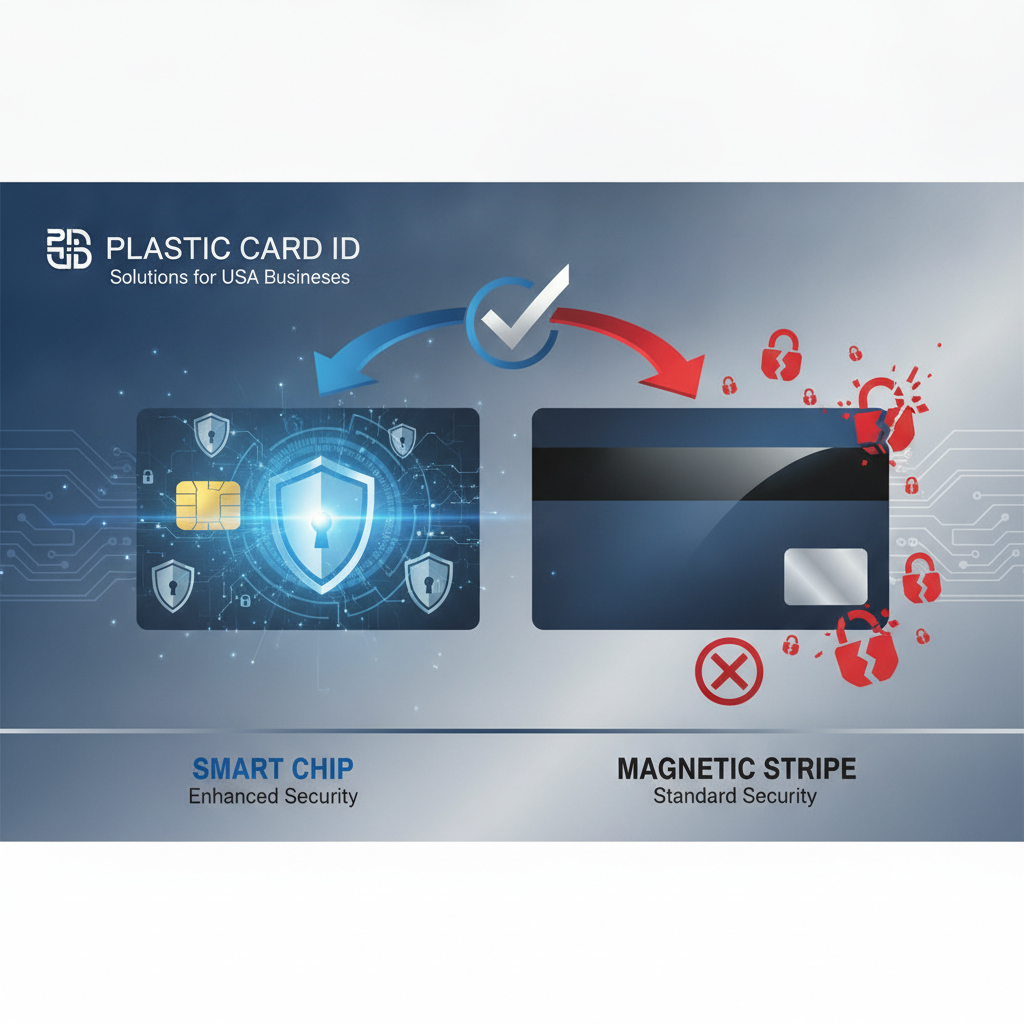 When placed side by side, the security differences between magnetic stripe and smart chip cards are not subtle. They are architectural. One technology stores data. The other processes it. That distinction carries cascading implications across every dimension of card program security.
For organizations operating in regulated industries, such as healthcare under HIPAA requirements, financial environments, government contractors, or educational institutions managing sensitive records, the choice of card technology is not merely operational. It reflects a posture toward data protection that auditors, regulators, and stakeholders increasingly scrutinize.
Data Encryption and Dynamic Authentication
Magnetic stripes transmit raw, unencrypted data on every read. Smart chip cards never transmit raw credentials at all. Instead, the chip and reader engage in a cryptographic challenge-response exchange. The actual credential data never leaves the chip in usable form. This means interception yields nothing actionable to a would-be attacker.
Additionally, smart chips can store multiple independent applications on a single card. An employee could carry one card that handles building access, time and attendance, cafeteria payments, and IT system login, each application siloed with its own encryption keys, preventing any compromise of one function from cascading into others.
Cloning and Skimming Resistance
Magnetic stripe skimming is one of the most documented forms of credential theft because it requires minimal technical knowledge and inexpensive tools. Cards can be silently cloned using devices hidden inside legitimate-looking readers or worn by individuals in proximity to unsuspecting cardholders. The cloned card works exactly like the original, because to any reader, it is effectively identical.
Smart chip cards resist cloning because copying the physical chip's cryptographic keys and algorithms is computationally infeasible under current technology. Even RFID interception, which is a genuine concern for some contactless formats, is addressed in MIFARE DESFire and similar advanced chips through mutual authentication and rolling session keys that change on every transaction.
Comparing Real-World Risk Profiles by Use Case
- Low-security loyalty and gift programs: Magnetic stripe is typically sufficient and cost-effective.
- Time and attendance tracking: Magnetic stripe or basic proximity, depending on workforce size and environment.
- Hotel key cards: LoCo magnetic stripe or contactless RFID; the latter is more durable and increasingly standard.
- Corporate access control: Smart chip RFID, particularly MIFARE or HID iCLASS formats.
- Casino player tracking: Smart chip with multi-application capability for loyalty plus access.
- Government and healthcare ID: Contact smart chip with strong encryption; FIPS-compliant options available.
- High-security facility access: MIFARE DESFire EV2/EV3 or equivalent with AES-128 encryption as a minimum standard.
Choosing the Right Technology for Your Card Program
The decision between magnetic stripe and smart chip is rarely absolute. Many organizations run hybrid programs, using magnetic stripe for non-sensitive applications while deploying smart chip for areas requiring genuine security. Understanding your threat model is the starting point for every technology decision.
Budget matters, but it should be evaluated honestly over the full program lifecycle. A mag stripe card might cost less per unit today, but if that program is compromised or requires frequent card replacement due to physical wear, the true cost calculation shifts. Smart chip programs carry higher upfront costs but deliver resilience that often justifies the investment over a two-to-five year horizon.
Questions to Ask Before You Commit
Before selecting card technology, every organization should be able to answer a handful of foundational questions. What data is stored on the card, and how sensitive is that data? Who reads the card, and can that equipment be trusted? How long will individual cards be in service, and how many times will they be used per day? Answering these questions honestly almost always points toward the right technology tier.
Organizations that find themselves uncertain about the right choice benefit enormously from working with a supplier that goes beyond simply shipping cards. CPE brings program-level expertise to these conversations, helping clients evaluate not just card type but encoding standards, reader compatibility, personalization options, and volume pricing structures that align with both budget and security requirements.
Hybrid Card Programs: Getting the Best of Both
Dual-interface cards combine contact chip and contactless capabilities in a single card body. Combination cards pair a smart chip with a magnetic stripe on the same card, allowing organizations to maintain backward compatibility with legacy mag stripe readers while introducing smart chip capability to newer infrastructure. This hybrid approach is particularly valuable during infrastructure transition periods.
Businesses upgrading their reader infrastructure incrementally, such as a retail chain rolling out new access control terminals across multiple locations over eighteen months, can deploy combo cards immediately, giving cardholders full functionality on day one while the infrastructure catches up. It is a practical strategy that avoids the binary disruption of a hard cutover.
Volume, Pricing, and Program Scalability
Card technology choice also intersects with volume and scalability in meaningful ways. Magnetic stripe cards are available in large blank stock quantities at competitive per-unit pricing, making them attractive for programs where cards are issued frequently and at scale, such as a national retail loyalty program issuing tens of thousands of cards monthly.
Smart chip cards carry a higher unit cost, but CPE works with businesses at every scale, from organizations ordering a few hundred smart cards for a pilot program to enterprises requiring mass production runs. The right supplier relationship means pricing structures that grow with your program, not against it, and access to technical guidance that ensures your technology investment performs as intended from day one.
Frequently Asked Questions: Smart Chip vs Magnetic Stripe
Businesses evaluating their card programs often come to CPE with a consistent set of questions. The answers below reflect the realities of card technology as it applies to practical, USA-based business programs.
Can a smart chip card be demagnetized or damaged the way a magnetic stripe card can?
Magnetic stripes are vulnerable to erasure from magnets, including those found in phone cases, clasps, and even some retail security tags. Smart chips, by contrast, are not affected by magnetic fields in the same way. Contactless smart chip cards are particularly resilient since they have no exposed contacts and communicate entirely wirelessly, eliminating the primary physical wear points that limit magnetic stripe card lifespan.
That said, smart chip cards are not indestructible. Extreme heat, physical puncturing of the chip area, or severe flexing can damage embedded circuitry. Standard wallet and badge carry conditions are well within the operational tolerances of any quality CR80 smart card, and cards supplied through CPE meet ISO 7810 dimensional standards with chip reliability specifications appropriate to each application tier.
Is it possible to read a smart chip card without the cardholder knowing?
This is a legitimate concern for contactless RFID cards and one that the industry has addressed in higher-security formats. Basic 125kHz proximity cards do broadcast without authentication and could theoretically be read at short range by unauthorized readers. MIFARE DESFire and equivalent high-security contactless formats mitigate this risk through mutual authentication, meaning the card verifies the reader's credentials before responding.
For organizations with heightened sensitivity around covert interception, shielded card sleeves and carriers provide an additional physical layer of protection. CPE supplies a complete range of card accessories including protective sleeves that block RFID signals when cards are not actively in use, a simple and cost-effective measure that meaningfully reduces exposure in high-risk environments.
How do I know which card technology my existing readers support?
Reader compatibility is one of the most common points of confusion in card program upgrades. Magnetic stripe readers come in three common configurations based on which tracks they read, and most are not backward compatible with chip technologies at all. RFID readers operate at specific frequencies, 125kHz or 13.56MHz, that are not interchangeable, meaning a card and reader must operate at the same frequency to function.
Before changing card technology, always audit your existing reader infrastructure to confirm compatibility or identify upgrade requirements. CPE can help clients navigate these decisions, matching card specifications to reader capabilities and flagging potential compatibility gaps before they become program disruptions. Call us at 800.835.7919 to discuss your existing setup and get expert guidance on the right path forward.
The Plastic Card ID Advantage: Your Strategic Card Program Partner
There is a difference between a vendor that ships cards and a partner that helps you build a program. Plastic Card ID has spent over 25 years operating on the partnership side of that distinction, serving over 100,000 customers and more than 50 million cards across every major card technology format in use today across the United States.
The catalog runs deep and the expertise runs deeper. Blank PVC stock, HiCo and LoCo magnetic stripe cards, RFID proximity cards, MIFARE smart chip cards including DESFire EV2 and EV3, contact chip cards, clear and frosted specialty cards, custom die-cut shapes, and luxury metal cards in stainless steel, brass, and gold are all available through a single supplier relationship. Add card printers from Evolis, Zebra, and Fargo, plus ribbons, cleaning kits, card carriers, sleeves, and card affixing and mailing services, and the one-stop-shop reality is not marketing language. It is a genuine operational convenience that simplifies procurement, vendor management, and program scaling.
Programs at Every Scale and Security Level
Whether you are issuing fifty employee badges a month for a regional business or managing a casino player card program in the tens of thousands, the infrastructure at CPE is built to serve programs of every size without treating smaller orders as afterthoughts. Every customer, regardless of volume, benefits from the same program-level thinking that has guided the company's approach since its founding.
Retailers switching from paper punch cards to plastic loyalty cards consistently report sales increases in the range of 35-50%, a figure that reflects the real behavioral impact of a card that lives in a wallet versus a paper card that lives in a junk drawer. Membership organizations that replace paper credentials with printed plastic cards see immediate gains in perceived legitimacy and member retention. The card in someone's wallet is a constant, tangible reminder of their relationship with your brand. That is a marketing and retention asset that works quietly around the clock.
Printer and Accessory Ecosystem
An in-house card printing program gives organizations total design control and dramatically lowers per-card cost over time compared to ordering pre-printed cards for every issuance cycle. CPE carries the full lineup of Evolis, Zebra, and Fargo card printers, covering everything from single-sided desktop units for small programs to high-throughput dual-sided models for enterprise operations.
Pairing the right printer with the right blank card stock is a nuanced decision that depends on print technology, ribbon type, encoding requirements, and throughput needs. Incompatible combinations produce poor results regardless of equipment quality. The team at CPE guides clients through these pairings, ensuring that hardware, consumables, and card stock work together as an integrated system rather than a collection of components purchased independently.
Specialty Cards for Demanding Applications
Not every card program fits the standard CR80 white PVC mold, and Plastic Card ID is equipped for the full spectrum of specialty requirements. Casino player cards built on smart chip platforms, hotel key cards optimized for LoCo magnetic stripe or contactless RFID, clear and frosted PVC cards for applications where transparency is a design feature, and luxury metal cards in stainless steel, brass, and gold for premium membership and VIP programs are all available.
Custom die-cut shapes take card programs off the standard rectangle entirely, creating brand assets that stand out in a cardholder's wallet or on a lanyard. Specialty card formats consistently outperform standard formats in brand recall and cardholder retention metrics, making them a legitimate strategic investment for programs where differentiation has measurable business value. Talk through your specific application requirements with the CPE team to identify which format delivers the right combination of function and impact for your program.
Ready to choose the right card technology for your program? The answer is one conversation away.
Reach Plastic Card ID at 800.835.7919 to speak directly with a card program specialist who understands both the security architecture and the practical realities of running a successful card program at any scale across the United States.
Plastic Card ID is your strategic partner for smart chip cards, magnetic stripe cards, and every card technology in between. Call 800.835.7919 today and build your program on a foundation that works.
Previous Page