Microtext Security Printing on Plastic ID Cards: Full Guide
Table of Contents []
- Why Plastic Card ID Recommends Microtext Security Printing for Plastic ID Cards
- What Microtext Security Printing Actually Is
- Industries That Benefit Most from Microtext on Plastic ID Cards
- Combining Microtext with the Right Card Substrate and Printer
- Designing a Card Program with Microtext Security Printing
- Frequently Asked Questions About Microtext on Plastic ID Cards
- Partner with Plastic Card ID for Your Microtext Security Card Program
Why Plastic Card ID Recommends Microtext Security Printing for Plastic ID Cards
Most people have never heard of microtext until the moment it matters - when a counterfeit badge slips through a checkpoint, when a membership card gets duplicated, when someone walks through a restricted door they were never supposed to enter. Suddenly, a security feature that seemed abstract becomes urgently real. That is where Plastic Card ID steps in, with over 25 years of supplying plastic cards to businesses across the United States and a deep understanding of what separates a card that merely looks official from one that actually is.
Microtext security printing is one of the most underutilized and most effective tools in modern card program design. It involves printing text so small - typically below 0.5mm in height - that it appears as a decorative line or border element to the naked eye, yet reads clearly under magnification. The technique is borrowed from currency printing, passports, and high-security documents, and it translates remarkably well onto CR80 plastic ID cards when executed properly.
| Security Feature | Visible to Naked Eye | Detectable with Tools | Difficulty to Counterfeit |
|---|---|---|---|
| Microtext Printing | No (appears as line) | Loupe / Magnifier | Very High |
| Holographic Overlay | Yes | Visual Inspection | High |
| UV Ink Printing | No (under normal light) | UV Light Source | High |
| Standard Color Printing | Yes | N/A | Low |
| Magnetic Stripe (HiCo) | Partial | Card Reader | Moderate-High |
What Microtext Security Printing Actually Is
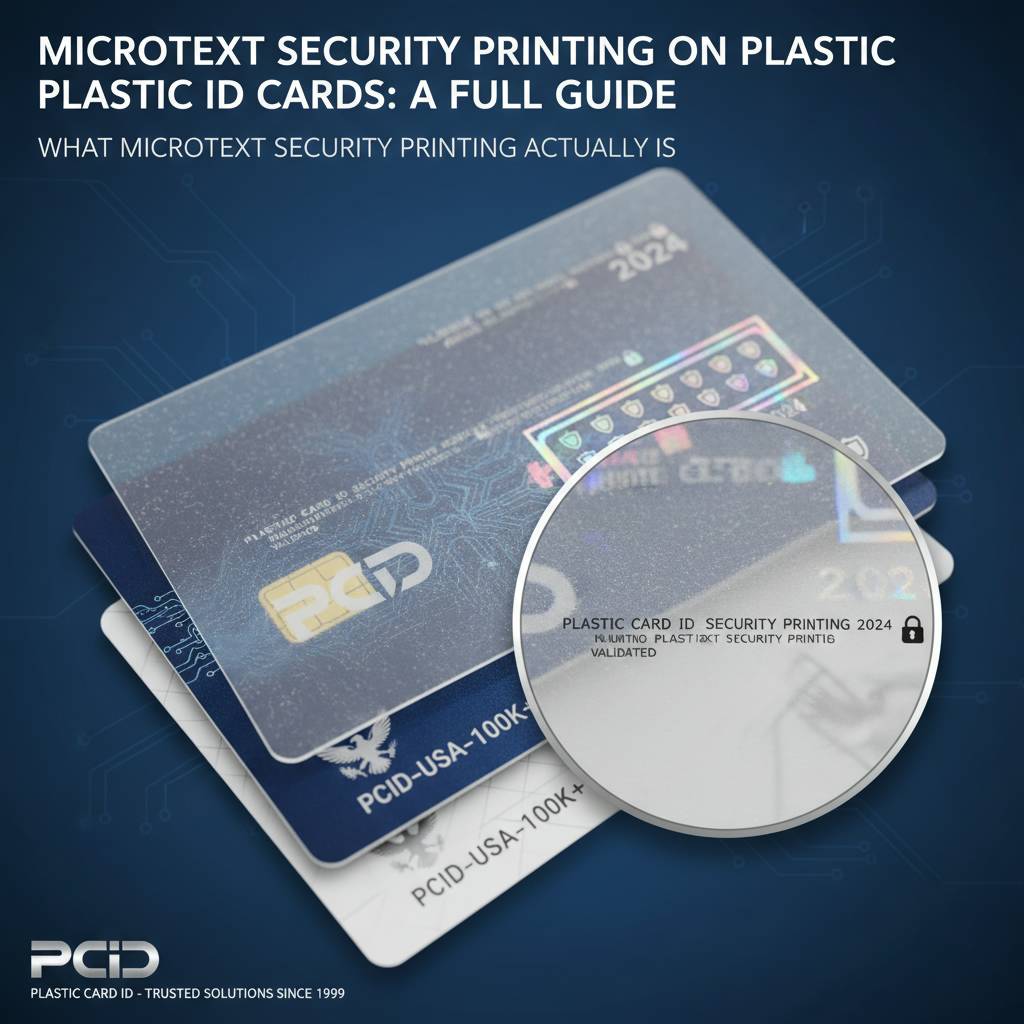 Strip away the jargon and microtext is elegantly simple: it is text printed at a scale so minute that casual inspection cannot read it. A string of repeated characters, a serial number, a brand name, or even a short phrase can be embedded within what looks like an ornamental border, a fine-rule line, or a background pattern on your plastic ID card. The result is a card that carries a hidden verification layer invisible to anyone who is not specifically looking for it.
The genius of microtext lies in what counterfeiters face when they attempt reproduction. Standard desktop printers and even many commercial printing setups cannot reproduce text at sub-0.5mm heights with fidelity. Characters blur, merge, or disappear entirely. When an inspector places a loupe or magnifying glass over a genuine card and sees crisp, legible microtext - then examines a copy and finds only a smeared gray line - the authentication is instant and irrefutable.
The Technical Mechanics Behind Microtext
Producing readable microtext on a plastic substrate requires precise control over resolution, ink viscosity, and print head calibration. Industrial card printers from manufacturers like Fargo and Zebra, paired with the right ribbons and card stock, can achieve the resolution necessary. The cards used matter equally - a quality blank PVC card at 30 mil thickness provides the rigid, flat surface that microtext printing demands.
Font selection is critical. Certain typefaces retain character definition at micro scales while others collapse into unreadable shapes. Serif fonts with distinct letterform features tend to survive micro-scale printing better than broad sans-serif designs. Working with a knowledgeable supplier who understands card printing specifications is not optional - it is the difference between functional security and decorative illusion.
Microtext Versus Other Security Printing Techniques
Microtext is often layered with complementary features rather than used in isolation. UV-reactive ink printing, for example, adds a second invisible layer verifiable under ultraviolet light, while microtext adds a layer verifiable under magnification. Together they create a two-factor authentication approach entirely embedded in the card's surface - no scanner, no database query, just a loupe and a UV pen.
Holographic overlaminates add a third visual dimension that is difficult to replicate without specialized materials. When microtext is printed beneath a holographic laminate on a CR80 PVC card, counterfeiters must defeat not one but three printing and materials challenges simultaneously. That combination dramatically raises the cost and sophistication required to fake a card, which is precisely the goal.
Who Verifies Microtext in the Field
Verification does not require a laboratory. Security personnel at access points can carry a small jeweler's loupe - a 10x loupe costs under $20 - and check cards in seconds. The protocol is simple: if the microtext line resolves into readable characters, the card is genuine. If it appears blurred or absent, the card warrants further scrutiny. This low-tech verification method is one of the feature's strongest practical advantages.
Organizations running large-scale access control programs often train a subset of staff as document verification specialists. For smaller operations - a single-location gym, a mid-size employer - training takes minutes. The verification skill is less about expertise than it is about knowing what to look for, which is a point any organization can communicate in a brief onboarding session.
Industries That Benefit Most from Microtext on Plastic ID Cards
Security printing is not a niche concern for government agencies alone. The applications span a surprisingly wide range of commercial, institutional, and event-based environments. Anywhere a card carries meaningful access rights, identity claims, or monetary value, microtext adds a layer of protection that paper and standard plastic printing simply cannot match.
Consider the stakes in a hospital environment: an employee badge that can be convincingly counterfeited is a direct threat to patient safety and facility security. The same logic applies to a university campus, a corporate headquarters, or a convention center hosting a high-profile industry event. The cost of a security breach dwarfs the incremental cost of enhanced card printing in virtually every scenario where sensitive access is at stake.
Corporate and Government ID Programs
Corporate headquarters with multiple access tiers - lobby, server room, executive floor - benefit enormously from cards that cannot be easily duplicated. When microtext encodes an employee ID number, department code, or issuance date within what appears to be a decorative border element, anyone attempting to clone the card for unauthorized access faces a technical barrier that standard office equipment cannot overcome.
Government contractors and agencies dealing with sensitive facilities have long used microtext as a standard component of credential design. For private companies operating under federal compliance frameworks or handling sensitive intellectual property, adopting similar standards is both a security best practice and a signal to partners and auditors that credential integrity is taken seriously.
Healthcare, Education, and Institutional Access
Hospitals, clinics, universities, and K-12 schools all issue large volumes of ID cards to populations that include visitors, contractors, volunteers, and students alongside core staff. Managing credential authenticity across a diverse and frequently changing population is a genuine operational challenge, and microtext provides a passive, always-on verification layer that does not require system integration to function.
Educational institutions in particular face the problem of credential longevity - a student ID issued in September needs to remain valid and verifiable through May, through summer programs, through graduate enrollment. Cards that visually degrade or can be easily altered with a home printer create ongoing administrative headaches. Microtext adds a permanence to the authenticity claim that cannot be replicated with a fresh print run on a personal device.
Event Credentialing and Temporary Access Programs
Trade shows, conferences, music festivals, and sporting events issue hundreds or thousands of credentials that must be quickly verified by staff who may have no prior training. A credential with microtext can be verified by any staff member given a loupe and a ten-minute briefing. For events where VIP access, backstage passes, or media credentials carry real value, the ability to instantly spot fakes is operationally critical.
Temporary access programs - construction site visitor passes, contractor badges for corporate campuses, event volunteer credentials - benefit from microtext even when the cards are issued for a single day. The cost of microtext security printing is not significant relative to the total cost of running a credentialing program, but the security benefit persists for the full duration of the card's validity period.
Combining Microtext with the Right Card Substrate and Printer
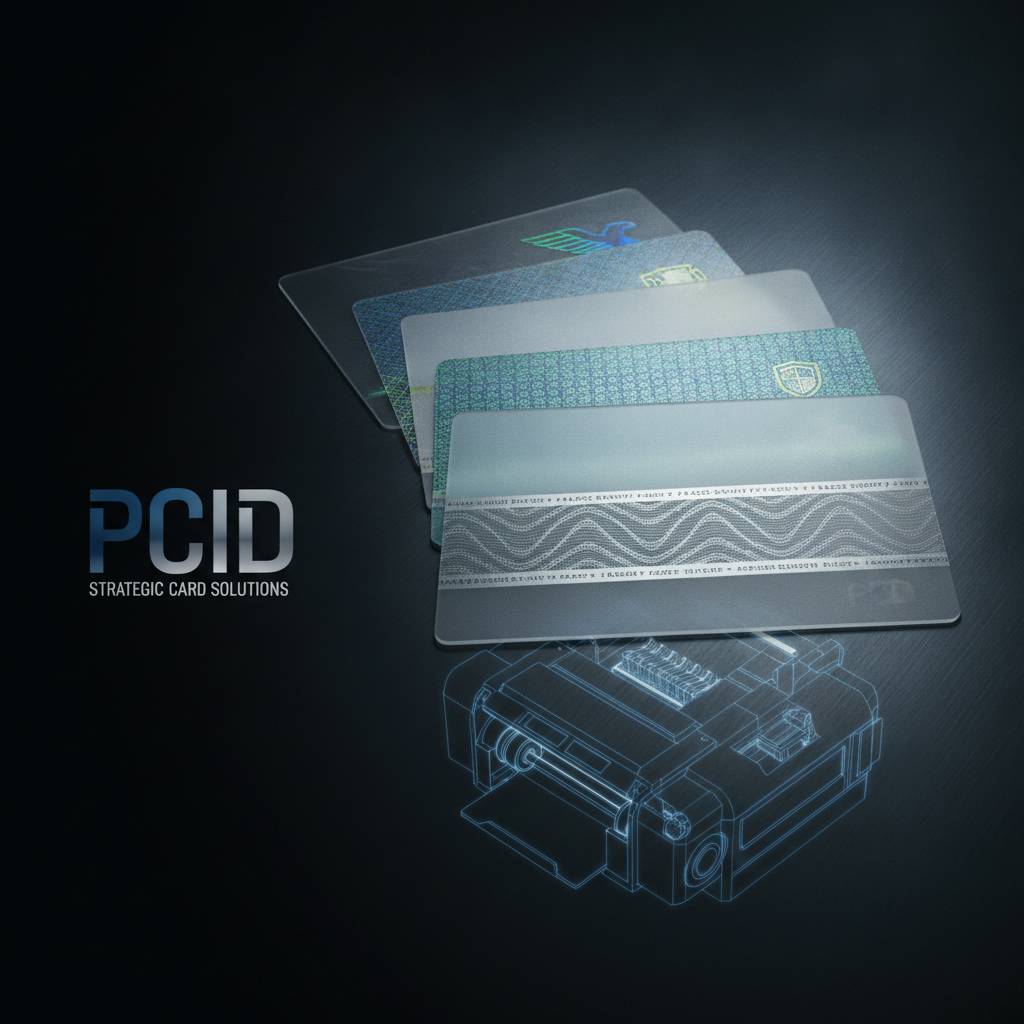 The effectiveness of microtext security printing is inseparable from the quality of the plastic card substrate and the printing hardware used. CPE works with businesses to match the right blank card stock to their security printing goals, because not every PVC card is built to the same tolerance and not every card printer delivers the same output resolution.
CR80 cards at 30 mil thickness - the ISO 7810 standard - are the baseline for professional ID card programs. Their rigid, flat surface holds fine print detail better than thinner stock or flexible alternatives. When microtext is the objective, starting with a quality blank card is not a corner-cutting opportunity. It is a foundational requirement.
Printer Selection for High-Resolution Security Printing
Fargo HDP printers use a retransfer printing process that deposits the full image onto a clear film before applying it to the card surface. This process achieves higher resolution than direct-to-card printing and produces finer detail - which is exactly what microtext requires. Zebra ZXP Series printers and Evolis high-tier models also offer resolution capabilities suitable for security printing applications when configured correctly.
Resolution alone does not guarantee microtext legibility. Ribbon choice matters: YMCKO ribbons with sharp dye-sublimation characteristics outperform economy alternatives for fine-detail work. Card surface texture also plays a role - glossy PVC surfaces generally yield finer text reproduction than matte finishes. These details are where working with an experienced supplier like CPE creates real value, not just convenience.
Magnetic Stripe and RFID Integration Alongside Microtext
Many organizations need their ID cards to do more than look secure - they need them to function in access control systems, time-and-attendance readers, or loyalty tracking platforms. HiCo magnetic stripe cards can carry encoded data alongside microtext printing, creating a card that has both visual authentication features and machine-readable functionality. The two security layers operate independently, which means verifying either one does not require the other to be functional.
RFID and proximity cards add a contactless layer to the security stack. MIFARE DESFire chips, for example, support encrypted communication between card and reader, making data interception and cloning technically demanding. When a card combines RFID functionality with microtext surface printing and a holographic laminate, it represents a genuinely multi-layered security credential that stands up to sophisticated threat actors as well as opportunistic counterfeiters.
Overlaminates and Laminate-Compatible Microtext
One consideration that organizations sometimes overlook is whether their chosen overlaminate is compatible with the microtext printing beneath it. Standard clear overlaminates preserve microtext fidelity well. Holographic overlaminates add complexity - the holographic pattern should not obscure the microtext zone, which requires deliberate design coordination between the card's surface layout and the laminate's optical features.
Call Plastic Card ID at 800.835.7919 to discuss laminate options that protect microtext detail while adding the visual security of holographic overlay. Getting this combination right requires specification-level conversation, not just a product selection from a catalog page, and it is exactly the kind of technical partnership that distinguishes CPE from a commodity card supplier.
Designing a Card Program with Microtext Security Printing
Implementing microtext is a design decision as much as a security decision. The placement, content, and size of the microtext element need to be deliberately integrated into the card's overall visual layout. Treating microtext as an afterthought - something to be dropped into a finished design at the last moment - typically produces suboptimal results both aesthetically and functionally.
The most effective microtext implementations weave the security element naturally into the card design. A border that appears to be a fine decorative rule, a background texture that resolves into repeating text under magnification, or a faux-guilloche pattern that contains embedded microtext characters - these approaches make the security feature genuinely covert while contributing positively to the card's visual quality.
Content Strategy for Microtext Elements
What text should your microtext contain? Common choices include the issuing organization's name repeated in a continuous string, a card-specific serial number, an issuance year, or an authentication phrase known only to verifying staff. For high-security applications, the microtext content itself can be a changing element - a quarterly rotation of authentication phrases, for example, that allows rapid identification of out-of-date credentials.
The content of your microtext is a security variable just as much as its presence. An attacker who does not know what the microtext says cannot reproduce it accurately even if they know it exists. Organizations issuing sensitive credentials should treat their microtext content with the same confidentiality they would apply to any other security protocol - it is not information for public documentation or casual conversation.
Ordering Volumes and Per-Card Cost Considerations
CPE supports card programs of any scale, from organizations needing 50 cards a month to those running mass production programs in the tens of thousands. For microtext-enhanced cards, there are economies of scale in both card printing and setup that make larger order volumes progressively more cost-efficient. A small program might see per-card costs in the range of $0.75-$2.50 depending on features; high-volume programs can achieve significantly lower per-unit costs.
For organizations evaluating in-house versus outsourced card printing with security features, the upfront investment in a quality card printer - systems capable of the resolution microtext requires range from roughly $800-$4,500 - must be weighed against long-term per-card costs and the flexibility of on-demand printing. CPE can walk through both scenarios with any prospective client, providing the kind of honest cost analysis that supports a genuine business decision rather than a sales outcome.
Sample Programs and Testing Before Full Production
Any organization implementing microtext security printing for the first time should insist on a sample production run before committing to full volume. Testing ensures that the chosen printer, ribbon, and card stock combination achieves legible microtext at the specified font size and placement. It also allows security staff to practice verification protocols before the cards are live in the field.
Sample programs are not just a quality assurance measure - they are an opportunity to catch design issues before they become expensive problems. A microtext border that looks perfect in a digital preview may render differently on actual card stock under actual printing conditions. Physical samples close that gap and give decision-makers confidence before they authorize a full production run.
Frequently Asked Questions About Microtext on Plastic ID Cards
Organizations exploring microtext security printing for the first time tend to arrive with a consistent set of questions. The answers are generally more accessible than people expect - microtext is a specialized feature, but it is not an exotic one, and implementing it well is achievable for organizations of many sizes and budgets.
Understanding the feature's practical scope - what it can and cannot do, what it costs, and what it requires - allows decision-makers to evaluate it honestly against their specific security objectives rather than being either oversold or unduly skeptical.
Can Any Card Printer Produce Microtext?
Not reliably. Consumer-grade card printers operating at 300 DPI resolution will struggle to produce microtext that resolves into legible characters at sub-0.5mm heights. Professional-grade card printers operating at 600 DPI or higher, particularly retransfer models, are the appropriate hardware for security-grade microtext. The Fargo HDP5000 and Fargo HDP6600 are commonly cited for high-resolution security printing applications.
It is worth noting that even capable hardware produces inconsistent results if improperly configured or used with mismatched consumables. Ribbon quality, card surface characteristics, and print speed settings all interact with resolution to determine the final output quality. This is why equipment selection should be part of a broader card program specification conversation, not an isolated purchasing decision.
How Hard Is It to Verify Microtext in Practice?
- A standard 10x jeweler's loupe is sufficient for field verification and costs under $20
- Staff training for microtext verification typically takes under 15 minutes
- Verification is immediate - genuine microtext resolves into readable text; counterfeits typically blur or disappear
- No network connection, card reader, or database access is required for verification
- Verification can be performed in any lighting condition adequate for general visual inspection
The simplicity of verification is one of microtext's most practical advantages. Unlike RFID-based authentication, which requires reader hardware and a functioning access control system, microtext verification requires nothing but a loupe and trained eyes. For organizations that need a backup authentication method or operate in environments where electronic systems may not always be available, this independence is genuinely valuable.
Is Microtext Appropriate for Small Organizations?
Absolutely. A regional healthcare clinic issuing 200 employee badges, a private school managing student and faculty ID programs, a mid-sized corporation protecting a single facility - all of these represent legitimate use cases for microtext security printing. The feature does not require a large organization to justify or implement effectively.
The incremental cost of incorporating microtext into an existing card program is often smaller than organizations anticipate, particularly when the card printing is handled in-house on capable hardware that is already part of the program. For outsourced card printing programs, adding microtext as a specification item adds to per-card cost but typically delivers security value that far exceeds the price difference on a per-card basis.
Partner with Plastic Card ID for Your Microtext Security Card Program
After more than 25 years and over 50 million cards supplied to more than 100,000 customers across the United States, CPE brings a depth of practical card program knowledge that generic suppliers simply cannot match. Microtext security printing is one of dozens of features we help organizations evaluate, specify, and implement as part of card programs that genuinely serve their security and operational needs.
Whether you are building a new ID card program from the ground up, upgrading an existing program that has outgrown its current security level, or adding microtext to a loyalty or membership card program that benefits from enhanced authenticity features, CPE is the partner that can take you from concept to verified, production-ready cards. Our catalog spans blank PVC cards, HiCo and LoCo magnetic stripe cards, RFID and proximity cards, smart chip cards with MIFARE DESFire, clear and frosted specialty stock, and the full range of Evolis, Zebra, and Fargo card printers with matching ribbons and cleaning supplies.
Physical cards drive measurable results. Retailers switching from paper to plastic gift cards see sales increases of 35-50%. Loyalty cards in wallets consistently outperform paper punch cards. Plastic ID cards signal the kind of institutional legitimacy and permanence that paper can never replicate. Adding microtext security printing to that foundation gives your card program a level of credential integrity that protects your organization, your staff, and everyone who depends on your access control systems functioning as intended.
Contact Plastic Card ID today at 800.835.7919 to discuss microtext security printing options, request a sample production run, or get a quote for your plastic ID card program. Our team is ready to help you build the most secure, functional, and professionally impressive card program your organization has ever issued.
Previous Page