Encoding Blank Plastic Cards for Secure Access: Step-by-Step
Table of Contents []
- Encoding Blank Plastic Cards for Secure Access - Plastic Card ID
- Understanding What "Encoding" Actually Means for Your Card Program
- The Case for In-House Card Encoding Programs
- Secure Access Applications: Where Encoding Makes the Difference
- Specialty Card Formats That Support Encoding
- Building and Scaling Your Card Program with Plastic Card ID
- Ready to Encode Smarter? Partner with Plastic Card ID
Encoding Blank Plastic Cards for Secure Access - Plastic Card ID
What separates a card program that actually works from one that creates headaches? Often, it comes down to a single decision made early: choosing the right encoding technology for the right blank card stock. Encoding blank plastic cards for secure access is not a one-size-fits-all proposition. The card in your hand is a platform - and what gets written onto it, embedded inside it, or printed across its surface determines everything about how your access program performs in the real world.
Plastic Card ID has built more than 25 years of expertise helping businesses across the United States figure out exactly that equation. More than 100,000 customers and 50 million cards later, the patterns are clear. Organizations that treat card selection as a strategic decision - not just a purchasing task - run tighter, more cost-effective, more secure programs. The ones that grab the cheapest option often circle back, frustrated, looking for a better answer. We help clients skip that frustration entirely.
| Technology | Best Use Case | Read Range | Security Level |
|---|---|---|---|
| Magnetic Stripe (HiCo) | Employee ID, Hotel Key, Loyalty | Contact swipe | Moderate |
| Magnetic Stripe (LoCo) | Gift Cards, Short-Term Use | Contact swipe | Basic |
| Proximity (125kHz) | Door Access, Timekeeping | Up to 6 inches | Moderate-High |
| RFID / Smart Chip | Secure Facilities, Casino, Hotel | Contactless tap | High |
| MIFARE DESFire | Enterprise Access, Data Security | Contactless tap | Very High |
Understanding What "Encoding" Actually Means for Your Card Program
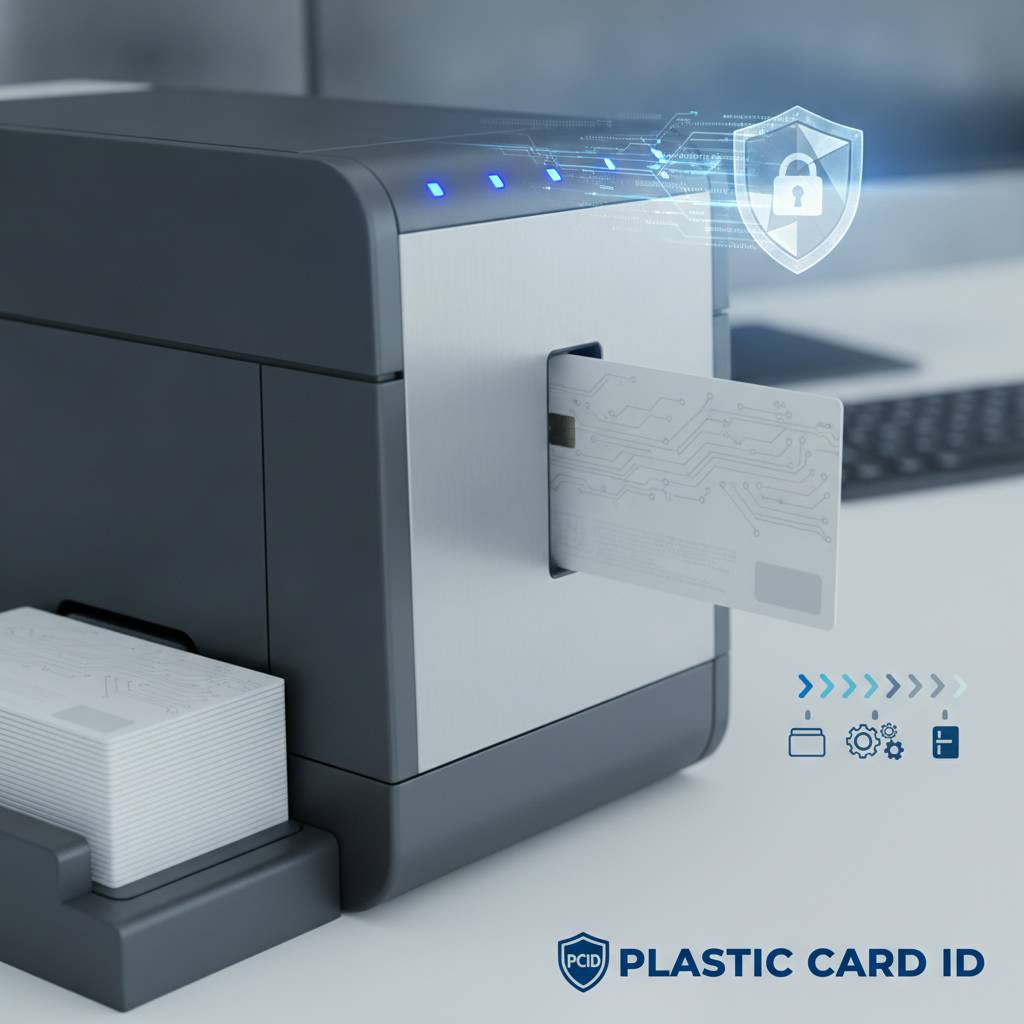 There is a tendency, even among experienced office managers and IT coordinators, to treat encoding as a mysterious back-end process best left to vendors. In practice, understanding the basics helps organizations make faster, smarter purchasing decisions - and avoid costly mismatches between card stock and card readers. Encoding simply means writing specific data onto a card's machine-readable component, whether that is a magnetic stripe, a chip, or an embedded antenna.
A blank CR80 PVC card - the standard 3.375 x 2.125 inch, 30 mil card defined by ISO 7810 - is a starting point, not a finished product. What transforms it into a functioning access credential is the combination of encoding and printing. CPE stocks a full range of blank card types ready for encoding, so whether your printer includes a built-in magnetic stripe encoder, a smart card contact station, or you are supplying pre-encoded cards to your hardware, the right substrate is available and ready.
Magnetic Stripe Encoding: HiCo vs. LoCo Explained
High coercivity - HiCo - magnetic stripe cards require a stronger magnetic field to encode and are far more resistant to accidental erasure from everyday sources like phone magnets or metal clasps. This makes HiCo the go-to choice for access badges, employee ID programs, hotel key cards, and any application where the card will be used repeatedly over weeks or months. The encoding holds reliably through real-world conditions.
LoCo cards use a lower coercivity rating and encode more easily at a lower cost per card. They are well-suited for short-term applications - event credentials, single-use hotel keys, temporary visitor badges, or gift cards with limited lifecycles. Choosing the wrong type can mean encoding failures or cards that demagnetize prematurely, both of which create operational headaches. Getting the coercivity right from day one prevents those issues entirely.
RFID and Proximity Cards: When Contact Swipe Is Not Enough
Proximity cards operating at 125kHz have been a staple of physical access control for decades. A cardholder taps or waves their card near a reader, and the reader captures the card's unique identifier without any contact required. This translates to faster throughput at entry points, less wear on both cards and readers, and a smoother user experience at high-traffic doors, parking garages, and time-clock stations.
RFID smart cards push the technology significantly further. Cards embedded with chips supporting protocols like MIFARE DESFire store encrypted data and support multi-application environments - the same card can authenticate an employee at a door, log a time-clock punch, and grant access to a secure server room. For organizations managing layered security, this flexibility is not a luxury; it is the right way to build a card program that scales without being rebuilt from scratch.
Smart Chip Cards and Contact-Based Authentication
Contact smart chip cards - the kind with a gold-colored chip pad on the face - communicate with readers through a direct electrical connection. They are common in corporate access programs, secure data environments, and certain government and institutional settings where cryptographic authentication is required. The chip stores and processes data on-card, providing a level of security that magnetic stripes simply cannot match.
Blank smart card stock in both contact and contactless formats is available through CPE, compatible with encoding hardware from major card printer manufacturers including Zebra, Fargo, and Evolis. Organizations running in-house card programs can encode directly at their desktop printer. Those needing pre-encoded stock can work with us to specify card type, chip standard, and encoding requirements before the cards ever ship.
The Case for In-House Card Encoding Programs
Outsourcing card production sounds simpler until the fourth rush reorder of the year comes in and the lead time is two weeks. Running an in-house encoding program shifts that calculus entirely. Organizations that print and encode their own cards gain immediate responsiveness - a new hire badge ready in minutes, not days. They gain cost control, because the per-card cost on blank stock drops significantly at volume. And they gain data security, because cardholder information never leaves the building.
The upfront investment in a card printer with encoding capability typically pays for itself quickly, particularly for organizations issuing more than 50 cards a month. The math is straightforward. A printer in the $1,200-$3,500 range combined with blank HiCo magnetic stripe cards at pennies per unit, versus outsourced card production at $2-$8 per finished card, reaches breakeven fast. From that point forward, the savings compound.
Choosing the Right Printer for Your Encoding Needs
Not every card printer encodes, and not every encoder handles every card type. The selection depends on what you are encoding and at what volume. Entry-level desktop printers from Evolis - the Primacy 2 or the Zenius, for example - offer single-sided printing with optional magnetic stripe encoding modules, ideal for small-to-medium programs. For dual-sided printing with higher throughput, the Zebra ZC300 or ZC350 series adds encoding in a compact unit.
High-volume operations or those requiring smart card encoding look to platforms like the Fargo HDP5000 or Zebra ZXP Series 8, which support lamination modules, contact and contactless smart card encoding, and throughput rates measured in hundreds of cards per hour. Matching printer capability to program volume is one of the most important decisions in building an in-house card program - and it is exactly the kind of guidance CPE provides to every customer, regardless of order size.
Blank Card Stock Selection for Encoding Compatibility
The physical card must match the encoding hardware. Standard blank PVC CR80 cards work with virtually all card printers and magnetic stripe encoders. Cards with embedded RFID antennae or smart chips require printers equipped with the corresponding encoding station - proximity cards need a proximity encoder, MIFARE cards need an HF smart card encoder, and so on. Ordering the wrong blank stock for your encoding hardware is a surprisingly common - and easily avoidable - mistake.
Plastic Card ID stocks a complete inventory of blank card types: standard PVC, composite PVC-polyester for longer life and higher durability, magnetic stripe in HiCo and LoCo, proximity 125kHz, RFID smart cards including MIFARE DESFire variants, smart chip contact cards, and specialty formats like clear, frosted, and colored stock. Whatever the encoding requirement, the right starting material is available here, in the quantities that match your program - from small runs to large-scale production orders.
Ribbons, Supplies, and Supporting Consumables
An in-house encoding program depends on more than blank cards and a printer. Printer ribbons must match the printer model and the output required - full-color YMCKO ribbons for photo-quality badges, monochrome for single-color text-only cards, and specialty ribbons for overlay panels that protect printed surfaces from wear. Cleaning kits maintain printer performance and card quality over time. Card carriers and sleeves protect finished credentials during handling and distribution.
Running out of ribbon mid-production is a real operational problem. Stocking the right consumables in sufficient quantities keeps programs running without interruption. CPE carries ribbons, cleaning kits, card carriers, lanyards, and card sleeves for all major printer brands, so restocking through one supplier is easy. Bulk ribbon pricing reduces cost per card further, improving the ROI calculation for in-house programs even more than the blank card savings alone.
Secure Access Applications: Where Encoding Makes the Difference
 Physical security is only as reliable as the credentials it depends on. Paper badges and laminated printouts create security theater - they look official until someone realizes how easy they are to replicate. Encoded plastic cards introduce a layer of verification that paper cannot replicate, because what authenticates the cardholder is not the design on the surface but the data written into the card's encoding layer, readable only by authorized hardware.
From small offices with a single controlled entry point to multi-site corporate campuses with layered access zones, encoded plastic cards provide the foundation of a functioning physical security program. The card format is consistent - CR80 PVC at ISO standard dimensions - which means it works with existing reader hardware, fits standard wallets and badge holders, and integrates with virtually all commercial access control software platforms already deployed in US facilities.
Employee ID and Access Badge Programs
Employee badge programs serve dual purposes simultaneously: identity verification and access control. A printed badge carries a photo, name, and title that establishes identity at a glance. The encoded magnetic stripe or RFID antenna embedded in the same card carries machine-readable credentials that authenticate the cardholder at door readers, elevator panels, parking gates, and time-clock terminals. One card, multiple functions, one issuance workflow.
HiCo magnetic stripe encoding is the most common choice for employee access programs in environments where swipe readers are already installed. RFID and proximity cards offer the upgrade path for organizations ready to invest in contactless infrastructure. The blank card stock for both is available at pricing that makes large-scale employee programs cost-effective, and CPE works with HR teams and facilities managers to ensure the right cards ship in the quantities their program requires.
Hotel Key Cards and Hospitality Access Solutions
Hotel key cards represent one of the highest-volume encoded card applications in the United States. A mid-sized property issuing 200 room keys per day at an average two-key-per-reservation rate goes through significant card volume annually. The encoding - typically magnetic stripe or RFID depending on the lock system installed - must be consistent, reliable, and compatible with the property management and door lock hardware in use.
Blank hotel key card stock from Plastic Card ID is available in both magnetic stripe and RFID formats, compatible with major hospitality lock systems. Custom-printed hotel key cards add branding, local advertising, or promotional messaging directly to the card surface. Properties encoding cards in-house at the front desk use desktop encoders and blank stock; larger properties or management groups encoding at a central location can order pre-encoded stock or in larger production quantities.
Casino Player Cards and High-Security Credential Programs
Casino player tracking cards represent a sophisticated encoded card application combining loyalty program data, access control, and identity verification in a single credential. The encoding layer tracks play activity, manages reward tier data, and in some configurations controls access to specific gaming areas or amenities. The security requirements are stringent - cards that can be cloned or manipulated represent direct financial exposure to the property.
MIFARE DESFire smart cards address the security requirements of casino environments with cryptographic protection that makes cloning practically infeasible. Combined with custom printing - holographic overlaminates, UV-reactive inks, or embedded security features - the finished credential is both functional and difficult to fraudulently replicate. CPE supplies blank smart card stock suitable for casino player programs and works with gaming operations teams to specify the right card type for their existing reader infrastructure.
Specialty Card Formats That Support Encoding
Standard white PVC CR80 cards are workhorses, but they are not the only option. A range of specialty card formats supports encoding while adding visual impact, unique material properties, or custom physical dimensions that standard cards cannot deliver. The encoding technology embedded inside - magnetic stripe, proximity antenna, or smart chip - is independent of the card's exterior format in most cases, meaning specialty aesthetics and functional encoding can coexist in a single card.
Organizations in hospitality, luxury retail, corporate environments, and exclusive membership programs frequently choose specialty formats precisely because the card itself communicates brand positioning before the cardholder even reaches the door reader. A matte black frosted card with embedded RFID says something different than a standard white card - and in contexts where the credential is also a brand touchpoint, that distinction has real value.
Clear and Frosted Plastic Cards
Clear and frosted PVC cards support magnetic stripe encoding and in some configurations support RFID embedding, depending on the manufacturing specification. They are popular in spa and wellness environments, boutique hotels, exclusive clubs, and any setting where the card is intended to feel premium. The translucent material creates visual contrast that makes printed graphics stand out in ways that opaque white stock cannot achieve.
Frosted cards in particular offer a tactile quality that is noticeably different from standard PVC - slightly softer in appearance, more distinctive in the hand. For loyalty programs, membership cards, and access credentials where the card is also a retention and engagement tool, the material choice reinforces the value proposition of the program. Encoding capability is built into the card at the manufacturing stage, not added after.
Luxury Metal Cards
Stainless steel, brass, and gold-finish metal cards occupy the premium tier of the card market. They are used in exclusive membership programs, VIP access credentials, black-card loyalty tiers, and corporate client gifting. The weight, sound, and feel of a metal card create an immediate impression that plastic - however well-designed - simply cannot match. For programs where the card itself is a status symbol, metal is the right material.
Metal cards can be produced with embedded encoding technology including magnetic stripes and certain RFID configurations depending on the specific production method. The finished product combines the functional access capability of an encoded credential with the physical presence of a luxury material. Plastic Card ID offers metal card options in stainless steel, brass, and gold finishes, custom-produced to client specifications for programs where standard formats are simply not sufficient.
Custom Die-Cut and Non-Standard Card Shapes
CR80 is the standard, but it is not a requirement. Custom die-cut cards in non-standard shapes - key fobs, mini cards, rounded rectangles, custom silhouettes - support encoding in many configurations and add instant brand differentiation. Mini key fob cards in particular are popular for loyalty and membership programs where cardholders want the convenience of a keychain attachment rather than a wallet card.
Custom-shaped cards require planning around the encoding component placement, since antennae and magnetic stripes have physical location requirements within the card body. Working with a supplier experienced in specialty formats ensures the encoding capability is not compromised by the shape customization. CPE supports custom format inquiries and works with clients to specify the right production approach for their program requirements.
Building and Scaling Your Card Program with Plastic Card ID
A card program that works at 50 cards a month looks different from one running at 50,000. The card type, the encoding approach, the printer selection, the supply chain for consumables - all of these need to scale coherently as the program grows. The organizations that build successfully scalable card programs treat their card supplier as a strategic partner, not a commodity vendor. That distinction, in practice, is the difference between a program that keeps pace with organizational growth and one that creates constant operational friction.
Plastic Card ID has supported card programs at every scale, from single-location small businesses issuing employee badges in-house to multi-site national operations running tens of thousands of cards monthly. The product catalog, the supply chain, and the depth of knowledge available to every customer - regardless of order size - reflects 25 years of doing this work for over 100,000 organizations across the United States. The next card program we help build could be yours.
Getting Started: What to Know Before You Order
- Know your reader hardware: Identify the encoding technology your existing readers support before ordering card stock. Proximity, magnetic stripe, and RFID require different card types.
- Estimate your monthly volume: Volume determines whether in-house production or pre-encoded stock makes more economic sense. Even rough estimates help narrow the best approach.
- Choose your printer carefully: If encoding in-house, match the printer's encoding module to the card type you plan to use. Not all printers support all encoding formats.
- Plan your consumable supply: Ribbons, cleaning kits, and card carriers are operational necessities. Build restocking into your program planning from the start.
- Consider the full card lifecycle: Cards get lost, damaged, and deactivated. A reliable reorder process and appropriate stock levels prevent credential gaps in your program.
The Plastic Card ID Product Catalog: One Source for Everything
Blank PVC cards, magnetic stripe HiCo and LoCo, proximity 125kHz, RFID smart cards including MIFARE DESFire, contact smart chip cards, clear and frosted stock, colored PVC, custom die-cut formats, metal cards - plus card printers from Evolis, Zebra, and Fargo, and the full range of ribbons, cleaning kits, card carriers, sleeves, and card affixing and mailing services. This is the catalog. Everything your card program needs, from one supplier, with the knowledge to match the right product to every program requirement.
Retailers who have made the switch from paper gift cards to plastic report revenue increases of 35-50%. Loyalty programs running plastic cards in wallets consistently outperform paper punch card alternatives. Membership and ID programs using plastic cards project a legitimacy that paper credentials simply cannot replicate. The card material matters as much as the encoding technology - and CPE carries both, for every program type, at every scale.
Contact the Team and Place Your Order
Whether you are building a new access program from scratch, upgrading an existing credential system, or scaling production to meet organizational growth, the right conversation starts with a call. 800.835.7919 connects you directly with a team that has helped over 100,000 organizations across the United States make exactly these decisions. No sales scripts - just direct, knowledgeable guidance on the card types, encoding options, and equipment that fit your specific program.
Orders ship across the United States. Programs of any size are supported. The product inventory is deep, the lead times are competitive, and the expertise behind every recommendation is real. Your access program deserves a supplier that understands what it takes to run one well.
Ready to Encode Smarter? Partner with Plastic Card ID
Encoding blank plastic cards for secure access is a decision that ripples through your entire operations - from the reader at the front door to the software managing cardholder data to the staff printing badges on demand. Getting it right from the start means fewer problems, lower long-term costs, and a credential program that your organization can actually rely on. Plastic Card ID has the products, the depth of catalog, and the two-plus decades of experience to help you build that program correctly, efficiently, and at the scale your organization requires.
Call Plastic Card ID today at 800.835.7919 - your access program starts with the right card, and the right card starts here.
Previous Page