Access Control Levels with Plastic Cards: A Practical Overview
Table of Contents []
- Access Control Levels with Plastic Cards: How Plastic Card ID Helps You Manage Who Gets In
- What Access Control Levels Actually Mean in a Card Program
- Card Types That Power Multi-Level Access Control Systems
- Blank PVC Cards and In-House Printing for Custom Access Credentials
- Specialty Cards for Advanced Access Control Applications
- Building and Scaling Your Access Control Card Program
- Why Plastic Card ID Is the Right Partner for Your Access Control Card Program
Access Control Levels with Plastic Cards: How Plastic Card ID Helps You Manage Who Gets In
Walk into almost any secured facility today - a hospital, a university, a corporate campus, a data center - and you will notice one thing immediately: plastic cards are doing a lot of the heavy lifting. Not just opening doors, but defining who belongs where, when, and under what conditions. Access control levels with plastic cards represent one of the most versatile, scalable, and cost-effective security strategies available to organizations of any size.
But here is where most guides stop short. They explain what access control is, then leave you to figure out the card side on your own. This page goes further - covering the card types, encoding technologies, program structures, and real-world configurations that make tiered access work in practice. Whether you are launching a system from scratch or upgrading an aging infrastructure, understanding the card layer is essential.
| Card Type | Technology | Typical Access Use | Security Level |
|---|---|---|---|
| Proximity Card | 125 kHz RFID | General building entry | Standard |
| Smart Chip Card | 13.56 MHz contactless | Multi-zone tiered access | High |
| MIFARE DESFire Card | 13.56 MHz encrypted | Sensitive / restricted zones | Very High |
| HiCo Magnetic Stripe | 2750 Oe magnetic | Hotel keys, parking, time-gated access | Moderate |
| Blank PVC CR80 | Print-encoded in-house | Visual ID, event credentials | Visual / Tiered by design |
What Access Control Levels Actually Mean in a Card Program
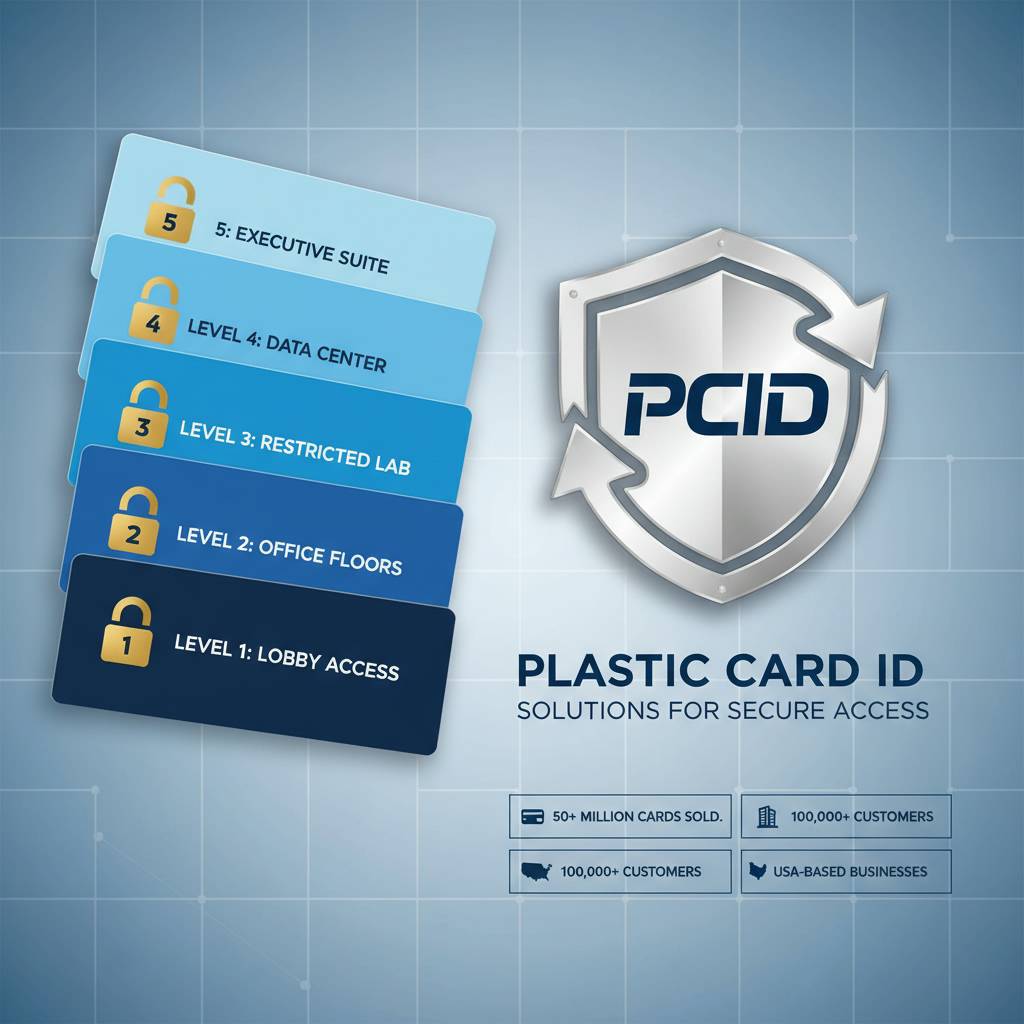 Access control levels are not a single setting - they are a system of layered permissions assigned to individuals based on role, clearance, department, or time of day. A contractor gets a different card than a full-time employee. A department head's card opens doors a general staff card never will. The physical card is the credential that carries those permissions, either through encoded data, a chip, or a magnetic stripe that communicates with your readers.
Understanding this layered architecture helps you make smarter card purchasing decisions. It is not just about buying cards in bulk - it is about knowing which card type supports which level of access, how many distinct tiers your system will require, and whether your current card stock can grow with you. That is precisely where CPE adds value from day one.
Defining Zones and Tiers Before You Choose a Card
Before anything gets printed or encoded, smart program managers map out their zones. A zone might be as simple as "public lobby versus restricted lab," or as complex as a multi-floor corporate tower with eight distinct clearance levels. Mapping zones first prevents costly re-issues later and helps you select the right card technology from the start rather than backfilling an incompatible solution.
Each zone corresponds to a tier, and each tier corresponds to a card credential type. A visitor badge for lobby-only access needs nothing more than a printed visual ID. A server room entry, by contrast, demands encrypted contactless smart card technology with audit logging. Define your tiers first, then match your card technology to each tier.
How Card Technology Supports Permission Levels
The encoding method on a card determines how much access intelligence it can carry. A plain magnetic stripe encodes a unique number that a reader matches against a database - simple, fast, and broadly compatible with legacy systems. A proximity card (125 kHz) does essentially the same wirelessly. Smart cards at 13.56 MHz go further, storing encrypted data directly on the chip and enabling multi-application credentialing on a single card.
For the highest security tiers, MIFARE DESFire technology encrypts every transaction between card and reader, making cloning and replay attacks dramatically more difficult. Organizations managing sensitive data, restricted laboratories, pharmaceutical storage, or government-adjacent facilities will find this level of card technology non-negotiable. It is not overkill - it is alignment between your security requirement and your credential capability.
Volume Planning: How Many Cards Per Tier?
One of the most underestimated aspects of program design is volume planning by tier. An organization with 300 employees might have 250 standard-access cards, 40 supervisor-level cards, and 10 executive or high-security cards. Getting that breakdown right before you order prevents overstock in one tier and shortage in another.
CPE serves programs ranging from 50 cards per month all the way up to mass production in the tens of thousands - which means volume planning support scales with you. Whether you are a small nonprofit issuing member IDs or a large enterprise running a multi-site access control program, the right card count per tier matters as much as the technology you choose.
Card Types That Power Multi-Level Access Control Systems
Not every card is equal, and the differences between them are not cosmetic. The card type you choose for each tier in your access control program should be driven by your security requirements, reader infrastructure, and budget constraints. The good news? There are excellent options at every price point, and CPE carries the full spectrum.
What separates a well-designed card program from a chaotic one is matching technology to tier. Using an overpowered card where a simple visual ID would suffice wastes budget. Underspecifying a high-security zone because you wanted to save money on cards is far more expensive when a breach occurs. Let the tiers guide the technology, and let the technology guide the card selection.
Proximity and RFID Cards for Everyday Access
Proximity cards operating at 125 kHz are the workhorses of standard-tier access control. They are widely compatible with existing reader infrastructure, affordable at volume, and simple to program and deactivate. For general building entry, common area access, or visitor management with defined time windows, prox cards are a trusted and proven choice.
RFID cards in the 13.56 MHz range offer higher data capacity and greater security than traditional prox cards. They support multiple applications on a single credential, making them ideal for organizations wanting to combine building access, time-and-attendance, and cafeteria payments onto one card. Multi-function cards reduce wallet clutter and simplify administration significantly.
Smart Chip Cards and MIFARE DESFire for High-Security Tiers
Smart chip cards bring the full power of on-card encryption to your access control infrastructure. MIFARE DESFire, in particular, uses AES encryption and supports diversified keys per card, making each credential mathematically unique. Even if a card is somehow physically duplicated, the cryptographic handshake fails at the reader. This is the gold standard for restricted-zone credentialing.
Organizations in healthcare, finance-adjacent industries, research institutions, and defense contractors increasingly require this level of card security. It is not a luxury tier - it is a compliance consideration in many regulated environments. If your access control vendor or IT security team is specifying MIFARE DESFire, the card supply chain starts here.
Call CPE at 800.835.7919 to discuss smart card options for your tiered access program.
Magnetic Stripe Cards for Time-Gated and Legacy Systems
HiCo magnetic stripe cards, encoded at 2750 Oe, offer strong durability against everyday demagnetization risks. They are widely used in hotel key card systems, employee time-clock access, parking garage credentials, and any application where a reader swipe is faster or more practical than a tap. LoCo stripes at 300 Oe suit lower-traffic applications where the card will not encounter strong magnetic fields.
For organizations running legacy access control systems that rely on magnetic stripe readers, upgrading the card stock to high-quality HiCo cards can dramatically reduce card failures and re-issue frequency. It is a simple, affordable improvement that pays dividends in reduced administrative overhead and improved user experience across every access tier.
Blank PVC Cards and In-House Printing for Custom Access Credentials
 There is something genuinely powerful about in-house card production. When your HR team or security office can print a new credential in minutes - not days - your program becomes dramatically more agile. An employee starts on Monday; their card is ready before they finish orientation. A contractor's temporary credential is issued with a specific expiration date printed right on the card. Control over your card production is control over your access program.
Blank CR80 PVC cards at 30 mil thickness are the ISO 7810 standard format - the same dimensions as a credit card, universally compatible with all major card printers. CPE stocks blank cards in white, full-color options, frosted, and clear finishes, giving your printed credentials a professional look that reinforces the legitimacy of your access control program visually, not just technically.
Choosing the Right Card Printer for Your Program
Card printers from Evolis, Zebra, and Fargo each bring distinct strengths to in-house credential production. Evolis printers are known for compact footprints and excellent output quality - ideal for HR departments or front-desk issuance points. Zebra printers emphasize durability and high-volume throughput, often the choice for large enterprises or multi-site programs with centralized print operations. Fargo printers offer deep encoding integration, making them a strong match for programs that need to print and encode magnetic stripes or smart chip data simultaneously.
Selecting the wrong printer for your volume or encoding needs creates friction across your entire program. A printer that handles 200 cards per day smoothly will bottleneck at 500. Choosing wisely upfront is a strategic decision, not just a hardware purchase. CPE can help you match printer capability to program scale.
Ribbons, Supplies, and Ongoing Program Support
A card printer without the right ribbon supplies is useless, and ribbon quality directly impacts card durability and print longevity. YMCKO ribbons for full-color ID cards, K ribbons for monochrome text-only passes, and specialty overlay ribbons for added scratch resistance are all part of a properly stocked card program. Running out mid-batch is a real operational risk many programs underestimate until it happens.
Beyond ribbons, card program essentials include cleaning kits that extend printer life significantly, card carriers and sleeves for professional distribution, and card affixing and mailing services for programs distributing credentials at scale. CPE operates as a true one-stop shop for all of these supplies, meaning fewer vendors, simpler ordering, and consistent quality across every element of your program.
Designing Visual Tiers Into Your Card Appearance
Access control levels do not have to be invisible. Many organizations intentionally design card appearance to reflect tier - color-coded cards, bold ACCESS LEVEL text, distinct background designs, or border colors that security staff can identify at a glance. This visual layer supplements your electronic controls and adds a fast, human-readable check at any checkpoint.
Blank colored PVC stock from CPE makes this easy. Start with a red card stock for visitor credentials, blue for standard employees, and a premium metallic or specialty finish for executive or high-security tier holders. When combined with printed text and electronic encoding, visually differentiated cards become a powerful dual-layer security signal that operates even when electronic readers are unavailable.
Specialty Cards for Advanced Access Control Applications
Standard PVC cards cover the majority of access control use cases beautifully - but certain environments demand something more. A casino managing thousands of player and staff credentials across a complex facility has different needs than a small business issuing employee IDs. A luxury hotel managing keycard access across 400 rooms operates at a different scale and specification than a boutique property with 30 keys.
Specialty card options exist precisely to serve these elevated requirements. From hotel key cards to casino player cards, from custom die-cut shapes that resist casual replication to luxury metal cards that signal executive tier status unmistakably, the card itself becomes part of the access control story. The medium is the message, and a well-chosen specialty card communicates its level of authorization before anyone even swipes or taps it.
Hotel Key Cards and Hospitality Access Programs
Hotel key cards are perhaps the most widely recognized application of plastic card access control. Magnetic stripe hotel keys encode a specific room number, check-in date, and check-out date - time-gating access automatically without any staff intervention at the door. Guests with room 412 credentials simply cannot open room 516, and every card deactivates at checkout automatically.
For properties wanting to elevate the guest experience while maintaining tight access control, smart contactless hotel key cards offer tap-and-go convenience alongside stronger encoding security. Printed with your property branding, logo, and design, hotel key cards double as miniature billboards that guests carry home - extending your brand presence well beyond checkout.
Casino Player Cards and Tiered Loyalty Access
Casino player card programs operate at the intersection of access control and loyalty - a remarkably complex combination that demands both technical precision and brand quality in the card itself. Tier levels - classic, silver, gold, platinum - must be physically distinct on the card surface while carrying encoded data that accesses the appropriate gaming and amenity privileges at each reader touchpoint throughout the floor.
High-volume casino programs often run tens of thousands of cards per cycle, requiring a supplier with the production capacity and quality consistency to deliver at scale without defect rates that trigger mass re-issue events. This is a specialty application where CPE's 25-plus years of card supply experience and 50-million-card track record translate directly into operational reliability.
Metal Cards and Premium Tier Credentials
- Stainless steel cards convey executive or VIP access tier status immediately and durably, with a weight and finish that paper or standard PVC cannot replicate.
- Brass and gold-finish metal cards are ideal for high-end membership programs, exclusive club access, or top-tier loyalty credentials where the card itself is part of the value proposition.
- Metal cards are difficult to damage or deform under normal conditions, giving them a practical durability advantage in high-use access scenarios.
- Custom die-cut shapes in plastic or metal add another layer of visual distinction, making tier-level identification instant and credentials harder to casually replicate.
- Premium card formats also carry significant perceived value - holders of metal tier cards report higher program engagement and retention compared to standard plastic credentials.
Building and Scaling Your Access Control Card Program
Starting a card-based access control program is rarely the hard part. Scaling it is. What works smoothly for 50 employees and a single building starts to fracture at 300 employees across three locations, each with different access tier requirements, different printer setups, and different card stock specifications. Planning for scale from the beginning prevents the expensive restructuring that catches many growing organizations off guard.
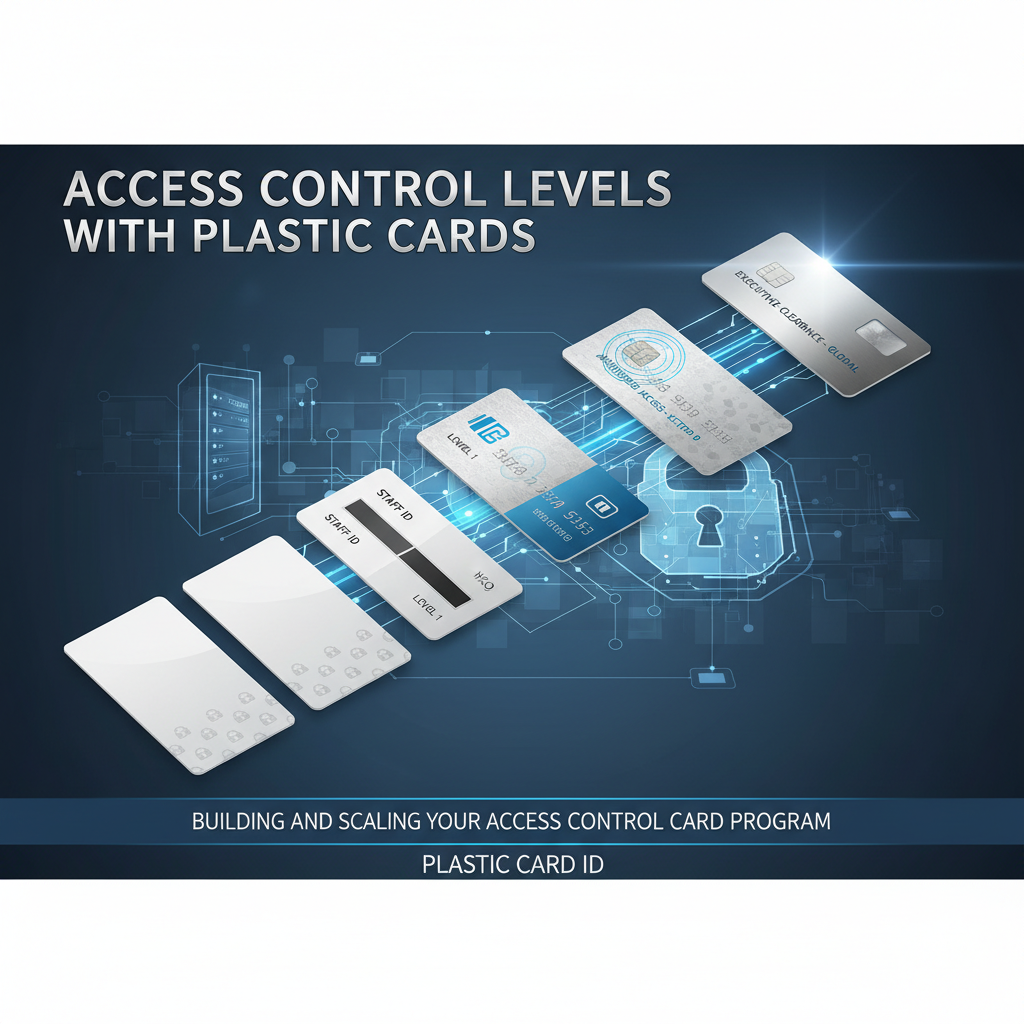
The best access control card programs share a few common traits: standardized card specifications across tiers, centralized or clearly distributed print and issuance workflows, a reliable and consistent card supply chain, and a process for rapid credential deactivation when an employee leaves or a card is lost. CPE supports all of these program dimensions, not just the card supply piece.
Structuring a Multi-Site Card Program
Multi-site access control programs introduce coordination challenges that single-location programs never face. Card stock must be consistent across sites so that a visiting employee's credential works seamlessly at a satellite location. Encoding must be compatible with reader systems at every site. And issuance workflows must be coordinated so that tier changes update across all locations, not just the home site.
Standardizing on a single card type per tier across all sites - ordered from a single, reliable supplier - is the simplest and most effective solution. It eliminates compatibility surprises, simplifies reorder logistics, and ensures that every card issued at any location meets the same quality and encoding specifications. This is a coordination advantage that CPE's one-stop supply model makes straightforward.
Credential Lifecycle Management and Re-Issue Planning
Every card in your access control program has a lifecycle: issued, active, replaced or deactivated. Lifecycle management is not glamorous, but it is critical. A card that should have been deactivated six months ago but was not is a security vulnerability, not just an administrative oversight. Tight lifecycle management closes the gap between your access policy and your actual access reality.
Planning for re-issue means keeping sufficient card stock on hand for rapid replacement, maintaining a clear deactivation protocol, and understanding your average card loss or damage rate so that reorder timing is never reactive. CPE programs range from standing monthly orders to bulk purchases with phased fulfillment - making lifecycle supply planning a solved problem rather than a recurring headache.
Frequently Asked Questions About Access Control Card Programs
What is the minimum order quantity for access control cards? CPE serves programs from as few as 50 cards per month up to mass production quantities, making it accessible for small organizations and large enterprises alike.
Can I order cards pre-encoded for my access control system? Yes - magnetic stripe cards can be encoded to your specifications, and RFID or smart chip cards can be supplied with the appropriate IC format for your reader infrastructure. Contact CPE at 800.835.7919 to discuss your specific encoding requirements before ordering.
Do blank PVC cards work with all card printers? Blank CR80 30 mil PVC cards are compatible with Evolis, Zebra, Fargo, and most other major desktop card printer brands. Always confirm ribbon and laminate specifications with your printer model to ensure optimal results.
Why Plastic Card ID Is the Right Partner for Your Access Control Card Program
There are plenty of places to buy plastic cards. What sets Plastic Card ID apart is not simply the catalog depth - though with blank PVC, magnetic stripe, RFID, proximity, smart chip, MIFARE DESFire, hotel key, casino, clear, frosted, colored stock, metal cards, and the full Evolis, Zebra, and Fargo printer lineup all under one roof, the catalog is genuinely comprehensive. What sets CPE apart is the strategic partnership model: over 25 years, more than 100,000 customers, and more than 50 million cards shipped to businesses across the United States.
Access control levels with plastic cards is not a simple purchase decision - it is a program design decision with long operational consequences. The right cards, the right technology per tier, the right volume planning, and a reliable supply chain that never leaves you scrambling for stock during a high-demand period: these are the outcomes that matter. Plastic Card ID is built to deliver exactly that - for programs of any scale, at any tier of complexity.
Ready to build or upgrade your access control card program? Contact Plastic Card ID today at 800.835.7919 - your strategic partner in plastic card solutions for USA businesses.
Previous Page