Shipping Blank Plastic Cards: What to Expect from Your Order
Table of Contents []
- What Happens After You Order: Shipping Blank Plastic Cards with Plastic Card ID
- Understanding the Contents of Your Blank Card Shipment
- Shipping Timeframes for Different Card Types and Order Sizes
- Specialty Cards: Extra Considerations for Shipping and Receiving
- Frequently Asked Questions About Blank Card Shipping
- Why Businesses Across the USA Trust Plastic Card ID for Card Shipments
- Get Your Blank Cards Shipped Fast - Contact Plastic Card ID Today
What Happens After You Order: Shipping Blank Plastic Cards with Plastic Card ID
You have placed your order. The confirmation email landed in your inbox. Now what? For businesses ordering blank plastic cards for the first time - or even the tenth - the shipping process can feel like a black box. What gets packed? How fast does it move? What should you do when the box arrives? These are legitimate questions, and they deserve straight answers.
Plastic Card ID has processed millions of card orders over 25 years, shipping to retailers, healthcare organizations, universities, gyms, hotels, event companies, and hundreds of other business types across every state. That kind of volume teaches you a lot about what customers actually need to know - and what surprises them. This guide exists to eliminate surprises entirely.
Order Processing: The Hours Before Shipment
When your order comes in, it does not sit in a queue waiting for someone to notice it on a Monday morning. Orders are reviewed, verified, and pulled the same business day in most cases. Blank PVC cards - the standard CR80 30 mil format that makes up the backbone of most card programs - are stocked in quantity, which means there is rarely a sourcing delay standing between your order and the dock.
The verification step matters more than people realize. If you ordered magnetic stripe cards - HiCo or LoCo - the team confirms the coercivity specification before pulling product. Mix those two up and your card encoder throws errors. That quick double-check has saved countless customers from receiving the wrong product, only to discover the issue weeks later when their encoding software starts complaining.
Packaging Standards and What Protects Your Cards
Blank plastic cards are not fragile in the way glassware is fragile, but they are precision products. A CR80 card must remain flat, clean, and scratch-free to print correctly. Cards that arrive warped, scuffed, or statically charged cause feed jams, color inconsistencies, and ribbon waste. Proper packaging is not a courtesy - it is a quality control measure.
Cards ship in sealed, boxed quantities - typically in increments of 100 or 500 per sealed pack - nested inside outer shipping cartons sized to minimize movement during transit. You will not find cards tumbling loose in an oversized box with a single air pillow trying to do the work of five. The packaging is deliberate and consistent, because the card has to arrive ready to run through a printer on day one.
Carrier Options and Transit Times Across the USA
Standard ground shipping reaches most of the continental United States within 3-7 business days. Expedited options - 2-day and overnight - are available for programs that cannot wait. If you are stocking up for a launch event, a trade show, or a new store opening, it is always worth padding your order date by at least two business days to account for unexpected carrier delays or high-volume shipping windows around holidays.
Alaska, Hawaii, and US territories follow different timelines and occasionally different carrier routing. If your organization operates in any of those locations, a quick conversation with CPE before ordering will save you the frustration of mismatched expectations. The team knows those routes and will give you an honest transit estimate, not an optimistic one.
| Card Type | Typical Stock Availability | Avg. Processing Time | Minimum Order |
|---|---|---|---|
| Blank PVC CR80 (White) | In Stock | Same Day | 100 cards |
| HiCo Magnetic Stripe | In Stock | Same Day | 100 cards |
| LoCo Magnetic Stripe | In Stock | Same Day | 100 cards |
| RFID / Proximity Cards | In Stock / Variable | 1-2 Business Days | 50 cards |
| Clear / Frosted PVC | In Stock | Same Day | 100 cards |
| Smart Chip / MIFARE Cards | Variable | 1-3 Business Days | 50 cards |
Understanding the Contents of Your Blank Card Shipment
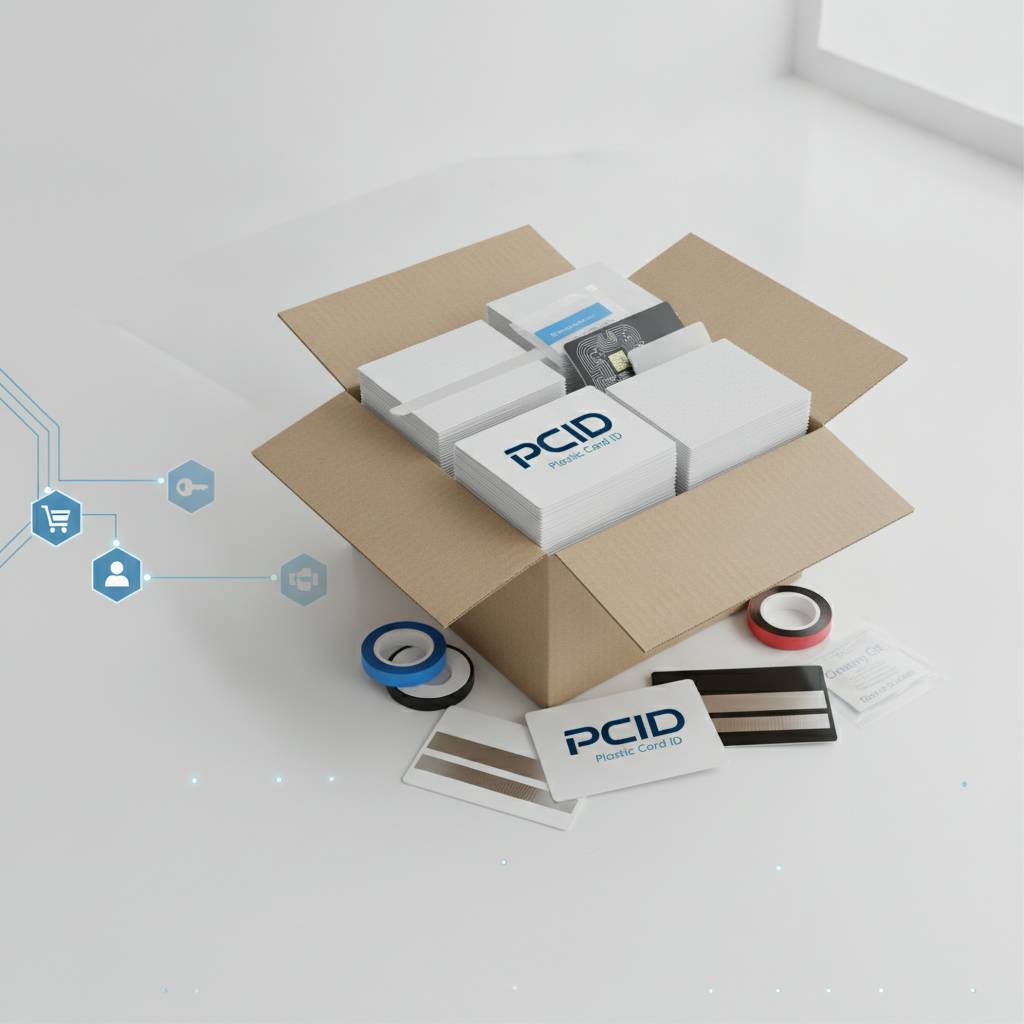 Opening a box of blank plastic cards for the first time - or after switching suppliers - should come with zero guesswork. Every shipment from Plastic Card ID is organized to tell you exactly what is inside without hunting through packing material. Packing slips reflect your order in plain language. Quantities are accurate. If you ordered 500 cards, you receive 500 cards.
That might sound like table stakes. But in a market where some suppliers ship short and expect customers not to count, accurate fulfillment is a genuine differentiator. Organizations running card issuance programs - employee badges, loyalty cards, hotel keys, membership credentials - are tracking inventory. Short shipments cause real problems downstream, and the team at CPE takes fulfillment accuracy seriously.
Reading the Packing Slip and Verifying Your Order
The packing slip will list product SKU, card type, quantity, and any encoding or specification notes. Check it against your order confirmation before you put a single card through a printer. Mismatches happen rarely, but catching one before you print 200 loyalty cards with the wrong magnetic stripe coercivity saves you a reprint job and a headache.
If your order included accessories - printer ribbons, cleaning kits, card sleeves, or card carriers - those may ship separately depending on warehouse location and availability. Do not assume everything arrives in one box. The packing slip will note if additional packages are en route. Keep your order confirmation until every item has been received and verified.
What to Do If Something Is Wrong on Arrival
Wrong item, damaged packaging, short count - these situations require immediate action, not a two-week wait. Photograph the packaging and contents before handling the cards extensively. Note the carrier seal condition (was it intact?) and document any visible damage to the outer carton. This evidence matters when filing a carrier claim or requesting a replacement.
Contact Plastic Card ID directly at 800.835.7919 with your order number and a description of the issue. The customer service team resolves fulfillment discrepancies quickly and without the runaround that some suppliers put customers through. Over 100,000 customers have trusted this operation - that kind of retention does not happen by ignoring problems.
Inspecting Card Quality Before Printing
Before you load a fresh pack into your card printer, take 10 seconds to fan through a small sample. You are looking for obvious surface defects, residue, or warping. A quality blank PVC card should be flat, uniformly white (or whichever stock you ordered), and completely free of surface scratches or fingerprint smudges. Even a small amount of surface contamination can cause streaking and ribbon adhesion issues during printing.
Store any unopened packs in a clean, climate-controlled environment away from direct sunlight and heat sources. Cards stored in a hot vehicle trunk or a humid warehouse corner will warp. Warped cards cause mechanical jams in virtually every desktop card printer on the market - Evolis, Zebra, Fargo, all of them. The cards themselves are not the failure point when stored correctly; the environment is.
Shipping Timeframes for Different Card Types and Order Sizes
Not every card ships on the same timeline, and understanding why helps you plan smarter. Standard blank white PVC cards are the simplest case - they are a commodity product stocked in bulk, and orders go out fast. Specialty cards require a bit more coordination, but Plastic Card ID's inventory depth means most specialty products move nearly as quickly as the basics.
Order volume matters too. A 500-card order of white CR80 stock moves differently through the warehouse than a 50,000-card order of RFID proximity cards. Both ship - reliably and accurately - but larger orders may require freight coordination rather than standard parcel service. If your organization is scaling up a card program to mass production volume, a direct conversation with the team ahead of placing the order is genuinely useful.
Small Orders: 50-500 Cards
This range is the heartbeat of small business card programs - a boutique gym issuing membership cards, a restaurant launching a gift card program, a startup getting employee badges sorted before the office opens. Orders at this scale typically ship same day or next day via parcel carrier. Ground delivery usually lands within 3-5 business days for most of the continental US.
Small orders are also where expedited shipping makes the clearest economic sense. The cost difference between ground and 2-day shipping on a 500-card order is modest. If your launch date has a hard deadline, paying a little extra for speed on a small order is almost always the right call.
Mid-Volume Orders: 500-10,000 Cards
Mid-volume orders serve growing businesses, multi-location retailers, regional associations, and organizations issuing cards at scale without crossing into mass production territory. Processing times remain tight, and these orders typically ship within 1-2 business days. Parcel service handles most of this range, though heavier shipments may go ground freight depending on total package weight.
At this volume, buyers are often managing a replenishment cycle rather than a one-time purchase. Setting a reorder trigger - ordering when you hit 20% of remaining stock - keeps your card program from ever going dark due to supply gaps. The last thing a loyalty program manager wants to explain is why new customers cannot receive a card because inventory ran out unexpectedly.
Large and Mass Production Orders: 10,000 Cards
Orders at this scale power hotel chains replenishing key card inventory, large employers managing badge programs across dozens of locations, and national retail gift card rollouts. These shipments are coordinated carefully, and the logistics conversation happens before the order is finalized - not after. Freight shipping, pallet quantities, and delivery scheduling all come into play.
One underappreciated benefit of working with CPE at this scale: the team has done this before, many times, across many industries. They know the questions to ask, the specifications to confirm, and the carrier options that protect a large card shipment from damage in transit. Volume buyers are not treated like a transaction - they are treated like the long-term partners they are.
Specialty Cards: Extra Considerations for Shipping and Receiving
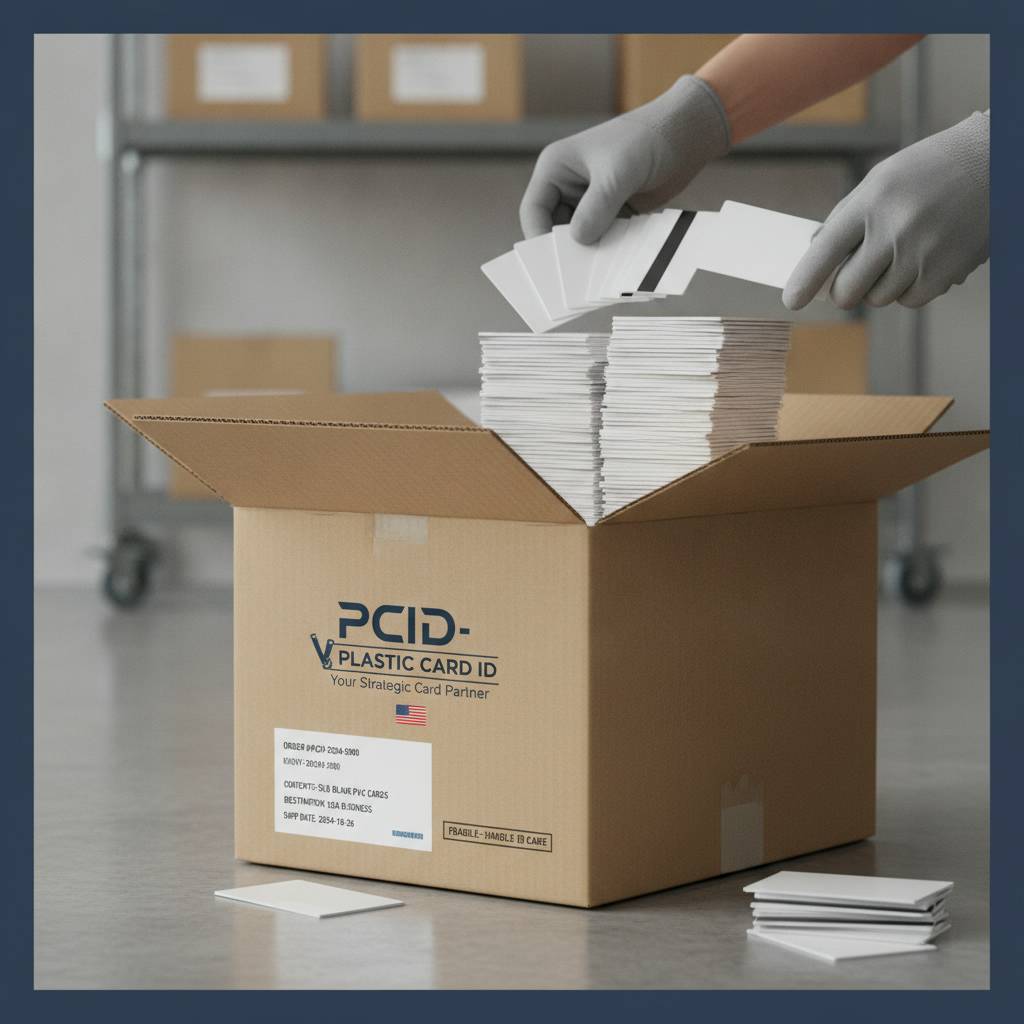 Not all blank cards are the same flat white PVC rectangle. Plastic Card ID's catalog includes clear and frosted cards, colored PVC stock, RFID and smart chip cards, proximity access cards, custom die-cut shapes, and even luxury metal cards in stainless steel, brass, and gold. Each of these comes with specific receiving and storage considerations that differ from standard card stock.
RFID and smart chip cards, for example, carry embedded electronics. They ship with anti-static packaging to protect the chip from electrostatic discharge. That packaging is functional, not decorative - do not discard it casually if you are storing unissued cards long-term. Metal cards are heavier, denser, and shipped with extra cushioning to prevent surface scratching during transit.
Clear and Frosted PVC Cards
Clear and frosted cards are visually striking products that serve loyalty programs, VIP memberships, and premium gift card lines particularly well. They also show fingerprints and surface marks far more readily than opaque white PVC. When receiving these cards, handle them by their edges and minimize direct contact with printing surfaces until they are ready to go through the printer.
Storage matters more with these cards too. Keep them sealed until use. A clear card that picks up dust particles in an open office environment will show those particles clearly under the printed design - which defeats the aesthetic purpose of choosing a clear card in the first place. Treat clear and frosted stock the way a photographer treats a lens: clean hands, sealed storage, minimal unnecessary handling.
RFID, Smart Chip, and Proximity Cards
These cards are the most technically complex products in the blank card catalog. They serve access control, hotel key systems, casino player tracking, transit programs, and high-security ID issuance. When you receive RFID or proximity cards, the first practical step is a test read with your access control hardware or encoding system before issuing cards to users. Confirm the technology matches your system specification - frequency, protocol, memory capacity.
MIFARE DESFire cards, used in the most sophisticated contactless access and loyalty applications, require system-level configuration before they carry useful data. Receiving the cards is step one of a multi-step process that ends with a fully issued, fully functional credential. If your technical team is new to contactless card deployment, Plastic Card ID can point you toward compatible encoder and printer hardware from the Evolis, Zebra, and Fargo lineups. Getting the card and the hardware from the same supplier simplifies the whole ecosystem significantly.
Luxury Metal Cards
Metal cards in stainless steel, brass, or gold-finish materials are a premium product category used by high-end loyalty programs, exclusive membership clubs, and organizations for which the card itself signals prestige. When these arrive, inspect them immediately for surface finish quality. Unlike PVC, metal cards cannot be run through a standard desktop card printer - they require specific printing and personalization methods.
The heft of a metal card communicates something that plastic simply cannot. Recipients feel it the moment the card lands in their hand. That tactile experience is a marketing outcome in itself, which is why premium brands invest in the format despite the higher per-card cost. Receiving a metal card shipment means receiving a marketing asset as much as an operational tool.
Frequently Asked Questions About Blank Card Shipping
After 25 years of shipping plastic cards to businesses across the United States, certain questions come up consistently. Answering them clearly here saves time for everyone involved.
Common Shipping and Receiving Questions
- Can I expedite my blank card order? Yes. 2-day and overnight shipping options are available at checkout for most standard card products. Specialty cards may have different lead times before shipping.
- Do blank cards ship in sealed packs? Yes. Standard increments are 100 or 500 cards per sealed pack inside outer shipping cartons. Cards arrive clean and ready to print.
- What if my cards arrive damaged by the carrier? Document the damage with photographs before further handling, then contact Plastic Card ID with your order number. The team will resolve the situation promptly.
- Can I track my shipment? Tracking information is provided when the order ships. Use it. Knowing exactly where your cards are prevents last-minute panics before a card program launch date.
- Are there minimums for shipping? Most card types have a 100-card minimum, though some specialty products like RFID and smart chip cards start at 50 cards. Confirm specifics when ordering.
- Do large orders ship by freight? Orders of sufficient volume and weight may ship via freight carrier. CPE coordinates this logistics step directly with customers before the order ships.
- Can accessories like ribbons and cleaning kits ship with my cards? Often yes, though warehouse location and availability may result in separate shipments. Your packing slip will note if additional packages are en route.
HiCo vs. LoCo Magnetic Stripe: Does It Affect Shipping?
Coercivity type - High Coercivity (HiCo) or Low Coercivity (LoCo) - does not affect how cards are shipped or packaged. It is, however, one of the most important specification points to confirm before ordering. HiCo cards (2750 Oe) are more resistant to accidental demagnetization from everyday sources like bag clasps and casual proximity to other magnetic fields. LoCo cards (300 Oe) are appropriate for short-term applications like event credentials and hotel room keys where cost is prioritized over long-term durability.
Ordering the wrong coercivity is a frustrating and costly mistake that results in cards that either fail to encode at your encoder's output level or erase too easily in use. Double-check your encoder's specifications before selecting HiCo or LoCo at checkout. When in doubt, HiCo is the safer default for most business card programs.
Ordering Accessories Alongside Blank Cards
A blank card is the starting point, not the complete solution. Printer ribbons, cleaning kits, card sleeves, card carriers, and card affixing and mailing services are part of a complete card program operation. Ordering accessories at the same time as your card stock is efficient and ensures compatibility - Plastic Card ID sells ribbons and supplies matched to the Evolis, Zebra, and Fargo printers in their hardware lineup.
Running out of ribbon mid-run while you have 300 blank cards waiting to be printed is an avoidable operational failure. Build a supply buffer into every order cycle - track ribbon yield against card volume and reorder before the last ribbon is consumed. Most ribbon manufacturers publish yield figures; use them to create a basic inventory plan that keeps your card program running without interruption.
Why Businesses Across the USA Trust Plastic Card ID for Card Shipments
Over 100,000 customers and 50 million cards shipped are not marketing statistics invented for a webpage. They represent gyms that replaced paper punch cards with plastic loyalty cards and watched member retention improve. Retailers who moved from paper to plastic gift cards and saw gift card revenue climb 35-50%. Hotels that standardized on a single key card supplier and eliminated compatibility headaches. Employers who streamlined their badge issuance into a smooth, repeatable program.
The reason organizations come back - order after order, year after year - is not simply that the cards arrive on time and undamaged, though that matters enormously. It is that Plastic Card ID operates as a strategic partner across the full card program lifecycle: product selection, hardware recommendations, supply chain planning, and troubleshooting when something goes sideways. That depth of engagement is rare in a supply category where most vendors only want to process transactions.
A Track Record That Speaks Through Results
Consider a mid-sized regional grocery chain running a loyalty card program across 22 locations. They were reordering cards reactively - scrambling when inventory dropped too low, occasionally issuing cards that had been stored improperly and caused printer jams. Working with CPE, they built a replenishment schedule aligned to their actual monthly issuance rate, established proper storage protocols, and reduced card-related printer downtime by a significant margin. That is the kind of outcome that a transactional vendor cannot deliver.
Or consider an event management company producing temporary access credentials for large conferences. Their need: thousands of cards on a predictable schedule, arriving correctly packaged and ready for in-house printing. The cards needed to be right, on time, every time - because conferences do not reschedule because a card shipment was late. Reliability is not a bonus feature in that context. It is the entire value proposition.
The Range of Industries Served
Blank plastic cards serve an astonishing range of business functions, and Plastic Card ID has shipped into virtually all of them. Healthcare organizations issue patient ID cards and staff badges. Universities produce student IDs and library access credentials. Fitness centers and yoga studios run membership card programs. Casinos issue player loyalty cards. Real estate agencies produce professional business cards on card stock. Transit authorities issue fare cards.
Each industry has its own technical requirements, volume patterns, and quality expectations. The breadth of the product catalog - from basic white CR80 PVC to MIFARE DESFire smart cards to gold-finish metal cards - exists specifically because a single card type cannot serve all of these applications. And the shipping and fulfillment operation behind that catalog is built to handle all of it with equal precision.
Accessible Support at Every Stage
Questions come up. Specifications get complicated. A new IT person inherits the card program and is not sure what was ordered before. An encoder starts throwing errors and someone needs to know if it is a card issue or a hardware issue. These are real scenarios that real customers face, and having a knowledgeable team available by phone makes all the difference between a quick resolution and a frustrating multi-day delay.
Reach the team at 800.835.7919 for product guidance, order status, technical questions about card compatibility, or help planning a card program at any scale. Whether you are ordering 100 blank cards for a neighborhood gym or 50,000 proximity cards for a corporate campus, the conversation starts the same way: with someone who knows the product and wants to help you succeed.
Ready to place your order and experience the difference? The catalog is deep, the inventory is stocked, and the shipping operation is ready to move your cards fast and accurately.
Get Your Blank Cards Shipped Fast - Contact Plastic Card ID Today
Blank plastic cards are one of those supply chain items that only gets noticed when something goes wrong - when inventory runs out before a launch, when the wrong coercivity arrives, when cards show up damaged and unusable. The businesses that never have those problems share one thing in common: they work with a supplier they can rely on unconditionally.
Plastic Card ID has spent 25 years earning that trust, one shipment at a time, with over 100,000 customers and 50 million cards delivered across every state in the USA. The product range, the fulfillment accuracy, the technical expertise, and the accessible customer service are all part of the same commitment: keeping your card program running without interruption, at any scale, for the long term.
Call Plastic Card ID at 800.835.7919 today to place your order, ask your questions, or start planning the card program your business deserves. The box ships fast. The cards arrive right. And the team is always there when you need them.
Previous Page