ISO 7810 Card Standard: What It Means for Buyers
Table of Contents []
- What ISO 7810 Actually Means -- and Why Buyers at Plastic Card ID Should Care
- The CR80 Card as the Foundation of Every Serious Card Program
- Magnetic Stripe Cards and the ISO 7810 Connection
- RFID, Smart Cards, and What ISO 7810 Makes Possible
- Building a Card Program: What Buyers Should Know Before They Order
- Why Physical Plastic Cards Outperform Paper and Digital Alternatives
- Partner with Plastic Card ID for Your Card Program -- Whatever the Scale
What ISO 7810 Actually Means -- and Why Buyers at Plastic Card ID Should Care
Pull a credit card, a hotel key, a gym membership card, or a staff ID out of any wallet in America. Odds are strong they all share something invisible to the naked eye: they conform to ISO 7810. That little alphanumeric string carries enormous practical weight -- dictating the dimensions, thickness, and physical tolerances that determine whether a card slides cleanly through a reader, prints correctly in a desktop card printer, or snaps into a badge holder without a fight. Understanding this standard is not an academic exercise. It is a purchasing decision.
At Plastic Card ID, we have been supplying blank and custom plastic cards to businesses across the United States for over 25 years -- more than 50 million cards delivered to more than 100,000 customers. In that time, one question surfaces again and again from first-time buyers: does card size actually matter that much? The short answer is yes, emphatically. The longer answer is what this page is for.
The Standard Itself: A Quick Technical Orientation
ISO 7810 is an international standard published by the International Organization for Standardization. It defines several card identification formats, but the one that dominates commercial plastic card programs is ID-1 -- more commonly called CR80. CR80 cards measure 85.60 mm by 53.98 mm (3.375 inches by 2.125 inches) and carry a nominal thickness of 0.76 mm, which translates to 30 mil in the American measurement convention. These numbers are not suggestions. They are precise engineering tolerances.
Other formats exist within the ISO 7810 family. ID-2 and ID-3 are larger -- used in passports and certain European identity documents. ID-000 is the tiny SIM card format. For the overwhelming majority of business buyers shopping for loyalty cards, membership cards, employee badges, access credentials, or event cards, ID-1/CR80 is the target. Everything else in this ecosystem -- printers, card slots, badge holders, laminators -- is engineered to that spec.
Thickness Matters More Than You Think
Thirty mil. That is 0.030 inches, or roughly three-quarters of a millimeter. Card printers, magnetic stripe readers, smart card contact stations, and proximity card readers are all calibrated to accept cards within a narrow tolerance band around that thickness. A card that comes in at 28 mil or 32 mil can jam rollers, cause print misalignment, or fail to make reliable electrical contact with chip readers. This is not hypothetical -- CPE hears from buyers who tried to save money with off-spec cards and ended up with frustrated staff and expensive printer service calls.
The 30 mil standard also governs how cards stack and ship. Card printers hold 100-card input hoppers engineered to that depth. If you are ordering 500 cards or 50,000 cards, uniformity across every single unit is what makes the whole system run without surprises. Consistency at scale is the invisible benefit of buying to standard.
How ISO 7810 Compliance Protects Your Investment in Equipment
Card printers represent a meaningful capital investment. A quality Evolis, Zebra, or Fargo desktop printer typically runs anywhere from a few hundred dollars to well over a thousand. These machines are precision instruments. Their feed rollers, printhead pressure settings, and retransfer mechanisms are designed around ISO 7810 ID-1 specifications. Running non-compliant cards through them voids warranties, degrades print quality, and shortens equipment lifespan.
When Plastic Card ID supplies blank PVC cards alongside a printer, every card in the order meets CR80/ISO 7810 specifications. That alignment is intentional. Your printer and your cards should come from a supplier who understands the entire system -- not just one component of it. That is the difference between a transactional vendor and a strategic partner.
| ISO 7810 Format | Common Name | Dimensions (mm) | Thickness | Typical Use Case |
|---|---|---|---|---|
| ID-1 | CR80 | 85.60 x 53.98 | 0.76 mm / 30 mil | Credit, ID, loyalty, access, membership |
| ID-2 | CR80 extended | 105 x 74 | Varies | French ID cards, some EU documents |
| ID-3 | Passport size | 125 x 88 | Varies | Passports, visas |
| ID-000 | Mini SIM | 25 x 15 | Varies | SIM cards for mobile devices |
The CR80 Card as the Foundation of Every Serious Card Program
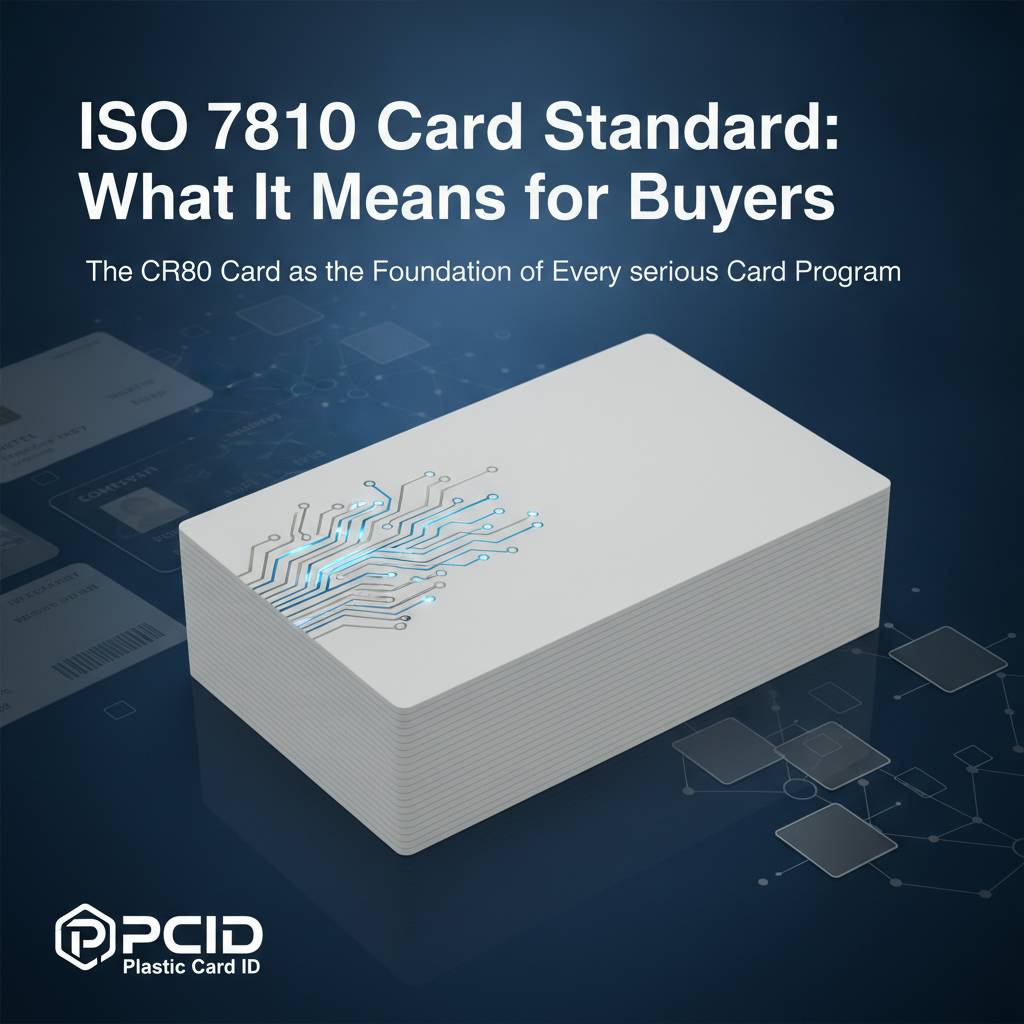 There is something almost underestimated about a blank white CR80 card. It looks like nothing much -- a rectangular slab of white PVC sitting in a shrink-wrapped box of 500. But that blank surface is a canvas of extraordinary commercial utility. Print on it and it becomes an employee badge. Encode a magnetic stripe and it becomes a loyalty card or hotel key. Embed an RFID chip and it becomes an access credential. The ISO 7810 form factor is what ties all of these possibilities to a universal infrastructure of printers, readers, and holders.
Blank CR80 cards give organizations something that pre-printed custom cards cannot always offer: immediate flexibility and lower per-card production costs over time. An in-house card printing setup -- a stack of blanks plus a printer plus ribbon -- puts control back in the hands of the organization. Names, photos, and data can change on the fly. No minimum order for each update. No waiting on a vendor turnaround. That is a material advantage for schools, healthcare facilities, hotels, retailers, and any organization managing a rotating roster of cardholders.
Blank Cards vs. Pre-Printed Custom Cards: A Buyer's Breakdown
The choice between buying blank ISO 7810 cards for in-house printing versus ordering fully custom-printed cards is one of the more consequential decisions in setting up a card program. Neither option is universally superior -- the right answer depends on volume, frequency of change, available equipment, and program goals. Understanding the tradeoffs is essential before placing an order.
- Blank CR80 cards offer the lowest per-unit cost, maximum design flexibility, and no minimum order restrictions on printing changes. They require a card printer and consumables (ribbon, cleaning kits).
- Pre-printed custom cards deliver professional, full-color offset or digital printing at high volumes with no in-house printer required. They are ideal for loyalty cards, gift cards, and membership cards with stable designs.
- Hybrid approaches use a pre-printed card body (logo, colors, design) combined with in-house variable data printing (names, numbers, photos) for the best of both worlds.
- Encoding options -- magnetic stripe (HiCo or LoCo), RFID, smart chip -- can be added to blank or custom cards, but must be specified at the card manufacturing stage, not added afterward.
- ISO 7810 compliance applies equally to both blank and custom cards. Any reputable supplier ensures this by default.
Why the 30 Mil Standard Enables the Whole Ecosystem
The reason CR80 became universal is not regulatory mandate -- it is market convergence. When every card, every printer, every reader, and every holder is built to the same dimensional standard, the entire ecosystem becomes interoperable. A card printed on a Zebra ZC300 will fit in the same badge holder as one printed on a Fargo HDP5000. A loyalty card from a small retailer will swipe through the same magnetic reader as one from a national chain. That interoperability has enormous commercial value.
CPE supplies cards that meet this standard rigorously. Whether the order is 100 blank PVC cards for a small office or 25,000 magnetic stripe loyalty cards for a regional retail chain, the CR80 spec is held throughout. Dimensional precision is not a premium feature -- it is the baseline.
Specialty Cards That Still Conform to ISO 7810
One of the more interesting aspects of the ISO 7810 standard is how much variety it accommodates within fixed dimensions. Clear plastic cards, frosted cards, colored PVC stock, and even luxury metal cards in stainless steel, brass, and gold can all be produced to CR80 dimensions. The card is still wallet-sized, still fits in a badge holder, still runs through compatible printers (where appropriate) -- but the material or finish changes the experience dramatically.
Custom die-cut shapes deviate from the CR80 profile, but they represent a deliberate choice -- marketing cards, novelty membership cards, and brand-statement pieces where the unconventional shape is the point. These are specialty applications. For any program built around readers, printers, or standard accessories, staying within the ISO 7810 ID-1 envelope is the sensible, practical default.
Magnetic Stripe Cards and the ISO 7810 Connection
Magnetic stripe technology is one of the oldest and most durable encoding methods in the card industry. HiCo (High Coercivity) and LoCo (Low Coercivity) stripes both live on cards that conform to ISO 7810 ID-1 dimensions -- and their placement on the card is also standardized, governed by ISO/IEC 7811. This layered standards framework means that a magnetic stripe card produced by one manufacturer will be readable by magnetic stripe readers produced by another, as long as both parties followed the specs.
HiCo magnetic stripes are the workhorse of long-life programs. They resist accidental erasure from everyday magnetic interference -- phone magnets, purse clasps, speaker magnets -- and are the right choice for employee ID cards, hotel key programs, and loyalty cards that will see heavy, repeated use. LoCo stripes, encoded at lower magnetic intensity, are appropriate for short-term applications like event credentials or single-use access passes where longevity is less critical.
Choosing Between HiCo and LoCo for Your Program
The technical difference between HiCo and LoCo stripes comes down to oersted (Oe) rating -- HiCo runs at 2750 Oe, LoCo at 300 Oe. Practically speaking, buyers should default to HiCo for any card that will be used more than a handful of times, stored in a wallet with other cards, or issued to an environment where the card may encounter magnetic fields. The cost difference is negligible; the performance difference is real.
LoCo cards are not inferior -- they are purpose-built for specific scenarios. Hotel door keys are often LoCo because the cards are disposable by design. Event credentials for a one-day conference are ideal LoCo candidates. The decision is programmatic, not qualitative. Plastic Card ID stocks both and can guide buyers toward the right choice based on their specific card program parameters. Call 800.835.7919 to speak with a specialist who can map stripe type to your program needs.
Encoding Standards That Layer on Top of ISO 7810
ISO 7810 defines the physical card. A separate but related standard, ISO/IEC 7811, defines the magnetic stripe -- its location on the card, the track layout, the recording density, and the signal characteristics. Track 1, Track 2, and Track 3 each carry different data types. Most loyalty and access programs use Track 1 or Track 2. Understanding which track your reader system expects is a prerequisite before ordering encoded cards.
Smart chip cards add yet another layer -- ISO/IEC 7816 governs contact chip cards, while ISO/IEC 14443 and ISO/IEC 15693 govern contactless (RFID) cards. MIFARE DESFire, a widely used contactless technology in access control and transit applications, operates under these contactless standards while still living in an ISO 7810 ID-1 body. The physical standard and the encoding standard are distinct but mutually dependent.
RFID, Smart Cards, and What ISO 7810 Makes Possible
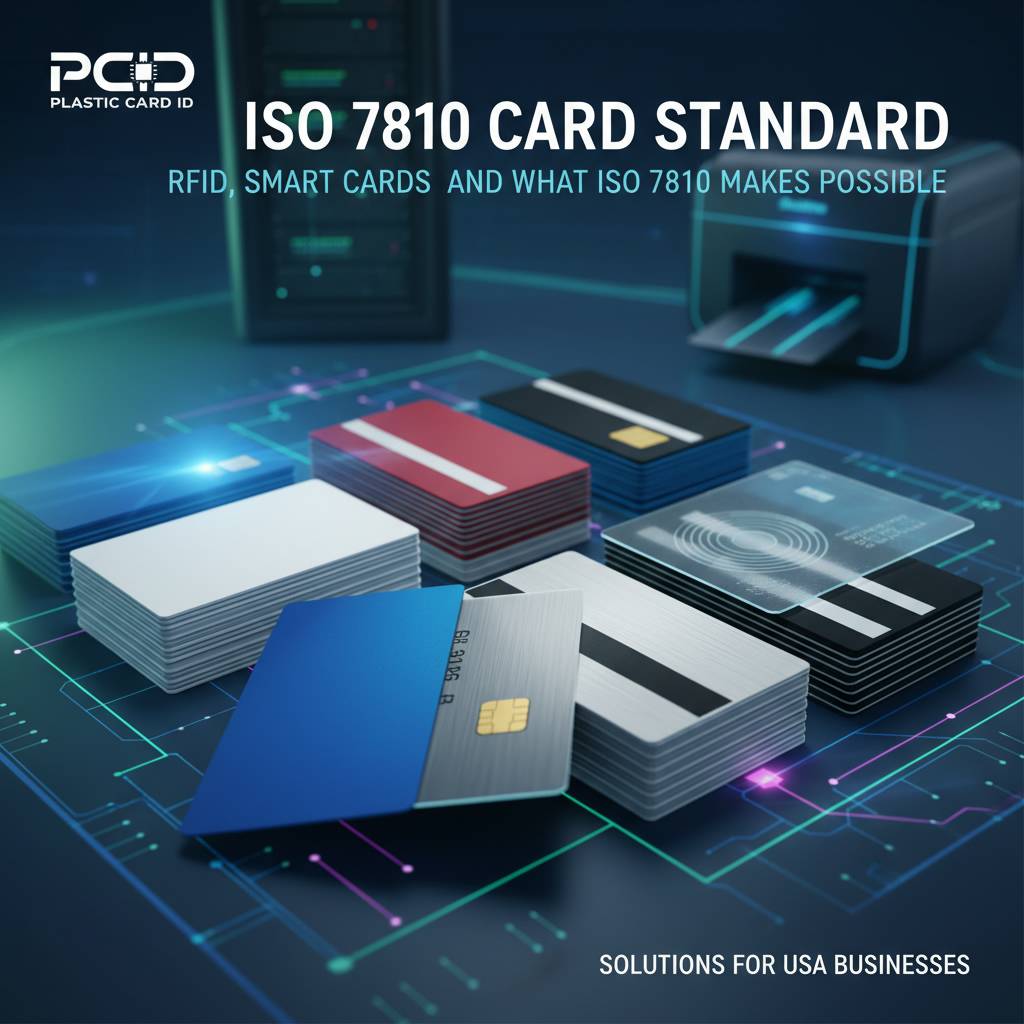 The same CR80 form factor that houses a simple blank PVC card can also house a sophisticated RFID transponder, a contact smart chip, or both simultaneously in a dual-interface card. This is one of the engineering marvels of the modern card industry -- the antenna, the chip module, and the IC all embedded within 0.76 mm of laminated PVC, indistinguishable from the outside from a plain white card. ISO 7810 compliance is what makes this transparent to end users and infrastructure alike.
Proximity access cards, MIFARE DESFire smart cards, and contactless employee badges all conform to CR80 dimensions. Readers mounted at doors, turnstiles, and kiosks are calibrated for that size. Badge holders and lanyards are sized to that form. The entire physical security and access control infrastructure of modern commercial buildings is built around the ISO 7810 ID-1 standard. Buying off-spec in this category is not a minor inconvenience -- it can mean a complete access system failure.
Proximity Cards for Access Control Programs
125 kHz proximity cards are among the most widely deployed access control credentials in the United States. They are passive -- no battery -- and communicate card identification data to a reader via radio frequency induction when brought within range. The card itself is an ISO 7810 CR80 card with an embedded antenna coil and microchip. Swipe it, hold it near a reader, and the door unlocks. Simple, reliable, and scalable from a single office to a campus-wide deployment.
Plastic Card ID supplies proximity cards across a range of formats and frequencies, including popular 125 kHz standard and higher-security 13.56 MHz options. Organizations upgrading from mechanical keys to contactless access find that the transition is substantially eased when all cards come from a single supplier who understands both the physical and encoding specifications involved.
Casino and Hotel Card Applications
Two industries that push card technology particularly hard are hospitality and gaming. Hotel key cards live in pockets with smartphones, get bent, get exposed to heat and humidity, and are expected to work reliably every single time. Casino player cards are swiped and tapped hundreds of times daily in high-traffic environments. Both categories demand rigorous ISO 7810 compliance -- off-spec cards jam key card readers, fail in slot machine card slots, and generate the kind of guest friction that costs real revenue.
Casino player cards and hotel key programs are exactly the kind of high-volume, high-reliability applications where a 25-year supply partner adds meaningful value. CPE has served these industries extensively and understands the operational stakes. A card program that breaks down is not an IT problem -- it is a customer experience problem with a direct line to the bottom line.
Building a Card Program: What Buyers Should Know Before They Order
There is a reliable pattern to card program failures: they start with a purchasing decision made without full information. Someone orders 10,000 cards that turn out to be incompatible with the reader system already installed. Or they buy a printer that cannot handle the card stock thickness they need. Or they select LoCo cards for a loyalty program where cardholders carry their cards in magnetic phone cases. Every one of these mistakes is avoidable with a brief conversation before the order is placed.
Plastic Card ID operates as a strategic partner for exactly this reason. The catalog spans blank PVC cards, magnetic stripe cards, RFID and proximity cards, smart chip cards, clear and frosted cards, and a full lineup of card printers from Evolis, Zebra, and Fargo. Printer ribbons, cleaning kits, card carriers, sleeves, card affixing, and mailing round out a genuinely comprehensive offering. Everything a card program needs, from blank stock to finished, mailed credential, lives under one roof.
Frequently Asked Questions About ISO 7810 Cards
Buyers new to plastic card programs consistently ask the same questions. Addressing them directly saves time and prevents costly ordering errors. The following represents the most common points of confusion encountered over 25 years of card program support.
- Are all CR80 cards automatically ISO 7810 compliant? Not necessarily. Reputable manufacturers produce to spec; low-cost overseas suppliers sometimes cut corners on thickness or dimensional tolerances. Always buy from a supplier who guarantees compliance.
- Can I print on RFID or smart chip cards with a standard card printer? Yes -- most RFID cards print normally on standard retransfer or direct-to-card printers. Encoding, however, requires printer modules or separate encoding hardware.
- What is the difference between 30 mil and 20 mil cards? Twenty mil cards are thinner, often used for paper-laminated or adhesive-back applications. Standard card readers and printers expect 30 mil. Using 20 mil in a standard printer can cause feed errors.
- Do loyalty cards need to be ISO 7810 compliant? If they will be swiped, tapped, or inserted into any reader, yes. If they are purely visual (no encoding), it still matters for wallet fit, badge holders, and printer compatibility.
- Can I order a mix of blank and encoded cards on the same order? Absolutely. Plastic Card ID handles mixed orders routinely and can structure quantities and specifications to match program requirements.
Card Program Scale: From 50 Cards to Tens of Thousands
One of the persistent misconceptions about professional plastic card programs is that they are only economical at large scale. That is simply not true. Plastic Card ID serves organizations running card programs from 50 cards per month up to mass production in the tens of thousands. The per-card economics shift with volume, but the quality, compliance, and support infrastructure remain consistent regardless of order size.
Small nonprofits running member ID programs, boutique hotels managing key card inventories, regional retailers building loyalty programs -- all of them benefit from the same ISO 7810-compliant card stock and the same supply chain reliability as a national enterprise customer. Scale does not determine the quality of what goes in the printer or the reader.
The Role of Accessories in a Complete Card Program
Cards are the centerpiece, but they are not the whole system. Printer ribbons are consumables that directly affect print quality and card longevity. Cleaning kits maintain printer roller performance and extend equipment life -- a maintenance step that many buyers skip until they see degraded output. Card carriers and sleeves protect finished credentials during mailing and distribution. Card affixing and mailing services handle fulfillment so organizations can focus on their programs rather than their logistics.
CPE supplies all of these alongside the cards themselves. This is not upselling -- it is program completeness. A loyalty card printed with a worn-out ribbon or damaged by a dirty printer roller does not represent the organization well, regardless of how carefully the design was conceived. The accessories are the unglamorous but essential supporting cast of every successful card program.
Why Physical Plastic Cards Outperform Paper and Digital Alternatives
The conversation about cards sometimes drifts toward digital alternatives -- mobile apps, digital wallet passes, QR codes on receipts. These tools have genuine utility in certain contexts. But the measurable performance data for physical plastic cards remains compelling and, for many program types, decisive. Retailers that have switched from paper gift certificates to plastic gift cards have documented sales increases of 35-50%. That is not a marginal improvement -- it is a category-level change in consumer behavior driven by a physical object.
Loyalty cards that live in wallets outperform paper punch cards on virtually every metric: redemption rates, return visit frequency, average transaction value. A plastic card in a wallet is a persistent, tactile brand impression that a digital notification simply cannot replicate. Membership cards and ID cards signal organizational legitimacy in a way that paper alternatives do not. These are not sentimental observations -- they are measurable program outcomes with real revenue implications.
Gift Cards as a Revenue and Retention Tool
Gift card programs are among the highest-return card investments a retailer or hospitality business can make. Unused gift card balances (breakage) contribute directly to revenue. Card recipients who redeem spend an average of 20% more than the card value. New customers introduced through gift card purchases convert at meaningful rates. None of this works with a paper certificate that fades, tears, and cannot be reloaded.
Plastic gift cards conforming to ISO 7810 can be magnetic stripe encoded for swipe-based POS systems, RFID-enabled for tap redemption, or issued as simple numbered cards tracked in a manual or digital register. The physical standard accommodates every technical approach. The question is not whether to use plastic gift cards -- it is how to structure the program for maximum performance.
Membership and ID Cards That Signal Permanence
There is a psychological dimension to card quality that program operators sometimes underestimate. A laminated paper membership card communicates impermanence. A 30 mil PVC card with a high-quality printed design communicates that the organization is serious, established, and here to stay. For professional associations, fitness clubs, medical practices, and any organization where perceived legitimacy matters, the card itself is part of the brand communication.
Employee ID badges carry the same dynamic. A staff ID printed on a high-quality ISO 7810-compliant card with a clear photo and professional design communicates something different than a paper badge in a plastic sleeve. That difference matters in customer-facing roles, in security-sensitive environments, and in any setting where the badge is part of the employee's professional presentation.
Partner with Plastic Card ID for Your Card Program -- Whatever the Scale
Twenty-five years. Over 100,000 customers. More than 50 million cards. Those numbers are the result of one consistent practice: treating every card program, regardless of size or complexity, as a partnership worth investing in. When a buyer calls Plastic Card ID with a new card program or an existing one that needs to scale, they reach people who have seen the full range of program types -- from single-location small businesses to multi-site enterprises -- and who understand that ISO 7810 compliance, encoding accuracy, and supply reliability are not optional features.
The catalog covers everything: blank CR80 PVC cards, HiCo and LoCo magnetic stripe cards, proximity access cards, RFID smart cards including MIFARE DESFire, contact chip cards, clear and frosted cards, colored stock, luxury metal cards in stainless steel, brass, and gold, custom die-cut specialty cards, and card printers from Evolis, Zebra, and Fargo. Ribbons, cleaning kits, card carriers, sleeves, and fulfillment services round out the offering. No other supplier combines this catalog depth with this depth of program support for USA-based buyers.
Ready to build or scale your card program? Call Plastic Card ID at 800.835.7919 today. Our specialists are standing by to match you with the right cards, the right equipment, and the right program structure -- from your first order to your hundred-thousandth card.
Previous Page