Blank Plastic Cards vs Paper Cards Durability Comparison Guide
Table of Contents []
- Blank Plastic Cards vs Paper Cards: Why the Comparison Isn't Even Close - Plastic Card ID
- The Durability Argument: What Paper Simply Cannot Do
- What Blank CR80 Cards Actually Represent for Your Business
- Card Printers: The Bridge Between Blank Cards and Finished Programs
- Specialty Cards: When Standard Plastic Isn't Enough
- Frequently Asked Questions: Blank Plastic Cards vs Paper Cards
- Your Next Card Program Starts Here - Plastic Card ID
Blank Plastic Cards vs Paper Cards: Why the Comparison Isn't Even Close - Plastic Card ID
There's a moment every business owner recognizes - the one where a customer fumbles through their wallet, pulls out a crumpled, faded paper punch card, and slides it across the counter with an apologetic look. That moment says something. Not just about the card, but about the program behind it. The material your card is made from communicates your brand's credibility before a single word is spoken.
Plastic cards and paper cards are not simply different materials - they represent entirely different philosophies about how a business presents itself and how it builds lasting relationships with customers, members, and employees. Plastic Card ID has spent over 25 years watching businesses upgrade from paper to plastic and experience measurable, tangible results. The data is convincing. The logic is simple. And once you understand the full picture, going back to paper feels unthinkable.
| Feature | Blank Plastic Cards (CR80 PVC) | Paper Cards |
|---|---|---|
| Durability | Years of daily use | Weeks to months |
| Wallet Retention | Stays in wallet long-term | Often discarded quickly |
| Professional Appearance | Crisp, clean, permanent | Fades, tears, warps |
| Encoding Capability | Mag stripe, RFID, smart chip | None or limited barcode |
| Perceived Brand Value | High | Low to moderate |
| Cost Over Time | Lower per-use cost | Frequent replacement costs |
The Durability Argument: What Paper Simply Cannot Do
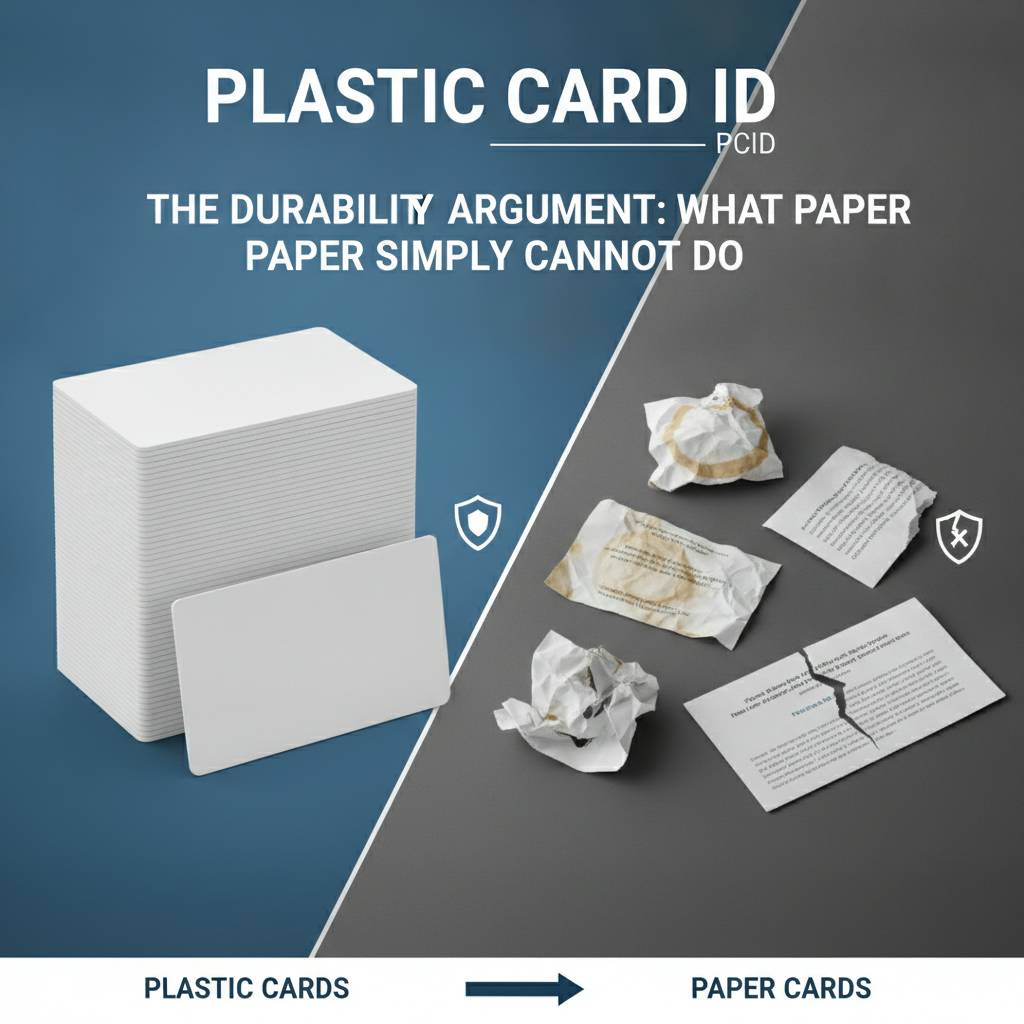 Durability isn't a minor point - it's the entire foundation of the plastic vs. paper debate. A blank CR80 PVC card manufactured to ISO 7810 standard is 30 mil thick, rigid, and built for repeated handling. It resists moisture, bending, and the general punishment of daily life inside a wallet or clipped to a lanyard. Paper cards begin degrading almost immediately upon first contact with the real world.
Think about the conditions a card faces: the humidity of a gym bag, the friction of a crowded wallet, the grease from a restaurant counter, the pressure of being sat on in a back pocket. PVC plastic handles all of it without complaint. Paper absorbs, warps, tears, and eventually becomes unreadable and unusable. For businesses running loyalty programs, access control systems, or membership programs, a card that fails is a customer experience that fails.
Physical Resilience in Real-World Use
The 30 mil CR80 standard isn't arbitrary - it matches the exact dimensions of a standard credit card, which means it slots perfectly into any wallet slot, card holder, or badge clip designed for modern cards. That precision engineering matters. When your loyalty card fits where your customer's Visa card fits, it gets carried everywhere that card gets carried.
Paper cards, even laminated ones, rarely achieve the same structural integrity. They crack at the corners, peel at the edges, and fade under UV exposure. A plastic card printed with a quality card printer maintains its legibility and appearance through hundreds - sometimes thousands - of uses without visible deterioration.
Moisture and Environmental Resistance
Water is paper's natural enemy. A paper loyalty card left in a wet jacket pocket is essentially destroyed. PVC plastic cards are inherently water-resistant, meaning a spilled drink or an unexpected rain shower doesn't end your customer's membership. Plastic shrugs off the conditions that destroy paper entirely.
This environmental resilience extends to temperature fluctuations as well. Cards stored in a glove compartment, a warehouse badge cabinet, or a retail display rack need to maintain their integrity across a wide range of temperatures and humidity levels. PVC cards do exactly that, consistently, without special handling or protective storage requirements.
Long-Term Cost per Use
There's a misconception that paper cards are the budget-friendly choice. In the short term, individual unit costs may appear lower. But when you factor in replacement frequency, reprinting costs, program disruption, and customer frustration, the economics shift decisively in favor of plastic. A plastic card issued once and used for three years costs a fraction per interaction compared to paper cards replaced every few months.
CPE works with businesses running programs of all sizes - from 50 cards a month to mass production in the tens of thousands - and the long-term cost analysis consistently favors plastic. The upfront investment in blank PVC cards and a quality card printer pays for itself rapidly, especially when you control printing in-house and eliminate per-order minimums and turnaround delays.
What Blank CR80 Cards Actually Represent for Your Business
A blank plastic card isn't an unfinished product - it's a canvas. It's potential, ready to become whatever your program requires. Print it with your logo and it's a membership card. Encode a magnetic stripe and it's a loyalty card tied to your POS system. Add an RFID chip and it becomes an access control credential. The card's blank state is the starting point, not the limitation.
Total design control is one of the most significant advantages of in-house card production. With blank CR80 PVC cards and a desktop card printer, your team can produce exactly the cards you need, on demand, with no minimum order requirements and no waiting on a vendor's production schedule. Update an employee badge in minutes. Produce event credentials the morning of an event. Customize a loyalty card for a VIP customer on the spot.
The CR80 Standard Explained
CR80 refers to the standard size (3.375 x 2.125 inches) and 30 mil thickness that defines a modern plastic card. This ISO 7810 standard ensures compatibility with virtually every card printer, badge holder, card reader, and wallet slot on the market. When you order blank CR80 cards from CPE, you're ordering cards that work with every system, every time.
This universality is not a small thing. Standardization means your cards integrate seamlessly into existing infrastructure - the card printer you already own, the badge clips in your supply closet, the card readers at your facility entrance. No custom hardware, no compatibility headaches, no surprises.
Encoding Options That Paper Will Never Offer
This is where the comparison becomes almost unfair. Blank plastic cards can be manufactured with embedded technology that transforms them from simple identification tools into functional system components. Magnetic stripes - available in HiCo (high coercivity) and LoCo (low coercivity) formats - allow cards to interface with point-of-sale systems, time-and-attendance software, and access control platforms.
RFID and proximity cards add contactless functionality, enabling tap-based access control, contactless loyalty programs, and smart building integrations. Smart chip cards, including those using MIFARE DESFire technology, offer encrypted data storage for high-security applications. No paper card has ever done any of this - not even close. Call 800.835.7919 to discuss which encoding option suits your specific program requirements.
Use Cases Across Every Industry
The versatility of blank plastic cards is genuinely remarkable. The same CR80 card stock becomes a hotel key card for a hospitality client, a casino player rewards card for a gaming operation, a student ID for a university, or an employee access badge for a manufacturing facility. The card is the same; the program and the printing give it purpose.
Retailers switching from paper to plastic gift cards report sales increases of 35-50% - a figure that reflects not just the durability advantage but the psychological upgrade that plastic represents. Customers hold onto plastic gift cards. They display them at the point of sale with confidence. They give them as gifts without embarrassment. Paper cannot replicate that experience.
Card Printers: The Bridge Between Blank Cards and Finished Programs
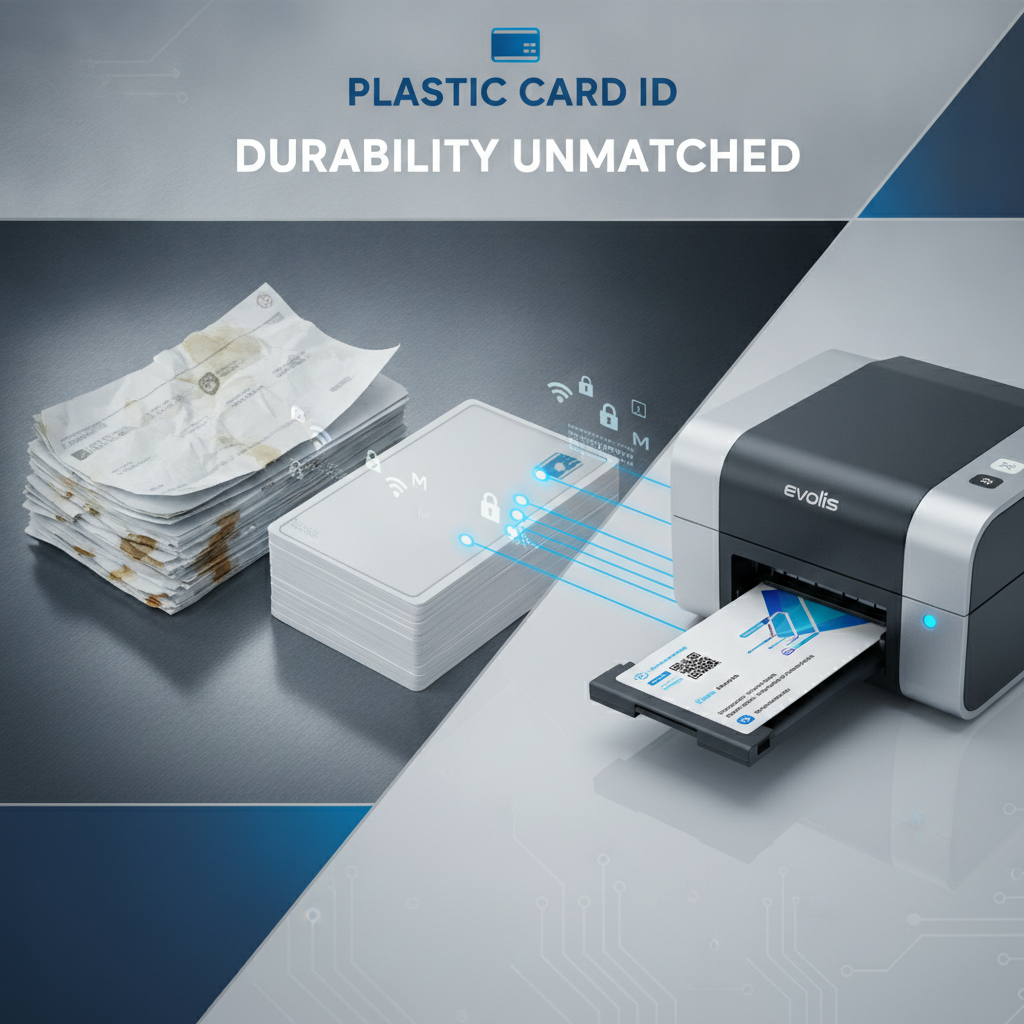 Owning blank plastic cards means nothing without the ability to print on them effectively. That's why Plastic Card ID supplies a full lineup of professional card printers from industry leaders Evolis, Zebra, and Fargo - three brands that represent the gold standard in desktop and industrial card printing. Whether your operation prints 10 cards a week or 10,000 cards a month, there's a printer engineered for your volume.
In-house printing transforms your card program from a reactive, vendor-dependent process into a responsive, self-sufficient capability. The ability to print cards on demand is operationally powerful in ways that businesses often don't fully appreciate until they experience it. No more rush orders. No more minimum quantities. No more waiting two weeks for replacement cards when an employee is hired or a member needs a replacement.
Choosing the Right Printer for Your Volume
Entry-level card printers handle single-sided printing for low-volume programs - perfect for small businesses, nonprofits, and organizations printing fewer than 500 cards per month. Mid-range dual-sided printers add full-color back printing, lamination options, and faster throughput. High-volume industrial printers run continuous card production with hopper capacities that minimize operator intervention.
The right printer choice depends on print volume, encoding requirements, and desired card finish. Glossy lamination adds a premium look and extends card life further. Retransfer printing delivers edge-to-edge color coverage on cards with embedded technology. CPE can help match the right printer to your specific program requirements.
Ribbons, Supplies, and Ongoing Program Support
A card printer is only as reliable as its consumables. Plastic Card ID stocks printer ribbons compatible with Evolis, Zebra, and Fargo printers, along with cleaning kits that maintain print quality and extend printer lifespan. A neglected printer is a card program waiting to fail - regular cleaning cycles prevent debris buildup that causes streaking, color shifts, and mechanical jams.
Card carriers, protective sleeves, and badge holders round out the supply chain. These accessories protect finished cards during distribution and in daily use, preserving that crisp, professional appearance that makes plastic cards worth having in the first place. Contact 800.835.7919 for a complete supply consultation tailored to your printer model and card volume.
Card Affixing and Mailing Services
For organizations distributing cards at scale, the logistics of getting finished cards into customers' or members' hands can be a genuine operational challenge. CPE offers card affixing and mailing services that handle this final step professionally - cards affixed to welcome letters, membership packets, or promotional mailers and sent directly to recipients.
This service is particularly valuable for insurance companies, associations, loyalty program operators, and any organization managing a distributed membership base. A seamlessly delivered card reinforces the professionalism that the plastic card itself communicates - the experience starts before the card is even used for the first time.
Specialty Cards: When Standard Plastic Isn't Enough
The blank CR80 PVC card is the workhorse of most programs, but there are applications where something more distinctive is exactly what the situation calls for. Plastic Card ID supplies a range of specialty card options that extend well beyond standard white PVC stock, serving clients who need a card that commands attention or functions differently than a standard card.
Specialty cards serve a dual purpose: they function as operational tools and as brand statements simultaneously. A luxury metal card handed to a VIP client doesn't just grant access - it communicates that the organization behind it values quality and takes its brand seriously. That signal is received, processed, and remembered. The card becomes part of the brand experience itself.
Clear, Frosted, and Colored Stock Options
Clear plastic cards offer a modern, minimalist aesthetic that many brands find compelling - especially when printing designs that intentionally incorporate the card's transparency as a visual element. Frosted cards provide a softer look with a slightly diffused surface that can add texture and visual interest to printed designs. Colored card stock eliminates the need to print background fills, reducing ribbon use and accelerating print times.
These options give in-house card designers meaningful creative flexibility without requiring exotic materials or specialized equipment. Most standard card printers handle clear, frosted, and colored stock without modification, making these specialty options accessible to programs of any size.
Metal Cards, Casino Cards, and Hotel Key Cards
At the premium end of the spectrum, CPE supplies luxury metal cards in stainless steel, brass, and gold finishes - products reserved for VIP programs, executive memberships, and high-end hospitality applications where the weight and feel of the card are part of the value proposition. These cards are not just functional; they are collectible artifacts that clients are genuinely proud to carry.
Casino player cards and hotel key cards represent specialized applications with their own technical requirements. Casino cards must survive constant handling in high-volume environments while maintaining reliable encoding. Hotel key cards require RFID or magnetic stripe encoding compatible with specific lock system standards. Plastic Card ID has supplied both categories for decades and understands the unique demands of each.
Custom Die-Cut Shapes and RFID Smart Cards
Standard CR80 dimensions work for the vast majority of programs, but custom die-cut shapes open up creative possibilities for marketing cards, promotional pieces, and specialty credential applications. A card shaped like a key, a tool, or a brand logo becomes a conversation piece and a memorable brand touchpoint that a standard rectangle simply cannot be.
RFID smart cards, including those using MIFARE DESFire encrypted technology, serve high-security access control environments where data integrity and authentication matter. These cards are used in university campuses, corporate headquarters, healthcare facilities, and government installations - anywhere that access control demands more than a simple magnetic stripe can provide.
Frequently Asked Questions: Blank Plastic Cards vs Paper Cards
Buyers new to in-house card programs often arrive with similar questions. Understanding the practical reality of plastic vs. paper - the actual cost math, the technical requirements, the realistic outcomes - helps organizations make confident decisions about their card programs. Here are the questions CPE hears most often.
Common Buyer Questions Answered
- How long do blank PVC cards actually last? Under normal use conditions, a 30 mil CR80 PVC card lasts several years without significant degradation. Cards used in demanding environments - badge clips, high-frequency swipe readers, outdoor applications - may show wear sooner, but still significantly outlast any paper alternative.
- What's the minimum order quantity for blank cards? Plastic Card ID serves programs from 50 cards a month upward, making plastic accessible to small businesses and nonprofits that previously assumed plastic was only for large organizations.
- Do I need a special printer to print on blank PVC cards? Yes - a dedicated card printer is required. Standard office inkjet or laser printers are not designed for CR80 card stock. However, entry-level card printers are more affordable than many buyers expect, and the investment pays back quickly in program control and per-card cost savings.
- Can blank cards be pre-encoded with magnetic stripes or RFID before I print on them? Absolutely. Many blank card orders include pre-encoded magnetic stripes or embedded RFID chips, ready for surface printing via your card printer once received.
- Is there a meaningful quality difference between card printer brands? Evolis, Zebra, and Fargo each excel in specific segments. Evolis is known for elegant desktop designs with excellent color output. Zebra dominates high-volume and ruggedized applications. Fargo offers strong mid-market options with excellent lamination capabilities. The right choice depends on volume and use case.
Understanding HiCo vs LoCo Magnetic Stripes
Magnetic stripe cards come in two primary varieties: high coercivity (HiCo) and low coercivity (LoCo). HiCo stripes are more resistant to accidental erasure from proximity to magnets - making them the preferred choice for access control, loyalty programs, and any application where cards are carried near other magnetic items. LoCo stripes cost slightly less and work well for short-term applications like hotel key cards that are replaced frequently.
Choosing the wrong stripe type for your application leads to frustrating card failures and reader errors. Matching your stripe specification to your reader hardware is a critical technical detail that impacts daily operations. The team at CPE can guide this decision as part of a complete program consultation.
Paper Card Programs vs Plastic: The Loyalty Program Case Study
A regional restaurant chain operating a paper punch card loyalty program switched to plastic loyalty cards printed in-house. Within 90 days, redemption rates increased, customer-reported satisfaction with the program improved, and replacement card requests dropped dramatically. The cards stayed in wallets. Customers carried them everywhere. The program's visibility increased simply because the cards were more likely to be seen and used.
This pattern repeats across industries. Retailers report gift card sales increases of 35-50% after switching from paper certificates to plastic. Gyms and fitness studios see member engagement improve when ID cards are replaced with durable plastic cards that also serve as access credentials. Plastic cards don't just replace paper - they upgrade the entire program they represent.
Your Next Card Program Starts Here - Plastic Card ID
The blank plastic card vs paper card comparison resolves quickly once the full picture is understood. Durability, professionalism, encoding capability, wallet retention, long-term cost, and program reliability all favor plastic - decisively and consistently, across every industry and every use case Plastic Card ID has served over the past 25-plus years and across more than 50 million cards delivered to over 100,000 customers nationwide.
Whether your program needs 50 blank CR80 cards per month or a continuous supply of tens of thousands of encoded cards for a national loyalty rollout, CPE has the product depth, technical expertise, and genuine partnership mentality to help you build and run a card program that works. From blank stock to card printers, ribbons, cleaning kits, and mailing services, everything your program needs lives under one roof.
Don't let a paper card represent your brand for another day. Contact Plastic Card ID now at 800.835.7919 and speak with a card program specialist who understands your industry and your goals.
Previous Page