Difference Between Blank Cards and Pre-Printed Cards Explained
Table of Contents []
- Blank Cards vs. Pre-Printed Cards: What Plastic Card ID Wants You to Know Before You Order
- Understanding What Blank Plastic Cards Actually Are
- What Pre-Printed Cards Are and When They Make Sense
- The Core Differences: A Side-by-Side Reality Check
- Specialized Card Types: Blank and Pre-Printed Versions Both Exist
- Buyer Tips: Choosing the Right Format for Your Program
- Ready to Build a Smarter Card Program? Contact Plastic Card ID Today
Blank Cards vs. Pre-Printed Cards: What Plastic Card ID Wants You to Know Before You Order
Here is a question that lands in our inbox more often than you might expect: should I order blank cards or pre-printed cards? It sounds simple. It is not. The answer depends on your print volume, your timeline, your in-house equipment, your brand flexibility, and frankly, how much control you want over your card program day to day. Getting this decision right can save you money, speed up your workflow, and give your program a serious competitive edge.
The difference between blank cards and pre-printed cards is not just cosmetic. It touches every part of how you manage identity, loyalty, access, and membership programs. Whether you are running 50 hotel key cards a month or cranking out 20,000 retail gift cards before the holiday season, understanding this distinction is the foundation of a smart purchasing decision. CPE has helped over 100,000 customers navigate exactly this choice across 25 years - and the nuance matters more than most buyers initially realize.
| Feature | Blank Cards | Pre-Printed Cards |
|---|---|---|
| Design Flexibility | Total control, print on demand | Fixed design, ordered in bulk |
| Per-Card Cost | Lower over time with printer | Lower upfront at high volume |
| Turnaround Speed | Instant, in-house printing | Lead time required |
| Personalization | Variable data per card | Uniform design, limited variable |
| Minimum Order | As low as 50-100 cards | Typically 500 for cost efficiency |
| Best For | ID badges, access cards, memberships | Gift cards, loyalty cards, mass retail |
Understanding What Blank Plastic Cards Actually Are
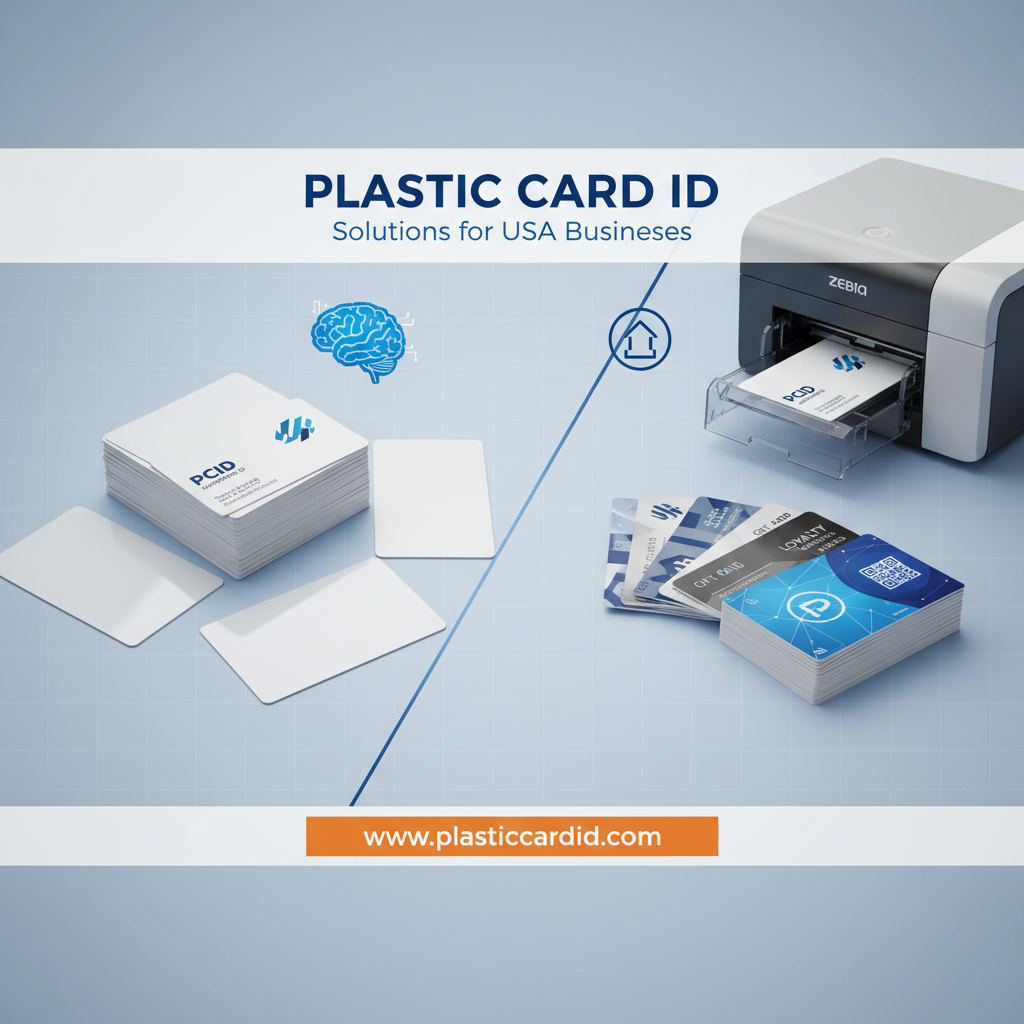 A blank plastic card is exactly what it sounds like: a CR80-format PVC card, 30 mil thick, cut to the ISO 7810 standard, arriving in your hands with no printing on it at all. Or almost none. Some blank cards come with a pre-applied magnetic stripe, a smart chip, or an embedded RFID antenna - but the visual surface is completely unmarked, ready for your printer, your design, your data.
Blank cards are the workhorse of in-house card programs. They give organizations total design freedom and dramatically lower per-card costs over time once a card printer is in the picture. They are the card equivalent of raw material - and for many businesses, that raw material is exactly what drives efficiency, speed, and scalability.
The CR80 Standard and Why It Matters
Every blank card worth ordering conforms to the CR80 standard: 3.375 inches by 2.125 inches, 30 mil thick. That is the same size as a credit card. This matters because it means your cards will slide into any standard card printer, any wallet slot, any card holder, and any badge reel without modification or adaptation.
When CPE sources blank cards, conformance to ISO 7810 is non-negotiable. A card that warps, jams a printer, or fails a swipe because of non-standard dimensions is not a card - it is an expensive problem. Precision manufacturing at the CR80 spec is the baseline expectation, not a premium feature.
Types of Blank Cards Available
Not all blank cards are the same substrate. The catalog includes plain white PVC, clear cards, frosted translucent cards, colored stock in dozens of shades, cards with HiCo or LoCo magnetic stripes, proximity cards, RFID smart cards (including MIFARE DESFire), and even specialty options like custom die-cut shapes and luxury metal cards.
The type of blank card you need is driven by function first, aesthetics second. An access control card may need a specific RFID frequency. A loyalty card may need a LoCo magnetic stripe for basic swipe compatibility. A staff ID might require only a plain printable surface. Matching the card substrate to the application is where buying decisions actually live.
Blank Cards and the In-House Printing Advantage
The reason organizations choose blank cards over pre-printed cards is frequently about speed and control. Need to issue a new employee badge at 8 a.m. on a Monday? A blank card and a desktop card printer from Evolis, Zebra, or Fargo can make that happen in under two minutes. Need to personalize 200 membership cards with names and member numbers? Variable data printing on blank stock handles that without a print run, a vendor call, or a lead time.
Over time, the economics are compelling. Once a card printer is in place, blank PVC cards are extremely cost-efficient per unit. The printer ribbon handles all the visual output. Organizations that print 100 or more cards per month routinely find that in-house printing pays for the printer investment within the first year.
What Pre-Printed Cards Are and When They Make Sense
Pre-printed cards arrive from the manufacturer with your branding, colors, and design already applied - typically through offset printing or digital print processes at scale. These are the fully designed retail gift cards you see racked in stores, the membership cards that go out in welcome kits, the event passes that get mailed in bulk. The visual work is done before the card ever reaches you.
Pre-printed cards shine when you need large quantities of a consistent design and personalization requirements are minimal or handled separately. A retail chain ordering 10,000 gift cards with identical branding - where the only variable is the card number encoded on the magnetic stripe - is a perfect pre-printed card scenario. High-volume, consistent design, centralized production.
The Economics of Pre-Printed at Scale
Per-card costs on pre-printed cards drop significantly as order volumes rise. The setup cost for a print run - color separations, press calibration, quality checks - is amortized over the full order. At 500 cards, you pay a relatively high per-unit cost. At 10,000 cards, that cost can fall to a fraction of the original.
This scaling effect makes pre-printed cards the preferred choice for retail gift card programs, season pass distributions, franchise membership rollouts, and large event credentials. When design is fixed and volume is high, pre-printed wins on cost every time. The trade-off is lead time and the inability to modify the design without placing a new order.
Pre-Printed Cards for Gift and Loyalty Programs
Retailers who have made the switch from paper-based gift certificates to plastic pre-printed gift cards have seen sales increases in the range of 35-50%. That is not a coincidence. Plastic cards live in wallets. They get seen every time a customer reaches for something else. They signal permanence and value in a way that paper simply cannot replicate.
Loyalty programs benefit from the same dynamic. A pre-printed loyalty card with your logo, your color palette, and your brand personality is a marketing asset that travels everywhere your customer goes. Pre-printed plastic loyalty cards outperform paper punch cards in redemption rates and customer retention - and the math on program ROI reflects that consistently.
Lead Times and Minimum Orders for Pre-Printed Cards
One of the most important practical considerations with pre-printed cards is planning ahead. A typical pre-printed card order requires a production window - time for art approval, proofing, press setup, printing, and quality control. Rush orders are possible but carry premium costs. If your program launch date is fixed, factor in lead time as a non-negotiable constraint.
Minimum order quantities for pre-printed cards vary, but cost efficiency usually starts to appear at 500 cards and becomes compelling at 1,000 and above. Orders below that threshold often make more financial sense as a blank-card-plus-printer arrangement, especially if design changes are anticipated in the near term.
The Core Differences: A Side-by-Side Reality Check
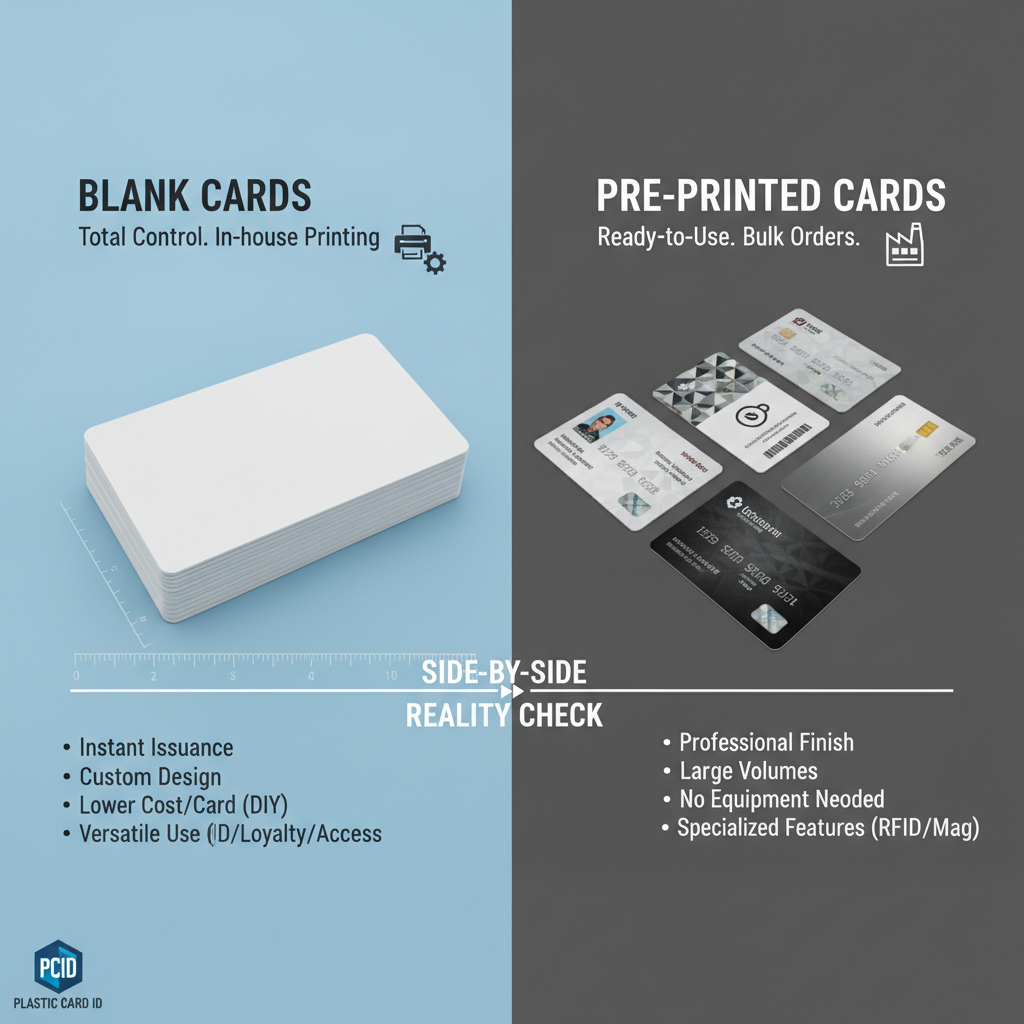 When buyers ask about the difference between blank cards and pre-printed cards, they are usually asking the wrong question first. The right question is: what does my card program actually need to accomplish? The format decision flows naturally from the functional requirements - not the other way around.
Blank cards are tools for dynamic, on-demand card issuance. Pre-printed cards are tools for consistent, high-volume brand distribution. Both are valid. Both are powerful. The mistake is choosing one format based on what sounds simpler rather than what fits the program architecture.
Personalization: Where Blank Cards Have No Equal
If every card in your program needs a unique name, a unique number, a unique photo, or unique encoded data - blank cards are the only practical answer. Pre-printed cards can have variable data added via encoding or secondary printing, but the core design is static. For employee ID programs, student cards, member credentials, and access control systems, the ability to personalize each card individually is the entire point.
Variable data printing on blank stock - made possible by desktop card printers - means you can print a single card or a batch of 500 with equal ease. Each card can carry a different name, a different photo, a different barcode, a different magnetic stripe encoding. That flexibility is simply not available in a pre-printed card workflow without significant additional infrastructure.
Branding Depth: Where Pre-Printed Cards Excel
The visual quality achievable through commercial offset printing on pre-printed cards is genuinely hard to match with a desktop card printer. Full-bleed photographic imagery, Pantone color matching, metallic inks, UV spot coatings, embossing - these production techniques produce a card that looks and feels premium in a way that in-house desktop printing cannot fully replicate.
For brand-sensitive applications where the card itself is a marketing touchpoint - retail gift cards, premium membership cards, VIP event credentials - the production quality of pre-printed cards justifies the lead time and minimum order requirements. When your card is your brand ambassador, production quality is not a luxury; it is a business requirement.
Cost Comparison: The Full Picture
- Blank cards have a low per-card cost but require a printer investment ($300-$2,500 depending on model) and ongoing ribbon and supply costs.
- Pre-printed cards have higher upfront setup costs but competitive per-card pricing at volume, with no equipment investment required on your end.
- Organizations printing fewer than 100 cards per month may find pre-printed cards more economical unless design flexibility is critical.
- Organizations printing 200 or more cards per month typically reach printer ROI within 12-18 months and see lower total program costs over time with blank cards.
- Hybrid programs - using pre-printed card stock with in-house variable data printing - can capture the benefits of both approaches simultaneously.
The honest answer is that neither format is universally cheaper. The economics depend on volume, design change frequency, equipment amortization, and program duration. CPE can help you model the actual cost comparison for your specific program parameters.
Specialized Card Types: Blank and Pre-Printed Versions Both Exist
One nuance that surprises many buyers is that the blank-versus-pre-printed distinction applies across virtually every card type in the catalog - not just plain white PVC. Magnetic stripe cards come in both formats. RFID cards come in both formats. Smart chip cards come in both formats. The underlying technology is independent of whether the card surface is printed or blank.
This matters practically. A hotel running a key card program might use blank RFID cards that get encoded on-site and carry minimal visual branding - or they might use pre-printed key cards with the property's full visual identity already applied. A casino might use pre-printed player cards with elaborate graphics and a loyalty tier indicator, or they might use a blank stock that gets printed on-demand at the player desk. Both approaches work. Which one works better depends on operational structure.
Magnetic Stripe Cards: HiCo vs. LoCo in Both Formats
HiCo (high coercivity) magnetic stripes are more resistant to demagnetization - they are what you want for cards that will be used frequently and stored near other cards or devices. LoCo (low coercivity) stripes are adequate for shorter-lifecycle cards like event passes or single-use access credentials. Both HiCo and LoCo cards are available in blank or pre-printed format.
For gift card programs, HiCo is the standard - the card needs to survive wallet friction and repeated swipes over months or years. For event credentials used once over a weekend, LoCo may be entirely sufficient and cost less per card. Matching stripe type to use-case is a detail that directly affects card program reliability.
RFID and Smart Cards: The Contactless Layer
RFID proximity cards and smart cards - including those using MIFARE DESFire and other contactless protocols - are available in blank form for encoding and in-house printing, or as pre-printed finished cards. The embedded chip or antenna does not care whether the surface is printed or not; functionality is determined entirely by the encoding.
Access control systems, hotel key programs, campus ID systems, and transit applications all use contactless card technology. For CPE, the ability to supply both blank and pre-printed versions of these cards means clients can structure their program operations to match their actual workflow - centralized production, distributed issuance, or something in between. Call 800.835.7919 to discuss which configuration fits your access control or smart card program best.
Buyer Tips: Choosing the Right Format for Your Program
After 25 years and over 50 million cards shipped, certain patterns emerge clearly. The buyers who get the most value from their card programs - whether they are running a small gym membership operation or a multi-location retail gift card rollout - share a common trait: they match their card format to their operational reality before they place an order.
Here is a practical framework for thinking through the decision. It is not a rigid formula - it is a starting point for a conversation about what your program actually needs.
Questions to Ask Before You Order
- How many cards do you issue per month, and is that number likely to grow significantly in the next 12 months?
- Does every card need to be personalized with unique data - names, photos, numbers, or encoded information?
- How often do you expect your card design to change - annually, seasonally, or unpredictably?
- Do you have or plan to invest in a card printer, or do you need cards to arrive ready to use?
- Is the visual quality of the card itself a significant brand statement, or is functionality the primary concern?
- What is your lead time tolerance - can you plan card orders weeks in advance, or do you need on-demand issuance capability?
Your answers to these questions map directly to the blank-versus-pre-printed decision. High personalization, unpredictable volume, and design flexibility needs point toward blank cards with in-house printing. High volume, fixed design, and brand quality emphasis point toward pre-printed. Many programs need both - and that hybrid approach is more common than most buyers initially expect.
The Hybrid Program Approach
A hybrid card program uses pre-printed card stock - cards that arrive with the base branding already applied through commercial printing - and then runs those cards through an in-house printer to add variable data. This gives you the visual quality of professional print production combined with the personalization flexibility of in-house printing.
This approach is common in healthcare ID programs, university student card systems, and corporate employee badge programs where branding consistency is mandatory but individualization is also required. The hybrid approach is often the most sophisticated answer to the blank-versus-pre-printed question - and it is an approach that CPE can help you structure from card selection through printer selection and ribbon supply.
Working With a Strategic Partner, Not Just a Vendor
There is a meaningful difference between buying cards from a commodity supplier and building a card program with a strategic partner. A commodity supplier ships you what you order. A strategic partner helps you figure out what you should be ordering in the first place - and then makes sure the supply chain is reliable enough that your program never stalls.
With over 100,000 customers served and more than 50 million cards shipped, the depth of program knowledge at CPE is not theoretical. It is the accumulated understanding of what works, what fails, and what the difference looks like in practice across thousands of real card programs. That perspective is available to you when you call, and it is genuinely worth the conversation.
Ready to Build a Smarter Card Program? Contact Plastic Card ID Today
Whether you are starting a brand-new card program or rethinking one that has outgrown its current format, the blank-versus-pre-printed decision is one of the most impactful choices you will make. Get it right from the start, and your program runs smoothly for years. Get it wrong, and you are constantly fighting supply constraints, cost overruns, or design rigidity.
Plastic Card ID is ready to help you get it right. From blank CR80 cards and specialty RFID stock to pre-printed gift and loyalty programs, the full catalog - backed by 25 years of real-world program expertise - is available to USA-based businesses and organizations of every size. Call 800.835.7919 today and speak with a specialist who understands your industry, your volume, and your goals.
Your card program deserves more than a commodity transaction. It deserves a partner. It deserves Plastic Card ID.
Previous Page