Blank White PVC Cards vs Printed Cards: Key Differences
Table of Contents []
- Blank White PVC Cards vs Printed Cards: Which Choice Actually Fits Your Program?
- The Real Cost Calculation: Beyond the Price Per Card
- Use Cases Where Blank White PVC Cards Outperform Pre-Printed Stock
- Specialty Card Types: When Standard Blank PVC Is Not the Answer
- Frequently Asked Questions: Blank PVC Cards vs Printed Cards
- Building a Smarter Card Program: Buyer Tips From 25 Years in the Field
- Partner With Plastic Card ID for Every Card Program Need Across the USA
Blank White PVC Cards vs Printed Cards: Which Choice Actually Fits Your Program?
Walk into any card program decision and you will find the same crossroads: do you stock blank white PVC cards and print in-house, or do you order pre-printed cards from a supplier? It sounds deceptively simple. In practice, the answer shapes your budget, your timeline, your brand consistency, and how quickly you can respond when your program grows - or pivots. Plastic Card ID has helped over 100,000 customers navigate exactly this decision, and the patterns are revealing.
Neither option is universally superior. What matters is the operational context you are working within. A hotel managing 300 key card activations per week has radically different needs than a boutique gym launching its first membership card. Understanding the structural differences between blank PVC stock and custom-printed cards puts you in control - not guessing at the counter of a supplier who just wants to move inventory.
What Blank White PVC Cards Actually Are
Blank white PVC cards are manufactured to the CR80 standard - 3.375 inches by 2.125 inches, 30 mil thick - which is the same physical specification as a standard credit card. That is not coincidental. The ISO 7810 standard exists precisely so cards are universally compatible with printers, card holders, wallets, and readers. A blank card is a clean canvas, and what gets printed or encoded onto it determines its entire identity and function.
These cards are produced from PVC plastic, which gives them exceptional durability compared to paper alternatives. They resist bending, moisture, and the daily friction of wallet life in a way that laminated paper simply cannot replicate. Durability is not a minor feature - it is the business case. When a loyalty card survives two years in a customer's wallet, your brand stays visible for two years without an additional marketing dollar spent.
What Custom Pre-Printed Cards Deliver
Pre-printed cards arrive fully branded - your logo, color scheme, text layout, and any visual design elements already on the card. The print quality from a professional card manufacturer can be exceptional: edge-to-edge color, photographic gradients, and precise pantone matching that a desktop card printer may struggle to replicate at small scale. For high-volume programs ordering tens of thousands of cards at once, the per-card cost on pre-printed stock can become very competitive.
The trade-off is lead time and flexibility. Pre-printed cards typically require setup, proofing, and production time - measured in days to weeks rather than minutes. If you need to update the design, add a new cardholder name, or encode a different chip configuration, you are placing a new order. Every design change restarts the clock. For dynamic programs where individual personalization matters, this creates friction that blank card programs handle effortlessly.
The Technology Layer: Encoding Options for Both Card Types
Both blank and pre-printed cards can carry functional technology. Magnetic stripes - available in High Coercivity (HiCo) and Low Coercivity (LoCo) formats - can be factory-applied to either card type. RFID and proximity chips, including sophisticated options like MIFARE DESFire, are embedded during manufacturing regardless of whether the card surface is blank or printed. The technology beneath the surface does not dictate what happens on top of it.
What matters is matching the technology to the use case. HiCo magnetic stripes are far more resistant to demagnetization and are the right choice for access control, loyalty programs, and any card that will be near other magnetic sources. LoCo stripes work well in controlled environments like hotel key systems. Choosing the wrong coercivity level is an expensive mistake - one that CPE helps customers avoid before a single card is ordered.
| Feature | Blank White PVC Cards | Pre-Printed Custom Cards |
|---|---|---|
| Print Control | Full in-house control | Fixed at order time |
| Personalization | On-demand, per card | Requires new order run |
| Minimum Order | As low as 50 cards | Varies; often higher |
| Lead Time | Fast; stock available | Production and proofing required |
| Per-Card Cost at Scale | Very low | Competitive at high volume |
| Technology Options | Mag stripe, RFID, chip | Mag stripe, RFID, chip |
| Design Flexibility | Update anytime | Fixed per print run |
The Real Cost Calculation: Beyond the Price Per Card
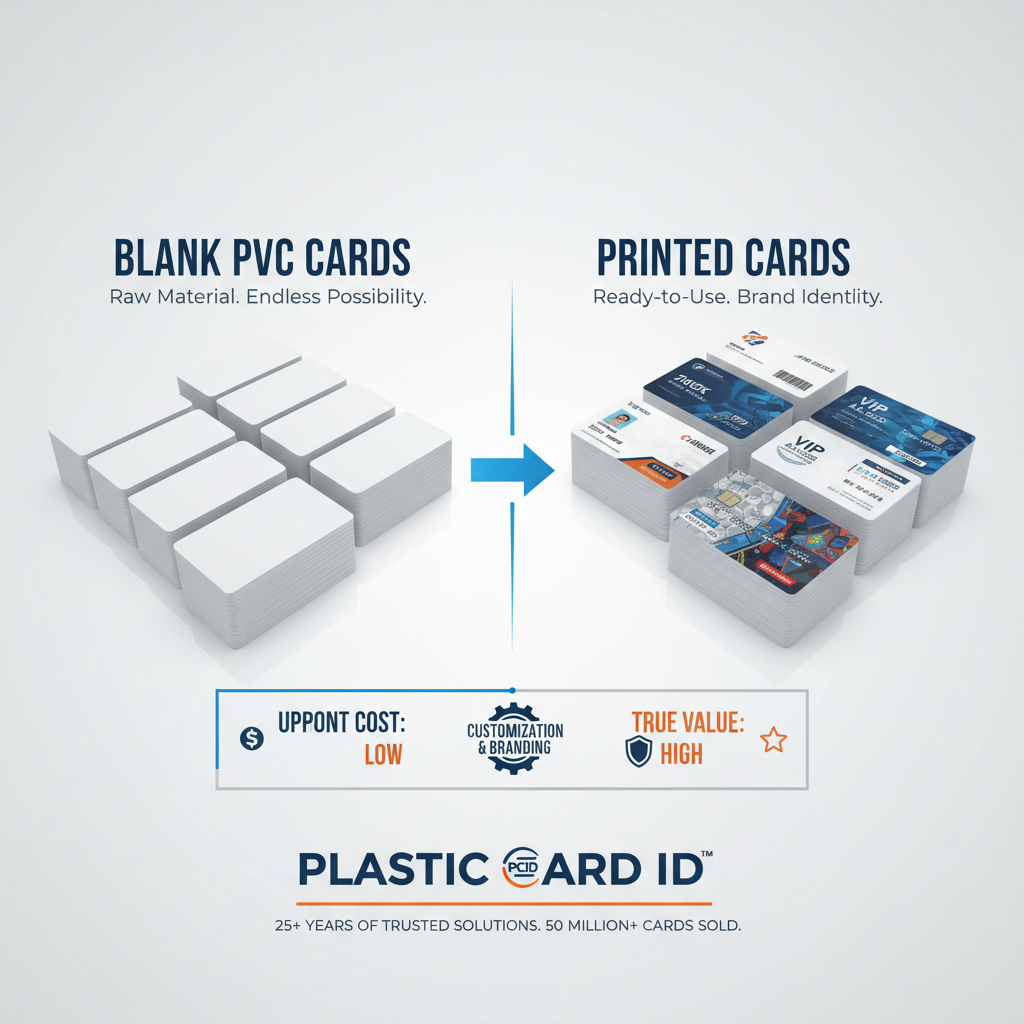 Price per card is the number most buyers look at first, and it is also the number most likely to mislead them. A pre-printed card at a lower per-unit cost looks attractive until you factor in the minimum order quantity, the setup fees, the storage cost of surplus inventory, and the write-off cost when you update your branding or program structure mid-run. The total cost of card ownership is the metric that actually matters.
Blank white PVC cards carry a straightforward per-card cost with no setup fees - and that price drops significantly as volume increases. When paired with an in-house card printer, the program produces exactly as many cards as needed, when needed. Waste disappears. Surplus inventory disappears. The ability to print one card or five hundred in a single afternoon is not just convenient; it is a genuinely different operational model.
Printer Investment vs Outsourced Print Costs
The central financial question for blank card programs is the printer. Card printers from leading manufacturers like Evolis, Zebra, and Fargo range across a broad spectrum depending on print speed, encoding capabilities, lamination options, and throughput volume. Entry-level single-sided printers appropriate for small to mid-size programs are available at accessible price points, while high-throughput dual-sided printers with lamination and encoding start in a higher range. The investment pays back through eliminated setup fees, reduced per-card costs, and complete design control.
Consider a mid-size gym issuing 150 new membership cards per month. Outsourcing those cards adds per-card cost, lead time, and minimum order constraints. In-house printing on blank PVC stock eliminates all three friction points. Within 12-18 months, the printer investment typically pays for itself - and after that crossover point, every in-house card printed represents direct savings compared to outsourcing.
Ribbon and Supply Economics
Card printer ribbons are a recurring cost in any blank card program, and it is worth understanding what you are buying. YMCKO ribbons - covering yellow, magenta, cyan, black, and overlay panels - are the standard for full-color card printing. Monochrome ribbons for single-color printing (ID badges, for instance) are significantly more economical on a per-card basis. The right ribbon choice for your program can cut consumable costs substantially.
CPE supplies a full range of printer ribbons, cleaning kits, and maintenance supplies alongside card stock. Keeping your printer in optimal condition protects your print quality and extends equipment life - both factors that directly affect the cost-per-card calculation over time. Cleaning kits are not optional maintenance; they are part of the economics of running a clean, consistent card program.
Volume Breaks and Stocking Strategy
Blank PVC card pricing rewards volume purchasing in a way that is easy to plan around. Programs that know their monthly card consumption can buy in quantities that capture meaningful price breaks - stocking two or three months of inventory at a time without the risk of design obsolescence that comes with pre-printed stock. The cards do not expire, they do not go stale, and the design on them changes only when you choose to change it through your printer.
For organizations running programs at scale - issuing tens of thousands of cards per year across multiple locations - central inventory of blank stock with distributed printers at each location creates an extremely flexible and cost-efficient model. Each location prints what it needs, when it needs it, without waiting on centralized fulfillment or managing site-specific pre-printed inventories.
Use Cases Where Blank White PVC Cards Outperform Pre-Printed Stock
There are program types where the blank card model is not just competitive - it is clearly the superior operational choice. Understanding these use cases helps organizations make confident decisions rather than defaulting to whatever approach they used last time. The programs that get the most value from blank PVC stock share a common trait: they require speed, flexibility, or personalization that outsourced printing cannot deliver efficiently.
Employee ID and Access Credential Programs
Employee ID programs are perhaps the purest argument for blank PVC cards and in-house printing. New hires need cards on day one - not in ten business days when the outsourced print run arrives. Terminations need cards deactivated and replaced. Access levels change. Photo IDs require individual personalization that makes batch pre-printing essentially impossible in any practical sense.
Blank PVC cards with magnetic HiCo stripes or RFID chips allow HR and facilities teams to issue, update, and replace cards on demand. The printer sits at reception or HR, the card stock is in a drawer, and a new employee credential takes minutes rather than days. That operational speed has real security value - gaps in access control during onboarding and offboarding are a genuine organizational risk that blank card programs eliminate.
Loyalty and Membership Programs for Retail and Hospitality
Retailers switching from paper punch cards to plastic loyalty cards consistently see dramatic improvements in program performance. The data from programs supported by CPE reflects the broader industry pattern: plastic loyalty cards increase enrollment rates, improve retention, and drive measurably higher repeat purchase frequency. The card lives in the wallet. Paper does not.
For membership programs - gyms, clubs, associations, libraries - plastic cards signal something paper simply cannot: permanence and legitimacy. A plastic membership card communicates that the organization takes the relationship seriously. That perception shift has real impact on member retention and perceived value. Members who receive a professional plastic card are less likely to let memberships lapse than those holding a paper card or relying on a phone app alone.
- Gyms and fitness studios - Issue photo ID membership cards on enrollment day with in-house printing
- Restaurants and cafes - Run loyalty programs with scannable or swipe-tracked plastic cards
- Retail stores - Replace paper punch cards with durable plastic that survives years of wallet use
- Hotels and resorts - Issue loyalty tier cards and key cards from the same blank card inventory
- Associations and clubs - Produce annual membership cards with updated dates printed on demand
Event Credentials and Conference Badges
Events create a specific card need that pre-printed stock handles poorly: the attendee list is often incomplete until days or hours before the event, VIP lists change, speakers are added, and last-minute registrations are the rule rather than the exception. Pre-printed credential orders placed weeks in advance are out of date before the event opens. Blank PVC stock and an on-site printer solve this completely.
Event credentials on CR80 PVC cards also outlast paper badges by an enormous margin - which matters for multi-day conferences, trade shows, and festivals where credentials need to survive repeated handling, lanyards, badge holders, and the general chaos of event environments. A card that fails on day one of a three-day conference creates friction for every attendee it affects.
Specialty Card Types: When Standard Blank PVC Is Not the Answer
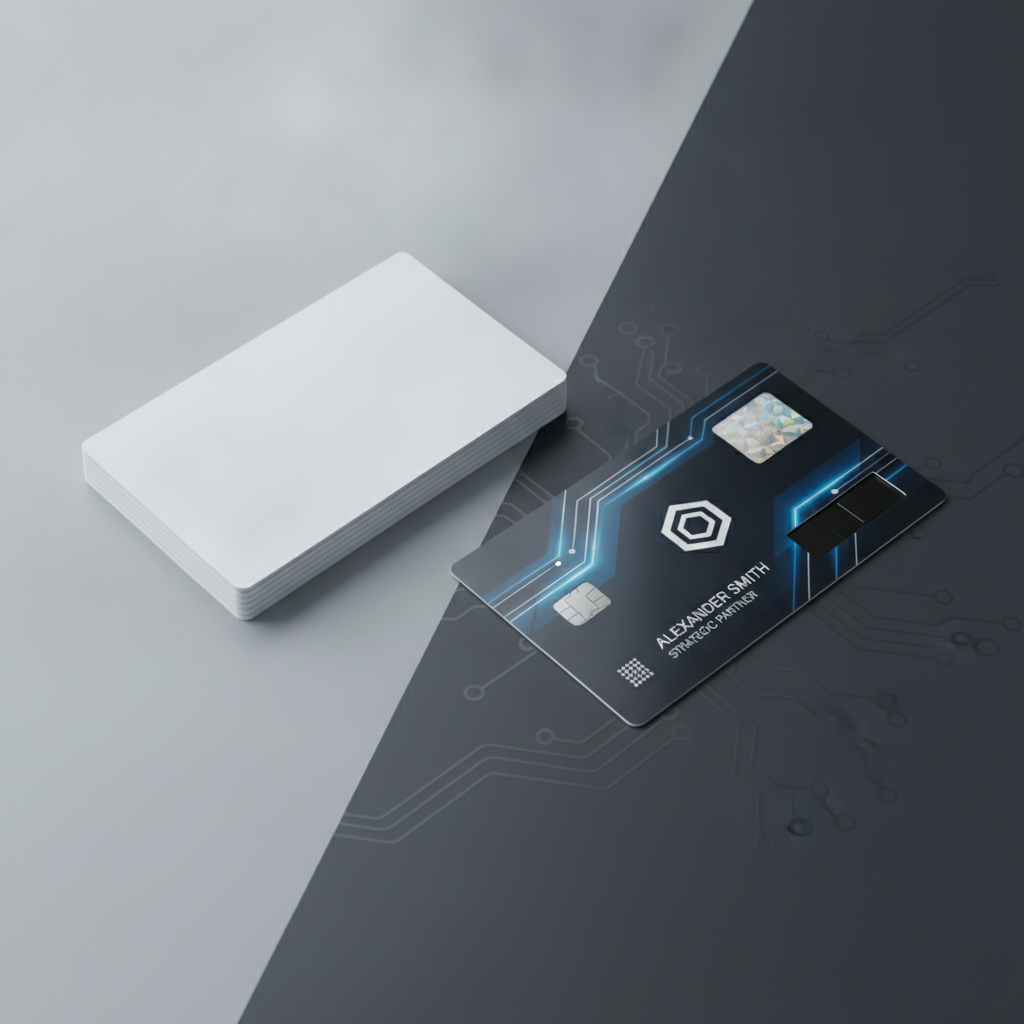 Not every program is best served by standard white PVC cards. Plastic Card ID carries a catalog that goes well beyond the baseline, and understanding where specialty card types add genuine value prevents programs from either over-engineering simple applications or under-specifying applications that need more.
Clear and Frosted PVC Cards
Clear plastic cards and frosted translucent cards are visually distinctive in a way that standard white stock cannot replicate. When printed, designs on clear cards appear to float - background elements show through the card body itself, creating a premium aesthetic that commands attention. Frosted cards offer a softer, diffused version of the same effect. Both are CR80-standard and compatible with the same printers and card readers as standard white stock.
For loyalty programs at premium brands, membership cards for exclusive clubs, or VIP credentials at events, clear and frosted cards communicate quality without requiring a completely different card infrastructure. The visual differentiation alone can justify the modest price premium for programs where perceived value is part of the product.
RFID, Smart Chip, and Proximity Cards
Contactless card technology has moved from specialty to mainstream across access control, transit, hospitality, and increasingly loyalty applications. RFID cards and proximity cards communicate wirelessly with readers - no swipe, no insert, just tap and go. For high-throughput environments like building access points or hotel room locks, contactless technology is faster and reduces wear on both the card and the reader.
Advanced options like MIFARE DESFire chips offer encrypted, secure communication suitable for high-security access control applications, casino player tracking systems, and transit programs. Hotel key cards are a familiar example of the proximity card category in daily use. Matching the chip technology to the reader infrastructure is critical - and it is exactly the kind of specification question where CPE adds value as a knowledgeable partner rather than a transactional supplier.
Metal Cards and Premium Specialty Options
For programs where the card itself is part of the brand statement - executive membership programs, premium loyalty tiers, high-end hospitality - metal cards in stainless steel, brass, and gold represent the top of the card quality spectrum. Metal cards carry significant tactile impact: the weight alone communicates something that no plastic card can replicate. They are not appropriate for every program, but for the programs that benefit from them, they are transformative.
Custom die-cut shapes expand the design vocabulary beyond the standard CR80 rectangle. Cards cut to brand-specific shapes stand out in any wallet or card holder - and since the ISO 7810 footprint is a convention rather than a physical requirement for all applications, there is real creative latitude available. Specialty card formats are not gimmicks - they are strategic tools when deployed in the right program context.
| Card Type | Best Application | Technology Options |
|---|---|---|
| Blank White PVC | ID, loyalty, membership, events | Mag stripe, RFID, plain |
| Clear / Frosted PVC | Premium loyalty, VIP credentials | Mag stripe, plain |
| RFID / Proximity | Access control, hotel keys | 125kHz, 13.56MHz, MIFARE |
| Smart Chip | Secure access, casino, transit | Contact, contactless, dual |
| Metal Cards | Executive membership, premium tiers | Mag stripe, specialty |
Frequently Asked Questions: Blank PVC Cards vs Printed Cards
After 25 years and 50 million cards, certain questions surface reliably when organizations are evaluating their card strategy. The answers below reflect real-world program experience - not theoretical best practices.
Can I mix blank and pre-printed cards in the same program?
Absolutely, and many sophisticated programs do exactly this. A common structure is to use pre-printed cards for the branded overlay design - a consistent background, logo placement, and color scheme applied at scale - and then print variable data (names, ID numbers, photos, barcodes) in-house on those cards. This approach captures the print quality advantages of professional pre-printing for static design elements while preserving the flexibility of in-house printing for personalization.
Alternatively, some organizations use blank white PVC for day-to-day operational cards - employee badges, temporary credentials, event passes - while ordering pre-printed stock for consumer-facing programs like loyalty cards where consistent brand presentation across a large cardholder base justifies the lead time. Hybrid approaches are not a compromise - they are often the most intelligent strategy available.
What is the minimum quantity I can order from Plastic Card ID?
Programs as small as 50 cards per month are fully supported. Plastic Card ID operates specifically to serve businesses and organizations of all scales - from small businesses launching their first card program to enterprise operations managing tens of thousands of cards across multiple locations. There is no program too small to benefit from professional-grade card stock and equipment.
For organizations uncertain about their monthly volume, starting with a smaller order to establish baseline consumption before committing to volume pricing is a sensible approach. The per-card cost savings at higher volumes are real - but only if the volume is actually there. CPE helps customers right-size their orders based on actual program needs rather than overselling volume that creates excess inventory.
How do I reach Plastic Card ID for program guidance?
Direct expert guidance is available for any question about card specifications, printer selection, encoding options, or program structure. Whether you are launching a new program or optimizing an existing one, speaking with someone who has seen thousands of card programs across every industry accelerates the decision-making process significantly. Call 800.835.7919 to connect with a card program specialist who will give you straight answers without a sales script.
Choosing between blank and pre-printed cards is a strategic decision, not just a procurement one. Getting that guidance from an experienced partner rather than guessing from a product catalog is one of the highest-value conversations you can have before committing your card program budget.
Building a Smarter Card Program: Buyer Tips From 25 Years in the Field
Experience at this scale reveals patterns that save new program managers significant time, money, and frustration. The tips below distill what CPE has learned from supporting over 100,000 customers across every type of card program imaginable.
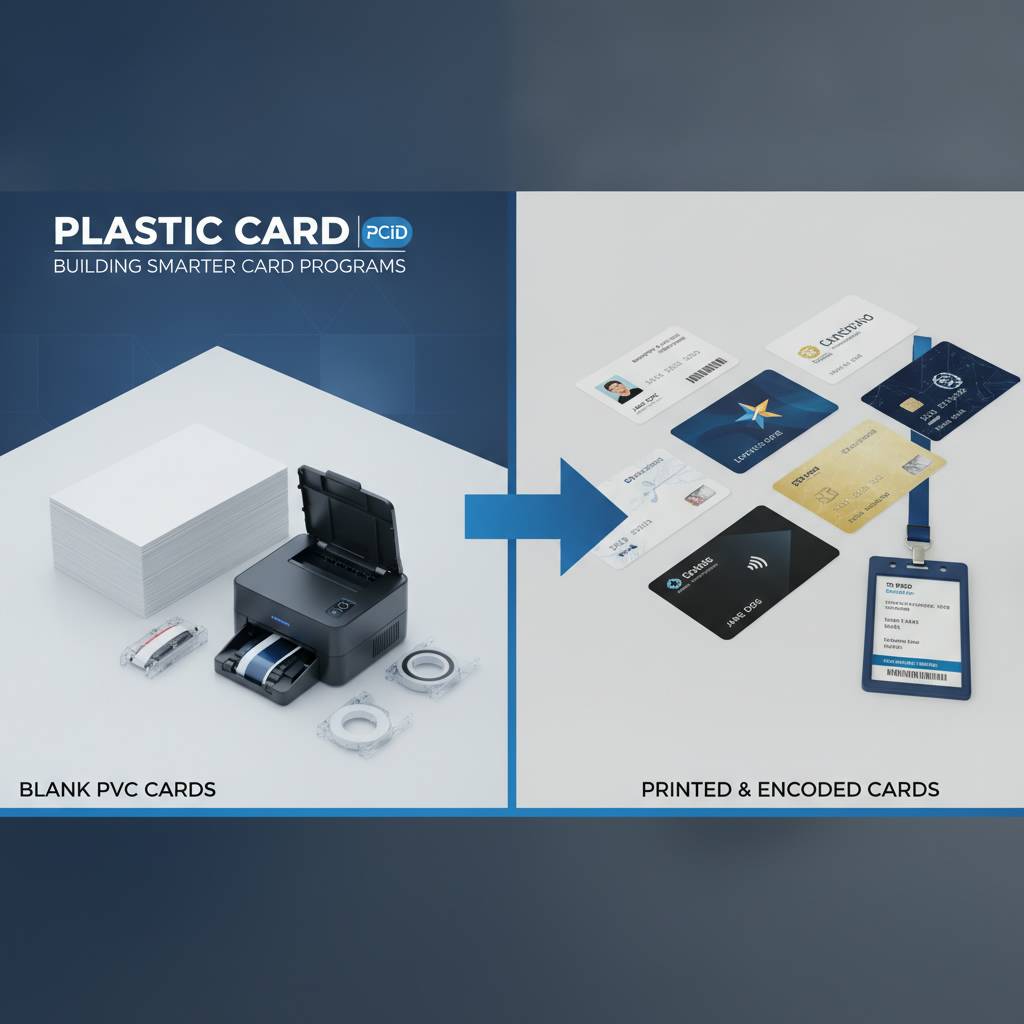
Start With the End Use, Not the Card Type
The single most common mistake in card program planning is starting with a card specification rather than a use case. Before selecting blank versus pre-printed, HiCo versus LoCo, RFID versus mag stripe - map out what the card needs to do. Who holds it? Where does it get read? How often is it replaced? What data needs to be on it or in it? The answers to those questions narrow the specification options dramatically.
A gym membership card that sits in a wallet and gets scanned at a front desk reader has completely different requirements than a hotel key card that gets inserted into a door lock multiple times daily. Mapping use case before specification prevents expensive mistakes that only become apparent after cards are already printed or encoded.
Factor Replacement Rate Into Your Card Economics
Cards get lost. They get demagnetized. They get left in pockets through the wash. Replacement rate is a real variable in card program economics, and programs that ignore it consistently underorder and face operational gaps. A realistic replacement rate estimate - typically 10-20% annually for most program types - should be part of your volume and budget planning from day one.
Blank PVC card programs handle replacement elegantly: the stock is on hand, the printer is ready, and a replacement card takes minutes. Pre-printed programs with minimum order constraints may require ordering more cards than needed just to replace a small number of losses. Replacement agility is one of the most underappreciated advantages of in-house printing on blank stock.
- Estimate 10-20% annual replacement rate for standard loyalty and membership cards
- Factor in printer ribbon yield when calculating true per-card costs for in-house programs
- Store blank card stock away from heat, direct sunlight, and magnetic sources
- Match printer throughput capacity to your peak issuance periods, not just averages
- Order cleaning kits with every ribbon purchase to maintain consistent print quality
- Keep a small buffer stock of pre-encoded cards for high-demand access programs
Evaluate Total Program Cost at 12 and 36 Month Horizons
Card program economics look very different at 12 months versus 36 months. Printer investments that appear significant in a one-month snapshot look entirely different when amortized over three years of eliminated outsourcing costs and setup fees. Organizations that evaluate programs at short time horizons consistently make suboptimal decisions - choosing outsourced printing to avoid upfront investment, then paying that investment back multiple times over in premium per-card pricing.
A structured total cost of ownership analysis that includes card stock, ribbons, printer amortization, maintenance supplies, and time savings at multiple volume scenarios gives a realistic picture. CPE can help build that analysis for programs of any size. Making a 36-month decision with 30-day math is one of the most expensive habits in card program management.
Partner With Plastic Card ID for Every Card Program Need Across the USA
From blank white PVC cards to smart chip credentials, from entry-level card printers to high-throughput laminating systems, Plastic Card ID provides the full infrastructure that card programs require to operate efficiently, professionally, and at scale. The catalog spans every technology, every card format, and every supply category - all supported by the kind of program knowledge that only comes from 25 years and 50 million cards of real-world experience.
Whether you are starting a loyalty program for a single retail location, scaling an employee badge operation across a national organization, or launching a sophisticated access control system with encrypted contactless credentials, the right guidance makes every phase faster and more cost-effective. The difference between a card vendor and a card program partner is measured in outcomes - and outcomes are what Plastic Card ID has been delivering to USA businesses since the beginning.
Your Complete Card Supply Chain in One Place
Card stock, printers, ribbons, cleaning kits, card carriers, card sleeves, and card affixing and mailing services - every component of a professional card program is available through a single relationship with Plastic Card ID. That consolidation is not just convenient; it means the supplies you receive are specified to work together, the guidance you get accounts for your complete setup, and the support you have access to covers the entire program rather than just the component a narrow vendor sold you.
A true one-stop card program supplier eliminates the coordination costs, compatibility risks, and support gaps that come from assembling a card program from multiple unrelated vendors. From the blank card in the tray to the printed credential in a cardholder's hand, Plastic Card ID owns the entire supply chain on your behalf.
Serving Every Scale, Every Industry, Every State
Card programs operate in every sector of the US economy - retail, hospitality, healthcare, education, corporate, government, events, entertainment, and beyond. Plastic Card ID serves organizations in every state, at every scale, with the same commitment to delivering exactly what each program needs rather than forcing a one-size-fits-all solution. A 50-card monthly program in a small town gym receives the same product quality and program expertise as an enterprise account issuing 50,000 cards a quarter.
Geography and scale do not change the fundamental quality standard. Every blank PVC card ships meeting ISO 7810 specifications. Every printer sold is from a manufacturer - Evolis, Zebra, Fargo - whose equipment meets professional-grade reliability standards. Quality is not tiered by order size at Plastic Card ID. It is the baseline expectation for every customer, every order, every time.
Ready to make a confident decision between blank white PVC cards and pre-printed stock? Call 800.835.7919 and connect with a program specialist at Plastic Card ID today - your card program deserves a genuine partner, not just another supplier.
Previous Page