Adding Logos and Photos to Blank Plastic Cards: How It Works
Table of Contents []
- Adding Logos and Photos to Blank Plastic Cards with Plastic Card ID
- Understanding the Technology Behind Card Printing
- Types of Cards That Benefit from Logo and Photo Printing
- Step-by-Step: How to Add a Logo and Photo to a Blank Plastic Card
- Advanced Card Options: Beyond the Standard Badge
- Frequently Asked Questions About Adding Logos and Photos to Plastic Cards
- Your Next Step Starts with Plastic Card ID
Adding Logos and Photos to Blank Plastic Cards with Plastic Card ID
There is a moment every organization reaches - when a handwritten name tag or a paper punch card starts to feel like a liability instead of an asset. That is exactly where blank plastic cards step in, and more specifically, where the question of adding logos and photos to blank plastic cards becomes the most practical conversation you can have about your brand identity. Whether you are running a gym, a school, a hotel, a retail shop, or a healthcare facility, the card you hand someone is a statement about who you are.
Plastic Card ID has spent more than 25 years delivering blank and custom plastic cards to businesses all across the United States. With over 100,000 customers served and more than 50 million cards shipped, they understand that the blank card is not the end of the road. It is the starting point for something far more powerful: a fully branded, photo-bearing credential that your employees, members, or customers will carry in their wallets every single day.
This guide walks you through everything you need to know about printing logos, adding photos, and building a card program that actually delivers results - not just cards.
Why Blank Cards Are the Smart Foundation
Blank CR80 cards - the industry-standard 30 mil PVC card measuring 3.375 x 2.125 inches - are the workhorse of any serious in-house card program. They conform to ISO 7810 specifications, meaning they fit every standard card printer on the market. Buying blank gives organizations total design control and a lower per-card cost over time.
When you add your own logo and photos using an in-house card printer, you are not locked into a minimum order from a commercial print shop. You print what you need, when you need it. That flexibility is enormous for schools that onboard students in waves, businesses that hire constantly, or event organizers who need credentials ready overnight.
The Real Impact of a Branded Card
Here is something worth understanding: a card with your logo on it performs differently than a generic one. Retailers who make the switch from paper gift cards to printed plastic cards with logos see revenue increases of 35-50%. That is not a small number. A physical card with branding signals permanence and legitimacy in a way that paper simply cannot replicate.
Loyalty cards bearing a company's logo that live in a customer's wallet are far more effective than paper punch cards stuffed in a drawer. They are visible daily, associated with your brand continuously, and carry a sense of value that reinforces the customer's decision to keep coming back. The logo is not decoration - it is a marketing engine.
Photos on Cards: More Than Just ID
Adding a photo to a plastic card transforms it into a secure identification tool. Employee badges, student IDs, healthcare worker credentials, visitor passes - all of these require a recognizable face attached to a name. The combination of a printed photo and a logo creates an instant trust signal that protects organizations from unauthorized access and validates individuals in professional settings.
Modern card printers from brands like Evolis, Zebra, and Fargo handle photo printing with impressive clarity, producing dye-sublimation results that are both sharp and durable. CPE carries all three brands and can help you match the right printer to the volume and quality level your program demands. Call 800.835.7919 to speak with someone who can walk you through the options without the sales pressure.
Understanding the Technology Behind Card Printing
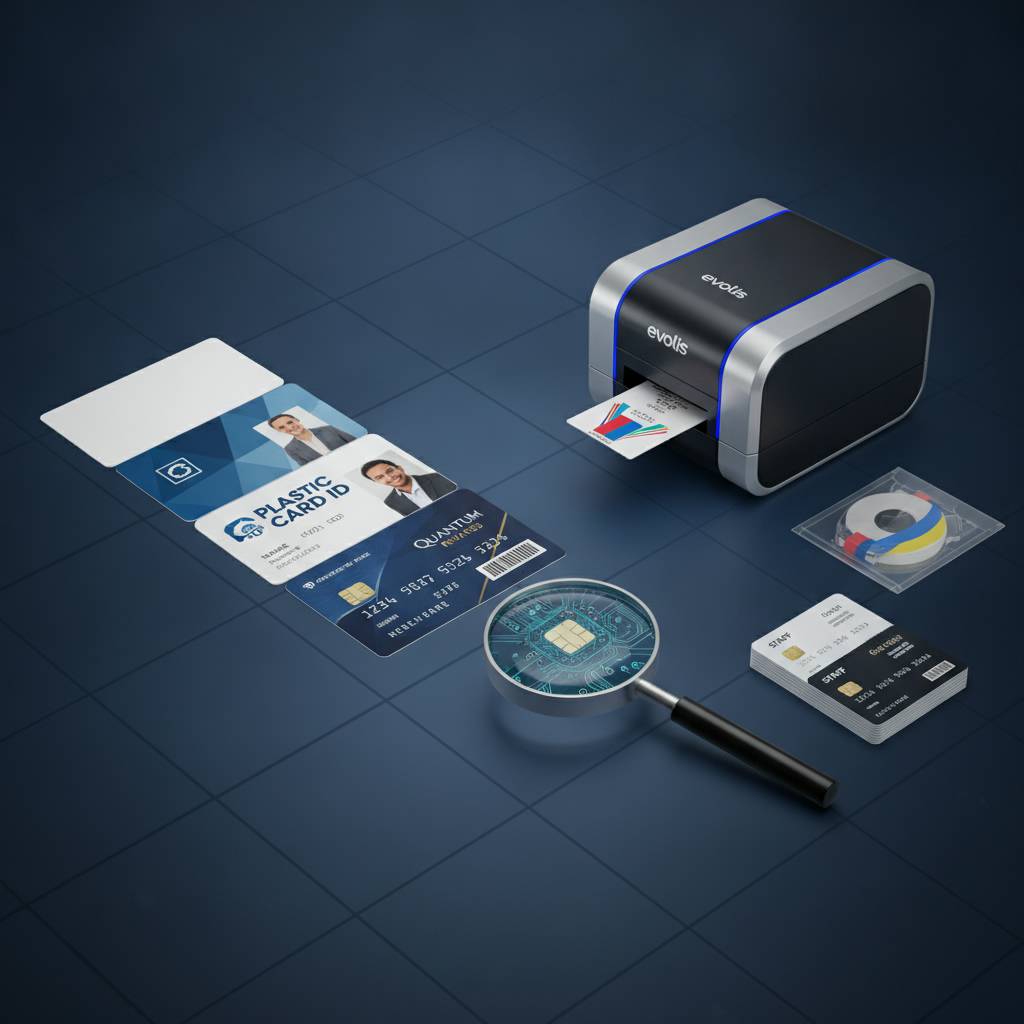 Printing logos and photos onto blank plastic cards requires more than just a desktop printer and good intentions. Card printing is a specialized process that depends on the right combination of printer hardware, ribbon type, and card stock. When these three elements align, the results are professional-grade credentials that look and feel like they belong in a serious organization.
Dye-sublimation printing is the dominant method for full-color card output, which includes both logos and photographs. The process heats dye from a ribbon panel and transfers it directly into the card surface, producing smooth gradients and photographic-quality imagery that is embedded into the plastic rather than sitting on top of it. That embedded quality makes it resistant to scratching, fading, and smudging over normal card lifespan.
Choosing the Right Printer for Your Program
Evolis printers are popular for low-to-medium volume programs, offering compact footprints and clean color output that suits membership cards, loyalty cards, and employee badges. Zebra printers are known for reliability at higher volumes and are widely used in enterprise environments where consistency across thousands of prints matters enormously. Fargo printers offer advanced security features including HoloKote overlaminates and dual-sided printing that meet rigorous ID requirements.
Matching your printer to your monthly card volume is one of the most important buying decisions you will make. A printer designed for 500 cards per month run at 2,000 cards will wear out prematurely. Plastic Card ID helps clients assess their volume and find the right hardware without overselling. That is what being a strategic partner rather than just a supplier looks like in practice.
Ribbons: The Unsung Hero of Logo and Photo Quality
Printer ribbons determine the color fidelity, sharpness, and durability of every printed card. YMCKO ribbons - yellow, magenta, cyan, black, and overlay panels - are the standard for full-color cards with photo printing. The K panel handles black text and barcodes with crisp definition, while the O panel lays down a protective topcoat that seals the printed surface.
Using the wrong ribbon, or a low-grade generic version, produces cards that look dull, fade quickly, or fail to render logos with the saturation your brand deserves. CPE stocks genuine manufacturer ribbons for all printer brands they carry, ensuring your cards come out exactly as designed every single time. Skimping on ribbons is the most common and most avoidable mistake in card program management.
Card Stock Matters More Than Most Realize
Not all blank PVC cards accept dye-sublimation printing equally. Premium printable cards have a surface coating specifically engineered to absorb dye evenly, producing vivid logos and sharp photo edges. Cards without this coating can produce muddy color, uneven gradients, or banding that ruins the professional appearance you are investing in.
Plastic Card ID supplies blank cards that are designed to work seamlessly with the printers they carry, removing the guesswork from the equation. Whether you need standard white PVC, frosted cards for a distinctive aesthetic, or pre-printed colored stock as a background layer, the card catalog covers every program type. Contact 800.835.7919 to discuss which card and printer combination is right for your specific application.
| Card Type | Best Use Case | Photo Printing | Logo Printing |
|---|---|---|---|
| Standard White PVC CR80 | Employee ID, Membership, Loyalty | Yes - Full Color | Yes - Full Color |
| Frosted/Clear PVC | VIP, Premium Membership, Event | Limited - Best with Light Designs | Yes - Striking Effect |
| Colored PVC Stock | Loyalty, Gift, Department ID | Yes with Proper Ribbon | Yes - Vibrant Results |
| Magnetic Stripe HiCo/LoCo | Hotel Key, Access, Gift Card | Yes - Combined with Encoding | Yes - Standard |
| RFID/Proximity | Access Control, Casino, Healthcare | Yes | Yes |
Types of Cards That Benefit from Logo and Photo Printing
The question is rarely whether you should add a logo and photo to your cards. The real question is which card types in your organization are missing that branding right now. Every card that leaves your organization is an opportunity to reinforce your identity, communicate professionalism, and create a lasting impression. Let us walk through the most impactful categories.
Employee ID and Access Badges
Employee badges are arguably the highest-stakes cards in any organization. They are presented at security checkpoints, used to verify identity in client meetings, and worn visibly throughout the workday. A badge that carries your organization's logo alongside a clear photo of the cardholder does triple duty: it identifies, it verifies, and it represents your brand in every interaction.
Organizations that print their own badges in-house gain a major security advantage: immediate issuance and immediate revocation. When someone joins or leaves, you print or retire a card on the spot rather than waiting on an outside vendor. Pair that with magnetic stripe or RFID encoding through CPE's card lineup, and you have an access control solution that is both branded and functional at a high level.
Loyalty and Membership Cards
Loyalty cards with logos keep your brand in a customer's wallet 365 days a year. That passive brand exposure is something no digital ad can replicate with the same intimacy. When customers reach for their wallet, your card is there. When they decide where to shop or dine, the physical presence of that card influences the decision more than most marketers account for.
Membership cards that carry a logo and member photo also create a sense of exclusivity and belonging. Gyms, clubs, professional associations, and retail membership programs all benefit enormously from a card that looks and feels like it was designed with care. The tactile quality of a 30 mil PVC card communicates something that digital apps are still struggling to match.
Event Credentials and Visitor Passes
Conferences, trade shows, corporate events, and campus visitor programs all require quick, reliable identification of attendees and guests. Printing branded credentials on plastic cards instead of paper badges immediately elevates the experience. Attendees are more likely to keep a card-sized credential and less likely to lose it than a paper lanyard badge that shreds by noon.
For recurring events, printed cards with a logo, event name, and photo of the attendee reduce check-in time, improve security, and double as a takeaway that promotes the brand long after the event is over. Plastic Card ID can supply blank stock in bulk quantities that let you print fresh credentials for every event without over-committing to custom pre-printed inventory.
Step-by-Step: How to Add a Logo and Photo to a Blank Plastic Card
 The process of adding logos and photos to blank plastic cards is far more accessible than most organizations assume. You do not need a graphic design degree or a commercial print operation. What you need is the right printer, the right software, the right ribbon, and a clear understanding of your card layout. Here is how it works in practice.
Design Your Card Layout
Most card printers come with or are compatible with card design software that lets you create a template using drag-and-drop fields. You define where the logo appears - typically the upper left or as a background watermark - and where the photo field sits, usually the left or right side of the card with text fields for name, title, and any encoded data like a barcode or employee number.
Logo resolution is critical. A logo saved as a low-resolution JPEG at 72 DPI will print blurry on a plastic card. You need vector files (AI, EPS, SVG) or high-resolution raster files at a minimum of 300 DPI at the intended print size. Most organizations already have these files from their graphic design or marketing team. If not, a quick request to whoever built your website or printed your last brochure will surface them.
- Use vector logo files when possible for perfectly sharp edges at any size
- Set your photo field to capture or import images at 300 DPI minimum
- Use a consistent card template across departments for brand uniformity
- Test print on a blank card before committing to a full batch
- Include a laminate overlay panel in your ribbon to protect the finished card
Capture or Import Photos
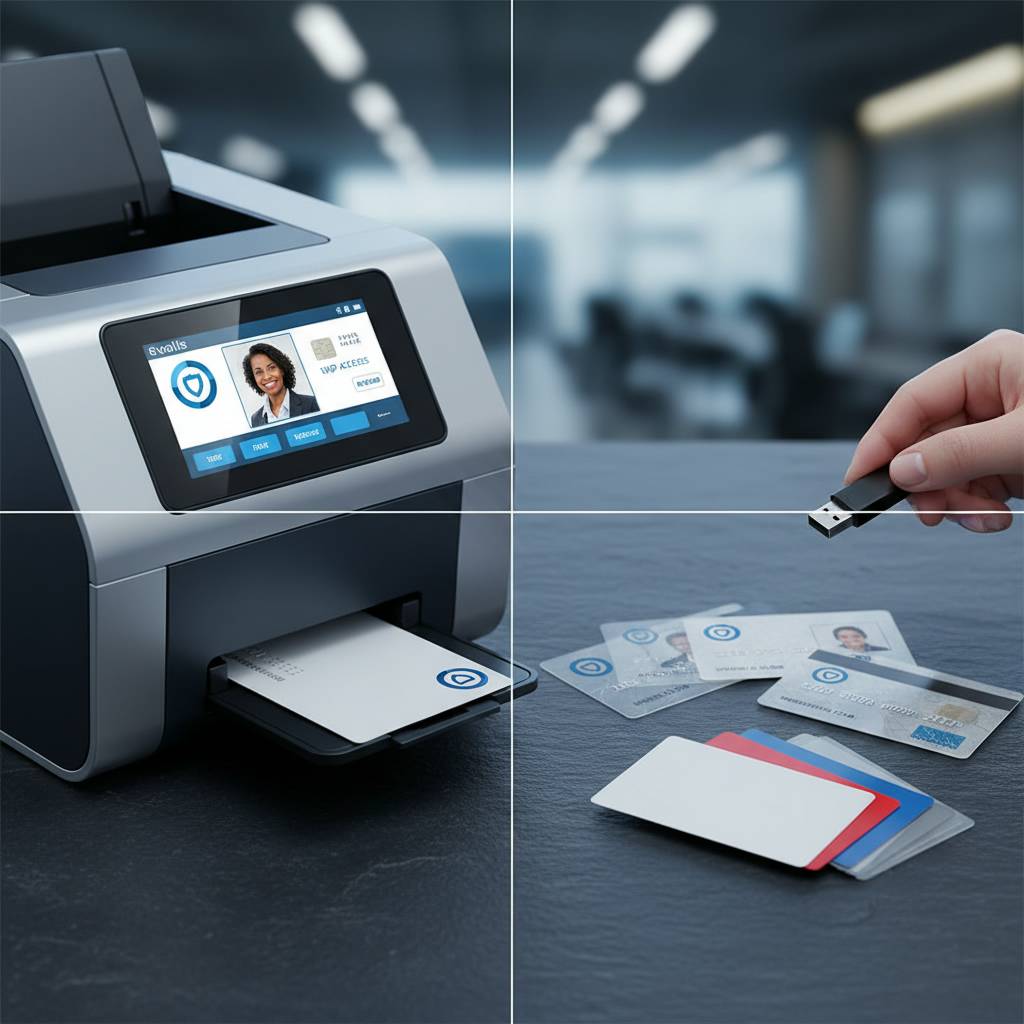
For employee ID programs, photos can be captured live using a webcam integrated with your card software, or imported from existing HR photo databases. Many Evolis and Zebra software packages support direct webcam capture with background removal features, which produce clean, professional headshots even without a dedicated photo backdrop.
Consistency matters. Establishing a photo standard across your organization - same background color, same framing, same lighting approach - creates a card program that looks cohesive and intentional rather than assembled haphazardly. CPE can recommend specific webcam setups and software integrations that streamline the capture process for your card printer model. Reach out at 800.835.7919 for a practical recommendation tailored to your setup.
Print, Encode, and Finish
Once the template is built and the photo is imported, printing takes seconds per card. A single-sided full-color card on an Evolis Primacy 2 or a Zebra ZC300 prints in roughly 20-30 seconds, including the protective overlay pass. Dual-sided cards take slightly longer but are completed in a single automated pass without manual card flipping.
If your cards require magnetic stripe encoding - for hotel key systems, gift card programs, or access control - the printer handles that simultaneously with the print job, writing data to the stripe while the dye-sublimation head prints the front. The finished card emerges fully branded, fully encoded, and ready for immediate use. That combination of branding and function in one workflow is what makes in-house printing so compelling for modern organizations.
Advanced Card Options: Beyond the Standard Badge
Standard white PVC cards cover the majority of use cases beautifully, but some programs call for something more distinctive. Plastic Card ID offers a range of specialty card options that take the concept of adding logos and photos to blank plastic cards into more sophisticated territory - without complicating the core workflow significantly.
Clear and Frosted Cards
Clear and frosted PVC cards create a striking visual effect when logos are printed on them. A frosted card with a single-color logo and a crisp photo presents a premium aesthetic that is particularly effective for VIP membership programs, upscale loyalty cards, and high-end event credentials. The translucency of the card itself becomes part of the design.
Printing on clear cards requires some adjustment in color approach - dark backgrounds that work beautifully on white cards may become invisible on clear stock. Most successful designs for clear cards rely on bold logos, strong typography, and high-contrast photo treatments that leverage the transparency rather than fighting it. CPE can provide sample cards to help you design confidently before committing to a full print run.
RFID and Smart Card Printing
RFID cards and proximity cards used in access control, healthcare, and casino environments can all carry full-color logo and photo printing just like a standard PVC card. The chip and antenna are embedded within the card body, leaving the printable surface completely available for branding. Casino player cards bearing a property logo and player photo are a perfect example of this combination in action.
MIFARE DESFire cards used in high-security access environments support the same printing process. The result is a card that is both a visually branded credential and a sophisticated electronic access token. For organizations managing secure facilities, that dual-function card reduces the need for separate visitor badges and electronic fobs - consolidating identity and access into one well-branded physical object.
Luxury Metal Cards
For organizations seeking maximum impact, Plastic Card ID offers luxury metal cards in stainless steel, brass, and gold finishes. These cards carry logos through laser engraving or specialized printing processes that produce permanent, premium-grade markings. While photo printing on metal cards requires specific techniques different from dye-sublimation on PVC, the end result for logo-centric applications is extraordinary.
Metal membership cards, VIP access credentials, and executive ID cards communicate a level of organizational prestige that no plastic card can fully replicate. They are heavier, more tactile, and dramatically more memorable. For select programs where the card itself is part of the brand experience, metal is worth the investment.
Frequently Asked Questions About Adding Logos and Photos to Plastic Cards
Organizations new to in-house card printing often arrive with the same set of practical questions. Getting clear answers upfront saves significant time and budget. Here are the questions CPE hears most often, answered directly.
What File Format Should My Logo Be In?
The best format for logo printing on plastic cards is a vector file - AI, EPS, or SVG. Vector files scale to any size without losing sharpness, which matters when a logo needs to appear at half an inch wide on a card. If you only have a PNG or JPEG, make sure it is exported at 300 DPI or higher at the actual size it will appear on the card.
Many organizations discover they have only a web-resolution logo on file - 72 DPI, designed for screens. Printing that at card scale produces a blurry result. Requesting a high-resolution or vector version from your designer before starting your card program is a step that saves significant frustration. Most designers retain these files even years after the original branding project.
Can I Print Cards One at a Time or Do I Need Minimum Orders?
In-house card printing with a desktop card printer means you print exactly as many cards as you need, whenever you need them - one card or one thousand. There is no minimum order constraint when you own the printer and the blank card stock. This is one of the most powerful economic arguments for building an in-house program rather than ordering from an outside printer for every batch.
Blank white PVC CR80 cards from Plastic Card ID are available in quantities that suit any program size, from small packs to large bulk orders. The per-card cost decreases as quantity increases, making it efficient to stock up while maintaining the flexibility to print on demand. Call 800.835.7919 to get current pricing and find the quantity tier that matches your program's monthly volume.
How Durable Are Printed Logos and Photos on PVC Cards?
When printed using dye-sublimation with a protective overlay panel, logos and photos on PVC cards are extremely durable under normal handling conditions. The dye bonds into the card surface rather than sitting on top, and the overlay adds a clear topcoat that resists surface abrasion, fingerprints, and moisture. Cards used in standard wallet or badge holder applications typically retain their print quality for years.
Adding a laminate overcoat through the printer ribbon significantly extends card life in high-touch environments like access badges and ID cards that are swiped through readers multiple times daily. Plastic Card ID carries YMCKO and YMCKOK ribbons that include this protective layer automatically, making durable, professional output the default rather than an add-on.
Your Next Step Starts with Plastic Card ID
Every card program starts somewhere. Some start with a single conversation about what blank card stock to buy. Others begin with a question about which printer handles photos best at 300 cards per month. And some arrive already knowing exactly what they want, just looking for a supplier who will actually deliver consistently at volume, year after year. Wherever you are in that spectrum, Plastic Card ID is built to meet you there.
The decision to add logos and photos to your blank plastic cards is not a cosmetic one - it is a strategic one. It determines how your employees represent your organization, how your members experience your brand, and how your customers think about you every time they reach for their wallet. Getting that right matters, and getting it right consistently requires a partner who has been doing this for decades, not months.
The Plastic Card ID Difference: Partnership, Not Transactions
What separates Plastic Card ID from a generic card vendor is the depth of support behind every order. When you call, you speak with people who understand card programs operationally - not just the products in the catalog. They can help you troubleshoot print quality issues, select the right ribbon for a specific card stock, or figure out why your logo is printing with a color shift. That kind of expertise is not available from a warehouse-only supplier.
From 50 cards a month for a small gym to tens of thousands for a large hospital system, CPE scales with you. Programs grow. Requirements evolve. The team at Plastic Card ID has seen every kind of card program imaginable over 25 years and has the inventory, knowledge, and relationships to support whatever comes next. This is what a true one-stop shop looks like in the plastic card industry.
Complete Card Program Supplies in One Place
Beyond blank cards and printers, Plastic Card ID carries every supply item a running card program needs: printer ribbons, cleaning kits, card sleeves, card carriers, badge holders, and card affixing and mailing services. You do not need four different vendors to run a complete program. Everything is available from one source, which simplifies purchasing, reduces shipping complexity, and ensures compatibility across every component.
That completeness matters when you are managing a card program alongside a dozen other responsibilities. Having a single partner who handles cards, printers, ribbons, and accessories eliminates the coordination overhead that fragments so many organizations' card programs. Order once, get everything, and get back to running your business.
Reach Out Today and Get Your Program Moving
Whether you are launching a brand-new card program or upgrading an existing one with better logo quality and photo printing, the conversation starts with a single call or inquiry. The team at Plastic Card ID is ready to walk you through blank card selection, printer matching, ribbon options, and any specialty card formats that fit your specific use case. No lengthy sales cycles, no pressure - just practical guidance from people who know this industry.
Call Plastic Card ID today at 800.835.7919 and discover how easy it is to build a card program that makes your logo and your people look exactly as professional as they deserve to be.