Are Blank Plastic Cards Recyclable? PVC Limitations Explained
Table of Contents []
- What Happens to Blank Plastic Cards at End of Life? Plastic Card ID Explains PVC Limitations
- Understanding PVC as a Card Material: Strengths, Limits, and Trade-Offs
- Are Blank Plastic Cards Recyclable? The Honest Answer for Card Program Buyers
- The Full Catalog: Blank Cards and Specialty Options from Plastic Card ID
- Card Printers, Supplies, and the Complete In-House Program Setup
- Industries and Use Cases: Where Blank Plastic Cards Deliver Measurable Results
- Partnering with Plastic Card ID for Your Card Program - Contact Us Today
What Happens to Blank Plastic Cards at End of Life? Plastic Card ID Explains PVC Limitations
Most conversations about plastic cards focus on what they can do - and they do a remarkable amount. But smart buyers also ask harder questions. What happens when a blank PVC card reaches the end of its useful life? Can it be recycled? Are there real limitations baked into the material itself? These are fair, practical questions, and they deserve honest, complete answers.
PVC - polyvinyl chloride - is the dominant material in the blank plastic card industry for reasons that have nothing to do with convenience alone. It is dimensionally stable, resistant to cracking and warping, and it holds print, encoding, and lamination with precision that no paper-based substitute has ever matched. The CR80 format, measuring 3.375 by 2.125 inches at 30 mil thickness, is the global ISO 7810 standard. Every card printer on the market is engineered around it.
The material's durability - its greatest commercial strength - is also what creates complexity at end of life. PVC cards are not accepted in standard municipal curbside recycling streams. They require specialty processing. This is a factual limitation worth understanding before you build or scale a card program, not a reason to avoid plastic cards, but context that helps you make decisions with full information.
| Property | Performance Benefit | Recycling Implication |
|---|---|---|
| Multi-layer lamination | Durability, print protection | Requires specialty separation |
| Magnetic stripe | Encoding capability | Mixed material - not curbside |
| RFID/chip embedding | Contactless access and data | Electronics require e-waste handling |
| Rigid 30 mil thickness | Long service life, wallet-ready | Longer replacement cycle = fewer cards |
| Color-matched PVC stock | Consistent branding | Pigments vary by specialty recycler |
Understanding PVC as a Card Material: Strengths, Limits, and Trade-Offs
 There is a reason PVC has dominated the card industry for decades. It accepts dye-sublimation printing with sharp fidelity, bonds cleanly with magnetic stripe coatings, and holds embedded chip modules without mechanical failure under normal wallet and reader use. No other material at this price point delivers the same combination of dimensional stability and encoding compatibility. That is the commercial reality driving billions of cards produced annually worldwide.
Understanding its limitations starts with understanding what PVC actually is. Polyvinyl chloride is a thermoplastic polymer that becomes workable under heat and sets rigid at room temperature. Card manufacturers fuse multiple PVC layers - often a core layer with printed overlays and protective laminates - into a single bonded sheet. This laminated construction is precisely what makes standard recycling difficult: the layers do not separate cleanly in conventional mechanical recycling systems designed for single-material streams.
Why PVC Cards Are Not Curbside Recyclable
Standard municipal recycling programs are engineered around high-volume, single-resin materials - HDPE milk jugs, PET water bottles, corrugated cardboard. PVC sits in a different category entirely, one that requires chlorine management during processing to prevent toxic byproduct generation. Most curbside programs explicitly exclude PVC, and plastic cards - even blank CR80 cards with no added components - fall into that exclusion.
This is not a hidden flaw. It is a disclosed characteristic of the material that has been understood by manufacturers and buyers for years. The practical response for card program operators is straightforward: identify specialty recyclers in your region who accept rigid PVC and maintain a collection process for retired cards rather than routing them to general waste or recycling bins where they create sorting problems.
For organizations running high-volume programs - think loyalty cards reissued seasonally, or employee badges cycled annually - building a card retirement process into program management is simply good operational hygiene. CPE works with clients across the United States who have integrated this kind of thinking into their card program lifecycle planning without it adding meaningful cost or complexity.
The Durability Argument: Fewer Cards Mean Less Total Waste
Here is a perspective that often gets lost in material debates: a card that lasts three to five years generates far less end-of-life waste than a paper or low-quality plastic card replaced every few months. PVC's durability is not incidental - it is a waste-reduction mechanism built into the material's physics. Loyalty cards that survive years in a wallet are replaced less frequently than fragile alternatives.
Retailers who switch from paper punch cards to blank PVC loyalty cards consistently see two things happen simultaneously: customer retention improves because the card persists in the wallet as a physical reminder, and card replacement rates drop because the material simply holds up. The net volume of material processed over a five-year program window is often lower with durable PVC than with "lighter" alternatives that require constant reprinting and redistribution.
Magnetic Stripe and RFID Cards: Added Complexity at End of Life
Blank PVC cards with no additional components are the simplest case. Once you add a HiCo or LoCo magnetic stripe, an embedded RFID antenna, a proximity chip, or a smart card module, the end-of-life picture changes. These cards become mixed-material items combining plastics, metals, and in some cases electronic components - each requiring different processing streams.
RFID smart cards, including those using MIFARE DESFire technology, contain antenna coils and chip modules that ideally go through e-waste handling rather than general recycling. Casino player cards, hotel key cards, and proximity access cards fall into this category. Organizations issuing these card types should work with e-waste specialists at end of program life. This is a minor logistical step, but it is worth building into any access control or smart card program from the start.
Are Blank Plastic Cards Recyclable? The Honest Answer for Card Program Buyers
If you came here asking whether blank plastic cards are recyclable, the direct answer is: yes, with important qualifications. Standard blank CR80 PVC cards are technically recyclable through specialty PVC recyclers, but they are not accepted in curbside or standard municipal recycling programs. This distinction matters enormously for program planning, purchasing decisions, and responsible disposal at scale.
The specialty recycling pathway for PVC cards exists and is accessible, though it varies by region. Companies specializing in rigid PVC - including industrial PVC pipe recyclers and some plastics reclamation facilities - can process card stock. Some card manufacturers and industry organizations have established take-back programs. For organizations retiring large quantities of cards, this path is practical. For individual consumers returning a single expired loyalty card, the logistics are less convenient.
What "Specialty Recycler" Actually Means for PVC Cards
A specialty recycler, in this context, is a facility equipped to handle PVC without contaminating other plastic streams or generating harmful byproducts. PVC recycling requires controlled thermal processing because chlorine compounds in the polymer can form dioxins if processed at incorrect temperatures. Properly equipped facilities manage this chemistry routinely - it is not exotic technology, but it is not found in a typical municipal facility.
To find a specialty PVC recycler, the most reliable starting point is Earth911's database, regional industrial recycling directories, or direct inquiry to plastic card manufacturers who may have established take-back relationships. Some office supply chains and card printer vendors have also developed card recycling partnerships worth investigating for volume buyers.
Blank Cards vs. Printed and Encoded Cards: Does It Matter?
From a recycling standpoint, a blank CR80 card is simpler to process than one carrying printed inks, laminate overlays, or magnetic coatings. But the base material - PVC - is the primary driver of sorting decisions, and specialty recyclers generally accept both printed and unprinted cards in the same stream. The presence of dye-sublimation printed graphics does not meaningfully complicate the PVC recycling process at facilities equipped to handle the material.
Where complexity does increase is with holographic overlaminates, metallic foil accents, or embedded components. These specialty finishes - common in premium loyalty cards, VIP membership cards, and security credentials - may require pre-sorting before processing. If your program uses these finishes at high volume, it is worth a direct conversation with your recycler before assuming standard PVC processing applies.
Building Card Retirement Into Your Program from Day One
The most practical guidance CPE offers to card program operators is simple: treat end-of-life as a program design element, not an afterthought. Organizations that plan their card retirement process upfront avoid the scramble of dealing with boxes of retired credentials when a program transitions, a lease ends, or an employee base turns over significantly.
This means identifying your specialty recycler before you issue your first card, establishing a collection point or return policy for issued cards, and communicating the retirement process to employees or customers who hold them. For access control and ID programs, card retrieval at employee termination is already best practice from a security standpoint - the recycling step is simply an addition to a process you are running anyway.
The Full Catalog: Blank Cards and Specialty Options from Plastic Card ID
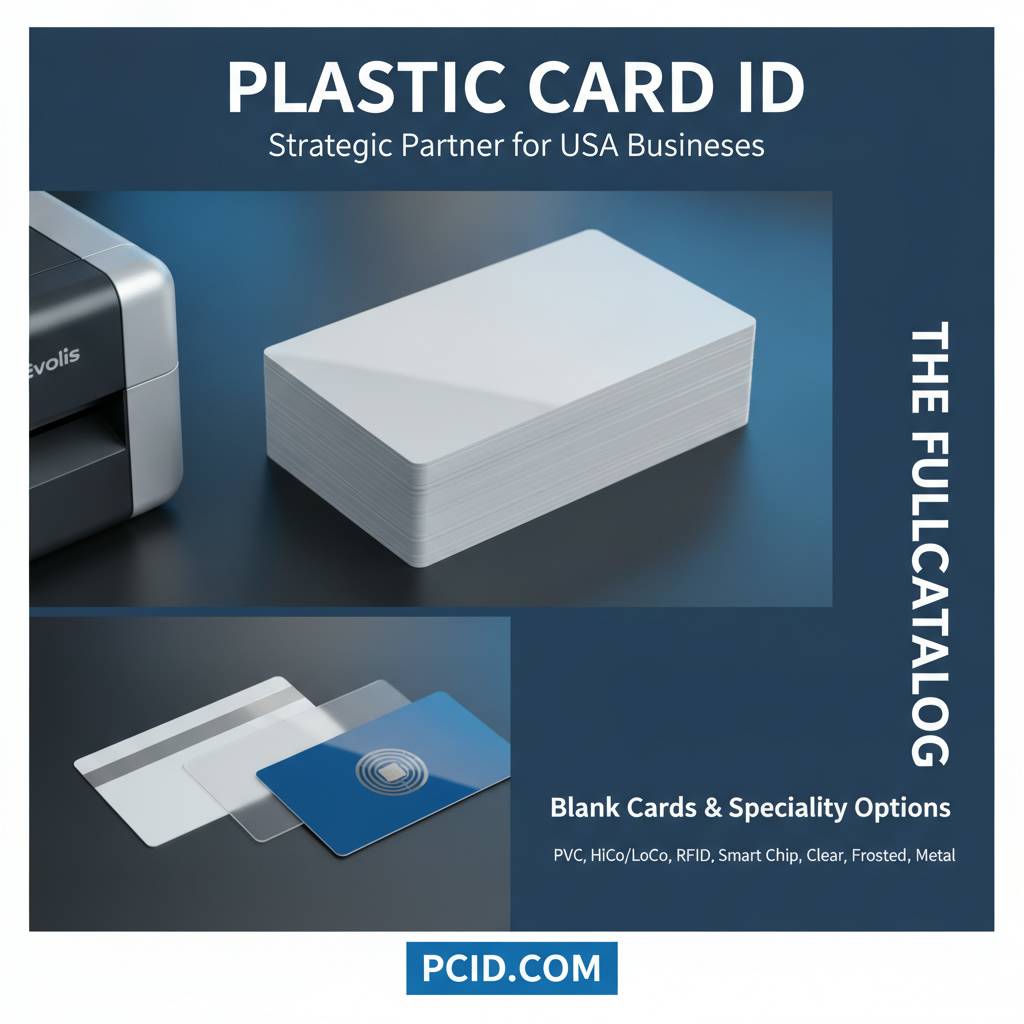 Whatever the program - employee badges, loyalty cards, membership credentials, event access, hotel keys, or casino player cards - CPE carries the specific card type the application demands. The catalog spans every major blank card format in use by USA businesses today, from the most straightforward white PVC stock to advanced contactless smart cards with MIFARE DESFire encryption.
Buying blank cards and printing in-house puts total design control in the hands of the organization. It also compresses the cost-per-card over time, particularly for programs that issue cards on a rolling basis - new employees, new members, new guests - rather than in a single large print run. Card printers from Evolis, Zebra, and Fargo are designed specifically for this workflow, and Plastic Card ID carries the full printer lineup alongside the cards themselves.
Blank CR80 PVC Cards: The Program Workhorse
The standard blank white CR80 card at 30 mil thickness is the entry point for virtually every in-house card program. It accepts every major print technology - dye-sublimation, direct-to-card, retransfer - and works with every printer on the market. At volume pricing, blank white PVC cards are among the most cost-effective materials in any identity or loyalty program.
Beyond white stock, Plastic Card ID carries blank cards in a wide range of colors - blue, red, gold, silver, black, and custom color-matched options - as well as clear frosted cards for premium presentation, dual-sided printable formats, and cards pre-configured for specific printer models. Colored stock simplifies card sorting and visual identification in multi-department or multi-tier programs without requiring a full print run to distinguish card types.
Magnetic Stripe Cards: HiCo and LoCo Options Explained
Magnetic stripe cards come in two coercivity ratings, and choosing the right one matters for system compatibility. High-coercivity (HiCo) stripes operate at 2750 Oersteds and resist accidental erasure from everyday magnetic exposure - wallets, smartphone cases, other cards. HiCo is the standard choice for long-life credentials like employee badges, membership cards, and gift cards. Low-coercivity (LoCo) stripes at 300 Oersteds are used in applications where the card is frequently re-encoded, such as hotel key cards that are reprogrammed for each guest.
Both formats are available as blank cards ready for in-house printing and encoding, or pre-encoded to specification for programs without on-site encoding equipment. Plastic Card ID supplies both, and the team can help buyers determine which coercivity their existing card reader infrastructure requires - a critical compatibility question that is easy to get wrong and expensive to fix after a large purchase.
To reach the team directly for magnetic stripe compatibility questions, call 800.835.7919 and speak with a card program specialist who can help match your card specifications to your reader system.
RFID, Proximity, and Smart Chip Cards for Access and Contactless Programs
Contactless card technology has moved well beyond basic access control. RFID smart cards carrying MIFARE DESFire chips support encrypted data storage suitable for multi-application programs - access control, cashless vending, time-and-attendance, and loyalty all on a single card. Proximity cards remain the workhorse of commercial building access in the United States, with 125kHz HID-compatible formats compatible with the vast majority of installed access control infrastructure.
Casino player cards, hotel key cards, and university ID programs frequently combine contactless technology with printed design elements and magnetic stripe encoding - making them among the most complex cards in the catalog. Plastic Card ID supplies these specialty formats alongside the simpler blank PVC stock, serving programs across every scale from small boutique hotels to large-scale institutional deployments.
Card Printers, Supplies, and the Complete In-House Program Setup
A card program is only as functional as the equipment printing and encoding it. Card printers from Evolis, Zebra, and Fargo represent the three dominant platforms in the USA market, each with distinct strengths by volume, print resolution, encoding capability, and form factor. Plastic Card ID carries the full lineup and can help organizations select the right printer for current volume with room to scale.
The complete in-house card program setup includes more than a printer and card stock. Printer ribbons, cleaning kits, card carriers, card sleeves, and holders are all consumables and accessories that programs burn through continuously. Sourcing them from the same supplier as the cards and printer simplifies purchasing, ensures compatibility, and typically improves pricing at volume.
Choosing the Right Printer for Your Card Volume
Card printer selection is one of the most consequential equipment decisions a card program manager makes, and it is frequently made with incomplete information. Matching printer throughput to actual card issuance volume - not hoped-for volume - is the starting point. Entry-level single-sided printers handle 50-200 cards per month with ease. Mid-range dual-sided models scale to 500-2,000 cards monthly. High-volume retransfer printers are built for continuous production environments issuing thousands of cards weekly.
Encoding capability is the second axis of printer selection. A program that issues plain visual ID cards needs only print capability. A program encoding magnetic stripes, writing RFID chips, or producing smart card credentials needs a printer with the appropriate encoding module built in - and not all modules are available on all printer models. Getting this wrong means either a second hardware purchase or a return and reorder, both costly and time-consuming.
Ribbons, Cleaning Kits, and Consumable Management
Printer ribbons are the most frequently repurchased consumable in any card program, and they are the item most often sourced from off-brand suppliers trying to undercut OEM pricing. Off-brand ribbons are one of the leading causes of print quality degradation and premature printhead failure in card printers - a false economy that costs far more in service calls and hardware replacement than the ribbon savings ever justified.
Plastic Card ID carries OEM and OEM-equivalent ribbons for all major Evolis, Zebra, and Fargo printer models, along with cleaning cards and cleaning kit bundles designed for each platform's specific maintenance protocol. Printer cleaning is not optional maintenance - it is the primary factor determining printhead lifespan, and most manufacturers tie their warranty coverage to documented cleaning compliance.
Industries and Use Cases: Where Blank Plastic Cards Deliver Measurable Results
The versatility of a blank CR80 card is genuinely extraordinary. The same physical format becomes an employee badge, a retail loyalty card, a gym membership, a hotel key, or a conference credential depending entirely on what is printed or encoded onto it. This universality is precisely why blank PVC cards have remained the default format across virtually every sector of the American economy for over two decades.
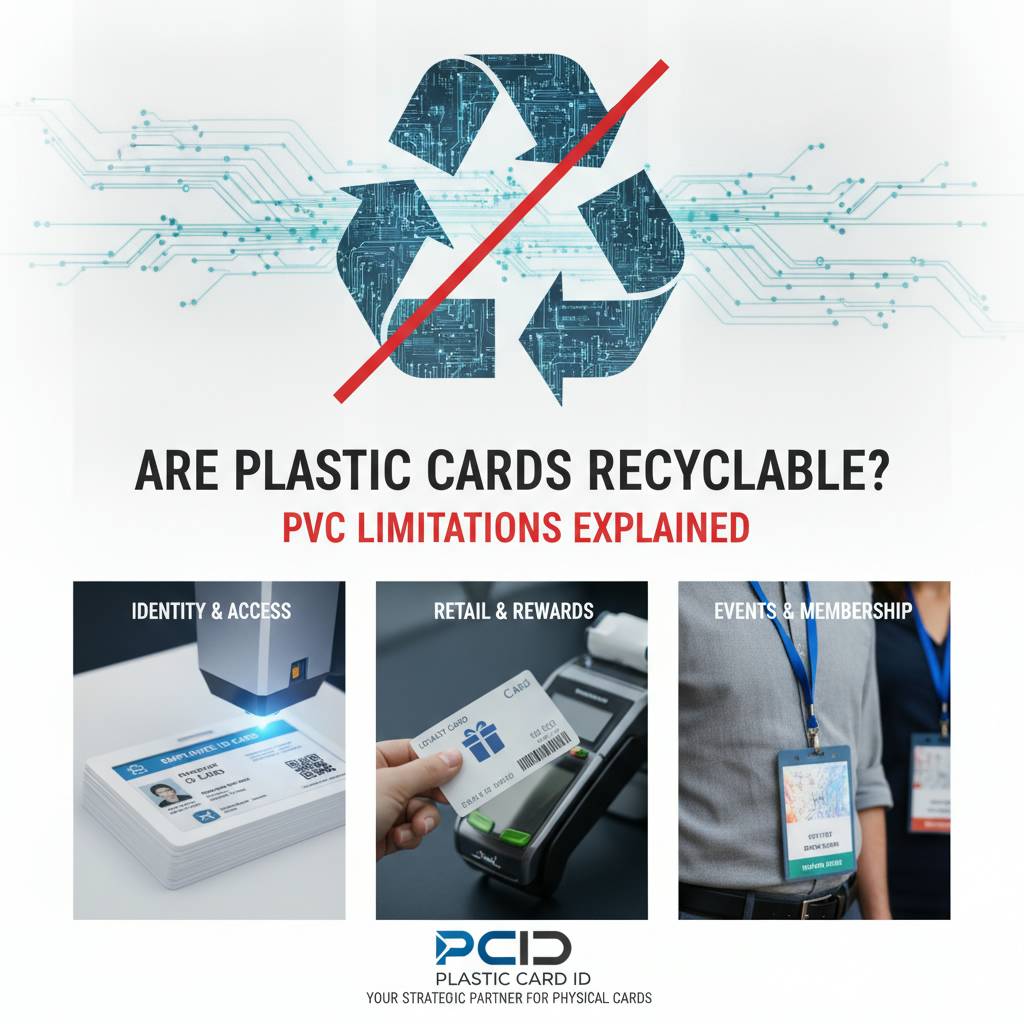
The performance case for plastic over paper is not theoretical. Retailers transitioning from paper-based gift card systems to plastic see sales increases in the 35-50% range - a documented phenomenon driven by the perceived value of the physical object, the durability that keeps cards in wallets instead of trash cans, and the encoding options that enable balance tracking and program analytics unavailable with paper punch formats.
Retail Gift Cards and Loyalty Programs
Gift cards are among the most commercially proven applications of blank plastic card stock. A well-designed plastic gift card is a retail marketing instrument as much as a payment vehicle - it introduces new customers to a brand, drives repeat visits, and generates float revenue when balances go unredeemed. Blank card stock printed in-house with dye-sublimation gives retailers full design control over each card's appearance and the ability to update designs seasonally without ordering new stock.
Loyalty programs similarly outperform their paper equivalents when built on plastic card infrastructure. A loyalty card that lives in a customer's wallet generates passive brand exposure daily. The physical reminder effect - the slight weight of the card, the visual trigger of the brand - produces measurably higher redemption rates and return visit frequency than digital-only or paper-based alternatives in most retail verticals.
Employee ID and Access Control Programs
Employee ID programs are a foundational use case for blank plastic cards and card printers. Every organization that issues credentials needs a card that is durable enough to survive daily use on a lanyard or in a badge holder, legible enough to identify the cardholder at a glance, and optionally encoded to interact with access control readers at building entry points. Blank PVC cards meet all three requirements at a price point that scales from a 10-person startup to a 10,000-employee institution.
- Blank white CR80 cards accept full-color photo ID printing on any dye-sublimation card printer
- Magnetic stripe versions enable encoded access levels and time-and-attendance integration
- Proximity and RFID cards provide contactless building access without physical swipe contact
- Smart chip cards support multi-application programs combining access, vending, and identity
- Card holders, lanyards, and badge reels complete the credential package from a single supplier
For organizations building or refreshing an employee ID program, CPE offers the complete supply chain from blank card stock through printer hardware, encoding equipment, and accessories - without requiring coordination across multiple vendors.
Membership, Event, and Specialty Card Applications
Membership cards issued by gyms, clubs, professional associations, and cultural institutions carry an implicit message beyond their functional purpose: membership in this organization is worth a physical credential. Paper cards and digital-only memberships do not convey the same permanence or value signal. A well-produced plastic membership card, particularly one in a custom color or with a premium finish, communicates organizational investment in the membership relationship.
Event credentials - conference badges, VIP access cards, trade show passes - benefit from the same durability argument in a compressed time frame. Even for a three-day event, a plastic card that holds up through hundreds of badge reader scans and days of pocket wear is a better operational choice than a paper credential that degrades by afternoon of day one. For high-security events requiring credential verification, encoded plastic cards add a layer of authentication that paper simply cannot provide.
Partnering with Plastic Card ID for Your Card Program - Contact Us Today
From the first blank card to the thousandth encoded credential, Plastic Card ID has been the strategic supply partner for card programs across the United States for over 25 years. More than 100,000 customers and 50 million cards served is not a marketing statistic - it is the accumulated result of treating every card program, at every scale, as a long-term relationship worth building carefully.
Whether your program issues 50 cards a month or tens of thousands, the same catalog, the same compatibility expertise, and the same direct-access team is available to help you specify the right card type, the right printer, and the right supply chain for exactly the program you are running - not a generic approximation of it.
Call 800.835.7919 today to speak directly with a card program specialist at Plastic Card ID. Get answers to your PVC questions, compatibility questions, volume pricing questions, or end-of-life planning questions from a team that has seen every card program scenario and knows exactly how to help yours succeed. Bold the name, bold the number, build the program - Plastic Card ID is ready when you are.
Previous Page