What Is a CR80 Card? Size Uses and Standards
Table of Contents []
- What Is a CR80 Card? Everything You Need to Know - Plastic Card ID
- The Blank CR80 Card: A Platform, Not Just a Product
- CR80 Card Materials and Specialty Options
- How CR80 Cards Drive Real Business Results
- Choosing the Right Card Printer for Your CR80 Program
- Frequently Asked Questions About CR80 Cards
- Partner With Plastic Card ID for Your CR80 Card Program
What Is a CR80 Card? Everything You Need to Know - Plastic Card ID
Pull a credit card out of your wallet. Turn it over. That rectangle in your hand - that precise, standardized, universally recognized piece of plastic - is almost certainly a CR80 card. But what exactly does that mean, and why does it matter when you're building a card program for your business? The answers run deeper than most people expect.
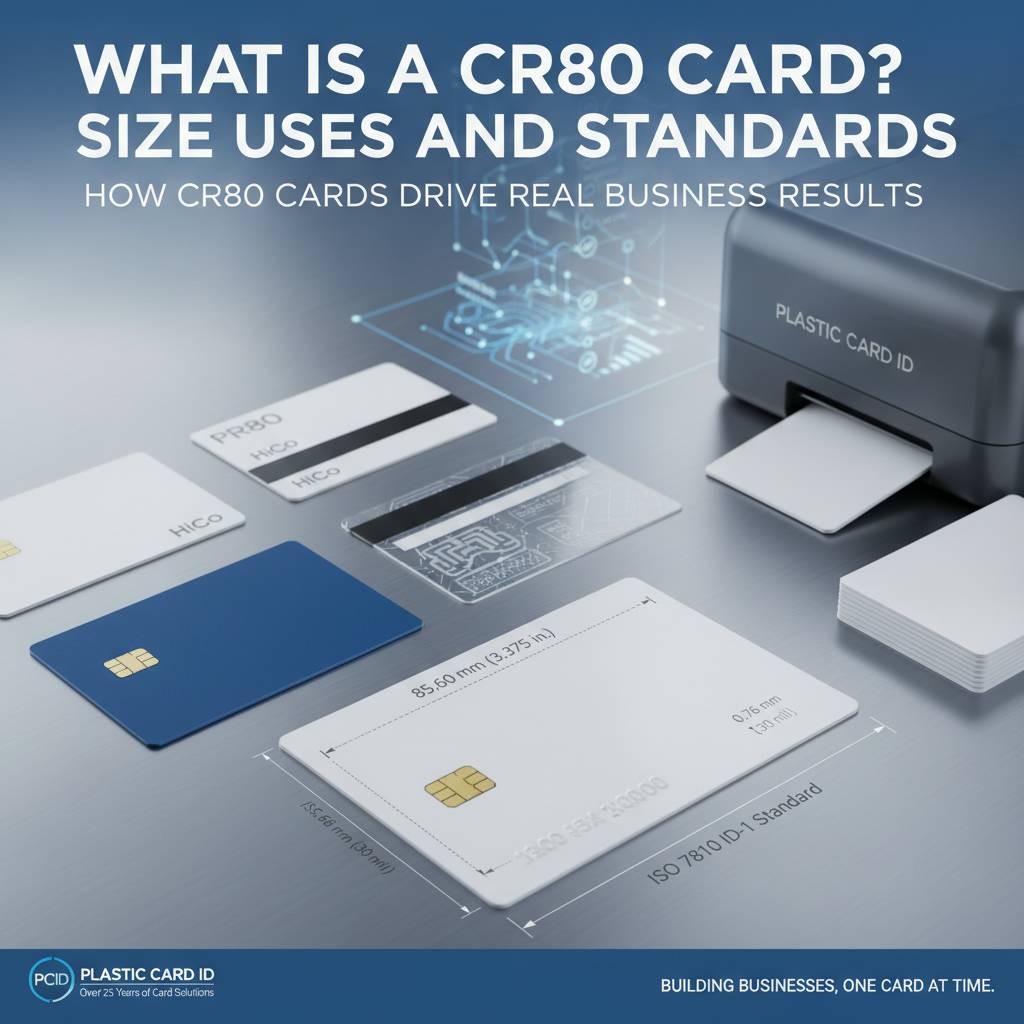
CR80 is the ISO 7810 international standard for card dimensions: 3.375 inches wide by 2.125 inches tall, at a thickness of 30 mil (0.030 inches). That's it. Simple enough on the surface. But that standardization is the foundation on which virtually every card reader, card printer, card holder, badge reel, and wallet slot in the world has been built. When your card is CR80, it works - everywhere, every time.
The ISO 7810 Standard Explained
ISO 7810 is an international standard defining the physical characteristics of identification cards. The CR80 designation falls under this standard as the ID-1 format - the same format used by bank cards, driver's licenses, hotel key cards, and employee badges worldwide. The "CR" stands for credit card, and "80" refers to the card's dimensions in compliance with that spec.
When a card conforms to CR80 dimensions, it fits every standard card printer, every wallet slot, every card reader tray, and every badge holder designed for that format. Deviation even by a fraction can cause jams, mis-reads, or rejection. Standardization isn't boring - standardization is reliability at scale.
Why 30 Mil Thickness Matters
The 30 mil thickness of a CR80 card is not arbitrary. It's the sweet spot between rigidity and workability - stiff enough to resist bending and folding under everyday use, thin enough to pass through card printers and readers without resistance. Cards that are too thick jam printers. Cards that are too thin feel cheap and crumple in pockets.
PVC at 30 mil also accepts printing beautifully. Whether you're running a direct-to-card thermal printer or a retransfer printer, the surface of a standard CR80 blank card receives ink, dye, and lamination layers exactly as designed. That perfect printability is why blank CR80 cards are the workhorse of in-house card programs across virtually every industry in the United States.
CR80 vs. Other Card Sizes
Not every plastic card is CR80. There are CR79 cards (slightly smaller, used inside clamshell badge holders), CR100 cards (larger than a standard card), and various custom die-cut shapes for specialty purposes. But CR80 remains the dominant format by an enormous margin - and for good reason. The global infrastructure of printers, readers, and holders is built around it.
If you're just starting a card program or scaling an existing one, CPE strongly recommends defaulting to CR80 unless your application specifically demands otherwise. Choosing the standard format eliminates compatibility headaches before they start.
| Card Format | Dimensions (inches) | Thickness | Common Use |
|---|---|---|---|
| CR80 | 3.375 x 2.125 | 30 mil | ID badges, loyalty, membership, gift cards |
| CR79 | 3.303 x 2.051 | 30 mil | Clamshell badge holders |
| CR100 | 3.88 x 2.63 | 30 mil | Insurance cards, specialty uses |
| Custom Die-Cut | Varies | Varies | Specialty promotional, luxury programs |
The Blank CR80 Card: A Platform, Not Just a Product
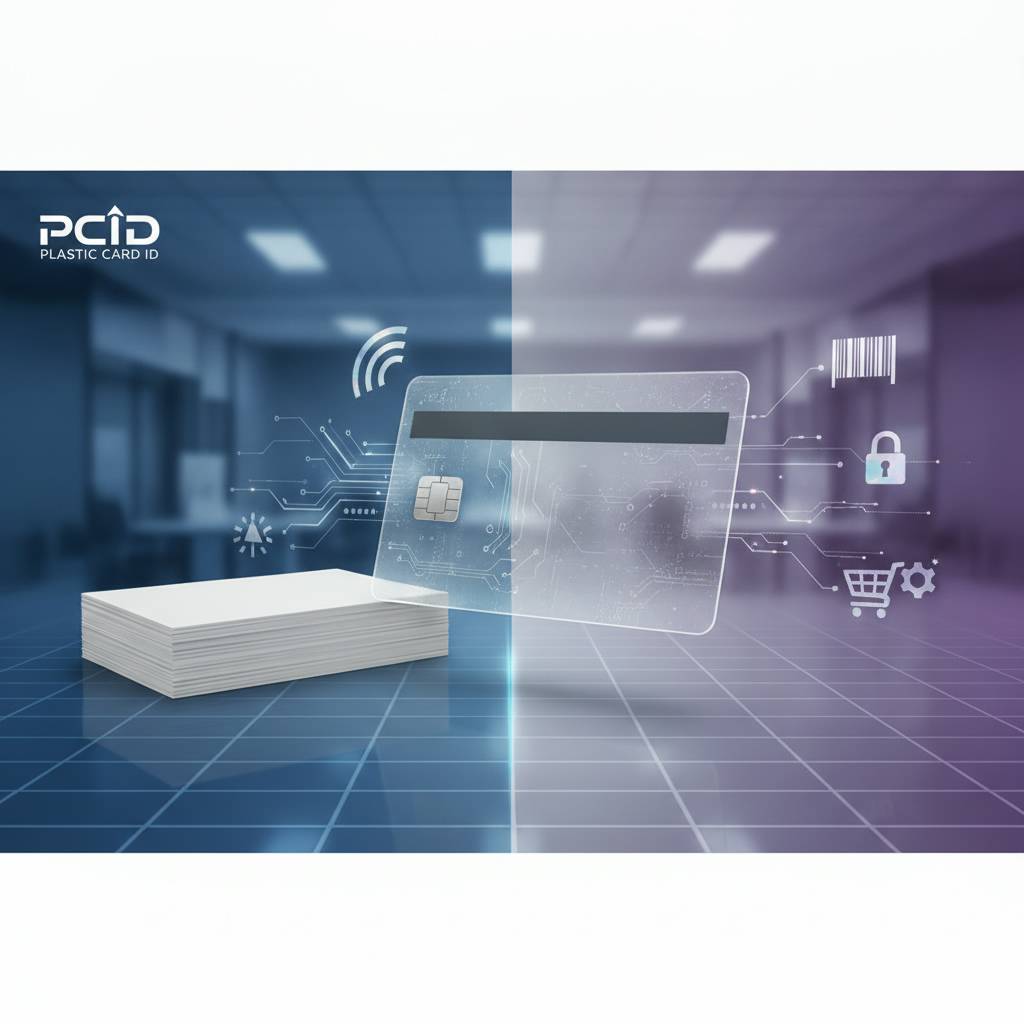 Here's what most people miss when they first explore blank plastic cards: a blank CR80 card isn't a finished product. It's a starting point - a platform. The same white PVC rectangle becomes an employee ID badge, a loyalty card, a hotel key, an event credential, or a gym membership card depending entirely on what you print, encode, or embed onto it.
That versatility is enormously valuable. Organizations that invest in a card printer and a stock of blank CR80 cards gain complete control over their card programs - design, timing, quantity, and cost. No waiting on print runs. No minimum order per design. Print five cards or five hundred on any given Tuesday morning.
What Can You Put on a Blank CR80 Card?
The surface of a blank CR80 card is a canvas. Direct-to-card printers apply dye-sublimation or thermal transfer printing directly onto the card surface, producing vivid, photo-quality images, logos, text, barcodes, and sequential numbering. Retransfer printers go one step further, printing onto a film that is then fused over the card surface - ideal for cards with embedded chips or antennas.
Beyond print, CR80 cards can be encoded with magnetic stripes (in HiCo or LoCo formats), embedded with RFID antennas and smart chips, or programmed with proximity technology. Every layer of functionality you add transforms the card into a more powerful tool. A printed card is a credential. A printed, encoded card is a functional access or transaction device.
Blank vs. Pre-Printed: Which Is Right for Your Program?
Blank CR80 cards are ideal when your organization needs flexibility - when names, photos, or data change frequently, or when you want to control production in-house. Pre-printed or custom-printed cards (where the base design is printed before you receive them) make sense when you have a consistent design across a large run and want to save printer ribbon by only overprinting variable data.
CPE carries both options. Many clients use a hybrid approach: receive cards with a pre-printed background design and overprint names or numbers in-house. This hybrid strategy cuts ribbon usage and speeds up personalization without sacrificing design quality. Call 800.835.7919 to discuss which approach fits your volume and workflow best.
Industries That Rely on Blank CR80 Cards Every Day
The list of industries that depend on CR80 cards is genuinely surprising in its breadth. Healthcare facilities print patient ID cards and staff credentials. Schools and universities issue student IDs and access badges. Retailers run loyalty and gift card programs. Hotels program room key cards. Gyms issue membership cards. Event organizers produce attendee credentials. Casinos issue player cards with encoded track data.
Each of these applications starts with the same blank CR80 card. What makes them different is the printer, the ribbon, the encoding, and the design. That's the elegance of a standardized platform - one card format, endless application possibilities.
CR80 Card Materials and Specialty Options
Not all CR80 cards are created equal. Standard white PVC is the most common substrate, but the world of CR80-format cards extends into specialty materials that open up entirely new program possibilities. Knowing your options ensures you match the right card to the right job rather than settling for a one-size-fits-all solution.
Material choice affects printability, durability, visual impact, and encoding capability. A decision made at the substrate level ripples through every aspect of your card program - which printer works, which ribbon to use, how long the card lasts, and how it feels in the recipient's hand.
PVC, Composite, and Specialty Substrates
Standard CR80 cards are made from PVC (polyvinyl chloride) - durable, flexible, and optimized for card printing. Composite cards, which blend PVC with polyester, are more durable and recommended for use with retransfer printers that apply heat to the card surface. Pure PVC cards can warp slightly under the high heat of a retransfer printer, while composite cards stay flat and true.
Clear and frosted CR80 cards offer a dramatically different aesthetic - perfect for programs where visual distinction matters. Colored PVC stock (available in a range of colors) lets you color-code departments, access levels, or membership tiers without any printing at all. The right substrate isn't just a material decision - it's a branding decision.
Magnetic Stripe CR80 Cards: HiCo vs. LoCo
Magnetic stripe CR80 cards come in two varieties: High Coercivity (HiCo) and Low Coercivity (LoCo). HiCo cards require a stronger magnetic field to encode and are far more resistant to accidental erasure from everyday magnets - making them ideal for access control, employee badges, and any card that needs a long, reliable service life. LoCo cards encode more easily and work well in short-term applications like event passes or hotel keys.
The magnetic stripe runs along the back of the card in a standardized position, compatible with virtually all swipe readers. Three data tracks (Tracks 1, 2, and 3) allow encoding of names, account numbers, discretionary data, and more. HiCo is the smart default for most business programs - pay a little more upfront, avoid re-encoding headaches down the line.
RFID, Smart Chip, and Proximity CR80 Cards
RFID CR80 cards embed an antenna and microchip within the card body itself - invisible from the outside, powerful from a functionality standpoint. Contactless smart cards using technologies like MIFARE DESFire can store and process data securely, enabling applications from building access control to transit systems to casino player tracking. Proximity cards (like 125kHz HID-format cards) are the workhorse of building access control across corporate America.
These cards look identical to a plain CR80 card. The technology is inside. And because they conform to CR80 dimensions, they work in every standard card printer that handles smart card encoding. CPE stocks a comprehensive range of RFID and proximity CR80 cards to match the most common access control systems in use today.
How CR80 Cards Drive Real Business Results
 There's a persistent myth that physical plastic cards are somehow less relevant in a digital world. The data tells a completely different story. Retailers who make the switch from paper punch cards or paper gift certificates to plastic CR80 cards consistently see measurable lifts in both sales and program participation. The card format itself - familiar, wallet-sized, durable - drives behavior in ways digital alternatives simply don't replicate.
Consider the gift card effect: retailers switching from paper gift certificates to plastic gift cards have documented sales increases of 35-50%. The card stays in the wallet. It gets handed to others. It triggers impulse purchases. Paper gets lost or forgotten in a drawer. Plastic gets used - and that difference has a dollar value attached to it.
Loyalty Programs: Why Physical Cards Still Win
A loyalty card that lives in someone's wallet is a marketing impression every time they open that wallet. It's a reminder of your brand, your program, and your value proposition - delivered repeatedly at zero ongoing cost. Digital loyalty apps require downloads, logins, and remembered passwords. A plastic CR80 loyalty card requires nothing except being in someone's wallet, which it is.
Program administrators consistently report higher participation rates, higher redemption rates, and stronger customer retention when loyalty programs are backed by physical plastic cards. The card signals commitment - from the business to the customer. A plastic card communicates that this program is real, substantial, and worth participating in.
Membership and ID Cards: The Legitimacy Signal
There's a reason every legitimate organization - from professional associations to fitness clubs to universities - issues plastic ID or membership cards rather than paper certificates. The card communicates permanence, investment, and seriousness in a way that paper simply cannot. It fits the wallet. It survives the wash cycle (mostly). It still looks professional after years of use.
For ID and access control purposes, a plastic CR80 badge with a printed photo, encoded magnetic stripe or RFID chip, and a clear laminate overlay is genuinely difficult to reproduce or tamper with. Physical security features make plastic ID cards dramatically more reliable than paper alternatives for any organization managing real access control requirements.
Event and Credential Cards That Command Respect
Event organizers increasingly use CR80-format plastic cards for attendee credentials, VIP passes, and staff identification. Unlike paper wristbands or printed paper badges, plastic cards photograph well (important in the social media age), last the duration of multi-day events without degrading, and can be encoded to control access to different zones or sessions.
Returned attendees keep plastic event cards as mementos. They don't keep paper lanyards. That retention extends your brand exposure well beyond the event itself - a marketing benefit that costs nothing extra once the card is already printed and distributed.
Choosing the Right Card Printer for Your CR80 Program
A CR80 card program without a printer is like owning a commercial kitchen without a stove. CPE supplies card printers from three of the industry's most trusted brands - Evolis, Zebra, and Fargo - each with distinct strengths suited to different volumes, applications, and budgets. Choosing the wrong printer for your program is one of the most common and costly mistakes organizations make.
The right printer depends on several factors: how many cards you print per month, whether you need single or dual-sided printing, whether your cards carry smart chips or magnetic stripes, what level of image quality you need, and whether lamination or other security overlays are required. Get these decisions right upfront and your program runs smoothly for years.
Entry-Level vs. High-Volume Printers
Entry-level card printers from Evolis (like the Primacy 2) or Zebra (ZC100/ZC300 series) are designed for organizations printing up to a few hundred cards per month. They're compact, reliable, easy to operate, and affordable. For a small business issuing loyalty cards or a school printing student IDs, an entry-level printer is the right starting point. No over-engineering required.
High-volume organizations - large corporations, universities, hospitals, event management companies - need printers built for sustained throughput. Fargo's HDP series and Zebra's ZXP Series 9 are engineered for thousands of cards per month with higher-grade internal components, faster print speeds, and modular options for encoding, lamination, and automated input/output hoppers.
Ribbons, Cleaning Kits, and Supplies
A printer is only as good as the consumables you run through it. CPE stocks a complete range of printer ribbons - YMCKO (full color with overlay), KO (black with overlay), monochrome options - for every printer model carried. Using the correct ribbon for your printer isn't optional; the wrong ribbon produces inferior results and can damage the print head over time.
Cleaning kits are equally non-negotiable. Dust, debris, and oils accumulate inside card printers and degrade print quality. Regular cleaning cycles using manufacturer-approved cleaning cards and swabs protect your investment and keep output quality consistent. Skipping maintenance is the number one cause of premature printer failure - a fact that experienced card program managers learn quickly. Call 800.835.7919 for guidance on the right supplies for your specific printer model.
Buyer Tips: What to Ask Before You Purchase
- How many cards will you print per month - now and in 12 months?
- Do your cards need single-sided or dual-sided printing?
- Will cards include magnetic stripes, RFID chips, or contact smart chips?
- Do you need a security laminate overlay for durability or tamper resistance?
- What is your budget for the printer itself vs. ongoing ribbon and supply costs?
- Does your IT environment support USB, Ethernet, or wireless connectivity?
- Do you need batch printing capability or card-by-card personalization?
Answering these questions honestly before you purchase saves significant money and frustration. CPE can match your answers to the right printer and consumable package, ensuring your program is built on the correct foundation from day one.
Frequently Asked Questions About CR80 Cards
After more than 25 years and over 100,000 customers served, CPE has heard virtually every question about CR80 cards. The following answers address the most common points of confusion for organizations building card programs for the first time or upgrading existing programs.
These aren't hypothetical questions - they come directly from real business owners, administrators, and program managers navigating the same decisions you may be facing right now.
Are CR80 cards the same as credit cards?
In terms of physical dimensions and format, yes - CR80 is the same standard used by banks for credit and debit cards. However, Plastic Card ID supplies CR80 cards strictly for business identity, loyalty, membership, access control, gift, and event card programs. We do not supply financial credit or debit cards and are not involved in payment processing of any kind.
The identical format means that CR80 cards from CPE fit every standard wallet slot, card holder, and card reader designed for credit card-sized cards. The format's ubiquity is what makes it so universally practical for business card programs.
What is the minimum order quantity for blank CR80 cards?
Plastic Card ID serves organizations of all sizes - from small businesses ordering 50 cards a month to large enterprises running mass production programs in the tens of thousands. There is no one-size-fits-all minimum, and the per-card cost naturally decreases as volume increases. Programs that scale over time benefit from pricing structures that reward growth.
Whether your program starts small or launches at volume, the right card is available at the right price. The important thing is matching your card type, encoding, and quantity to your actual operational needs rather than over- or under-ordering based on assumptions.
Can I print on CR80 cards without a special printer?
Standard office inkjet or laser printers are not designed for PVC card printing and will not produce acceptable results - and can actually damage the printer. CR80 card printing requires a dedicated card printer that uses dye-sublimation or thermal transfer technology specifically calibrated for the PVC card substrate. The investment in a proper card printer pays for itself quickly in quality, reliability, and program credibility.
For organizations that want professionally printed cards without investing in a printer, pre-printed custom card orders are available. CPE can guide you toward the option - in-house printing or custom orders - that makes the most financial and operational sense for your specific program size and needs.
Partner With Plastic Card ID for Your CR80 Card Program
A CR80 card is deceptively simple. Three and three-eighths inches wide. Two and one-eighth inches tall. Thirty thousandths of an inch thick. And yet within those precise dimensions lives the foundation of employee ID programs, loyalty ecosystems, access control systems, membership organizations, event management operations, and gift card programs that generate measurable revenue for businesses across the United States every single day.
Getting the right cards, the right printer, and the right supplies from a supplier who understands your program - not just your order - is what separates card programs that thrive from card programs that struggle. Plastic Card ID has spent over 25 years becoming exactly that kind of partner for more than 100,000 organizations across the country, delivering more than 50 million cards in the process. That experience is not incidental - it is the entire point.
Ready to build or upgrade your CR80 card program? Call 800.835.7919 today and speak with a card program specialist who will take the time to understand your operation and recommend the right solution - not just the nearest one.
Contact Plastic Card ID now at 800.835.7919 - your card program deserves a partner who has seen it all and can help you get it right from the start.
Previous Page