Custom vs Pre-Printed Blank Cards: Which Is Better
Table of Contents []
- Custom Printed Cards vs. Blank Cards: Which Strategy Actually Wins for Your Business?
- Understanding the Core Difference Between Custom and Blank Plastic Cards
- The Real Cost Comparison: Upfront Investment vs. Long-Term Savings
- Card Types and What They Mean for Your Printing Decision
- Use Case Spotlight: Which Businesses Benefit Most from Each Approach
- Frequently Asked Questions About Custom vs. Blank Card Programs
- How Plastic Card ID Supports Your Card Program From Day One
- Ready to Choose the Right Card Strategy? Plastic Card ID Is Your Next Call
Custom Printed Cards vs. Blank Cards: Which Strategy Actually Wins for Your Business?
Here is a question that stops more card program managers in their tracks than almost any other: do you buy cards pre-printed with your branding, or do you stock blank cards and print in-house? It sounds simple. It is absolutely not. The answer depends on volume, flexibility, budget timing, and how much control you want over the final product - and getting it wrong costs real money.
Plastic Card ID has navigated this exact decision with over 100,000 customers across the United States over the past 25-plus years. What we have learned is that neither option is universally superior. What matters is matching the right card strategy to your specific operation - your pace, your scale, your staffing, and your growth trajectory.
This guide breaks down both paths with honesty and precision. By the end, you will know exactly which approach fits your business, and you may find that the smartest programs use both.
| Feature | Custom Pre-Printed Cards | Blank PVC Cards In-House Printing |
|---|---|---|
| Upfront Cost | Higher per order | Lower per card over time |
| Design Flexibility | Fixed at print time | Fully adjustable anytime |
| Minimum Order | Typically 250-500 | As low as 50 cards |
| Personalization | Limited without re-ordering | Full variable data printing |
| Best For | Stable, high-volume programs | Agile, growing operations |
| Encoding Options | Must be specified upfront | Done on demand in-house |
Understanding the Core Difference Between Custom and Blank Plastic Cards
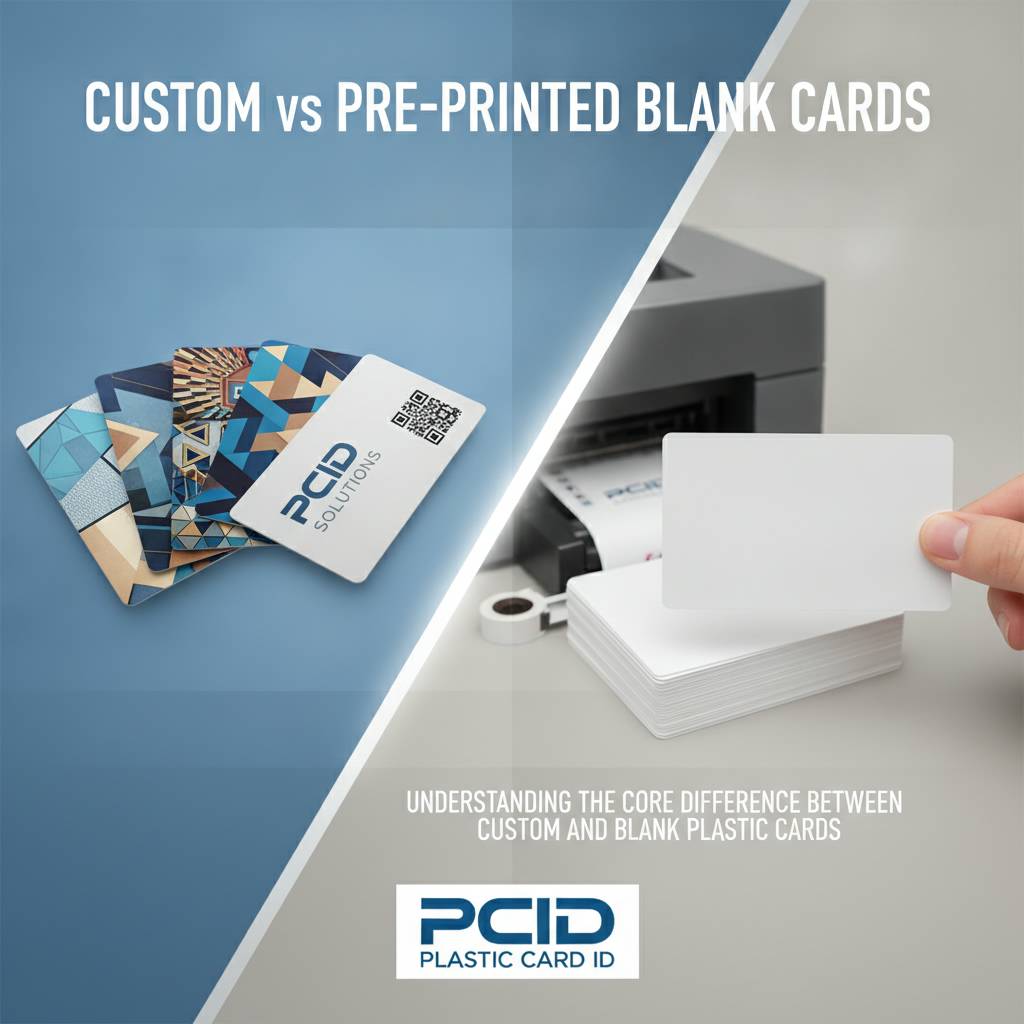 Let us define terms clearly, because the industry uses these phrases loosely and that causes confusion. Custom pre-printed cards arrive at your door fully designed - your logo, colors, background imagery, and any fixed text are already embedded into the card's surface through offset or digital commercial printing. You hand them out or load them into a printer only for variable data. Blank PVC cards are exactly that: clean, white (or colored) CR80-sized card stock, 30 mil thick, compliant with ISO 7810, ready for whatever you decide to put on them.
The distinction sounds cosmetic. It is actually operational. A pre-printed card commits you to a design the moment ink hits plastic. A blank card gives you a canvas that your desktop card printer can transform into an employee badge, a loyalty card, a membership credential, or an event pass - on demand, one at a time or in batches, with full personalization every single time.
What Goes Into a Custom Pre-Printed Card Order
When you order custom-printed cards, you are engaging a commercial print process. Design files are prepared to exact bleed specifications, proofed, approved, and then printed across your full run quantity. Encoding - magnetic stripes, RFID chips, smart card modules - must be specified before production begins, and any post-print services like card carriers or affixing for mailing are coordinated at the same time.
The result is a polished, professional card that requires zero additional equipment on your end. For organizations that issue a single, consistent card type in large volumes - retail gift card programs, hotel key cards, casino player cards - this model is efficient and cost-effective at scale. The per-card price drops significantly when you order in the thousands.
What Makes Blank Cards So Powerfully Flexible
Blank CR80 cards are the workhorse of in-house card programs, and the reason is simple: they give you total control. Your card printer - whether it is an Evolis Primacy, a Zebra ZC300, or a Fargo HDP5000 - takes that blank canvas and produces a finished card in seconds. You can print one card or a thousand, change the design between prints, add variable data like names and membership numbers, and encode magnetic stripes or smart chips in the same pass.
For organizations that manage multiple card types, run seasonal promotions, issue individual employee badges, or operate at an unpredictable pace, blank cards eliminate the waste and rigidity that come with pre-printed stock. Run out of one card type? Print more in minutes. Need to update your logo? Swap the template file and keep printing. There is no minimum order, no reprint cycle, and no pile of obsolete cards when your branding changes.
The Role of Card Printers in a Blank Card Program
Plastic Card ID carries a full lineup of card printers from three of the most trusted manufacturers in the industry: Evolis, Zebra, and Fargo. Each brand serves different production speeds, print quality requirements, and encoding capabilities. Choosing the right printer is as important as choosing the right card stock, and CPE can help match both to your specific program needs.
Printer ribbons, cleaning kits, and maintenance supplies are all available alongside the printers themselves, which means your entire operation ships from a single source. That logistical simplicity has real value - fewer vendors, fewer invoices, fewer delays when you need to restock quickly.
The Real Cost Comparison: Upfront Investment vs. Long-Term Savings
Money is where this decision gets genuinely interesting - and where conventional wisdom often steers businesses wrong. The instinct is to compare per-card prices. A blank card might cost $0.10-$0.25 each. A custom pre-printed card might cost $0.50-$1.50 each depending on quantity and finishing. The blank card looks cheaper. But that comparison is incomplete.
A blank card program requires a card printer, ribbons, and ongoing consumables. An entry-level single-sided printer might run $300-$800. A professional dual-sided retransfer printer could be $2,000-$5,000 or more. Ribbons for full-color printing typically yield 200-500 prints per panel set, adding $0.15-$0.60 per card in consumable costs. When you run the full numbers over 12-24 months, the crossover point - where blank cards become cheaper than pre-printed - typically falls somewhere between 500 and 2,000 cards per year depending on complexity.
When Pre-Printed Cards Win the Cost Argument
If your organization issues a single card design to thousands of recipients and rarely changes that design, pre-printed cards often win on total cost. A hotel ordering 10,000 key cards per year with a consistent brand design, encoded with the same RFID frequency, does not need in-house printing capability. The commercial print run handles everything at a low per-unit cost, and the hotel's staff simply loads pre-programmed key cards into the property management system.
The same logic applies to retail gift card programs. Retailers switching from paper gift certificates to plastic cards see sales increases of 35-50% - and those cards work best with high-impact commercial print quality that showcases the brand visually. The gift card is a marketing asset as much as a payment vehicle, and commercial printing delivers photo-quality results that a desktop card printer cannot always match.
When Blank Cards Deliver Superior ROI
Consider a mid-sized company issuing 800 employee badges per year across multiple locations, with frequent turnover, new hires, and occasional rebranding. Every design change requires a new pre-printed order with a new minimum quantity. Obsolete cards accumulate. Shipping delays slow onboarding. An in-house blank card program eliminates all of that friction entirely.
The same applies to loyalty programs that personalize cards with member names and numbers, membership organizations that issue cards on-site at enrollment, and event organizers who print credentials day-of. The speed and flexibility of in-house printing has a dollar value that never appears in a simple per-card price comparison but shows up clearly in operational efficiency.
Hidden Costs Worth Knowing Before You Decide
- Minimum order requirements on pre-printed cards often force you to buy more than you need, inflating effective per-card cost.
- Design revision fees can add up quickly if your branding or card information changes between production runs.
- Storage and obsolescence - pre-printed cards that sit in a drawer for 18 months may be outdated before they are used.
- Printer maintenance for in-house programs requires cleaning kits and occasional head replacements, which are real but predictable costs.
- Rush shipping for custom pre-printed card reorders can eliminate cost savings if your inventory runs low unexpectedly.
Card Types and What They Mean for Your Printing Decision
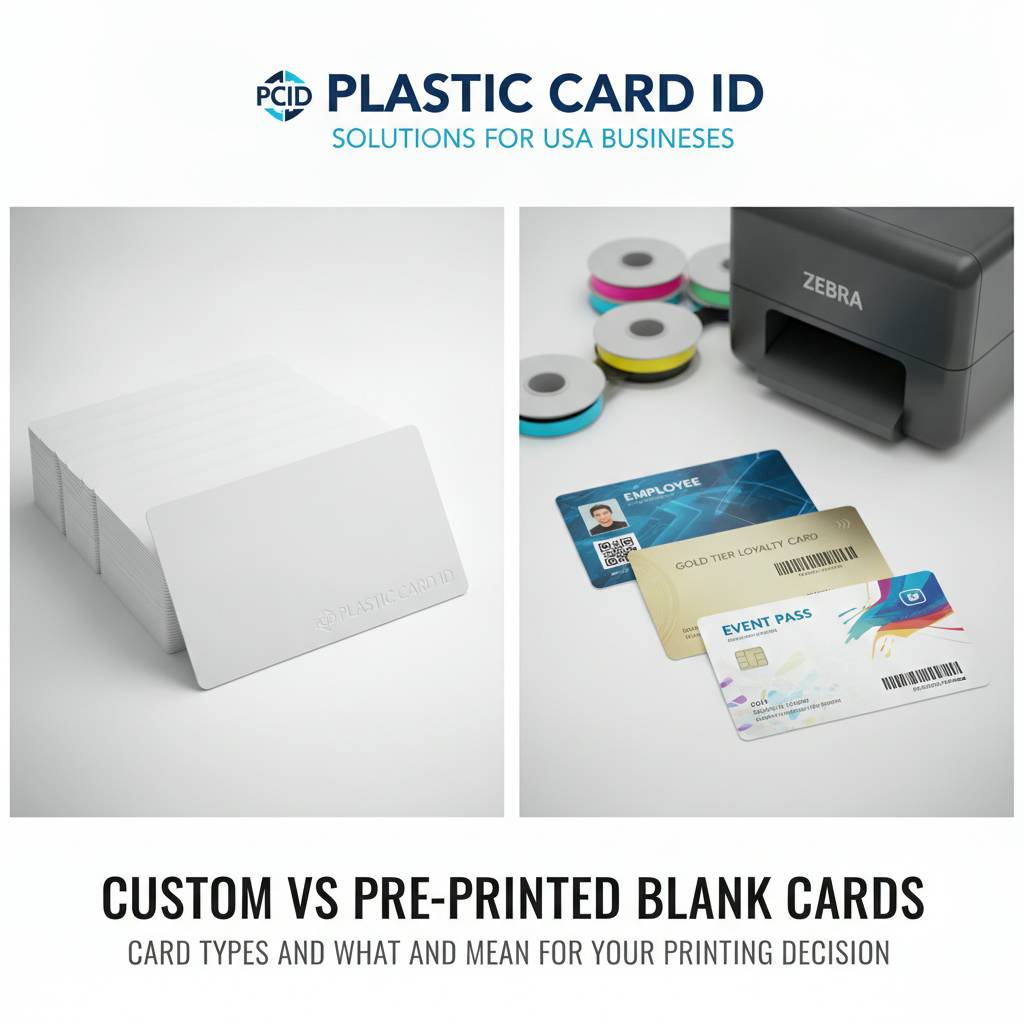 Not all plastic cards are created equal, and the type of card you need has a direct bearing on whether pre-printed or blank stock makes more sense. Magnetic stripe cards, RFID and proximity cards, smart chip cards, clear and frosted cards, and specialty formats each carry their own production considerations. Understanding these distinctions helps you make a decision that actually fits your program - not just your budget spreadsheet.
CPE stocks all of these card types in blank form, which means you can source the base card type you need and print or encode in-house. Alternatively, Plastic Card ID can supply fully finished custom cards with encoding, printing, and even card carriers or mailing services handled before the cards reach your door.
Magnetic Stripe Cards: HiCo vs. LoCo and What You Can Do In-House
Magnetic stripe cards come in two coercivity grades: HiCo (high coercivity) and LoCo (low coercivity). HiCo stripes are more resistant to accidental erasure from everyday magnets - they are the standard for access cards, gift cards, and loyalty cards that will be used repeatedly over months or years. LoCo stripes are sufficient for short-term use cases like hotel key cards with brief stay durations.
Both HiCo and LoCo magnetic stripe cards are available in blank form from Plastic Card ID, and desktop card printers with encoding modules can write data to these stripes during the print cycle. This means a single pass through your printer produces a fully printed and encoded card - no secondary processing required. For programs that issue cards with unique account numbers, member IDs, or access codes, in-house encoding is a game-changing capability that pre-printed card orders simply cannot provide on demand.
RFID, Proximity, and Smart Chip Cards in Blank and Custom Form
Proximity access cards (125kHz) and RFID smart cards (13.56MHz, including MIFARE DESFire and other advanced formats) represent the cutting edge of card-based access control and data storage. These cards contain embedded antennas and chips that communicate contactlessly with readers. They are widely used in hotel room access, corporate security systems, campus ID programs, and casino player tracking.
Blank RFID cards from Plastic Card ID can be printed and encoded in-house if your printer is equipped with a smart card or contactless encoding module. Pre-programmed cards are also available for organizations that prefer to outsource the encoding entirely. Casino player cards, hotel key cards, and high-security access credentials are all available through CPE, in whatever format best fits your operational model. Call 800.835.7919 to discuss encoding specifications before placing an order - the chip type, frequency, and data format must match your reader infrastructure exactly.
Specialty Cards: Clear, Frosted, Colored Stock, and Luxury Metal
Beyond the standard white PVC CR80, the card catalog expands into genuinely striking territory. Clear and frosted plastic cards create a distinctive visual effect that stands out in a wallet. Custom colored stock eliminates the need to print a background color entirely, reducing ribbon consumption and speeding up production. Die-cut shapes break the rectangle entirely for branded novelty cards that make an impression.
At the premium end, luxury metal cards - available in stainless steel, brass, and gold finishes - communicate exclusivity that no plastic card can replicate. These are not novelty items; they are serious membership and VIP program credentials used by organizations that want their card to feel as premium as the program it represents. Metal cards have a weight and permanence that recipients notice immediately, and they rarely end up discarded at the bottom of a bag.
Use Case Spotlight: Which Businesses Benefit Most from Each Approach
Theory is useful. Real-world application is more useful. The following scenarios represent the kinds of decisions Plastic Card ID helps customers navigate every week - from a single retail location launching its first loyalty program to a multi-site enterprise standardizing its access control infrastructure.
Retail Gift Card Programs: The Case for Custom Pre-Printed
A regional retail chain with 12 locations decides to launch a plastic gift card program to replace paper gift certificates. They need a consistent, brand-forward card that looks great in a display rack. The design will not change for at least two years. They expect to distribute 8,000 cards per year across all locations. This is a textbook case for custom pre-printed cards - commercial print quality, consistent branding, and volume economics that make per-card cost very attractive.
The chain can also take advantage of Plastic Card ID's card affixing and mailing services, shipping activation kits or card carrier packages directly to store locations or even to customers. Plastic gift cards consistently outperform paper certificates in average transaction value, repeat purchase rate, and brand recall - and a beautifully printed card is part of why.
Employee Badge and ID Programs: The Case for Blank Cards In-House
A healthcare organization employs 400 people across three facilities. Staff turnover runs at roughly 20% annually. Employees need photo ID badges that include their name, title, department, and an encoded magnetic stripe for time and attendance. Every badge is unique. Waiting for a custom print run each time a new employee starts is not operationally viable. This organization needs an in-house printing setup with blank PVC cards, a dual-sided printer with mag stripe encoding, and a database-connected card software solution.
The total investment in equipment might be $1,500-$3,000 upfront. Within the first year, the savings in rush shipping, reprint fees, and operational delay more than justify that investment. More importantly, new employees get their badge on day one - not day ten. That matters for access control, compliance, and first impressions.
Loyalty and Membership Programs: A Hybrid Approach That Works
Many loyalty and membership programs benefit from a hybrid strategy that Plastic Card ID is uniquely positioned to support. The card back and generic elements - barcode placement, standard terms, magnetic stripe - are produced commercially in a large blank-template run at low per-card cost. The card front, including member name and number, is printed in-house at enrollment using a desktop card printer. This splits the economic advantage of volume printing from the operational advantage of on-demand personalization.
Loyalty cards that live in wallets - physical, wallet-sized plastic cards - consistently outperform paper punch cards in program retention and visit frequency. The physical presence of a loyalty card in a customer's wallet is a perpetual brand impression that a mobile app notification simply cannot replicate in the same way. Membership organizations that issue physical cards signal legitimacy and permanence that paper documentation cannot match.
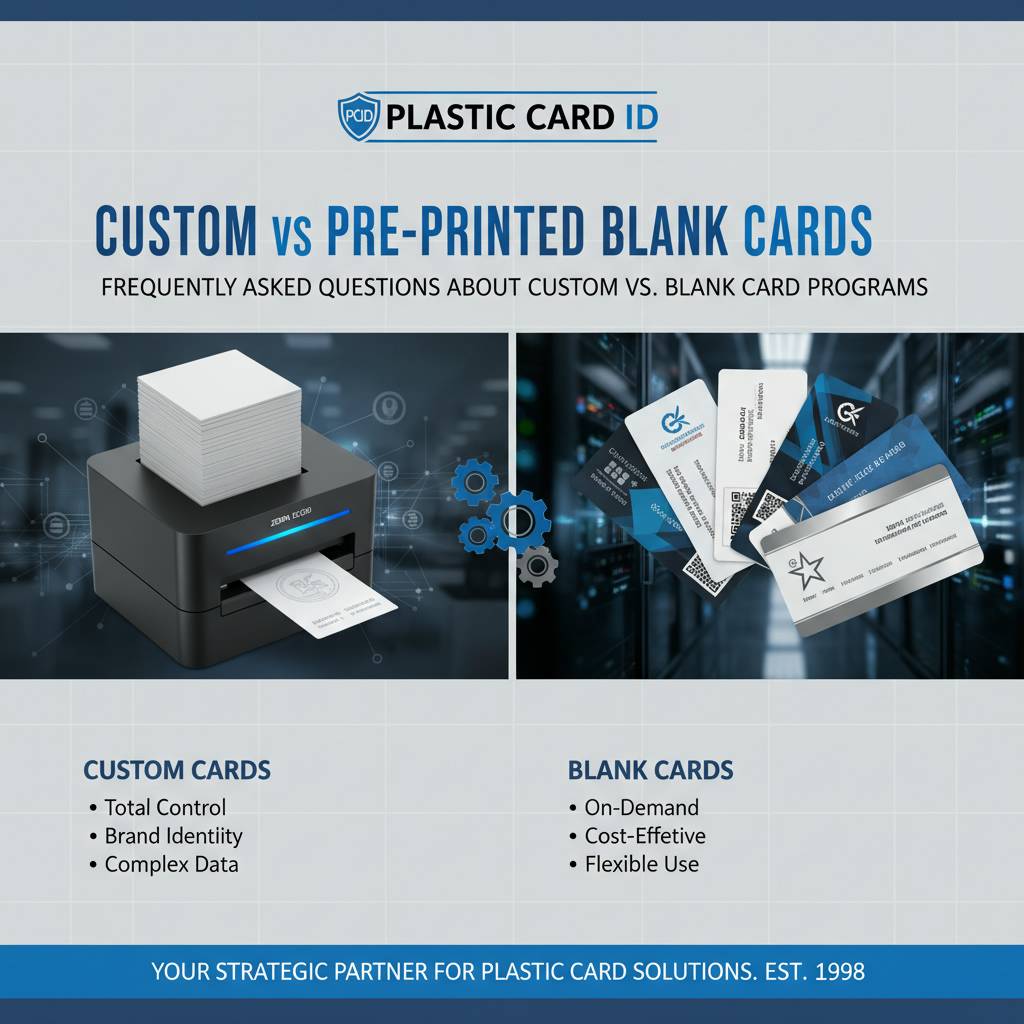
Frequently Asked Questions About Custom vs. Blank Card Programs
These are the questions Plastic Card ID hears most often from businesses evaluating their options. The answers reflect 25-plus years of helping programs succeed at every scale, from 50 cards a month to tens of thousands.
Can I Order a Small Quantity of Blank Cards to Test Before Committing?
Yes - and this is one of the most underused advantages of blank card programs. Plastic Card ID supports orders as small as 50 cards, which means you can test card stock type, thickness, and finish with your existing printer before making a large inventory commitment. This is especially valuable when evaluating whether a colored or frosted card stock will produce the print quality you expect with your specific printer model and ribbon type.
Testing at small scale before bulk ordering is a straightforward way to avoid the expensive mistake of stocking 5,000 cards that do not print the way you expected. CPE recommends requesting samples or starting with a test order whenever switching card stock types or introducing a new card format to your program.
What Happens When My Design Changes After I Have Stock on Hand?
This is the most common pain point reported by businesses that committed to large pre-printed card inventories without accounting for design evolution. A logo refresh, a new address, a rebranded program name - any of these can render a warehouse of pre-printed cards unusable, or at least awkward to distribute. Blank card programs have zero vulnerability to this problem because the design lives in your print template file, not on the card itself.
For organizations that know their branding is stable for two or more years, a custom pre-printed order at volume is a smart bet. For organizations in growth mode, in the middle of a rebrand, or operating across multiple departments with different card designs, blank cards with in-house printing eliminate reprint waste entirely.
How Do I Know Which Card Printer Is Right for My Volume and Card Type?
Printer selection depends on four factors: print volume per month, card type complexity (single-sided vs. dual-sided, with or without encoding), print quality requirements, and budget. Entry-level printers from Evolis, Zebra, and Fargo handle 200-500 cards per month comfortably. Mid-range models scale to 2,000-5,000 per month. High-volume retransfer printers like the Fargo HDP series can handle enterprise-scale production with superior edge-to-edge print quality.
- Evolis Primacy 2 - ideal for mid-volume programs with optional encoding modules
- Zebra ZC300 - compact, reliable, excellent for small to mid-size ID programs
- Zebra ZXP Series 7 - high-throughput dual-sided printing for busy operations
- Fargo HDP5000 - retransfer technology for superior edge-to-edge quality on any card surface
- Fargo DTC1500 - versatile mid-range workhorse for access control and ID programs
How Plastic Card ID Supports Your Card Program From Day One
Plastic Card ID is not simply a card vendor. Over 25 years and more than 50 million cards shipped, CPE has become a strategic partner for the organizations it serves - understanding their programs, anticipating their needs, and providing the supply chain reliability that keeps card programs running without disruption. Whether your program issues 50 cards a month or processes tens of thousands, the level of service scales with you.
The catalog spans every card type a U.S. business is likely to need: blank PVC in white and custom colors, magnetic stripe in HiCo and LoCo, RFID and proximity cards, smart chip cards, clear and frosted formats, and specialty options including die-cut shapes and luxury metal cards. Card printers, printer ribbons, cleaning kits, card carriers, sleeves, and card affixing and mailing services round out a genuinely one-stop supply source.
Ongoing Supply and Replenishment Made Simple
One of the most underappreciated aspects of working with a specialist like Plastic Card ID is inventory continuity. Card programs fail when supplies run out at the wrong moment - a new employee cannot be badged, a loyalty card cannot be issued at enrollment, an event credential is not ready for distribution. Reliable, consistent supply is not a luxury; it is an operational necessity.
Building a replenishment rhythm with CPE means your team is not scrambling for cards at the last minute. Standard reorder cycles, volume pricing tiers, and fast shipping from a dedicated U.S. supplier eliminate the supply chain anxiety that plagues programs relying on inconsistent sources. This is the kind of operational steadiness that lets card programs scale without chaos.
Value-Added Services That Complete the Picture
Beyond the cards and printers themselves, Plastic Card ID offers the accessories and finishing services that transform card stock into a finished, deliverable product. Card carriers present loyalty and membership cards professionally at point of enrollment or in a retail setting. Card sleeves protect credentials in high-use environments. Affixing and mailing services handle the logistics of getting cards to recipients directly - useful for large membership organizations, subscription services, or programs that mail cards to new members nationwide.
These services matter because a card program is only as good as the end-to-end experience it delivers. A beautifully printed card that arrives damaged, or that gets lost because it was mailed without a carrier, undermines the impression you worked to create. Every detail in the card fulfillment chain reflects on your organization's professionalism. CPE helps organizations get every detail right, from the first card ordered to the thousandth mailed.
Who Plastic Card ID Serves Across the United States
Plastic Card ID serves businesses and organizations exclusively within the United States, across virtually every industry vertical that uses card-based programs: retail, hospitality, healthcare, education, corporate enterprise, government, nonprofit membership organizations, casinos, event management companies, and more. The common thread is not industry - it is the need for a reliable, expert card program partner who can support programs of any size without bureaucratic friction.
It is worth noting clearly: Plastic Card ID does not supply financial credit or debit cards and does not process payments. The focus is identity, access control, loyalty, membership, marketing, and event card solutions - the programs that businesses operate and manage themselves, powered by physical plastic cards that deliver measurable results.
Ready to Choose the Right Card Strategy? Plastic Card ID Is Your Next Call
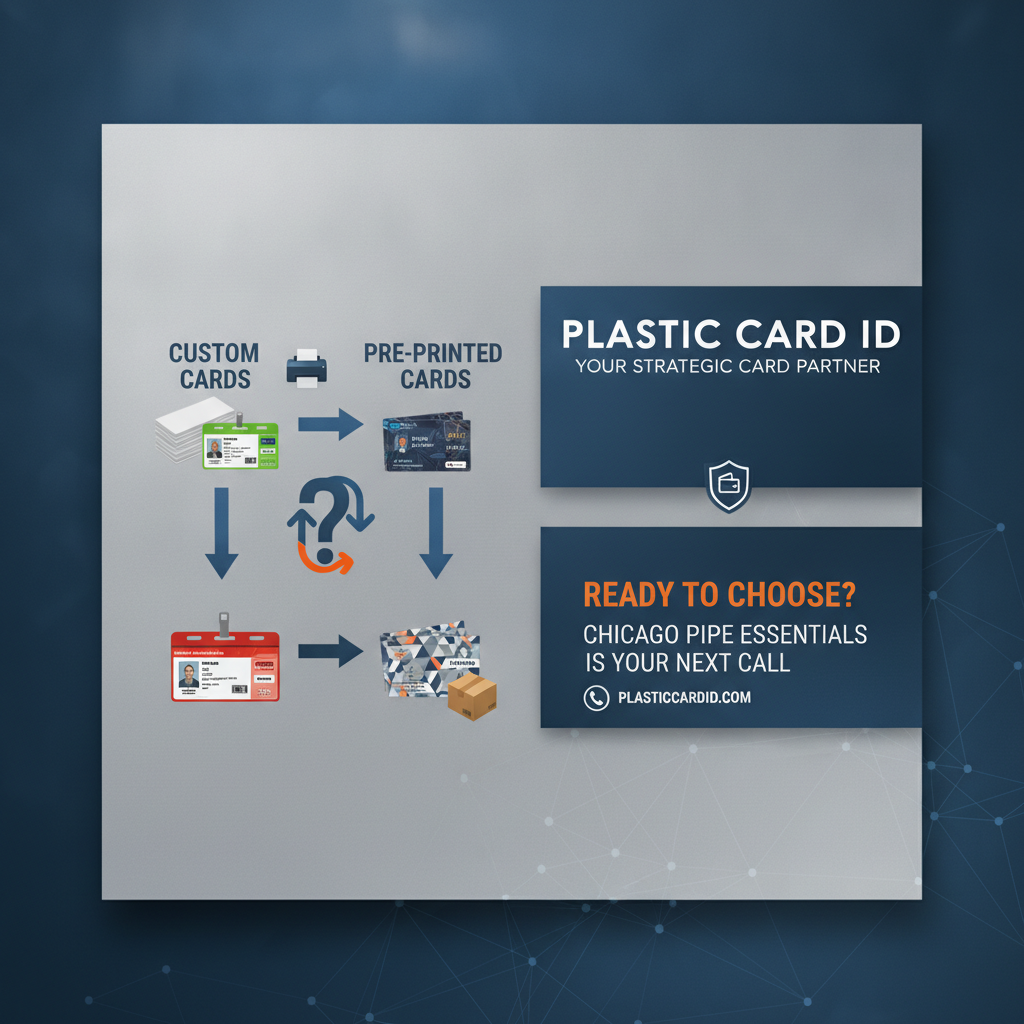 The custom vs. blank card decision does not have a universal right answer - but it does have a right answer for your specific program. The variables are knowable: your volume, your design stability, your personalization requirements, your budget timeline, and your operational capacity. What takes years to develop is the pattern recognition to see quickly which approach fits which scenario.
That pattern recognition is what Plastic Card ID brings to every conversation. More than 100,000 customers. More than 50 million cards. Twenty-five-plus years of helping programs succeed at every scale. The expertise is real, the catalog is comprehensive, and the commitment to your program's success is genuine.
Call Plastic Card ID today at 800.835.7919 and speak directly with a card program specialist who can help you evaluate your options, calculate your true total cost of ownership, and get your program set up for long-term success. Whether you need 50 blank cards or a custom run of 50,000, CPE has the supply, the expertise, and the service to deliver.
Previous Page