Blank Plastic Card Supplier Checklist: What to Verify
Table of Contents []
- Your Blank Plastic Card Supplier Checklist: What Plastic Card ID Wants You to Know Before You Buy
- Why Card Stock Quality Is the Foundation of Every Program
- The Encoding Spectrum: Matching Card Technology to Your Application
- Evaluating Supplier Reliability: The Questions That Reveal the Real Story
- Card Printers and Supplies: Why Your Card and Printer Must Work Together
- Real-World Impact: What Plastic Cards Actually Deliver for Businesses
- Your Complete Buyer's Checklist Before Placing a Blank Plastic Card Order
- Work With Plastic Card ID - A Partner Built for the Long Run
Your Blank Plastic Card Supplier Checklist: What Plastic Card ID Wants You to Know Before You Buy
Choosing a blank plastic card supplier is not as straightforward as it might first appear. The wrong partner - one who ships inconsistent stock, fumbles bulk orders, or leaves you hunting for compatible ribbons - can quietly derail an entire card program before it gains any momentum. The stakes are real, and the checklist matters.
Whether you are launching a loyalty program, scaling up employee ID badges, or issuing event credentials for thousands of attendees, the supplier you choose shapes every downstream result. This guide walks you through exactly what to evaluate, what questions to ask, and what separates a strategic card partner from a box-shipper who happens to stock plastic.
| Checklist Category | What to Verify | Why It Matters |
|---|---|---|
| Card Specifications | CR80 size, 30 mil thickness, ISO 7810 | Ensures compatibility with card printers |
| Encoding Options | HiCo/LoCo mag stripe, RFID, chip | Matches your access or loyalty system |
| Order Flexibility | Minimum orders, bulk pricing tiers | Supports programs at any scale |
| Supply Chain Reliability | USA-based fulfillment, stock depth | Prevents costly program interruptions |
| Ancillary Products | Printers, ribbons, cleaning kits, sleeves | One-stop sourcing reduces vendor complexity |
Why Card Stock Quality Is the Foundation of Every Program
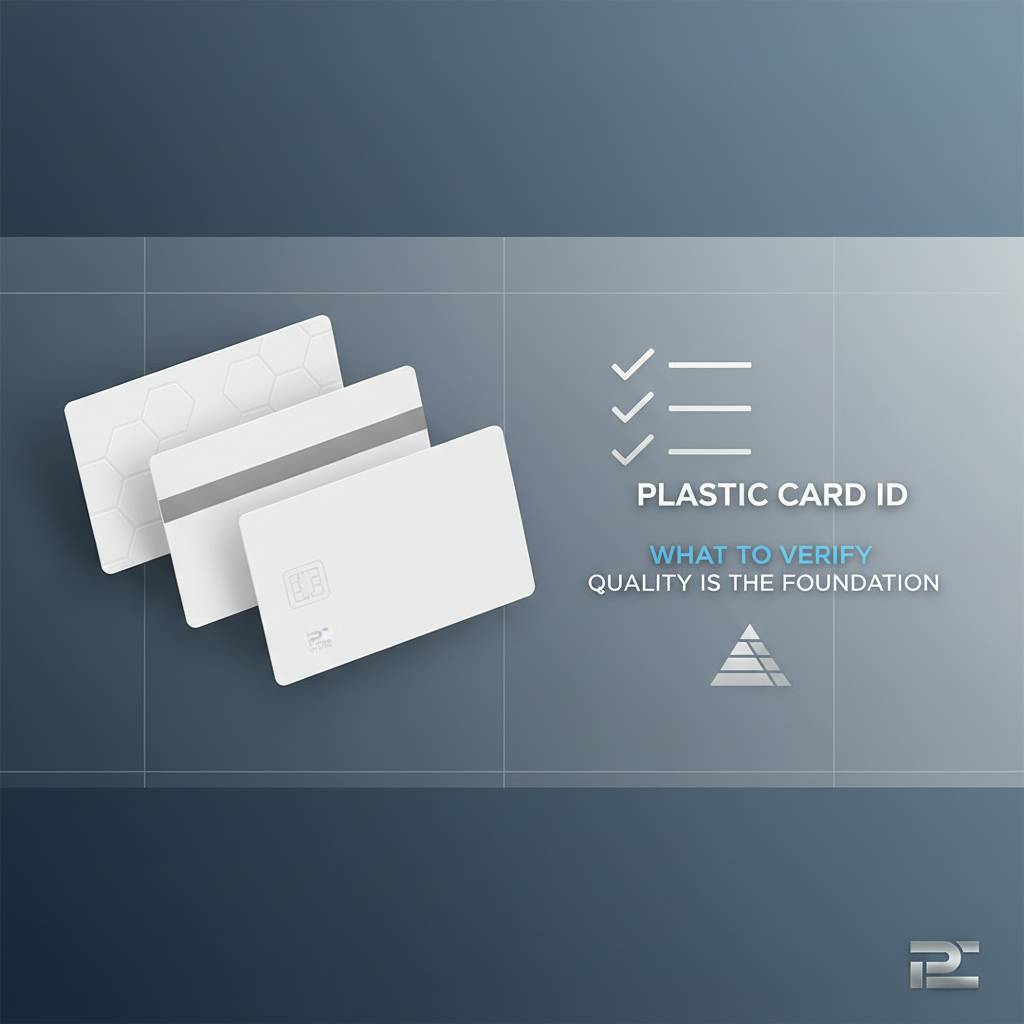 It starts with the card itself. A plastic card that warps under a printer's lamination roller, that feeds inconsistently through a card dispenser, or that cracks at the first sign of daily wallet friction - that card undermines everything built on top of it. Card stock quality is the single most consequential variable in any in-house card program, and it rarely gets the attention it deserves until something goes wrong.
Standard CR80 blank PVC cards measure 3.375 x 2.125 inches at 30 mil thickness, conforming to the ISO 7810 ID-1 standard. That is not a coincidence of industry convention - it is the reason your cards work seamlessly in every printer, every reader, every cardholder, and every wallet slot on the market. Deviation from that spec, even slightly, introduces friction at every point downstream.
What CR80 30 Mil Means for Your Operation
The 30 mil specification refers to card thickness - 0.030 inches, to be precise. This is the thickness that card printers from Evolis, Zebra, Fargo, and similar manufacturers are calibrated to handle. Go thinner and the card may buckle during thermal printing. Go thicker and the printer's rollers may jam or damage the printhead over time.
Consistency across your card stock supply matters as much as the spec itself. A supplier whose batch-to-batch thickness varies by even a few thousandths of an inch will cause irregular print quality, misalignment, and - eventually - printhead wear that results in costly repairs. Always ask for tolerance specifications before committing to a supplier.
PVC Composition and Print Receptivity
Not all PVC cards accept dye-sublimation printing equally. The surface treatment on a quality blank card is engineered to allow YMCKO ribbon layers to bond cleanly, producing sharp edges on text, accurate color representation on graphics, and durable laminate overlay adhesion. A card with inconsistent surface treatment will produce banding, color shifts, or peeling overlaminates - problems that look unprofessional and accelerate card failure.
When evaluating suppliers, request sample cards and run them through your specific printer model before placing a significant order. What works beautifully with one card stock formulation may underperform with another, and the only way to know is to test. CPE makes this evaluation process easy by maintaining a well-documented catalog of card types and their typical use cases.
Blank Cards vs. Pre-Printed Stock: A Strategic Decision
Some organizations default to ordering fully printed cards from a commercial printer, receiving finished cards ready to distribute. Others maintain a stock of blank PVC cards and print in-house as needed. The in-house approach delivers total design control, faster issuance, and significantly lower per-card cost over time - but only when the blank card stock is right and the printer setup is properly matched.
For organizations issuing fewer than 500 cards per month, in-house printing with quality blank stock almost always wins on cost and speed. For larger volumes, the calculus shifts, and a hybrid approach often makes the most sense. A knowledgeable supplier helps you model both options honestly rather than steering you toward whatever generates the higher margin sale.
The Encoding Spectrum: Matching Card Technology to Your Application
Blank plastic cards are blank in name only. Within their layers, these cards can carry magnetic stripes, embedded RFID antennas, contact chip modules, or nothing at all - and that embedded technology determines everything about how the card functions in the real world. Choosing the wrong encoding technology is one of the most common and most expensive mistakes organizations make when setting up a card program.
The encoding decision should always begin with the end application. An employee access control system, a retail gift card program, a hotel key system, and a casino player card all operate on different infrastructure, speak different data protocols, and require different card technologies. Working backward from the application - rather than forward from what cards happen to be cheapest - is the mark of a genuine program partner.
Magnetic Stripe Cards: HiCo and LoCo Explained
Magnetic stripe cards come in two primary varieties: High Coercivity (HiCo) and Low Coercivity (LoCo). HiCo cards use a stronger magnetic field to store data, making them more resistant to accidental erasure from everyday magnets and magnetic interference. LoCo cards store data at lower field strength, making them easier to encode and re-encode - but more susceptible to demagnetization.
HiCo stripes are the default choice for most access control, employee ID, and loyalty applications where card longevity matters. LoCo stripes appear most commonly in short-use applications like hotel key cards, where the card will be discarded after a brief stay. Selecting HiCo for a long-term loyalty program and LoCo for a hotel key program is not overthinking - it is correct program design.
RFID, Proximity, and Smart Chip Technologies
Contactless cards represent the growing edge of card program technology. Proximity cards operate at 125 kHz and are widely used in legacy access control systems - cost-effective, reliable, and broadly compatible. RFID smart cards, including those using the MIFARE DESFire platform, operate at 13.56 MHz and support encrypted, multi-application data storage that proximity cards simply cannot match.
For organizations building new access control infrastructure, smart card technology offers substantially better security and flexibility. MIFARE DESFire EV2 and EV3 platforms support multi-sector data, application-level encryption, and mutual authentication - features that matter enormously for high-security environments. Smart chip contact cards add another layer of data storage for applications requiring both physical and digital credential verification.
Specialty Cards: Clear, Colored, Die-Cut, and Metal
Standard white CR80 cards handle the majority of programs, but specialty stock unlocks design possibilities that create genuinely memorable cardholder experiences. Clear and frosted cards, for example, allow printed graphics to interact with the card's translucency - producing visual effects that opaque white cards cannot replicate. Colored core stock eliminates the white edge visible when a card is cut, creating a more polished finished product.
At the premium end, luxury metal cards in stainless steel, brass, and gold deliver a sensory experience - weight, sound, temperature - that plastic fundamentally cannot. Casino player cards, executive membership credentials, and VIP access tokens benefit enormously from the perceived value metal communicates. The physical object becomes part of the brand message. For organizations where that distinction matters, the investment pays dividends in engagement and retention.
| Card Technology | Typical Application | Key Advantage |
|---|---|---|
| HiCo Magnetic Stripe | Loyalty, employee ID | Durable, long-term encoding |
| LoCo Magnetic Stripe | Hotel key cards | Easy re-encoding for short-use |
| 125 kHz Proximity | Legacy access control | Wide infrastructure compatibility |
| MIFARE DESFire RFID | High-security access, multi-use | Encrypted, multi-application |
| Metal Card | VIP, casino, executive programs | Premium perceived value |
Evaluating Supplier Reliability: The Questions That Reveal the Real Story
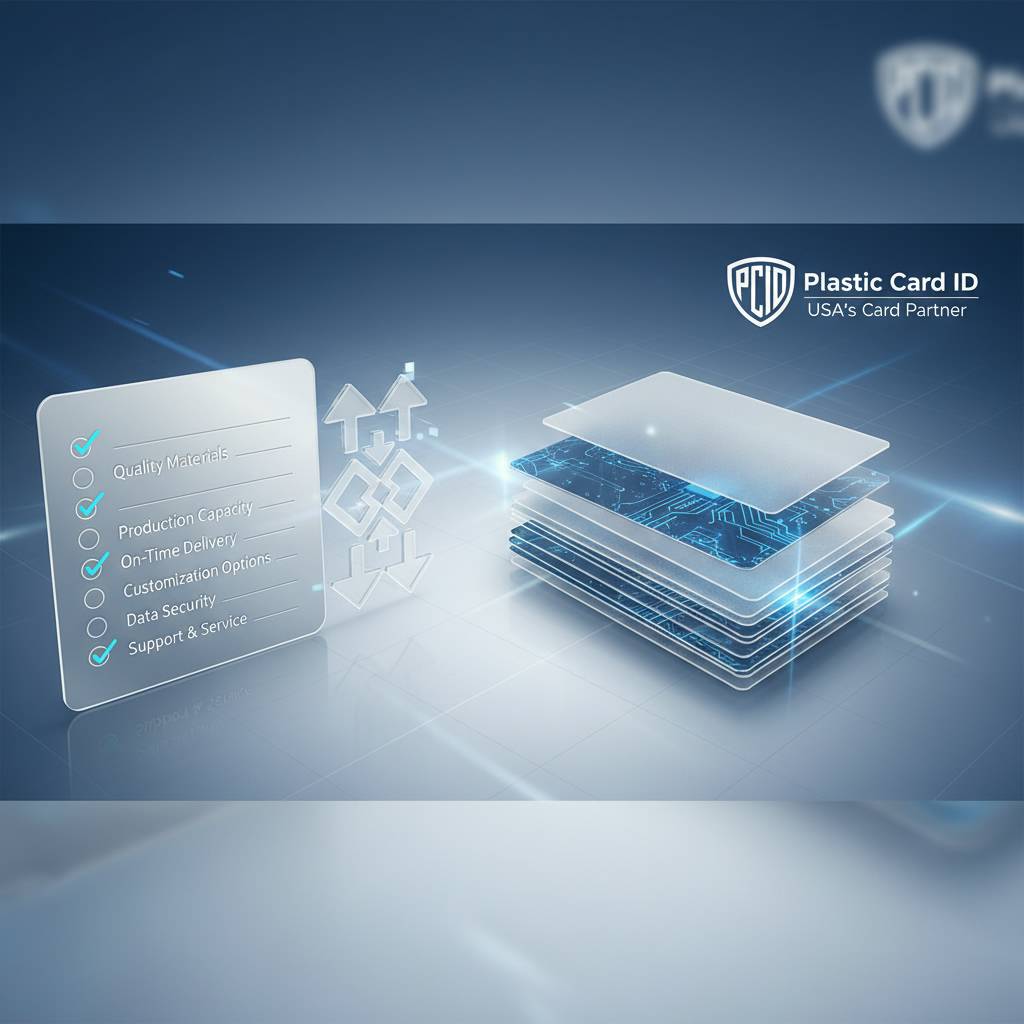 Every supplier claims reliability. The ones who actually deliver it respond to questions about stock depth, lead times, and order minimums with specific, verifiable answers - not marketing language. A reliable supplier knows their inventory in real time and communicates proactively when supply conditions change. That distinction matters enormously when your card program is a live operational dependency, not a discretionary purchase.
For USA-based businesses, domestic fulfillment should be a baseline expectation, not a premium feature. Overseas suppliers may offer lower per-unit pricing, but the carrying cost of longer lead times, the risk of customs delays, and the complexity of resolving quality disputes across international shipping lanes frequently erases those savings - and then some.
Key Questions for Your Supplier Evaluation
- What is your standard in-stock depth for CR80 blank white PVC cards, and how quickly can you fulfill an order of 5,000 or 50,000 cards?
- Do you stock HiCo and LoCo magnetic stripe cards in quantity, or are those special-order items with extended lead times?
- What is your minimum order quantity, and do you offer pricing tiers that reward volume purchasing?
- Can you supply card printers, ribbons, and cleaning kits - or will I need to source those from a separate vendor?
- Do you offer card carriers, sleeves, or mailing services for programs that require card distribution?
- How do you handle defective stock, and what is your return or replacement policy?
- Have you supported card programs similar to mine in scale and application type?
The answers to these questions - not the marketing materials - reveal the operational reality of what a supplier can actually deliver. A partner with 25-plus years of experience serving over 100,000 customers and 50 million cards sold will answer these questions with the kind of specificity and confidence that comes only from having done this at scale, repeatedly, across industries.
Red Flags in Supplier Responses
Vague answers about lead times, reluctance to specify card tolerances, an inability to describe their encoding technology in detail, and the absence of any ancillary product offering are all warning signs worth taking seriously. A supplier who cannot explain the difference between HiCo and LoCo, or who has never heard of MIFARE DESFire, is not equipped to support a modern card program. Expertise is not optional - it is the whole point of a strategic partnership.
Similarly, suppliers who cannot confirm ISO 7810 compliance for their blank card stock are taking a risk with your program. Non-compliant cards introduce compatibility failures at the printer level that manifest as production downtime, wasted ribbon, and premature printhead failure. The cost of a non-compliant card is always higher than the cost of a compliant one, regardless of price-per-unit.
Understanding Pricing Structures and Hidden Costs
Per-card pricing tells only part of the story. Shipping costs, minimum order requirements, ribbon compatibility costs, and the overhead of managing multiple vendors for cards versus printers versus accessories can significantly inflate the true cost of a card program. A one-stop supplier who offers competitive per-card pricing and bundles ancillary products frequently delivers better total economics than a cheaper-on-paper single-product vendor.
Request itemized quotes that include shipping, and compare total landed cost rather than per-unit cost alone. For recurring programs, model the annual cost across multiple order frequencies - a supplier with better volume pricing tiers may outperform a cheaper small-order competitor once you are ordering at scale. CPE helps clients run these comparisons honestly so they can make genuinely informed decisions.
Card Printers and Supplies: Why Your Card and Printer Must Work Together
A card printer is not a commodity peripheral - it is precision manufacturing equipment calibrated to specific card tolerances, ribbon chemistries, and lamination pressures. The printer and the card stock are a system, not two independent components, and sourcing them from a single knowledgeable supplier dramatically reduces the friction of getting that system dialed in correctly.
Evolis, Zebra, and Fargo represent the leading card printer platforms for in-house issuance programs. Each brand has distinct strengths across different program scales and print quality requirements. Evolis printers are particularly well-regarded for small-to-medium volume programs requiring excellent image quality. Zebra's platform excels in high-volume issuance with robust reliability. Fargo printers offer strong security feature support for high-assurance credential programs.
Ribbon Selection and Consumable Compatibility
Printer ribbons are consumables with a direct impact on both print quality and per-card cost. YMCKO ribbons - covering Yellow, Magenta, Cyan, Black, and Overlay panels - are standard for full-color card printing. KO ribbons handle monochrome printing at significantly lower cost per card for applications where color is not required. Selecting the right ribbon type for your application is not a minor detail; it directly determines your program's consumable budget.
Ribbon compatibility is specific to printer model - an Evolis Primacy 2 ribbon is not interchangeable with a Zebra ZC300 ribbon. A supplier who stocks ribbons for the printers they sell, and who can advise on yield per ribbon roll for your specific card design, eliminates a significant category of operational guesswork. Call 800.835.7919 to discuss which ribbon configuration best matches your printer and program volume.
Cleaning Kits and Preventive Maintenance
Card printer longevity is almost entirely a function of cleaning discipline. Dust, debris, and card stock residue accumulate on rollers and printheads over time, degrading print quality and - if left unaddressed - causing premature component failure. Most printer manufacturers specify cleaning intervals in cards-printed, and following those intervals is the single most cost-effective maintenance practice available to any card program operator.
Cleaning kits are not optional accessories - they are operational necessities for any program running more than a few hundred cards per month. Sourcing cleaning kits from the same supplier as your cards and printer simplifies procurement and ensures you have the right cleaning media for your specific printer model. Swabs, cleaning cards, and isopropyl cleaning rollers are not interchangeable across platforms.
Card Carriers, Sleeves, and Mailing Services
For programs that distribute cards to cardholders by mail - loyalty programs, membership organizations, employee onboarding - card carriers, sleeves, and affixing services are as operationally important as the cards themselves. A card carrier provides a branded, professional presentation surface. A sleeve protects the card surface during mailing. Affixing services streamline the process of attaching cards to carriers at scale.
Organizations that manage all of this in-house frequently underestimate the labor cost of stuffing, affixing, and mailing at volume. Outsourcing card mailing services to a supplier equipped to handle it eliminates that overhead and ensures professional, consistent presentation at every cardholder touchpoint. It is a detail that compounds quietly into significant program quality over time.
Real-World Impact: What Plastic Cards Actually Deliver for Businesses
There is a persistent temptation to treat the card medium as incidental - as if a loyalty card is just a loyalty card, regardless of what it is made of. The numbers argue otherwise. Retailers who switch from paper gift certificates to plastic gift cards reliably see sales increases in the 35-50% range, driven by improved visibility, card retention, and the psychological weight of a physical object worth keeping.
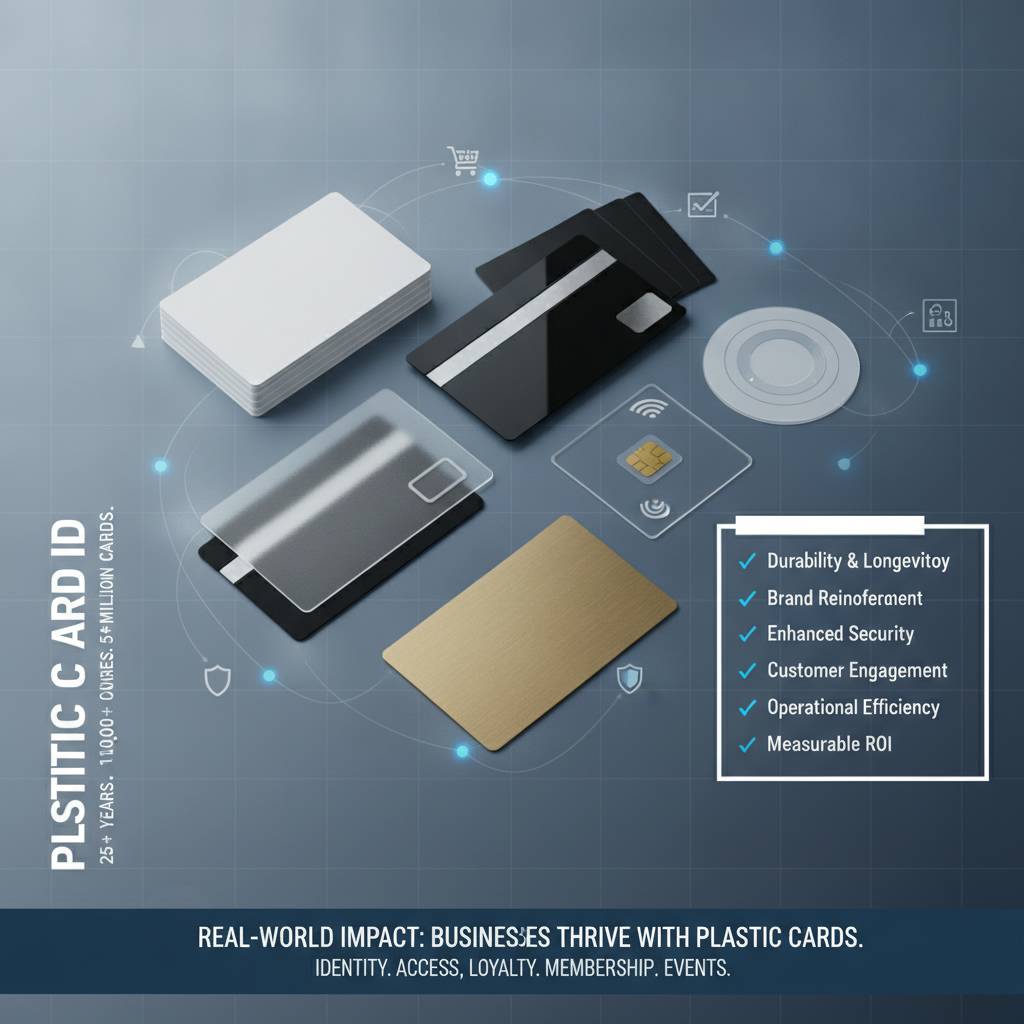
Plastic cards that live in wallets outperform paper punch cards on every measurable dimension. They are more likely to be carried, more likely to be used, and more likely to generate return visits. The card medium is not a delivery mechanism for a loyalty program - it is an active participant in driving program engagement. Paper is not a cheaper version of plastic. It is a different product with meaningfully inferior performance outcomes.
Loyalty and Gift Card Programs
For retail and hospitality businesses, the shift from paper to plastic is almost never regretted. A plastic loyalty card signals seriousness, communicates that the program has permanence and worth, and travels with the customer in a way that paper rarely does. The investment in blank plastic card stock and an in-house printer pays for itself quickly when measured against the incremental revenue driven by improved program engagement.
Gift card programs benefit additionally from card reloadability - a feature that paper categorically cannot support. A customer who receives a plastic gift card and reloads it is worth dramatically more over time than one who exhausts a paper certificate and moves on. Building reload capability into a gift card program transforms a one-time purchase into an ongoing customer relationship, and it starts with the right card stock and encoding technology.
Membership and ID Card Programs
Membership organizations, fitness clubs, professional associations, and institutions of every description use plastic ID and membership cards to communicate legitimacy, belonging, and permanence. A paper membership card looks temporary. A plastic card - durable, wallet-sized, professionally printed - communicates that the organization behind it takes itself seriously and expects the cardholder to do the same. That perception gap has real consequences for member retention and engagement.
Employee ID programs benefit from identical logic. A plastic badge is a credential. Paper is a temporary measure. For organizations where security, professional appearance, or regulatory compliance drives ID badge requirements, blank plastic card stock combined with in-house printing capability delivers exactly the control and consistency those requirements demand.
Access Control and Event Credentials
Event credentials, conference badges, and access control cards share a common requirement: they must function reliably at the point of use, every single time. A credential that fails at an access reader or scans incorrectly at an event gate creates a cascade of operational problems that extends far beyond the individual failure. Card stock quality and encoding precision are not negotiable in these applications.
For recurring events or access programs, establishing a reliable supply chain with a proven supplier is worth more than any per-card savings from a lower-cost, lower-reliability source. The cost of a failed credential at the access gate - in staff time, in attendee frustration, in reputational impact - is always higher than the cost differential between a quality supplier and a cut-rate one. CPE has supported programs at every scale across this exact spectrum of applications.
Your Complete Buyer's Checklist Before Placing a Blank Plastic Card Order
Consolidating everything into a working checklist makes the supplier evaluation process concrete and comparable. Use this framework before committing to any supplier, and revisit it at each significant program inflection point - when you scale volume, change applications, or onboard new encoding technology. A good checklist is a living document, not a one-time exercise.
The goal is not to over-engineer a purchase decision, but to ensure that the operational realities of your card program are matched by a supplier who has the depth, reliability, and expertise to support them. The following checklist items represent the categories where supplier quality differences show up most consequentially in real programs.
Pre-Order Specification Checklist
- Confirm card dimensions: CR80 (3.375 x 2.125 inches), 30 mil thickness, ISO 7810 compliant
- Identify required encoding: none, HiCo mag stripe, LoCo mag stripe, 125 kHz proximity, 13.56 MHz RFID, contact chip
- Determine card surface: standard white PVC, colored core, frosted, clear, or specialty material
- Verify printer compatibility: confirm card stock is tested and approved for your specific printer model
- Establish order volume and frequency: minimum order, estimated monthly volume, preferred stocking level
- Confirm ancillary needs: ribbons, cleaning kits, card sleeves, carriers, affixing and mailing services
- Validate supplier location: USA-based fulfillment for reliable lead times and accessible customer support
Supplier Qualification Checklist
Beyond specifications, supplier character matters. A partner with deep catalog experience, transparent pricing, and a demonstrated willingness to support your program through its evolution is worth considerably more than a transaction-focused vendor who is hard to reach after the order is placed. Verify years in business, customer base size, and whether the supplier can actually speak to the technical nuances of your application before you commit.
Ask specifically whether they have supported programs in your industry at your scale. A supplier who has served over 100,000 customers across identity, access control, loyalty, membership, marketing, and event applications has seen most of what your program will encounter and knows how to help you navigate it. That experience is a tangible asset, not a marketing claim.
Ongoing Program Management Considerations
Once a program is running, supplier reliability becomes an ongoing operational dependency. Establish reorder cadences that prevent inventory gaps. Monitor ribbon yield per roll against your original projections and adjust ribbon type or print settings if yield underperforms. Schedule cleaning kit usage in alignment with your printer manufacturer's specifications. Track card quality batch-to-batch and flag any variation to your supplier immediately.
The best card programs run like infrastructure - invisible when functioning, immediately felt when they are not. Building that reliability starts with the right supplier relationship and is maintained by systematic attention to the operational details that most organizations only notice after something breaks. Make those details routine, and the program runs. Let them drift, and the costs compound quietly until they become impossible to ignore.
Work With Plastic Card ID - A Partner Built for the Long Run
 Not every supplier has spent over 25 years building relationships with USA-based businesses across every industry that uses plastic cards. Not every supplier has shipped more than 50 million cards, supported over 100,000 customers, or developed the catalog depth to serve a 50-card-a-month startup and a tens-of-thousands-per-month enterprise with equal competence. Plastic Card ID has done all of that, and the depth of that experience is available to every client who calls.
From blank white CR80 PVC cards to HiCo magnetic stripe stock, proximity access cards, MIFARE DESFire RFID smart cards, clear and frosted specialty cards, luxury metal credentials, card printers from Evolis, Zebra, and Fargo, ribbons, cleaning kits, card carriers, sleeves, and full affixing and mailing services, CPE offers everything a serious card program needs under one roof. That is not a coincidence of catalog breadth - it is a deliberate commitment to being the only call you need to make.
Ready to build a card program that performs? Call Plastic Card ID today at 800.835.7919 and speak with a team that has been doing this longer, and doing it better, than almost anyone else in the industry. Your program deserves a partner who takes it as seriously as you do.
Previous Page