Minimum Order Quantities for Blank Plastic Cards Explained
Table of Contents []
- What Plastic Card ID Wants You to Know About Minimum Order Quantities for Blank Plastic Cards
- A Closer Look at Card Types and Their Minimum Thresholds
- How Order Volume Affects Per-Card Pricing - The Math That Changes Everything
- Specialty Cards and Their Unique Minimum Order Considerations
- Buyer Tips: Getting the Most From Your Blank Card Order
- Frequently Asked Questions About Minimum Orders for Blank Plastic Cards
- Partner With Plastic Card ID for a Card Program Built to Perform
What Plastic Card ID Wants You to Know About Minimum Order Quantities for Blank Plastic Cards
Here is something most card suppliers will not tell you upfront: the minimum order quantity question is almost always the wrong first question. What you actually need to ask is - what quantity makes your card program work efficiently at the lowest possible cost per card? Those are two very different conversations, and only one of them saves you money.
At Plastic Card ID, we have spent more than 25 years watching businesses overbuy, underbuy, and buy the wrong card entirely - not because they were careless, but because no one took the time to walk them through the options. That changes here. Whether you are ordering 50 cards for a boutique loyalty program or scaling up to tens of thousands for a national rollout, understanding MOQs (minimum order quantities) is the key to running a lean, cost-effective card program that actually delivers results.
Why Minimum Order Quantities Exist - and Why They Vary
Card manufacturing involves setup, inventory handling, quality control, and logistics. These fixed costs do not disappear just because an order is small. Suppliers set minimum quantities to ensure that each order remains economically viable to fulfill - for both parties. The good news? At CPE, minimums are structured to serve small businesses just as well as enterprise-level operations.
Blank CR80 PVC cards - the standard 30 mil, ISO 7810 format that fits every card printer on the market - tend to have the most accessible minimums. Specialty cards like RFID, magnetic stripe, and smart chip cards carry slightly higher minimums because of encoding requirements, chip programming, or specialized lamination processes involved in their production.
The CR80 Standard: Your Most Flexible Entry Point
The workhorse of the card world is the CR80 blank PVC card. Standard dimensions, standard thickness (30 mil), and compatible with virtually every desktop card printer from Evolis, Zebra, and Fargo. When you buy blank stock, you retain complete design control - print in-house, encode on demand, and adapt your program on the fly without waiting for a third-party print run.
This flexibility matters enormously for growing programs. A small gym might start printing 50 membership cards per month. Six months later, they need 300. With blank stock on hand and a capable printer, that scaling is effortless. Blank CR80 cards give your organization the agility that pre-printed cards simply cannot match.
Matching Your Volume to the Right Tier
Card pricing is tiered - and the tiers are steep enough to make volume decisions genuinely impactful. A business ordering 500 blank white PVC cards will pay meaningfully less per card than one ordering 100. A business ordering 5,000 cards will pay dramatically less per card than one ordering 500. Understanding where your volume naturally lands in the pricing structure is fundamental to budgeting accurately.
If your organization is brand new to a card program, resist the temptation to order the absolute minimum just to test the waters. Cards are not perishable. Buying a slightly larger quantity upfront - say, 250 instead of 100 - often cuts your per-card cost enough to offset the larger initial spend within the first billing cycle. CPE can help you run those numbers before you commit.
A Closer Look at Card Types and Their Minimum Thresholds
 Not all blank plastic cards are created equal, and not all of them carry the same minimum order requirements. The type of card you need - plain PVC, magnetic stripe, RFID, smart chip, colored stock, or specialty format - determines both the minimum quantity and the per-unit cost structure. Getting clear on card type early prevents surprises later.
Below is a general overview to orient your purchasing decisions. Actual pricing varies by specification, quantity, and any additional features like HiCo vs. LoCo magnetic encoding strength, RFID chip type, or card color. Contact CPE directly for a precise quote aligned to your exact needs.
| Card Type | Typical Min. Order | Common Use Cases | Approx. Price Range (per 500) |
|---|---|---|---|
| Blank White PVC (CR80) | 50-100 cards | ID, loyalty, membership | $15-$45 |
| LoCo Magnetic Stripe | 100-250 cards | Gift cards, loyalty, access | $35-$80 |
| HiCo Magnetic Stripe | 100-250 cards | Hotel keys, access control | $40-$90 |
| RFID / Proximity Cards | 25-50 cards | Access control, contactless ID | $75-$200 |
| Smart Chip Cards | 25-100 cards | Secure access, campus ID | $80-$250 |
| Colored / Frosted / Clear PVC | 100-500 cards | Branding, VIP, specialty programs | $30-$120 |
Blank White PVC Cards: The Smallest Minimums, The Broadest Utility
Plain white CR80 PVC cards are available at the lowest minimum order quantities in the entire catalog. These are the cards that become anything - employee badges, event credentials, loyalty cards, punch replacements, or access tokens - depending entirely on what your printer encodes or imprints onto them. The versatility of the blank white card is genuinely unmatched in the plastic card world.
For small organizations just launching a card program, starting with a modest order of blank white stock alongside a capable desktop printer from Evolis or Zebra is often the most rational path. Low upfront commitment, complete design flexibility, and a per-card cost that drops with every reorder as your program matures.
Magnetic Stripe Cards: HiCo vs. LoCo and What Each Requires
Magnetic stripe cards come in two flavors - High Coercivity (HiCo) and Low Coercivity (LoCo) - and the difference matters more than most buyers initially realize. HiCo cards store data on a harder-to-demagnetize stripe, making them ideal for hotel key systems, access control, and high-use applications. LoCo cards work well for gift card programs, loyalty applications, and other uses where the card is swiped but not exposed to strong magnetic fields.
Minimum orders for magnetic stripe cards typically start slightly higher than plain PVC stock, reflecting the additional manufacturing step of applying and quality-checking the stripe itself. That said, CPE keeps those minimums accessible enough that a small hotel property, a single-location retailer, or a community organization can comfortably meet them without overcommitting inventory.
RFID, Proximity, and Smart Chip Cards: When Tech Meets Thresholds
Contactless cards - including RFID proximity cards, MIFARE DESFire smart cards, and other chip-based formats - have unique minimum order considerations. Because each card contains an embedded chip or antenna that must be tested and sometimes pre-programmed, the production process is more involved. However, minimum quantities for RFID cards are often surprisingly low, especially for organizations deploying access control systems at a single facility.
Smart chip cards used in campus ID systems, casino player programs, or secure corporate environments may require coordination between the card order and the reader/writer hardware configuration. Plastic Card ID supports that process - not just as a card vendor, but as a program partner who understands how the pieces fit together.
How Order Volume Affects Per-Card Pricing - The Math That Changes Everything
Let us talk about numbers, because the numbers are where most organizations lose money without realizing it. Card pricing scales in ways that can feel dramatic when you first see them laid out. The difference between a 100-card order and a 500-card order is not just quantity - it is often a per-card cost reduction significant enough to fund the additional cards themselves.
Smart volume planning is one of the most underrated cost-control levers available to organizations running card programs. It does not require you to overbuy. It requires you to think one or two replenishment cycles ahead and let the math guide your order size rather than defaulting to "the smallest possible quantity" as a reflex.
Breaking Down the Volume Tiers That Matter Most
For blank white PVC cards, a rough illustration: ordering 100 cards might cost $0.18-$0.25 per card. At 500 cards, that figure might drop to $0.09-$0.12. At 5,000 cards, you could be looking at $0.04-$0.06 per card. Those numbers shift by card type, but the directional trend holds across the entire catalog. Volume rewards buyers who plan ahead.
For magnetic stripe or RFID cards, the per-unit cost difference between minimums and mid-tier volumes is even more pronounced - because the fixed costs of production (chip testing, stripe application) are spread across more units. An organization upgrading from a 100-card access control order to a 500-card order might see per-card cost fall by 30-45%.
Calculating Your True Annual Card Consumption
Here is a practical exercise: estimate your card program's actual annual consumption. Count new enrollments, replacements for lost or damaged cards, seasonal spikes, and any expansion plans for the next 12 months. That number - your annual run rate - should anchor your volume planning more than any single order's immediate needs.
If your annual run rate is 1,200 cards, ordering 100 at a time means 12 separate orders, 12 shipping charges, and 12 opportunities for inventory gaps. Ordering 500 twice per year with a storage buffer is almost always the smarter financial move - and blank PVC cards store perfectly without any degradation in normal indoor conditions.
When to Consider Bulk Orders vs. Steady Replenishment
Not every organization benefits from bulk purchasing. A business with highly volatile card program needs - say, an event company whose card volumes swing dramatically by season - may genuinely be better served by placing multiple moderate orders rather than a single massive one. The key variable is predictability. Predictable programs benefit from bulk. Variable programs benefit from flexibility.
Call 800.835.7919 and walk through your actual program cadence with a CPE specialist. The right order strategy is not one-size-fits-all - it is specific to your organization's rhythm, storage capacity, and cash flow preferences.
Specialty Cards and Their Unique Minimum Order Considerations
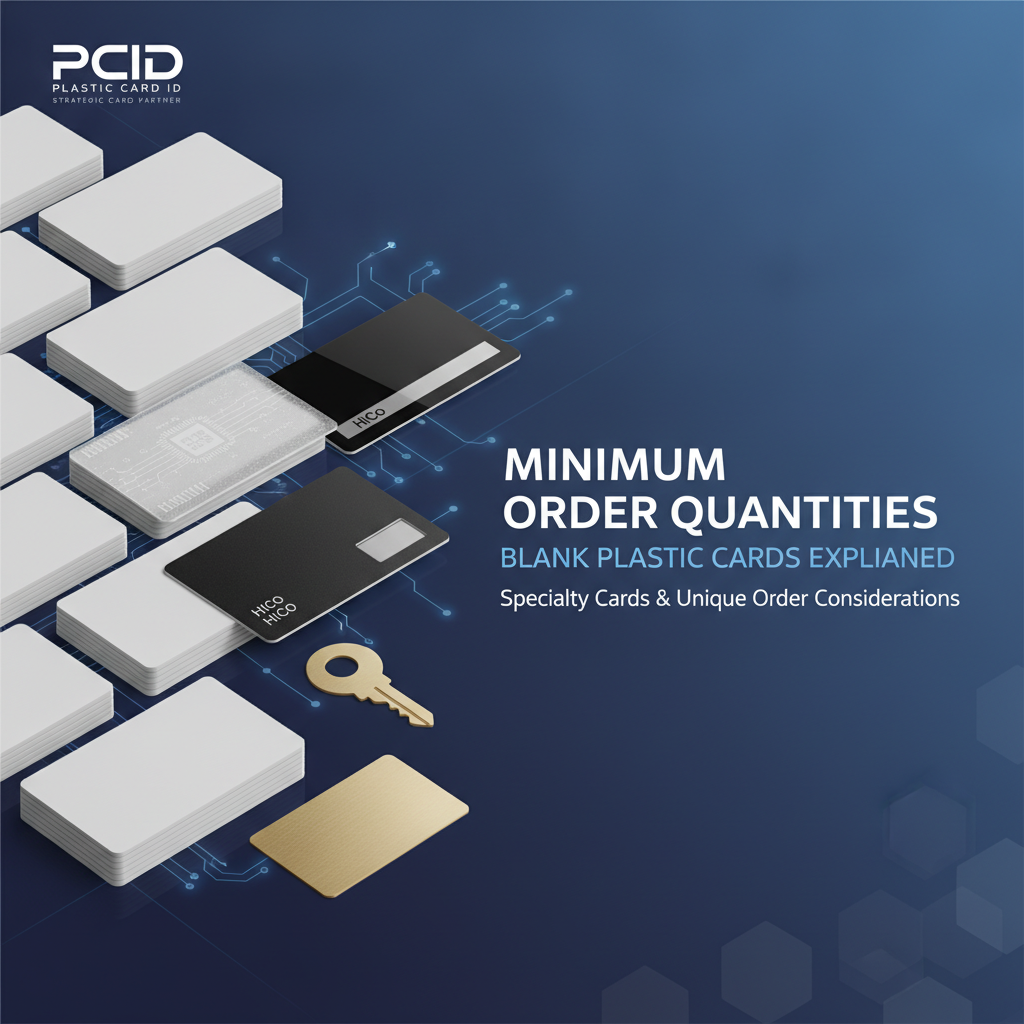 Beyond the standard PVC catalog, Plastic Card ID offers a range of specialty formats that carry their own minimum order structures - and genuinely deliver results that standard cards cannot. Whether it is a luxury metal card designed to signal exclusivity, a clear frosted card that showcases your branding with a premium aesthetic, or a casino player card engineered for high-frequency use, specialty cards serve specific program goals that plain stock simply cannot address.
These are not novelty items. Casino properties deploy player cards that must survive daily contact with wallets, drinks, and card readers for months. Hotel key cards must encode reliably across hundreds of lock interactions. Specialty formats exist because certain use cases demand materials and configurations that standard PVC cannot deliver.
Clear and Frosted PVC Cards
Clear and frosted plastic cards have minimum orders that typically fall in the 100-500 card range, depending on the supplier. They are popular with boutique fitness studios, upscale retail brands, and VIP programs where visual distinction is part of the value proposition. A clear card printed with a vibrant logo creates a dramatically different customer perception than a standard white card with the same design.
Frosted cards offer a softer, more premium feel - popular in spa, wellness, and luxury hospitality contexts. Both formats are fully printable with standard card printers and compatible with magnetic stripe encoding if needed. The visual impact of a clear or frosted card often justifies its slightly higher per-unit cost many times over.
Luxury Metal Cards and Die-Cut Specialty Formats
Stainless steel, brass, and gold-finish metal cards occupy a category of their own - and so do their minimum order considerations. These are high-investment, high-impact cards typically deployed for VIP membership programs, premium loyalty tiers, or executive credentialing. Minimum orders for metal cards are generally lower in quantity than you might expect, precisely because the per-unit value is high enough to make small runs viable.
Die-cut cards - cards manufactured in custom shapes rather than the standard CR80 rectangle - also have distinct minimum requirements based on the tooling involved. These are powerful for brand differentiation in trade show, event, or retail contexts. A card in an unexpected shape stops the recipient in their tracks. That attention translates directly into brand recall and program engagement.
Casino and Hotel Key Cards: Volume-Driven Specialization
Casino player cards and hotel key cards are high-volume, high-turnover applications. A mid-sized casino property might distribute thousands of new player cards monthly. A hotel may need a continuous supply of HiCo key cards to keep pace with guest turnover. Both of these applications benefit from volume pricing - and both require careful attention to encoding specification to ensure compatibility with existing reader hardware.
CPE works directly with casino operators and hotel management companies to align card specifications with their systems, ensuring that every card in the order performs exactly as required from day one. Minimum orders for these specialized formats are calibrated to match real-world operational needs - not arbitrary round numbers.
Buyer Tips: Getting the Most From Your Blank Card Order
Buying blank plastic cards is not complicated, but there are several variables that consistently trip up first-time buyers and cost veteran buyers more than they should be spending. A few targeted tips from 25-plus years of working with organizations at every scale can save you real money and real headaches.
Always Confirm Printer Compatibility Before Ordering
Not all blank cards are identical, even when they share the same CR80 dimensions. Card thickness, surface finish, and core composition all affect how a card feeds through a printer, accepts ink or resin, or holds an encoded stripe. Ordering cards that are incompatible with your printer is one of the most avoidable and frustrating mistakes in card program management.
Before placing any order, confirm the card specifications recommended by your printer manufacturer - or contact CPE with your printer model and we will match you to the right stock. Evolis, Zebra, and Fargo all have specific card recommendations, and Plastic Card ID carries inventory aligned to all three major brands.
Build a Small Safety Stock Into Every Order
Running out of cards at a critical moment - right before a major event, during a membership drive, or in the middle of a hotel's peak season - is an operational problem with a simple prevention strategy: always carry a small safety buffer. Even 10-15% above your projected consumption is enough to absorb unexpected demand spikes or the occasional print error without scrambling for an emergency order.
Blank PVC cards do not expire. They do not yellow, warp, or degrade when stored appropriately at room temperature away from direct sunlight. Safety stock is free insurance against program disruption - and at the per-card cost of standard blank PVC, the carrying cost is genuinely negligible.
Pair Your Card Order With the Right Supplies
- Printer ribbons: Match your ribbon to your card stock and printer model - mismatches cause print quality issues that waste both ribbon and cards.
- Cleaning kits: Regular printer cleaning extends printer lifespan and maintains print quality over high-volume runs. Do not skip this.
- Card carriers and sleeves: Protect printed cards during distribution and extend their useful life in wallets and cardholders.
- Card affixing and mailing services: For programs that mail cards to cardholders, Plastic Card ID offers fulfillment support that eliminates a major operational burden from your team.
- Lanyards and badge holders: For ID and event credential programs, the right accessories complete the professional presentation.
Buying supplies alongside your card order in a single transaction saves on shipping and ensures everything arrives together - ready to deploy without chasing down missing components from separate vendors.
Frequently Asked Questions About Minimum Orders for Blank Plastic Cards
After 25 years and over 100,000 customers, certain questions come up again and again. We have gathered the most common ones here - answered directly and without the runaround.
Can I Really Order Just 50 Cards?
For standard blank white CR80 PVC cards, yes - small minimums are available, particularly for organizations just launching a card program or piloting a new format. That said, the per-card economics improve significantly as quantity increases, so it is worth running a quick cost comparison before defaulting to the smallest possible order. The right minimum for your program is the one that balances cash flow with cost efficiency - not necessarily the lowest number on the sheet.
For specialty cards like RFID, smart chip, or custom formats, minimums may be slightly higher due to production complexity. A quick conversation with CPE will clarify exactly what applies to your specific card type and use case.
Do Minimums Apply Per Card Type or Per Order?
Minimums apply per card type and specification. An order containing 100 blank white PVC cards and 100 HiCo magnetic stripe cards is treated as two separate line items, each subject to its own minimum threshold. Combining multiple card types into a single order does not merge their minimums - but it does consolidate shipping, which is its own form of savings.
If you are building a card program that requires multiple card types - say, standard employee ID cards alongside RFID access cards for a subset of staff - CPE can help you structure the order in a way that minimizes total spend while meeting the minimums for each card type efficiently.
What Happens If I Need to Reorder Quickly?
Reorder lead times for standard blank PVC cards are typically very fast - often same-day or next-business-day shipping for in-stock items. Specialty cards with encoding or custom production requirements carry longer lead times, which is another strong argument for maintaining that safety stock buffer. Planning your reorder before you run out is always smarter than reacting after you do.
Call 800.835.7919 to confirm current lead times for your specific card type before your inventory drops to a critical level. Demand fluctuations do occasionally affect stock availability, and a quick check costs nothing while potentially saving a program disruption.
Are There Volume Discounts for Large Standing Orders?
Yes - and for organizations with consistent, predictable card consumption, standing order arrangements can unlock pricing that single one-off orders cannot match. If your organization distributes thousands of cards per month on a reliable schedule, that volume represents leverage worth discussing. Plastic Card ID is built for long-term partnerships, and pricing structures reflect the value of ongoing relationships as much as individual transaction size.
Retailers who have switched from paper gift certificates to plastic gift cards have seen sales increases of 35-50%. Loyalty programs built around durable plastic cards consistently outperform paper punch card equivalents in retention and redemption metrics. The data is clear: investing in a proper card program pays back. Investing in the right volume strategy amplifies that return.
Partner With Plastic Card ID for a Card Program Built to Perform
There is a meaningful difference between buying cards from a catalog and building a card program with a partner who has seen 50 million card orders across 100,000 organizations. Plastic Card ID brings both the inventory depth and the institutional knowledge to help you make decisions that serve your program for years, not just your next order cycle.
From the simplest blank white PVC order to sophisticated RFID access deployments, from solo entrepreneurs starting their first loyalty program to national organizations running mass-production card operations - the answer to "what is the right minimum order quantity for blank plastic cards?" is always specific to your situation. And getting that answer right is what CPE does best.
Ready to start or scale your card program? Call Plastic Card ID at 800.835.7919 today and speak with a specialist who will help you find the right card, the right quantity, and the right strategy for exactly where your program is headed.
Previous Page