What Is a CR79 Card? Everything You Need to Know
Table of Contents []
- What Is a CR79 Card? Everything You Need to Know From Plastic Card ID
- The CR79 Card Defined: Size, Standard, and Purpose
- How CR79 Cards Fit Into a Complete Card Program
- Buyer's Guide: Choosing Between CR79 and Other Card Formats
- FAQ: CR79 Cards and Card Format Questions Answered
- The Value of a Strategic Card Supplier: What Plastic Card ID Delivers
- Start Your Card Program the Right Way With Plastic Card ID
What Is a CR79 Card? Everything You Need to Know From Plastic Card ID
Most people in the card industry know CR80 - it's the gold standard, the wallet-sized workhorse behind ID badges, loyalty programs, and membership cards everywhere. But ask about CR79, and you'll get blank stares. That gap is worth closing, because CR79 cards serve a genuinely distinct purpose that no other card size replicates. Whether you're building an access control program, designing hotel key cards, or upgrading a cardholder-based credential system, understanding CR79 might be the detail that makes your entire card program work correctly.
At Plastic Card ID, we've spent over 25 years supplying plastic cards to businesses across every corner of the United States. We've served more than 100,000 customers and put over 50 million cards into wallets, lanyards, doors, and printers. So when clients call asking about CR79 versus CR80, or wondering whether the size difference actually matters for their application - we don't just have opinions. We have data, experience, and a catalog built to serve both formats well.
| Specification | CR79 Card | CR80 Card |
|---|---|---|
| Width | 3.303 inches (83.9 mm) | 3.370 inches (85.6 mm) |
| Height | 2.051 inches (52.1 mm) | 2.125 inches (53.98 mm) |
| Thickness | 30 mil (0.76 mm) | 30 mil (0.76 mm) |
| ISO Standard | Non-standard overlay size | ISO 7810 ID-1 |
| Primary Use | Overlay cards, laminated credentials | Standard ID, loyalty, gift, access cards |
| Typical Application | Placed over a CR80 base card | Standalone card programs |
The CR79 Card Defined: Size, Standard, and Purpose
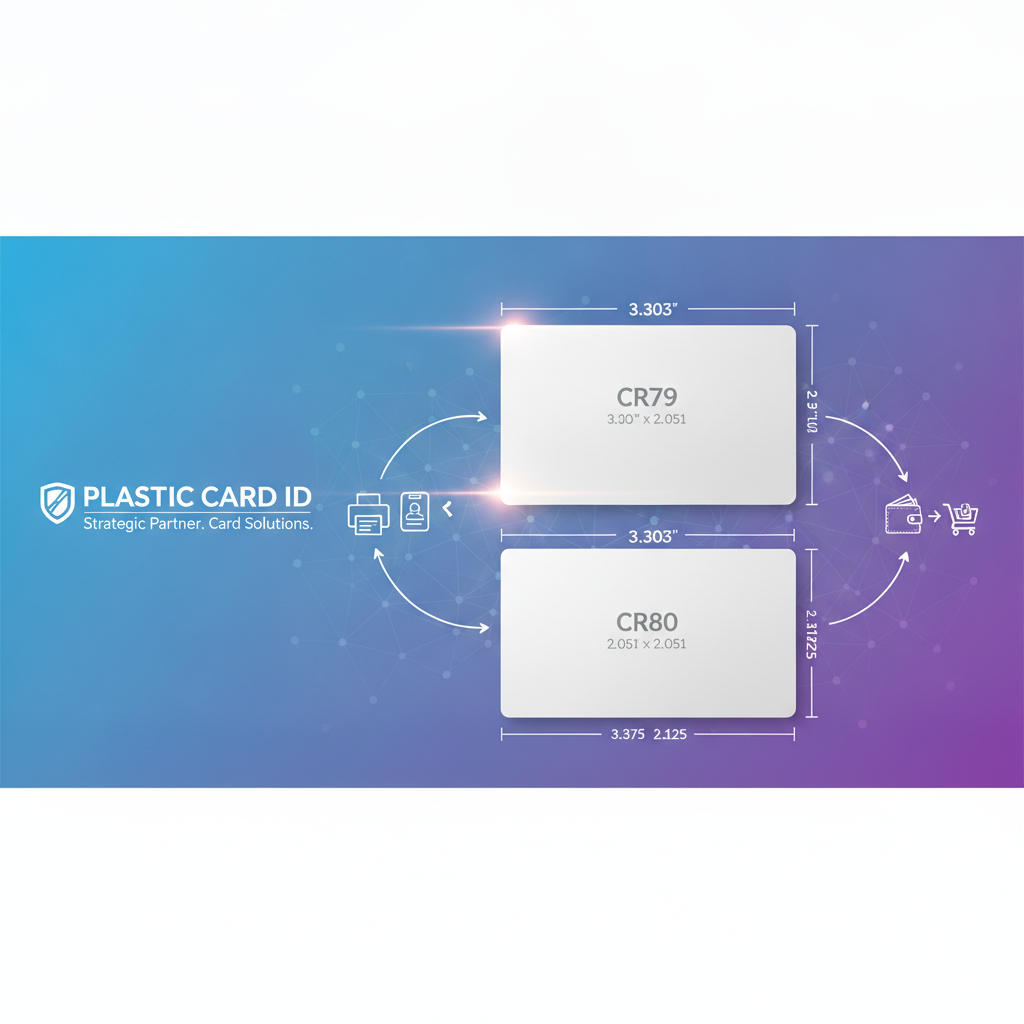 A CR79 card measures 3.303 x 2.051 inches - just slightly smaller than the familiar CR80. That difference, roughly 1/16 of an inch on each dimension, sounds trivial. It isn't. The size was deliberately engineered so that a CR79 card can sit on top of a CR80 base card with a small, even border visible around the edges. This makes CR79 the standard format for overlay cards - those thin laminated layers that carry printed information, encoding, or branding, and bond with or rest over a substrate card beneath.
The thickness is identical to CR80: 30 mil (0.76 mm). So when a CR79 overlay is placed over a CR80 base card, the combined stack reaches approximately 60 mil - which still fits in most standard card holders and many readers depending on configuration. The use case isn't universal, but in the right system, CR79 delivers capabilities that a standalone card simply cannot replicate.
Why the Slight Size Difference Matters Enormously
Imagine printing a security overlay onto a card that's the exact same size as the base card. Any misalignment - even half a millimeter - causes a visible edge mismatch, an improper seal, or a credential that looks poorly assembled. By making the overlay card fractionally smaller, CR79 ensures that the base card's perimeter is always visible, alignment is forgiving, and the professional appearance is preserved regardless of minor placement variance.
This engineering logic also benefits lamination processes. In high-volume card issuance environments - government contractors, hotels, large corporate access control systems - cards go through automated laminators. A CR79 overlay that sits inside the CR80 border means the laminator doesn't need to trim edges or account for bleed inconsistencies. The smaller card simply lands where it belongs.
CR79 vs. CR80: A Practical Comparison
The terminology gets confusing fast. CR stands for "Card Radius" - referring to the corner radius of the card, not a manufacturer brand. CR80 is the ISO 7810 ID-1 standard used for everything from driver's licenses to credit cards. CR79 is not a separate ISO standard; it exists as a defined smaller size specifically for overlay applications layered over CR80 cards.
Where CR80 is the workhorse, CR79 is the specialist. You wouldn't use CR79 for a standalone gift card or loyalty card - it would look oddly small in a wallet slot designed for standard card dimensions. But in a dual-layer credential system, a hotel keycard assembly, or a laminated ID application, CR79 is exactly the right tool. CPE stocks both formats and can help you identify which one your program actually needs before you order.
Common Industries That Use CR79 Cards
Hotel and hospitality operations frequently use CR79 overlays to add personalized guest information on top of a keyed base card. Corporate access control programs with layered security credentials rely on CR79 for the printed or encoded overlay that completes the credential pair. Government-contracted ID programs, healthcare facilities, and large campus environments round out the primary CR79 user base in the United States.
There's also a growing segment of event organizers and conference producers who use CR79 overlay cards to create temporary credentials that slip over reusable base cards - reducing long-term costs while still maintaining a professional, plastic card appearance for attendees. It's a clever system, and CPE can supply both layers of the solution.
How CR79 Cards Fit Into a Complete Card Program
Understanding CR79 in isolation is useful. Understanding how it plugs into a larger card program is transformative. At Plastic Card ID, we talk about card programs as systems - not one-off purchases. The card itself is only part of the equation. The printer, the ribbon, the base card substrate, the encoding technology, and the issuance workflow all interact. CR79 cards are particularly relevant when your program involves lamination overlays or dual-card credentials.
When a client calls asking about CR79, the conversation usually expands quickly. What printer are they using? Do they need magnetic stripe encoding on the overlay or the base? Are they running a proximity card below the overlay? Is the application for access control, ID issuance, or something more specialized? Those details shape everything - and that's where having a strategic partner like Plastic Card ID makes the difference between a program that works and one that gets rebuilt six months later.
Pairing CR79 Cards With the Right Printer
Not every card printer handles CR79 without configuration. Most Evolis, Zebra, and Fargo printers are calibrated for CR80 by default. When you introduce CR79 cards, the printer's card feed sensor, print head alignment, and output tray settings may need adjustment. Running CR79 cards in an unconfigured CR80 printer can cause jams, misaligned prints, or encoding errors - problems that look like equipment failure but are actually a card-size mismatch.
CPE carries the full lineup from Evolis, Zebra, and Fargo and can walk you through printer compatibility before you lock in your card format. Some printers handle the size difference with minimal adjustment; others require a specific input hopper or configuration profile. Knowing this before ordering saves time, money, and significant frustration on the production floor.
Ribbon and Supply Compatibility for CR79 Printing
Printer ribbons are designed to print within specific card dimensions. When a CR79 card passes through a printer calibrated for CR80, the ribbon may deposit color beyond the card's edge - wasting ribbon material and potentially causing ink buildup inside the printer. Ribbon waste adds up fast in high-volume operations, and it's an expense that many organizations don't attribute to card format decisions until someone does the math.
The good news: ribbon waste from CR79 printing is manageable with proper configuration, and the cost differential is typically minor in programs where CR79 is the right format choice. Plastic Card ID stocks ribbons for all major printer brands and can supply cleaning kits to maintain printers running CR79 cards through extended production runs.
Encoding Options Available on CR79 Cards
CR79 cards can carry the same encoding technologies available on CR80 cards - with some practical considerations. Magnetic stripe encoding (both HiCo and LoCo) is available on CR79 cards. RFID and smart chip technology can also be embedded, though the application matters. In a dual-layer system, the encoding is usually on the base CR80 card while the CR79 overlay carries the printed identity layer.
- HiCo magnetic stripe: High coercivity, more resistant to demagnetization, preferred for access control overlays
- LoCo magnetic stripe: Lower coercivity, suitable for short-term or low-security applications
- RFID proximity: Contactless technology embedded in the base card beneath the overlay
- Smart chip (contact): Physical chip for credential programs requiring higher data security
- MIFARE DESFire: Advanced contactless smart card standard used in high-security applications
The interplay between the overlay and the base card's encoding is something Plastic Card ID helps clients map out before production begins. Getting the encoding architecture right the first time prevents costly reprints and program delays that ripple through entire organizations.
Buyer's Guide: Choosing Between CR79 and Other Card Formats
 Shopping for plastic cards without a clear format specification is a common way organizations end up with inventory they can't use. CR79, CR80, CR100, and other specialty formats all exist for specific reasons. Buying the wrong format - even the right card type in the wrong size - creates compatibility headaches that no amount of clever workarounds fully solves. Here's how to think through the decision clearly.
The first question is always: is this card meant to stand alone, or is it part of a layered credential? If it's standalone - a gift card, loyalty card, ID badge, or event credential that functions independently - CR80 is almost certainly the right choice. If it's designed to overlay a base card, carry laminate, or function as part of a dual-layer system, CR79 earns its place in your program.
When CR80 Is the Better Choice
For the vast majority of card programs in the United States, CR80 is the correct format. Gift card programs, employee ID programs, loyalty and rewards programs, access control with single-card credentials, membership cards, hotel key programs with single-card issuance - all of these are CR80 territory. The ISO 7810 standard means CR80 cards fit every standard wallet slot, card holder, badge reel, and lanyard clip designed for standard card dimensions.
Plastic Card ID sells blank CR80 PVC cards in quantities ranging from small runs ideal for testing new programs to bulk orders serving organizations that issue tens of thousands of cards per year. Blank CR80 cards give in-house print operations complete design control at a lower per-card cost than pre-printed custom cards - making them the workhorse format for organizations that prioritize flexibility and cost efficiency.
When CR79 Is the Right Call
Choose CR79 when your card program involves lamination overlays, when you need a printed layer that sits over a separate encoded base card, or when your existing credential system was specifically designed around the dual-layer format. Hotels that use keycard systems requiring a personalized overlay printed at check-in - rather than pre-encoded cards - often work in CR79. Large corporate campuses running high-security access programs with layered credentials similarly gravitate toward CR79 overlays.
If you're unsure whether your application calls for CR79 or CR80, the fastest way to find out is a direct conversation with the team at Plastic Card ID. We've navigated this question with clients across every industry sector in the country, and we can usually identify the right format in a single call - saving you the cost of ordering the wrong inventory.
Specialty Formats Worth Knowing About
Beyond CR79 and CR80, there are several other card formats and specialty options worth knowing. CR100 cards are larger than CR80 and used for applications requiring more print area. Clear plastic cards offer a distinctive, transparent appearance for premium programs. Custom die-cut cards in non-rectangular shapes - circles, keytags, special shapes - work for events and promotional programs. Luxury metal cards in stainless steel, brass, and gold represent the high end of the spectrum for VIP membership and premium brand experiences.
CPE also carries frosted cards, colored PVC stock, and cards pre-configured with various RFID and smart chip technologies. Whatever your program needs - from the most basic blank white PVC card to a sophisticated multi-technology credential - the catalog at Plastic Card ID is built to cover it completely.
FAQ: CR79 Cards and Card Format Questions Answered
After 25 years and more than 100,000 customers, Plastic Card ID has fielded just about every question there is to ask about plastic cards. Here are the most common ones specifically related to CR79 cards and how they compare to other formats in the market.
Can I Print CR79 Cards on a Standard Desktop Card Printer?
Yes, in most cases - with the right configuration. Desktop card printers from Evolis, Zebra, and Fargo are designed primarily for CR80 cards, but most support CR79 with adjustments to card sensor settings and output tray configuration. Some models include a specific CR79 mode or a dedicated input slot for smaller card formats. Always verify compatibility with your specific printer model before ordering CR79 cards in bulk.
If you call CPE at 800.835.7919 with your printer model in hand, we can confirm CR79 compatibility on the spot and walk you through any setup steps your printer requires. It's a quick call that prevents a slow problem from developing once your card inventory arrives.
Is CR79 the Same as a Proximity Card?
No - these are different attributes of a card. CR79 describes the physical dimensions of the card. A proximity card describes the technology embedded within it. A card can be CR79 format with proximity technology, CR79 without any technology, CR80 with proximity, or any combination thereof. Size and technology are independent variables in the card specification process.
That said, CR79 cards used in access control overlay applications are frequently paired with a proximity-enabled CR80 base card. The CR79 overlay carries the visual identity layer - name, photo, organization logo - while the CR80 base card carries the proximity chip that actually opens doors. It's a clean system when it's designed correctly from the start.
What Quantities Are Available for CR79 Cards?
Plastic Card ID supplies CR79 cards to organizations of all sizes. Whether you need a modest quantity of 50-100 cards to test a new credential workflow, a medium-run order for a campus rollout, or bulk quantities in the tens of thousands for a high-volume issuance program, the team at CPE can configure an order that fits both your volume and your timeline.
- Small test orders for new program pilots
- Mid-volume runs for departmental credential programs
- Bulk orders for large-scale corporate or institutional deployments
- Ongoing replenishment programs for organizations with continuous issuance needs
Pricing scales favorably with volume - a detail that matters most for programs with regular, ongoing card needs rather than one-time purchases. Long-term supply relationships with Plastic Card ID consistently deliver better per-card economics than sourcing cards from multiple vendors on an ad hoc basis.
The Value of a Strategic Card Supplier: What Plastic Card ID Delivers
There's a real difference between buying cards from a supplier and building a card program with a strategic partner. Suppliers take your order and ship the product. Strategic partners ask the questions that prevent expensive mistakes - and they're there when something unexpected comes up in your production workflow. That distinction is the core of how Plastic Card ID operates across every client relationship, from a 50-card monthly program to a mass production account moving tens of thousands of cards per year.
With over 25 years in the business and a catalog that spans blank PVC cards, magnetic stripe formats, RFID and smart chip technologies, printers from the three leading brands, ribbons, cleaning kits, card carriers, sleeves, and card affixing and mailing services - Plastic Card ID is genuinely a one-stop shop. That matters most when a program grows, evolves, or encounters a format or technology question that requires experienced guidance rather than a generic FAQ page.
One-Stop Supply Means Fewer Coordination Problems
When cards, printers, ribbons, and accessories all come from different vendors, coordination problems are inevitable. Ribbon compatibility issues. Card format mismatches. Printer warranty questions that fall between vendor territories. By sourcing through Plastic Card ID, organizations eliminate most of those gaps - everything is cross-referenced and supply chain friction drops dramatically when one partner handles the full stack.
Card carriers, sleeves, lanyard accessories, and mailing services round out the catalog in ways that matter for organizations running credentialing programs at scale. Sending 5,000 membership cards to customers nationwide involves more than printing and encoding - it involves professional card carriers, address management, and mail-ready packaging. CPE handles all of it.
Physical Cards Drive Measurable Results
Retailers who switch from paper gift certificates to plastic gift cards regularly report sales increases in the 35-50% range. Loyalty programs built on plastic cards - the kind that live in wallets alongside credit cards - outperform paper punch card alternatives across virtually every industry segment that has tested both. There is something psychologically powerful about a physical plastic card that digital alternatives haven't managed to fully replicate, even as digital wallets have proliferated.
Membership cards, employee ID badges, and access credentials printed on plastic signal permanence and legitimacy that paper cards simply cannot project. When your organization hands someone a well-designed, durable plastic card, the implicit message is that the program is serious, professional, and built to last. That perception translates into engagement, retention, and measurable program performance over time.
From CR79 Overlays to Metal Cards: The Full Spectrum
The breadth of the Plastic Card ID catalog reflects 25 years of learning what different clients actually need. On one end: simple blank white CR80 PVC cards for in-house ID programs. On the other: luxury metal cards in stainless steel, brass, and gold for premium VIP membership programs that demand a physical credential as impressive as the program itself. Casino player cards, hotel key systems, RFID access programs, MIFARE DESFire smart card applications - all of it is within scope.
CR79 cards occupy a specific, important niche in that spectrum. They're not for every program - but for the programs that need them, they're irreplaceable. And knowing where CR79 fits, how it works with the rest of your card system, and how to source it reliably is exactly the kind of knowledge Plastic Card ID brings to every client conversation.
Ready to clarify your card format needs and get your program on solid footing? The team at CPE is available to answer every question - from basic format comparisons to complex multi-technology credential architecture.
Start Your Card Program the Right Way With Plastic Card ID
Whether you came here knowing exactly what a CR79 card is or you're leaving with a clearer picture than you had before, the next step is the same: connect with a card supplier that treats your program as a long-term investment rather than a transactional sale. Plastic Card ID has been that partner for more than 100,000 businesses and organizations across the United States - and the experience shows in every conversation, every recommendation, and every order that goes out the door.
From blank CR79 overlays to fully configured smart card systems, from entry-level desktop printers to high-volume production equipment, from single-format programs to multi-technology credential architectures - the depth of knowledge and the breadth of the catalog at Plastic Card ID covers the complete range of what serious card programs require. Don't let a format question, a technology decision, or a volume uncertainty hold your program back.
Call Plastic Card ID today at 800.835.7919 and let our team help you build a card program that performs from day one and scales with your organization for years to come. Whether your question is "what is a CR79 card" or "how do I upgrade my entire credentialing system" - we have the answers, the inventory, and the experience to back them up.
Previous Page