What Is a HiCo Magnetic Stripe Card: Complete Guide
Table of Contents []
- What Is a HiCo Magnetic Stripe Card? Your Complete Guide from Plastic Card ID
- The Science Behind Magnetic Stripe Coercivity
- Applications Where HiCo Magnetic Stripe Cards Deliver Real Results
- Blank HiCo Magnetic Stripe Cards: The In-House Printing Advantage
- Advanced Magnetic Stripe Card Options for Specialized Programs
- Frequently Asked Questions About HiCo Magnetic Stripe Cards
- Why Businesses Across the USA Choose Plastic Card ID for HiCo Magnetic Stripe Cards
What Is a HiCo Magnetic Stripe Card? Your Complete Guide from Plastic Card ID
Swipe a card at a gym front desk, a hotel side entrance, or a loyalty kiosk - and buried in that half-second transaction is a technology that has quietly powered millions of card programs for decades. The magnetic stripe. But not all magnetic stripes are created equal, and understanding the difference between HiCo and LoCo encoding could be the single most important technical decision you make before ordering cards for your business.
This guide breaks down exactly what a HiCo magnetic stripe card is, why it matters, and how choosing the right coercivity level protects your data, your brand, and your cardholders' experience. Whether you are running a hotel key card program, a retail loyalty system, or an employee access solution, the information here applies directly to your program.
| Feature | HiCo (High Coercivity) | LoCo (Low Coercivity) |
|---|---|---|
| Coercivity Level | 2750 Oersteds | 300 Oersteds |
| Durability | High - resists demagnetization | Moderate - more easily erased |
| Best For | Loyalty, ID, access, membership | Hotel keys, short-term use |
| Stripe Color | Dark brown or black | Brown or lighter brown |
| Encoding Requirement | Higher-powered encoder needed | Standard encoder sufficient |
The Science Behind Magnetic Stripe Coercivity
 Coercivity is a measure of a magnetic material's resistance to becoming demagnetized. In the context of plastic cards, it describes how strongly the iron oxide particles embedded in the magnetic stripe hold onto their encoded data. The higher the coercivity, the harder it is to accidentally wipe or corrupt that data. HiCo cards are rated at approximately 2750 Oersteds, while LoCo cards sit around 300 Oersteds - a difference of nearly ten times.
Think about the environments cards live in: wallets crammed next to smartphones, purses with magnetic clasps, countertops near POS equipment, retail environments with electronic article surveillance systems. In any of those real-world scenarios, a LoCo stripe faces constant low-level magnetic interference. A HiCo stripe shrugs it off. That resilience is not a minor convenience - it is the reason data integrity holds across thousands of swipes over months or years of active use.
How Magnetic Encoding Actually Works
The magnetic stripe on a plastic card contains three tracks of data. Each track can store a different type of information depending on the standard used, most commonly ISO/IEC 7811. Track 1 holds alphanumeric data, Track 2 is numeric only and is the track most commonly read at point-of-sale terminals, and Track 3 is used for specialized financial and access applications.
Encoding writes a unique pattern of magnetic polarizations onto these tracks using a card encoder - either a standalone unit or a feature built into a card printer. HiCo encoding simply requires a stronger magnetic write head to set those particles into place. Once encoded, a HiCo card retains that pattern reliably even in magnetically noisy environments. The encoding process is fast, and the data stored is immediately readable by virtually any standard magnetic stripe reader.
Why Coercivity Is a Real-World Performance Issue
Businesses that have switched from LoCo to HiCo cards consistently report fewer failed reads, fewer customer complaints about cards not working, and lower card replacement rates. When a loyalty card fails at the checkout counter, the friction it creates is not just a minor inconvenience. It undermines trust in your program, creates a line-stopping situation for your staff, and increases operational costs when replacements need to be issued.
Hotel key cards are actually an exception - they use LoCo intentionally because they are short-term cards that need to be re-encoded frequently between guests, and the lower write energy is a feature rather than a flaw. But for any card program where longevity and reliability matter, HiCo is the professional standard. Choosing the right coercivity upfront eliminates one of the most common preventable failure points in card program management.
Reading HiCo Cards: Equipment Compatibility
One of the most common questions businesses ask is whether HiCo cards require special readers. The answer is no - standard magnetic stripe readers can read HiCo cards without any modification. The difference in coercivity affects the write side of the equation, not the read side. A reader that works with LoCo cards will work equally well with HiCo cards.
On the encoding side, however, you do need a printer or encoder equipped with a HiCo write head. Most professional card printers from brands like Evolis, Zebra, and Fargo offer HiCo encoding as a built-in feature or optional module. Before purchasing a printer for a HiCo card program, confirming that the unit supports high-coercivity encoding is an important step that CPE always recommends clients verify.
Applications Where HiCo Magnetic Stripe Cards Deliver Real Results
Knowing what a HiCo magnetic stripe card is becomes significantly more useful when you can see where it performs best. The technology is not theoretical - it is actively powering some of the most effective card programs across retail, hospitality, access control, healthcare, and membership organizations throughout the United States.
The versatility is genuine. A single blank HiCo magnetic stripe card in CR80 format can become a gym membership card, a casino player card, a corporate ID badge with access privileges, a university student ID, or a retail loyalty card - depending entirely on what is printed on its surface and what data is encoded into its stripe. The card is the canvas; the program is what gives it meaning.
Retail Loyalty Programs
Retailers who upgrade their loyalty programs from paper punch cards to plastic HiCo magnetic stripe cards routinely see measurable results. The card lives in a wallet alongside payment cards - which means it travels with the customer to every shopping trip. It gets swiped, it tracks points, it triggers rewards automatically at the POS without any staff intervention or manual lookups.
The data encoding capability is what makes this automation possible. A unique customer ID encoded on Track 2 connects the card to a database record the moment it is swiped. Everything else - purchase history, reward balances, tier status - flows from that single reliable read. Businesses that make this switch to plastic loyalty cards report sales increases in the range of 35-50% compared to paper-based alternatives. The card itself becomes a marketing asset that fits in a wallet.
Employee ID and Access Control
Employee badge programs are one of the most consistent use cases for HiCo magnetic stripe cards. An encoded employee ID can serve as a visual identification credential, a time and attendance tracker, a cafeteria payment card, and a door access card all in one piece of plastic. The magnetic stripe carries the employee identifier; the printed card carries the photo, name, and department.
Organizations running large facilities - office campuses, manufacturing plants, healthcare networks - rely on HiCo encoding precisely because of its durability. Badges get clipped to clothing, dropped, stuffed into pockets, and swiped dozens of times per day. A LoCo stripe in that environment would be a liability. HiCo encoding keeps the data stable over the badge's entire lifespan, typically one to three years depending on the organization's renewal cycle. Contact 800.835.7919 to discuss your specific employee badge program needs.
Membership and Club Card Programs
Fitness clubs, country clubs, professional associations, libraries, museums, and subscription businesses all benefit from the credibility and functionality of a plastic HiCo membership card. The card signals to members that their affiliation is serious, established, and professionally managed. Paper simply cannot communicate that same level of institutional permanence.
The encoding capability adds functional value on top of the visual credential. Member numbers, tier levels, and access permissions can all be stored in the stripe and read automatically at entry points, service desks, or retail locations. A well-designed membership card program builds retention by making members feel genuinely affiliated - and the card they carry in their wallet is a daily reminder of that affiliation.
Blank HiCo Magnetic Stripe Cards: The In-House Printing Advantage
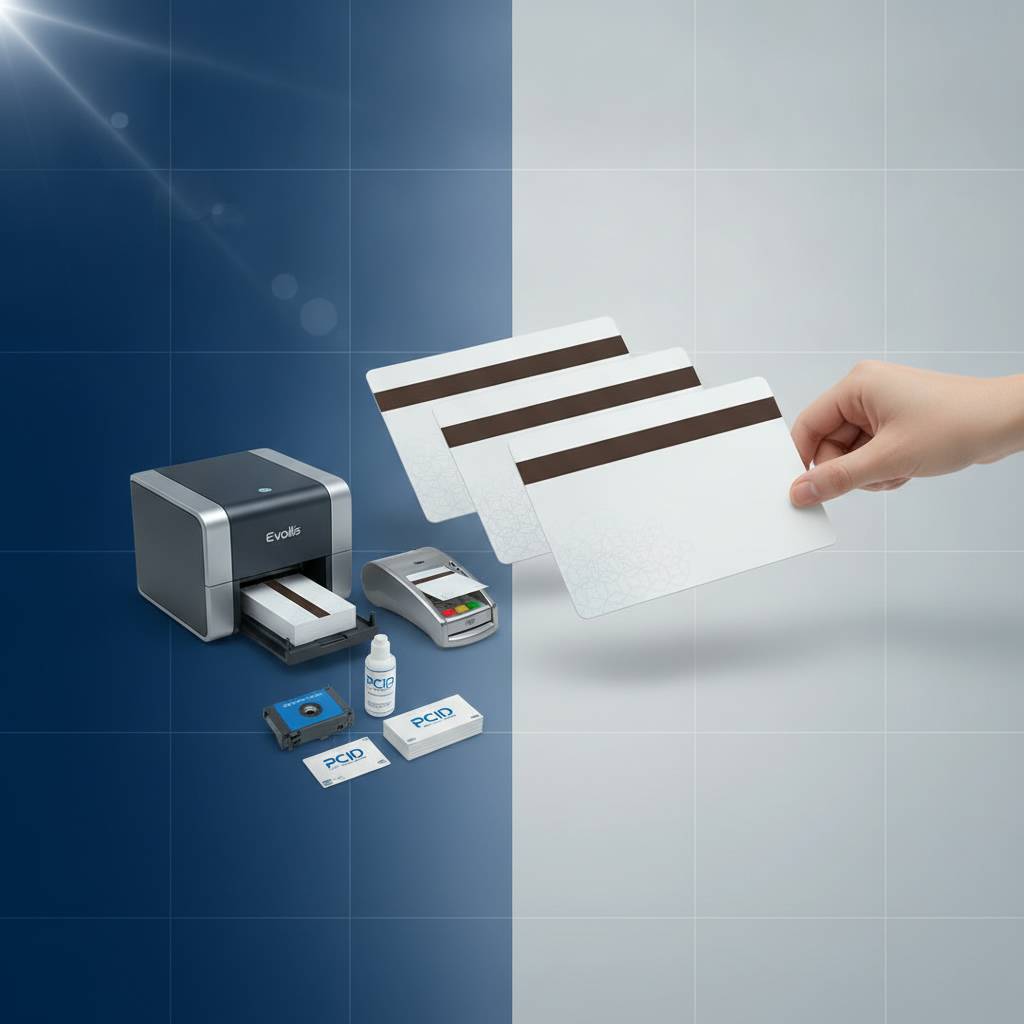 Blank HiCo magnetic stripe cards are the foundation of in-house card programs. Starting with a blank CR80 card - the ISO 7810 standard size, 3.375 inches by 2.125 inches, 30 mil thick - organizations gain total control over their card production process. Print what you need, when you need it, encode in real time, and issue cards on the spot without waiting for a print vendor or managing large pre-printed inventories.
The economics of in-house printing improve significantly at scale. While the initial investment in a card printer is real, the per-card cost drops substantially over time compared to outsourcing. Organizations issuing 50 cards a month to those running production programs in the tens of thousands can all find a workflow that makes financial sense with the right printer-card combination.
Choosing the Right Blank HiCo Card Stock
Not all blank HiCo cards are the same. Core material quality, stripe placement, stripe width, and the surface finish all affect print quality, encoding reliability, and long-term durability. Premium PVC card stock produces sharper printed images, more consistent magnetic stripe performance, and a card that feels substantial in the hand - which matters when that card represents your brand.
- Standard PVC HiCo cards are ideal for most loyalty, membership, and ID programs
- Composite PVC cards (40% polyester core) offer enhanced durability for high-use applications
- Glossy finish cards produce the sharpest full-color photo quality for ID badges
- Matte finish cards provide better signature panel adhesion and a premium tactile feel
- Cards with pre-punched slots or notches are available for badge reel and lanyard programs
CPE maintains inventory of blank HiCo cards across all standard configurations, with quantities available from small sample orders to bulk pallets. Having the right card stock on hand ensures your card program never stalls waiting on supplies.
Card Printers That Support HiCo Encoding
The printer you choose determines what your card program can actually do. Evolis, Zebra, and Fargo each offer card printer lines with built-in or optional HiCo magnetic stripe encoding modules. Entry-level single-sided printers work well for organizations issuing fewer than 500 cards per month. Mid-range dual-sided printers with built-in encoding are ideal for active ID or loyalty programs. High-throughput retransfer printers handle demanding production environments.
Key features to evaluate when selecting a printer for a HiCo card program include encoding speed, ribbon capacity, connectivity options (USB, Ethernet, Wi-Fi), and software compatibility with your card design and database management tools. Matching the right printer to your actual production volume prevents both under-investment and over-investment - a balance CPE helps clients find every day.
Supplies That Keep Your Card Program Running Smoothly
A card program is only as reliable as its supply chain. Printer ribbons, cleaning kits, card sleeves, card carriers, and encoding consumables all need to be available when you need them. Running out of ribbon mid-production is a preventable problem that disrupts card issuance at the worst possible times - during employee onboarding, event registration, or a loyalty program launch.
Stocking genuine OEM ribbons for your specific printer model ensures consistent print quality and protects your printer's warranty. Cleaning kits are inexpensive and extend printer head life significantly. Card sleeves and cardholders protect issued cards during distribution. Building a complete supply inventory from the start means your card program operates without interruption regardless of demand spikes or timing constraints.
Advanced Magnetic Stripe Card Options for Specialized Programs
Beyond standard blank HiCo PVC cards, there is a broader world of specialty card formats that incorporate magnetic stripe technology in combination with other features. For programs with complex requirements - multiple access levels, combined loyalty and ID functions, casino or gaming applications - these hybrid card formats open up capabilities that a single-technology card cannot provide.
Understanding what is available allows program designers to spec the right card from the start rather than discovering limitations mid-rollout. The choices are genuinely varied, and matching the right card format to the program's actual functional requirements is a process worth taking seriously before the first order is placed.
Combo Cards: Magnetic Stripe Plus Smart Chip or RFID
Combo cards combine a HiCo magnetic stripe with a contact smart chip or a contactless RFID antenna in a single CR80 card. These cards serve programs that need to interface with both legacy magnetic stripe readers and modern contactless or chip-based systems simultaneously. A university campus card is a classic example - swipe to pay at the dining hall, tap to open dormitory doors.
MIFARE DESFire is one of the most commonly specified RFID standards for combo cards in access control and smart campus programs due to its strong security architecture and multi-application capability. The ability to store different data types on different technologies within the same card streamlines the cardholder experience while giving administrators flexible control over what each technology layer can access.
Casino Player Cards and Specialty Magnetic Stripe Applications
Casino player cards are a specialized segment where HiCo magnetic stripe encoding is essentially mandatory. Player tracking systems require cards that survive heavy daily use in an environment where cards are swiped constantly at slot machines, table games, and service kiosks. The stripe must hold its encoded data reliably across thousands of swipe cycles without degradation.
Casino player cards often incorporate additional security features alongside the magnetic stripe - holographic overlaminates, UV-visible security printing, or embedded smart chips for high-value tier programs. The card itself becomes a physical representation of player status, which is why premium finishes and luxury card formats including metal cards in stainless steel, brass, and gold are increasingly common in high-tier player card programs.
Clear, Frosted, and Custom Die-Cut HiCo Cards
HiCo magnetic stripe technology is not limited to standard white PVC card stock. Clear plastic cards and frosted cards both support magnetic stripe encoding and offer dramatically different visual effects that can differentiate a card program from the standard landscape. A clear loyalty card with a visible stripe and full-color printed graphics is immediately distinctive in any wallet.
Custom die-cut shapes - cards that break from the standard CR80 rectangle - are available for programs where the card's physical form is part of the brand experience. Key fob shapes, rounded rectangles, and custom outlines are all possible with appropriate lead times and order quantities. The stripe is positioned and encoded exactly as it would be on a standard card, maintaining full reader compatibility while delivering a genuinely unique physical object.
Frequently Asked Questions About HiCo Magnetic Stripe Cards
When clients are evaluating magnetic stripe cards for the first time, the same practical questions come up consistently. Getting clear answers early in the process saves time, prevents specification errors, and leads to better program outcomes. Here are the questions CPE hears most often.
Can I Encode HiCo Cards With My Existing Equipment?
If your current card printer includes a magnetic stripe encoder, it may support HiCo, LoCo, or both - depending on the model. Check your printer specifications for the listed coercivity rating. Printers that support both will typically have a software setting that allows you to switch between coercivity levels before encoding. If your printer is LoCo-only, encoding HiCo cards with it will produce an unreliable stripe because the write head lacks sufficient power to properly magnetize the particles.
Upgrading to a HiCo-capable encoder is a relatively simple equipment decision that pays for itself quickly in reduced card failures and replacement costs. The CPE team can help you identify which current printer in your workflow supports HiCo encoding and what upgrade paths are available if yours does not.
What Is the Minimum Order Quantity for HiCo Cards?
Blank HiCo magnetic stripe cards are available in small quantities - organizations just starting a card program or running low-volume in-house production do not need to commit to large pallets. Starter quantities allow programs to test card stock and verify compatibility with existing equipment before scaling up. Volume pricing applies at higher quantities, making per-card economics significantly more attractive for larger programs.
Programs running 50 cards per month and those producing tens of thousands of cards per month both find workable economics with CPE's card inventory. Scalable supply relationships mean your card program can grow without switching suppliers or renegotiating terms every time your volume tier changes.
How Do I Store and Handle Blank HiCo Card Stock Properly?
Blank HiCo cards should be stored in a cool, dry environment away from strong magnetic fields and direct sunlight. While HiCo cards resist accidental demagnetization far better than LoCo cards, prolonged exposure to powerful magnetic sources during storage - like sitting directly on top of a speaker or industrial motor - can affect stripe integrity before cards are even encoded.
Temperature and humidity matter for the PVC card body as well. Extreme heat can cause cards to warp, which affects print quality and printer feed reliability. Store cards in their original packaging until use, keep storage areas between 60-80 degrees Fahrenheit, and avoid high-humidity environments. Proper card storage is a small operational detail that prevents avoidable print quality issues during production runs.
Why Businesses Across the USA Choose Plastic Card ID for HiCo Magnetic Stripe Cards
Twenty-five years of supplying plastic cards to businesses of every size and type builds a level of practical knowledge that purchasing from a generic distributor simply cannot replicate. Over 100,000 customers and more than 50 million cards represent an enormous breadth of real program experience - loyalty programs, access control systems, casino operations, university ID programs, retail gift card rollouts, and everything in between.
That experience translates directly into better guidance for new and growing programs. When a client calls to ask about HiCo versus LoCo for a new membership card program, CPE is not reading from a spec sheet - they are drawing on direct experience with programs that faced the same decision and lived with the results. That kind of informed partnership is what separates a strategic supplier from a box-shipping operation.
A True One-Stop Shop for Card Programs of Any Scale
From blank card stock to card printers, printer ribbons, cleaning kits, card sleeves, card carriers, and even card affixing and mailing services, everything a card program needs is available through a single supplier relationship. Eliminating the need to source cards from one vendor, printers from another, and supplies from a third is a significant operational simplification - fewer purchase orders, fewer shipping relationships, fewer points of failure in your supply chain.
The catalog spans blank white PVC, HiCo and LoCo magnetic stripe, RFID and proximity cards, smart chip cards, clear and frosted cards, colored card stock, and specialty formats including casino cards, hotel key cards, and luxury metal cards. Whatever the program requires, the product is available. Running a card program through a single trusted supplier means your supply chain is as reliable as your card program itself.
Serving USA-Based Organizations Across Every Vertical
Retail, hospitality, healthcare, education, corporate, government, nonprofit, fitness, entertainment, financial services - HiCo magnetic stripe card programs run across virtually every sector of the American economy. CPE serves all of them, with a focus specifically on USA-based businesses and organizations that need a domestic supplier relationship with reliable fulfillment and knowledgeable support.
The scale of programs served ranges from small businesses issuing a few dozen cards per month to enterprise organizations with mass production requirements in the tens of thousands. Both ends of that spectrum get the same quality of product and the same depth of program support. Scale does not determine the quality of attention your program receives - every card program matters because every card represents a real relationship between a business and its customers, employees, or members.
Ready to Start or Upgrade Your Magnetic Stripe Card Program
Whether you are specifying HiCo cards for the first time, upgrading from LoCo, expanding an existing loyalty program, or sourcing cards for a new access control system, the right starting point is a conversation. Understanding your program's volume, encoding requirements, printing setup, and end-use environment takes minutes and leads directly to the right card specification.
The difference between a card program that works reliably for years and one that generates ongoing headaches often comes down to a single specification decision made at the beginning. Reach out to CPE at 800.835.7919 to make sure your HiCo magnetic stripe card program is built on the right foundation from day one.
Contact Plastic Card ID today at 800.835.7919 to discuss your HiCo magnetic stripe card program. Blank cards, combo cards, specialty formats, card printers, and all supporting supplies are ready to ship to USA businesses of every size. Call now and let Plastic Card ID help you build a card program that performs reliably for years to come.
Previous Page