Blank Plastic Cards for Employee ID Badges: Top Picks
Table of Contents []
- Blank Plastic Cards for Employee ID Badges - Plastic Card ID
- Why the Blank Card You Choose Defines Your Entire Badge Program
- Building an In-House Badge Program From the Ground Up
- Specialty Card Options for Advanced Employee Badge Requirements
- Frequently Asked Questions About Blank Plastic Cards for Employee Badges
- The Business Case for In-House Employee Badge Printing
- Partner With Plastic Card ID for Your Employee Badge Card Program
Blank Plastic Cards for Employee ID Badges - Plastic Card ID
Walk into almost any office, hospital, school, or corporate campus in America and you will see them clipped to lanyards, sliding through readers, and sitting on desks: the employee ID badge. It seems simple. It is anything but. The card stock you choose, the encoding you add, and the quantity you order will shape how your card program runs for years. Plastic Card ID has been making those decisions easier for over 25 years, supplying blank plastic cards for employee ID badges to organizations of every size across the United States.
Whether you are launching a brand-new badge program for 50 employees or scaling an enterprise operation that prints tens of thousands of credentials a year, the blank PVC card sitting in your printer tray is the foundation of everything. Get that foundation right, and the rest of your program practically builds itself.
| Card Type | Best Use Case | Key Feature |
|---|---|---|
| Blank CR80 PVC (30 mil) | Standard employee badges | ISO 7810 standard size, credit-card dimensions |
| HiCo Magnetic Stripe | Access control, time tracking | High-coercivity stripe resists accidental erasure |
| LoCo Magnetic Stripe | Short-term credentials, visitor badges | Lower coercivity, easy to encode and reuse |
| RFID / Proximity Cards | Contactless door access, security zones | Tap-to-read convenience, no swipe required |
| Smart Chip Cards | High-security facilities, data storage | Embedded microprocessor, advanced encryption |
| Clear / Frosted PVC | Specialty badges, modern aesthetics | Transparent or semi-opaque finish |
Why the Blank Card You Choose Defines Your Entire Badge Program
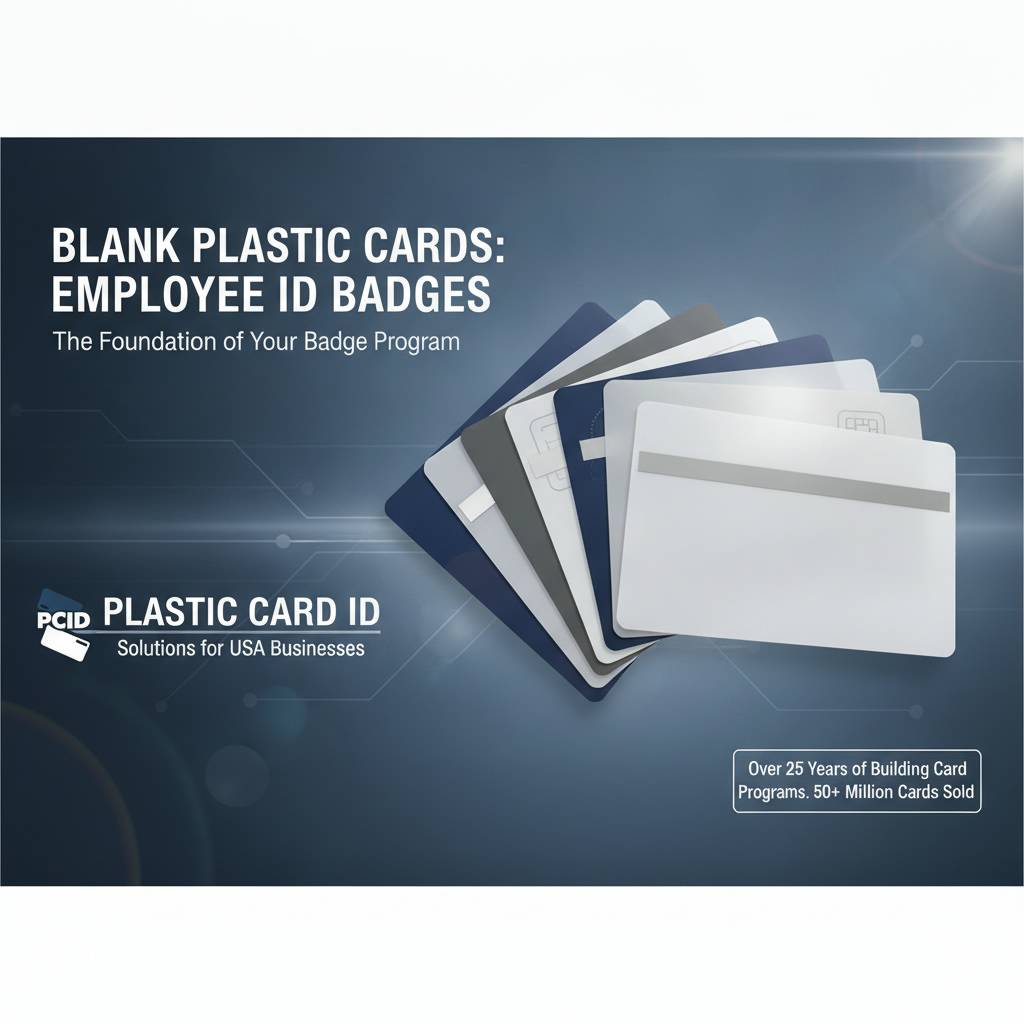 There is a tendency to think of blank plastic cards as commodities - interchangeable white rectangles that only differ by price. That assumption costs organizations real money and real headaches. The card substrate you start with determines what you can print, encode, and do with each badge down the line. A card that cannot accept a clean dye-sublimation print will produce washed-out badges. A card with the wrong magnetic stripe coercivity will fail at your card readers on day one.
The standard for employee ID badges in the United States is the CR80 format: 3.375 inches by 2.125 inches, 30 mil thick. This is the ISO 7810 standard - the same footprint as a credit card. That standardization matters because it means your badges fit every card printer, every card holder, every lanyard slot, and every wallet without modification. When CPE talks about blank PVC cards, this is the format they mean unless otherwise specified.
CR80 Blank PVC Cards - The Workhorse of In-House Badge Programs
Plain white CR80 cards are the starting point for the vast majority of in-house badge programs. They accept vibrant full-color printing from direct-to-card and retransfer printers, handle lamination overlays, and can be punched or slotted for badge reels and lanyards. The per-card cost of blank PVC stock is remarkably low, especially when purchased in quantities of 500 or more, making it practical to reprint and reissue without budget anxiety.
Because you are printing in-house, you control everything: the layout, the data, the photo, the timing. New hire starting Monday? Print the badge Friday afternoon. Security policy change? Update the template and reprint immediately. That flexibility is simply not available when you outsource badge production to a third party with a two-week turnaround.
Magnetic Stripe Cards - When a Badge Needs to Do More Than Identify
Many organizations need their employee badges to do double duty - identifying the cardholder visually while also granting electronic access, logging time and attendance, or interfacing with point-of-sale systems. That is where magnetic stripe cards enter the picture. CPE carries both HiCo (high-coercivity) and LoCo (low-coercivity) magnetic stripe cards in the standard CR80 format.
HiCo magnetic stripe cards are the right choice for most employee badge programs because the high-coercivity stripe resists accidental erasure from proximity to everyday magnets - purse clasps, phone cases, refrigerator magnets. LoCo cards have a role in short-term credentials and visitor badges where data will be rewritten frequently and longevity is less critical.
Choosing between HiCo and LoCo is not complicated once you know the rule: if the card will be used daily for months or years, go HiCo. If the card is a temporary credential that will be reprogrammed or discarded, LoCo may be perfectly adequate and slightly less expensive per card.
RFID and Proximity Cards - Contactless Credentials for Modern Workplaces
The fastest-growing segment of the employee badge market is contactless. Proximity cards and RFID smart cards allow employees to simply tap or wave their badge near a reader rather than inserting or swiping. In high-traffic access control environments - building entrances, server rooms, secure manufacturing floors - that fraction of a second per transaction adds up to meaningful efficiency gains across a workforce.
RFID cards supporting MIFARE DESFire and other advanced protocols offer encrypted data storage and superior security compared to legacy proximity technology. For organizations with serious security requirements, the jump from a basic mag-stripe badge to a MIFARE DESFire smart card is not a luxury - it is a necessary upgrade.
Building an In-House Badge Program From the Ground Up
Starting an in-house employee ID badge program sounds daunting to organizations that have never done it before. In practice, the components are straightforward, the learning curve is short, and the long-term savings over outsourced badge production are substantial. The three pillars of any in-house program are the card stock, the printer, and the software. Plastic Card ID supplies all three, along with the ribbons, cleaning kits, and accessories that keep everything running smoothly.
The question CPE hears most often from new customers is some variation of: "How many cards do I need to order to make this worth it?" The honest answer depends on your printing volume, but even organizations issuing 50 cards a month find that in-house printing pays for itself within the first year when measured against outsourced alternatives.
Selecting the Right Card Printer for Your Volume and Budget
Plastic Card ID carries a full lineup of card printers from three of the industry's most trusted manufacturers: Evolis, Zebra, and Fargo. Each brand has a distinct sweet spot. Evolis printers are known for their compact footprint and user-friendly operation, making them excellent choices for small to medium offices that need professional results without a dedicated IT setup. Zebra printers are workhorses built for high-volume enterprise environments. Fargo printers offer retransfer printing options that produce edge-to-edge, photo-quality results ideal for credential-intensive programs.
Matching your printer to your card volume is one of the most important decisions you will make. An entry-level direct-to-card printer rated for 200 cards per day will burn out quickly in an environment printing 1,000 cards daily. Conversely, an enterprise-grade retransfer printer is unnecessary overhead for a 100-person company issuing 10 new badges a month. Call 800.835.7919 and the team at CPE will help you match printer to program without overselling.
Ribbons, Cleaning Kits, and Accessories - The Overlooked Essentials
A card printer without consumables is like a printer without ink - obvious in hindsight but frequently overlooked in the excitement of setting up a new badge program. Printer ribbons are the consumable that most directly affects print quality and per-card cost. YMCKO ribbons (yellow, magenta, cyan, black, overlay) are the standard for full-color ID badge printing. Monochrome ribbons in black, white, or other single colors cost significantly less per card and are the right choice for single-color badge designs.
Cleaning kits are not optional. Dust, debris, and ribbon residue accumulate inside card printers with every print cycle. A regular cleaning regimen - typically every 250-500 cards, depending on the manufacturer - keeps print heads performing at spec and dramatically extends printer life. Skipping cleaning kits is the single most common reason card printers fail prematurely.
Card Carriers, Sleeves, and Badge Accessories
Once printed, employee badges need to be worn, stored, and transported. Plastic Card ID supplies card carriers, protective sleeves, badge reels, lanyards, and card holders to complete the picture. Protective sleeves extend the life of printed badges by shielding the card surface from scratches, skin oils, and moisture. Badge reels and lanyards make it easy for employees to present their cards at readers without removing them from their holders.
For organizations that mail badges or credentials to remote employees, card affixing and mailing services mean you never have to run a manual envelope-stuffing operation. A complete end-to-end solution - from blank card to delivered badge - is available through a single supplier. That simplicity has real operational value for HR teams managing distributed workforces.
Specialty Card Options for Advanced Employee Badge Requirements
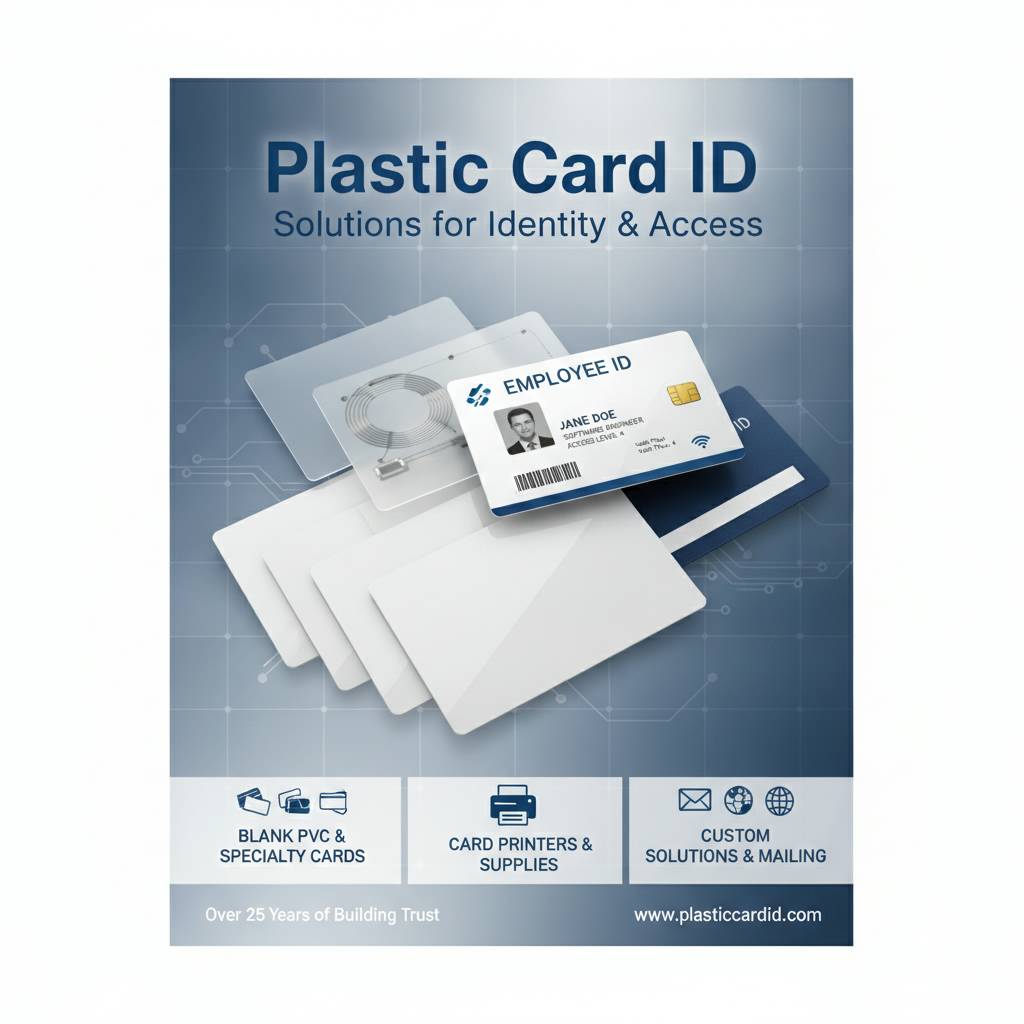 Standard white PVC covers the vast majority of employee badge applications. But some organizations have requirements that push past the standard. Security-sensitive facilities need cards that are harder to clone or counterfeit. Design-forward companies want badges that reflect their brand identity. High-end hospitality and corporate environments sometimes request materials that communicate prestige and permanence in ways a plain white card simply cannot.
CPE supplies specialty card options that address all of these needs - from clear and frosted PVC to custom die-cut shapes to luxury metal cards in stainless steel, brass, and gold. These are not novelties. Each specialty format solves a specific problem for a specific type of organization.
Clear and Frosted Plastic Cards
Clear and frosted PVC cards have become increasingly popular for organizations that want their employee badges to stand out visually. A transparent card printed with a bold logo and employee photo creates a striking visual effect that plain white stock cannot replicate. Frosted cards offer a softer, semi-opaque aesthetic that works particularly well with minimalist badge designs.
Clear cards require specific printing techniques to achieve optimal results - the absence of a white base layer means colors print differently than they do on standard white stock. The team at CPE can advise on which printer ribbons and print settings work best for clear card applications based on your specific printer model and design requirements.
Luxury Metal Cards and Custom Die-Cut Shapes
Metal cards in stainless steel, brass, and gold are the choice of organizations for whom a plastic badge sends the wrong message. Executive credentials, high-tier membership cards, VIP access badges - these applications call for a card that communicates value through its weight and finish. A metal card in a lanyard holder makes an impression that no paper or standard PVC credential can approach.
Custom die-cut shapes move beyond the standard CR80 rectangle to create badges in brand-specific silhouettes. While die-cut cards do not fit standard card printers, they serve as pre-printed credentials, promotional items, and event passes where visual impact outweighs the need for in-house printing flexibility. The minimum order quantities and pricing for die-cut and metal cards differ from standard stock - contact CPE for specifics.
Smart Chip Cards for High-Security Credentials
Organizations with stringent security requirements - defense contractors, healthcare systems, research facilities, financial institutions - often need employee badges that go beyond what a magnetic stripe or basic RFID card can deliver. Smart chip cards carry an embedded microprocessor capable of storing encrypted data, executing authentication protocols, and interfacing with sophisticated access control systems.
MIFARE DESFire is among the most widely adopted standards for high-security smart card applications. These cards support multi-application use, meaning a single card can function simultaneously as an employee ID, an access credential, a time-and-attendance token, and a cashless vending card - all within the same CR80 form factor.
Frequently Asked Questions About Blank Plastic Cards for Employee Badges
After 25 years and over 100,000 customers, Plastic Card ID has heard just about every question there is about blank plastic cards for employee ID badges. The following covers the most common ones - the questions that come up whether the caller is setting up their first badge program or scaling an existing one.
What Quantity Should I Order?
This is the most common first question, and the honest answer is: order based on your 90-day consumption plus a buffer. For most organizations, that means ordering at least 500 cards at a time. Per-card cost drops noticeably as you move from 100-card packs to 500-card boxes to case quantities. Bulk ordering is not just about price - it is about program continuity. Running out of card stock mid-week because a case was backordered is a disruption that a small inventory buffer prevents entirely.
- Under 50 employees: 100-500 card packs are typically sufficient for quarterly reorders
- 50-500 employees: 500-1,000 card quantities balance per-card cost and storage practicality
- 500 employees or high-turnover environments: Case quantities of 1,000-5,000 cards deliver the best per-card pricing
- Enterprise or multi-site programs: Volume pricing tiers and dedicated account support are available through CPE
- Seasonal programs or event credentials: Order 20% above your estimated need to account for printing errors and last-minute additions
What Is the Difference Between 30 Mil and Other Card Thicknesses?
The ISO 7810 standard specifies 30 mil (0.030 inches) as the thickness for CR80 cards. This is the thickness of a standard credit card and the correct specification for use in virtually all card printers and card readers. Using non-standard card thickness in a card printer will jam the feed mechanism and potentially void your printer warranty. Some specialty applications use 20 mil or 10 mil cards - these are thinner overlaminates and specialty stock, not standard badge cards.
If you see cards advertised without a mil thickness specification, ask before ordering. Supplying cards at exactly 30 mil is a basic quality standard that Plastic Card ID takes seriously across its entire catalog. 800.835.7919 is available to answer specification questions before you place your first order.
Can I Use Any Blank Card in Any Card Printer?
Broadly, yes - standard 30 mil CR80 blank PVC cards are compatible with all major card printer brands including Evolis, Zebra, and Fargo. However, specialty cards - clear PVC, frosted, smart chip - may have specific compatibility considerations depending on your printer model. Magnetic stripe cards are universally compatible as long as the stripe is on the correct side and in the correct position, which is the case for all cards supplied by CPE.
Retransfer printers (which print to a film that is then laminated onto the card) are generally more forgiving with specialty card types than direct-to-card printers. If your program includes a mix of standard and specialty cards, a retransfer printer may be worth the additional investment for the printing flexibility it provides.
The Business Case for In-House Employee Badge Printing
Outsourcing employee ID badge production has a surface appeal: someone else handles the equipment, the supplies, and the printing. But that convenience comes with costs that are easy to underestimate - per-card pricing that includes the vendor's margin, production lead times measured in days or weeks, and complete dependency on an outside party for what is fundamentally an internal business process.
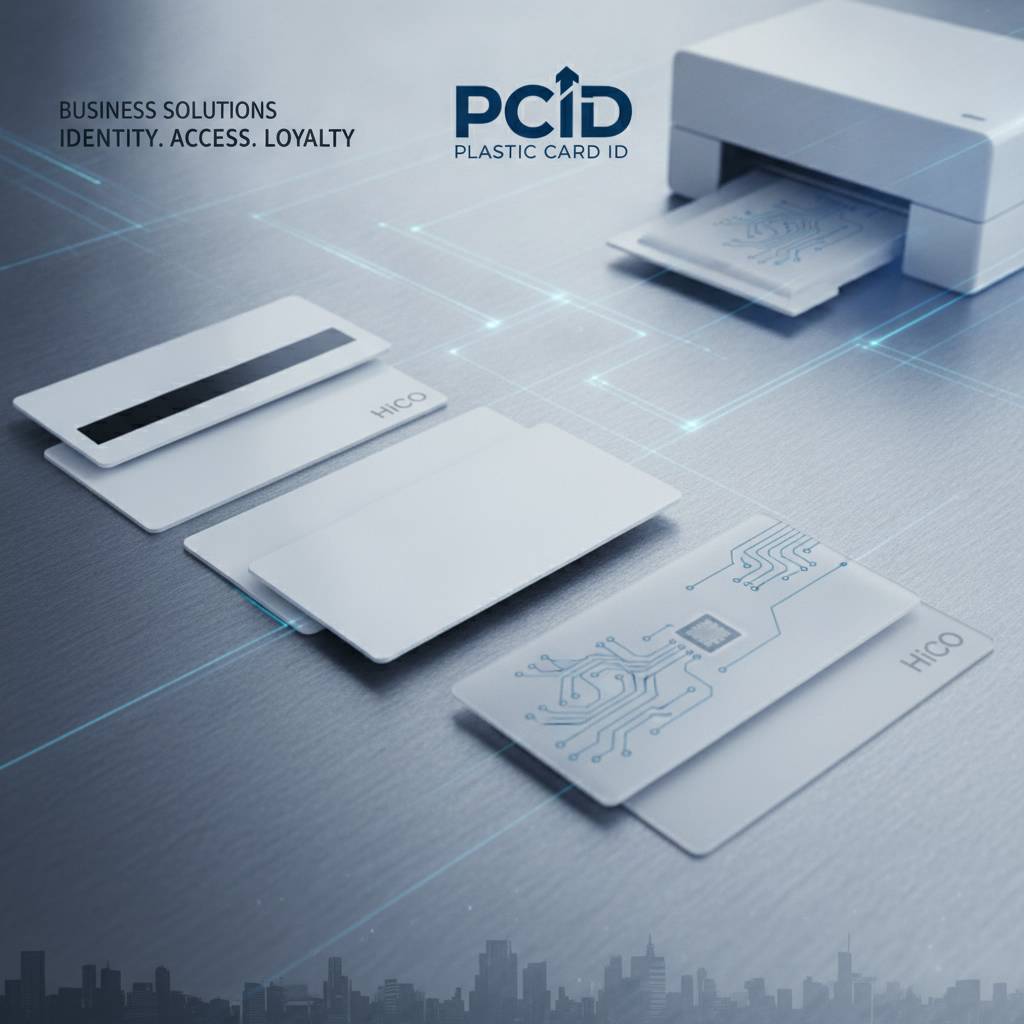
In-house badge printing puts control back where it belongs. HR prints a new hire badge the morning of their first day. Security reprints a compromised credential within minutes. The event coordinator prints 200 visitor badges the afternoon before the conference. None of these scenarios require a purchase order, a vendor phone call, or a shipping wait.
Total Cost of Ownership Over Time
The upfront cost of a card printer - which can range from $300-$800 for an entry-level Evolis model to $2,000-$5,000 for an enterprise Fargo retransfer unit - is the number that initially gives organizations pause. The calculation shifts significantly when you factor in per-card printing costs. In-house printing typically lands between $0.30-$0.75 per card (including ribbon and card stock) compared to $2-$8 per card for outsourced production at comparable quality levels.
At 100 cards per month, the break-even point between in-house and outsourced production typically falls within 6-12 months. At 500 cards per month, the break-even arrives in a matter of weeks. For programs printing 1,000 or more cards monthly, in-house production generates meaningful cost savings from the very first print run.
Compliance, Security, and Audit Readiness
Industries with regulatory requirements around employee credentialing - healthcare, finance, education, government contracting - benefit from in-house badge programs in ways that go beyond cost. When you print in-house, you maintain complete control over the credential issuance chain. Badge issuance is logged within your system. Revocations are immediate. Audit trails are your own, not dependent on a third-party vendor's records.
For organizations subject to HIPAA, FERPA, or federal contractor requirements, the ability to demonstrate a controlled credentialing process is not a nice-to-have - it is a compliance requirement. An in-house program supported by reliable card stock and documented printing procedures strengthens that compliance posture considerably.
Partner With Plastic Card ID for Your Employee Badge Card Program
Twenty-five years. Over 100,000 customers. More than 50 million cards shipped across the United States. Those numbers represent something specific: the accumulated experience of building card programs that work, at every scale, for every industry. Plastic Card ID is not a transactional supplier that ships a box of cards and moves on. The relationship is designed to grow with your organization - from your first order of 500 blank CR80 cards to the card printer that sits on your HR desk to the ribbon replenishment orders that keep your program running without interruption.
The catalog covers every card type your program might need: plain white PVC, HiCo and LoCo magnetic stripe, RFID and proximity cards, MIFARE DESFire smart chip cards, clear and frosted stock, colored PVC, custom die-cut shapes, and luxury metal cards. The printer lineup from Evolis, Zebra, and Fargo covers every volume and budget point. The value-added services - ribbons, cleaning kits, card carriers, sleeves, card affixing and mailing - mean you can run your entire badge program through a single supplier relationship.
Getting Started Is Simpler Than You Think
New customers consistently report that the hardest part of starting an in-house badge program was deciding to do it. The actual process - selecting card stock, choosing a printer, ordering supplies - moves quickly with the right guidance. The team at CPE has helped organizations of every size and industry navigate these decisions, and they bring that accumulated experience to every new customer conversation.
Whether you know exactly what you need or you are starting from scratch with nothing but the knowledge that your organization needs employee ID badges, the conversation starts the same way: a phone call or an order. There are no minimums that make small programs unwelcome and no order too large for the fulfillment capacity behind CPE.
Ready to Build Your Employee Badge Program?
Call Plastic Card ID today at 800.835.7919 and speak directly with a card program specialist who will help you select the right blank plastic cards, printer, and supplies for your specific employee badge requirements. From 50 cards a month to tens of thousands, your program deserves a partner with the experience and inventory to back it up.
Do not let another week go by with a badge program that is slower, more expensive, or less professional than it needs to be. Plastic Card ID has the cards, the printers, and the expertise to change that - starting with your next order.
Previous Page