How Many Blank Plastic Cards Do I Need to Order
Table of Contents []
- How Many Blank Plastic Cards Do I Need to Order? A Practical Guide from Plastic Card ID
- Understanding Card Types Before You Calculate Order Volume
- Volume Pricing Tiers and What They Mean for Your Budget
- Loyalty and Gift Card Programs: Why Volume Drives Results
- Frequently Asked Questions About Blank Card Order Quantities
- Getting the Most Out of Your Card Program: Beyond the Card Count
How Many Blank Plastic Cards Do I Need to Order? A Practical Guide from Plastic Card ID
It sounds like a simple question. But the moment you sit down and actually try to calculate it, the variables multiply fast. Are you issuing cards to employees? Running a loyalty program? Setting up event credentials that expire after a weekend? The right quantity depends on factors most buyers do not think about until their second or third order - and that learning curve can get expensive.
At Plastic Card ID, we have worked with over 100,000 customers and shipped more than 50 million cards across the United States. What we have seen, again and again, is that the organizations that plan their order quantities strategically spend significantly less over time - and never scramble to reprint badges the morning of a conference. This guide exists to help you get it right from the start.
Why Quantity Planning Matters More Than You Think
Blank CR80 plastic cards - the standard 30 mil, ISO 7810 format that fits every wallet and works in every printer - are priced on volume tiers. Order 100 and you pay a premium per card. Order 1,000 and the math shifts noticeably in your favor. Order 5,000 and you are operating at a cost level that makes in-house card programs genuinely competitive with outsourced printing.
There is also the operational reality to consider. Running out of blank cards mid-program forces you to either pause issuance or place a rush order at a higher unit cost. Neither outcome is good. Smart quantity planning is really just smart business planning - and it starts with understanding your actual usage patterns before you place that first order.
The Basic Formula: Current Needs Plus Buffer
Start with what you know. If you manage employee badges for a company of 80 people and you onboard roughly 10 new staff per year, your baseline need is clear. Add a buffer for replacements - cards get lost, damaged, or demagnetized. A 15-20% overage above your projected need is a reasonable starting point for most programs.
For loyalty or membership programs, the math is different. You are not just replacing; you are acquiring. If you plan to enroll 500 new members in a quarter, you need at least 500 cards plus reprints for errors and damaged cards during encoding. Factor in your printer's reject rate - even the best card printers from Evolis, Zebra, and Fargo will occasionally produce a card that needs to be reprinted.
What CPE Recommends for First-Time Buyers
If you have never run an in-house card program before, the instinct is often to order conservatively - say, 250 cards - to minimize risk. We understand that hesitation. But here is what CPE consistently tells new clients: the per-card savings between 250 and 500 cards is often enough to justify the larger quantity on its own, especially if you have even modest confidence in your program's continuation.
The sweet spot for many small-to-midsize programs is somewhere between 500 and 2,500 cards for an initial order. This range gives you meaningful volume pricing, enough inventory to cover a full operational cycle, and manageable storage requirements. And blank PVC cards, stored properly away from heat and humidity, maintain their quality for years.
Reach out to our team at 800.835.7919 if you want help estimating your needs before committing to a quantity. We do this kind of consultation regularly - no pressure, just numbers.
Understanding Card Types Before You Calculate Order Volume
 Not all blank plastic cards are interchangeable. The type of card you need depends entirely on how it will be used and what equipment will read or encode it. Getting this right before you order is just as important as getting the quantity right - because ordering the wrong card type at a great price is still money wasted.
Blank does not mean generic. A blank card can be a standard white PVC card, a magnetic stripe card in HiCo or LoCo format, an RFID proximity card, a smart chip card, a frosted card, a colored stock card, or even a clear card. Each serves a specific function, and each requires the right printer and encoding hardware to work properly in your program.
Magnetic Stripe Cards: HiCo vs. LoCo and Why It Affects Quantity
High-coercivity (HiCo) magnetic stripe cards are more durable and resistant to accidental erasure from everyday magnetic fields - things like phone cases, bag clasps, and retail security systems. They are the right choice for cards that will be used frequently over a long period, such as employee access cards or loyalty cards. LoCo cards are fine for short-term use like event passes or hotel-style applications where the card lifecycle is brief.
Why does this affect quantity planning? Because HiCo cards have a longer effective lifespan, you replace them less often. A well-maintained HiCo loyalty card can remain in circulation for two to three years before needing replacement. LoCo cards used for events might be single-use or limited to a few days. These lifecycles should directly influence how many you order at a time.
RFID and Proximity Cards: Different Usage Patterns, Different Volumes
RFID smart cards and proximity access cards are typically used in access control environments - office doors, secure areas, parking garages. These cards tend to be issued once and used for extended periods, which means your replacement rate is lower than it would be for loyalty or gift cards. But they are also more expensive per card, which makes accurate quantity estimation even more critical.
Advanced RFID options like MIFARE DESFire cards carry embedded microchips capable of storing encrypted data. They are used in sophisticated access control systems and casino player programs. Ordering the wrong quantity of these premium cards is a costly mistake - either you over-invest in inventory that sits idle, or you run short and delay card issuance for employees or members who need access immediately.
Specialty Cards and When to Order in Smaller Quantities
Clear plastic cards, frosted cards, custom die-cut shapes, and luxury metal cards in stainless steel, brass, or gold occupy a different category altogether. These are typically used for premium membership programs, VIP credentials, or high-end brand experiences. They are not the kind of card you order by the thousand on a first run.
For specialty cards, a smaller pilot quantity makes more sense - enough to validate the design and test member response before scaling. Many of CPE's clients who run VIP or prestige card programs start with 100-250 specialty cards and then reorder once the program is established. The higher per-card cost at low volumes is an acceptable trade-off for validation and flexibility.
| Program Type | Typical Starting Quantity | Reorder Frequency |
|---|---|---|
| Employee ID / Access Badges | 250-500 | Annually or as needed |
| Retail Loyalty Cards | 500-2,500 | Quarterly |
| Event Credentials | Equal to attendance 10% | Per event |
| Membership Programs | 500-1,000 | Semi-annually |
| Specialty / VIP / Metal Cards | 100-250 (pilot) | As program grows |
| Gift Card Programs | 1,000-5,000 | Monthly to quarterly |
Volume Pricing Tiers and What They Mean for Your Budget
Volume pricing on blank PVC cards is not just a sales incentive - it reflects the genuine economics of card manufacturing and fulfillment. Once you understand how the tiers work, it becomes easier to make decisions that align with both your program needs and your budget constraints. The goal is to land in a tier that saves you money without forcing you to hold more inventory than you can realistically use.
Most buyers see meaningful price breaks at quantities like 100, 500, 1,000, 2,500, and 5,000 cards. The jump between 100 and 500 is often the most dramatic. Doubling or tripling your initial order quantity can sometimes cut your per-card cost nearly in half - a calculation that is worth running before you submit that conservative first order.
Calculating Your True Cost Per Card
The sticker price on a box of 500 blank cards is not your true cost. Factor in shipping, any encoding supplies, printer ribbon yield (how many cards one ribbon panel can print), and the labor or time cost of your card production process. When you spread all of those costs across the number of cards produced, the per-card economics of larger orders become even more compelling.
Here is a quick way to think about it: if your card printer ribbon produces 250 cards per ribbon and you are ordering 500 cards, you need two ribbons regardless of whether you ordered 500 or 1,000 cards. The ribbon cost is essentially fixed for that production run. More cards for the same ribbon cost means a lower effective cost per card - which is why production volume and card inventory should be planned together, not separately.
When Smaller Orders Actually Make Sense
There are real scenarios where ordering smaller quantities is the smarter move. If you are testing a new card program for the first time and uncertain about uptake, a smaller initial order limits your exposure. If you are piloting a new card design before committing to a full run, small quantities protect you from being stuck with outdated inventory if the design changes.
Similarly, if you use specialty card types - colored stock, frosted, or clear cards - and you are mixing these into a program alongside standard white PVC cards, it may make sense to order specialty types in smaller quantities relative to your standard card inventory. The key is matching inventory to actual projected usage, not ordering for the sake of volume discounts you cannot actually realize.
Budget-Conscious Buyers: How to Plan Across a Full Year
Rather than asking how many cards you need for your next order, ask how many you need for the next twelve months. Then divide that annual figure by the number of orders you want to place per year. If you want two orders annually, cut the annual figure in half. This approach lets you hit better volume price points on each order while keeping inventory lean enough to manage easily.
If you have questions about how to structure your annual card budget, our team at 800.835.7919 is available to walk through the numbers with you. We work with programs of every scale, from organizations ordering 50 cards a month to enterprises running mass production in the tens of thousands.
Loyalty and Gift Card Programs: Why Volume Drives Results
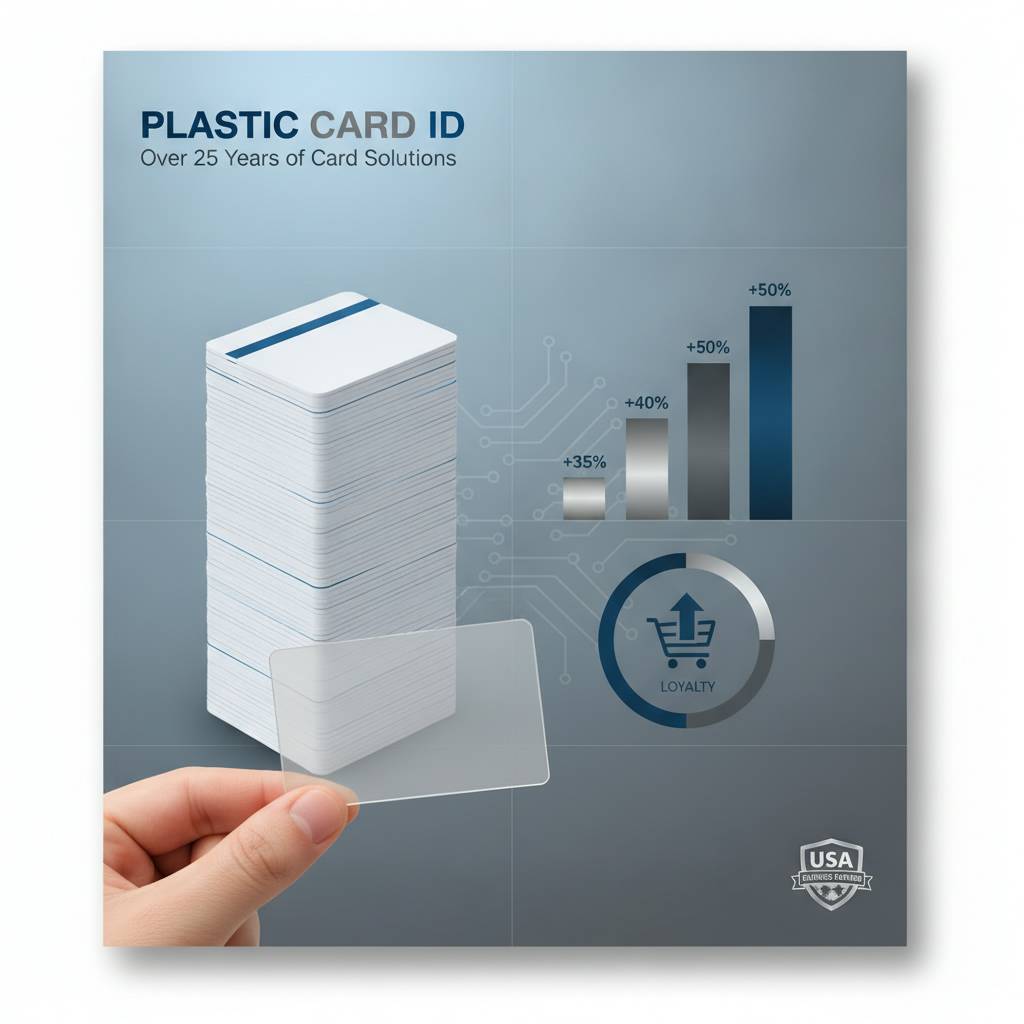 There is a compelling business case for investing in plastic loyalty and gift cards, and it is not subtle. Retailers that switch from paper punch cards to plastic loyalty cards consistently see stronger member retention and higher average transaction values. Businesses that graduate from paper gift certificates to plastic gift cards report sales increases of 35-50% - a figure rooted in real program data, not marketing copy.
Why does plastic outperform paper so decisively? Partly it is the physical durability - a plastic card survives the bottom of a bag, a wallet crammed full of receipts, and a spin through the laundry. But it is also about perceived value. A well-designed plastic card signals that your program is serious, permanent, and worth engaging with. Paper communicates temporary. Plastic communicates commitment.
Scaling a Loyalty Program: How Many Cards to Start With
If you are launching a retail loyalty program from scratch, resist the urge to order just enough cards for your current customer count. Loyalty programs grow - that is the point of them. Order enough to cover your existing customer base, anticipated new enrollments over the next six months, and a replacement buffer of at least 10-15%. Running out of loyalty cards during a busy enrollment period is a missed acquisition opportunity you cannot recover.
A reasonable starting point for a small-to-medium retail loyalty launch is 500-2,500 cards. If you have an existing customer database of 300 people and a marketing plan to grow by another 200 in the next quarter, you are looking at a minimum of 500 cards just to cover that window - and that does not account for replacements or walk-in enrollments you had not anticipated.
Gift Card Inventory: Planning Around Seasonal Demand
Gift card programs have a uniquely seasonal demand curve. Holiday periods, graduation seasons, and back-to-school windows can spike your gift card issuance dramatically. Running out of gift cards during a peak demand period is one of the most preventable revenue losses a retailer can experience. Order ahead of your busy seasons - typically six to eight weeks in advance - and build a reserve that covers your projected peak plus 20%.
For year-round gift card programs, a steady quarterly reorder cycle tends to work well for most small and mid-size retailers. Larger operations with high-volume gift card programs may benefit from semi-monthly orders timed to their inventory management cycles. The CPE team has helped design card inventory strategies for programs at both ends of that spectrum.
Frequently Asked Questions About Blank Card Order Quantities
Over 25 years of working with organizations of every type and size, we have heard the same questions come up again and again. Here are the most common ones - answered honestly, without the sales spin.
Can I Order Just 50 or 100 Cards?
Yes. Minimum order quantities at Plastic Card ID are accessible to small programs. You do not need to be a large enterprise to order blank plastic cards. That said, the per-card cost at very low quantities is significantly higher than at volume tiers, and the math usually favors ordering at least 250-500 cards if you have any confidence that you will use them within a reasonable timeframe.
If you are running a very small program - say, a local gym with 75 members or a small business issuing employee ID cards to a team of 40 - ordering 100-250 cards to start is entirely reasonable. Just go in knowing that your next order will likely be cheaper per card if you move up a tier.
What Happens If I Order Too Many?
Blank PVC cards store exceptionally well. Kept in their original packaging, away from direct heat and high humidity, they maintain their quality for years. Unlike paper stock or pre-printed cards with specific dates or designs, blank cards do not become obsolete just because time passes. Overstocking blank cards is a far less costly mistake than running out mid-program.
The exception is if your card type has embedded technology - RFID chips, for example - that may become outdated as access control systems evolve. For standard blank white PVC cards and magnetic stripe cards, long-term storage is a non-issue.
Do I Need to Order Cards and Ribbons at the Same Time?
- Yes, ideally. Running out of printer ribbon when you have a stack of blank cards to print creates unnecessary delays.
- Each ribbon type is specific to a printer model - Evolis, Zebra, and Fargo ribbons are not interchangeable across brands or even always across models within a brand.
- Calculate your ribbon needs based on yield per ribbon panel and the number of cards you plan to print in your next production cycle.
- Order a small buffer of cleaning kits and card sleeves at the same time to keep your printer running at peak performance and protect your finished cards.
- Plastic Card ID carries the full range of ribbons, cleaning supplies, card carriers, and accessories - everything you need to run a complete in-house card program from a single source.
Is There a Right Time to Switch to Mass Production Quantities?
When your card program reaches a point where you are placing orders of 2,500 or more cards multiple times per year, it is worth having a conversation about your overall card program structure. At that scale, the economics of inventory planning, storage, and per-unit cost start to look very different. Mass production quantities in the tens of thousands can dramatically reduce your cost per card and may open up options for custom-printed cards that would be cost-prohibitive at lower volumes.
The transition from small-batch to high-volume ordering is a milestone many of CPE's clients hit within two to three years of launching a successful loyalty or membership program. Our team helps with that transition regularly - it is one of the more satisfying conversations we have.
Getting the Most Out of Your Card Program: Beyond the Card Count
Ordering the right quantity of blank plastic cards is important. But the organizations that get the most out of their card programs are the ones that think holistically - cards, printers, supplies, fulfillment, and strategy all working together. A well-designed card program is not just an operational function; it is a customer touchpoint, a brand statement, and a retention tool rolled into one durable, wallet-sized piece of plastic.

Think about what happens after the card is printed. Does it go straight to the cardholder, or does it need to be mailed? Do you need card carriers or envelopes? Are the cards being distributed at a point-of-sale, a front desk, or sent out in a batch mailing? Plastic Card ID offers card affixing and mailing services for programs that need a fulfillment solution, not just a card supply. Everything your card program needs, from the blank stock to the stamped envelope, is available in one place.
Printer Selection and How It Affects Your Card Quantity Needs
Your card printer's speed, capacity, and ribbon yield should factor into how you plan your card quantities. A desktop card printer designed for low-volume issuance - say, 10-20 cards per day - has different implications for inventory management than a high-throughput printer capable of printing several hundred cards per hour. Match your printer to your program volume, and match your card inventory to your printer's realistic output cycle.
Evolis, Zebra, and Fargo each offer printers across a wide range of production volumes. If you are not sure which printer fits your program, that is another area where CPE's team can guide you. The printer-card-ribbon combination needs to function as a system, and we can help you spec that system correctly from the start.
Card Affixing, Mailing, and Fulfillment Services
For programs that mail cards to members, customers, or employees, the logistics of card fulfillment can become a real operational burden at scale. Printing the cards in-house is one thing; collating, stuffing, and mailing them individually is another. Plastic Card ID offers card affixing and mailing services that take that burden off your team entirely.
This matters for quantity planning because when you outsource fulfillment, your in-house blank card inventory needs shift. Instead of holding a large buffer to cover mailing batches, you can align your orders more precisely with your enrollment cycles. Streamlined fulfillment means leaner inventory and better cash flow - another reason to think about your card program as a system, not just a supply line.
Consistency, Quality, and Long-Term Partnership
One of the underrated advantages of working with a single supplier for all your card program needs is consistency. When all your blank cards come from the same source, they are consistent in thickness, finish, and magnetic stripe quality - which matters enormously for printer calibration and cardholder experience. Mixing card stock from multiple suppliers introduces variables that can cause print quality issues and encoding errors.
Over 25 years and more than 100,000 customers, Plastic Card ID has built its reputation on being that consistent, reliable source for card programs of every size. We are not just selling you cards - we are helping you run a program that works. That long-term perspective is what makes the difference between a supplier and a strategic partner.
Ready to figure out exactly how many blank plastic cards your program needs? Our team is here to help you calculate quantities, select the right card types, and build an ordering strategy that keeps your program running without interruption.
Contact Plastic Card ID today at 800.835.7919 - let's get your card program running at the right scale, with the right cards, at the best possible cost per card.
Previous Page