Blank Plastic Cards for Barcode Scanning: Accurate Results
Table of Contents []
- Blank Plastic Cards for Barcode Scanning - Plastic Card ID
- Why Plastic Cards Outperform Paper for Barcode Programs
- Types of Blank Plastic Cards Available for Barcode Scanning
- In-House Printing vs. Pre-Encoded Cards - Choosing the Right Model
- Applications - Where Blank Barcode Cards Are Used
- Frequently Asked Questions About Blank Plastic Cards for Barcode Scanning
- Ready to Build a Barcode Card Program That Works - Contact Plastic Card ID
Blank Plastic Cards for Barcode Scanning - Plastic Card ID
Barcodes are everywhere - on products, badges, event credentials, membership cards, and loyalty programs. But not every card stock handles scanning reliably. The substrate matters enormously, and organizations that rely on accurate, repeatable barcode reads know that blank plastic cards purpose-built for barcode scanning are the only real answer. Plastic Card ID has spent over 25 years supplying exactly that to businesses across every industry in the United States.
Whether you need 500 cards for a gym membership program or 50,000 for a retail loyalty rollout, the blank CR80 PVC card is the foundation of a professional card program. Print your barcode on-site, encode it, laminate it - the plastic card holds up where paper fails. That durability is not a minor detail; it is the entire point.
| Card Type | Best For | Barcode Compatibility | Typical Volume Range |
|---|---|---|---|
| Blank White PVC CR80 | Employee badges, loyalty cards, ID cards | 1D, 2D, QR codes | 50 - 100,000 |
| Magnetic Stripe Barcode | Access control, hotel keys, retail | 1D, 2D barcodes mag stripe encode | 100 - 50,000 |
| RFID / Proximity Cards | Contactless access, smart credentials | RFID printed barcode overlay | 50 - 25,000 |
| Colored PVC Stock | Color-coded departments, events | 1D, 2D, QR codes | 100 - 10,000 |
| Clear / Frosted PVC Cards | Premium programs, specialty credentials | 1D, 2D with proper contrast ink | 50 - 5,000 |
Why Plastic Cards Outperform Paper for Barcode Programs
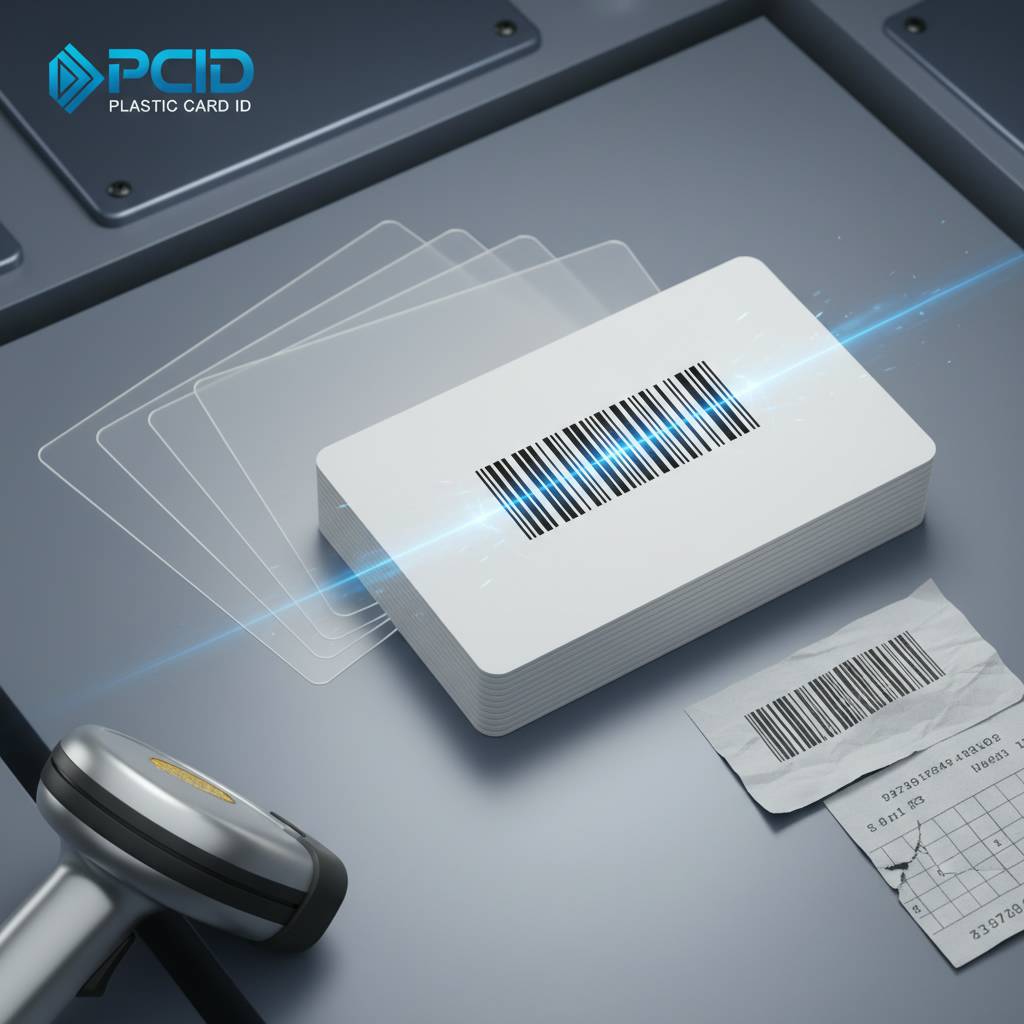 Paper barcode cards bend, tear, smudge, and absorb moisture. A creased paper card can completely foil a laser scanner - the barcode distorts, the scanner misreads, and suddenly your checkout line, membership desk, or access control point grinds to a halt. Plastic eliminates that failure mode entirely. CR80 PVC cards maintain dimensional stability through heat, humidity, and thousands of swipes.
There is a real operational cost to failed scans that organizations often underestimate until it happens repeatedly. A loyalty card that cannot be read at the point of sale frustrates customers and staff alike. A membership card that fails at the gym turnstile creates friction that erodes confidence in your program. The fix is straightforward - start with a substrate built for the job.
The CR80 Standard - What It Means for Your Program
CR80 is the ISO 7810 standard card size - 3.375 inches by 2.125 inches, 30 mil thick. That is the size of every credit card you have ever carried. It fits every standard card printer, card slot, badge holder, and wallet on the market. When you buy blank CR80 PVC cards from CPE, you are buying cards that will work with your existing infrastructure without modification.
The 30 mil thickness is not arbitrary. It provides sufficient rigidity for clean transport through card printer rollers, enough surface tension for sharp barcode printing, and durability for years of repeated handling. Thinner stock warps. Heavier stock jams. CR80 at 30 mil is the sweet spot - proven over decades of real-world use across every card program type imaginable.
Scan Reliability - What Affects It and How to Protect It
Barcode scan reliability depends on contrast, print resolution, and surface consistency. White PVC card stock provides the highest-contrast background for black barcode printing - which is why it remains the dominant choice for barcode card programs. A clean white surface and a sharp printer ribbon produce barcodes that scan first-time, every time.
Surface texture matters too. Glossy PVC stock reflects light uniformly, which helps both laser and CCD scanners read barcodes accurately. Matte finishes can work well with 2D and QR code formats but may require slightly higher print density settings. The good news is that when you source your cards and ribbons from the same supplier, those variables are already optimized for compatibility.
Longevity and Durability in High-Use Environments
A plastic barcode card issued today should still scan reliably two or three years from now. For retail loyalty programs, gym memberships, library cards, and employee badges, that longevity is not optional - it is expected. PVC plastic resists scratching, moisture, and everyday wear in ways that paper and cardstock simply cannot match.
Consider the math: a loyalty card that lasts three years is handed to a cashier scanner dozens - perhaps hundreds - of times over that lifespan. Each scan is a micro-stress event on the card surface. A PVC card handles that. A paper card does not survive the first month of wallet life with barcode integrity intact. The choice is not really a choice at all when you think it through.
Types of Blank Plastic Cards Available for Barcode Scanning
Not every barcode card program has the same requirements. A healthcare facility issuing patient identification cards has different needs than a coffee shop running a punch-replacement loyalty program. Plastic Card ID stocks a deep catalog of card types precisely because the right card depends on what you are encoding, how you are scanning, and what else the card needs to do.
Versatility in your card inventory is a genuine competitive advantage. Organizations that carry multiple card types - say, white stock for standard programs and colored stock for VIP tiers - deliver a more polished program without necessarily spending more per card. The blank card is a canvas, and what you put on it defines the experience.
Blank White PVC Cards - The Workhorse Option
Blank white CR80 PVC cards are the single most versatile item in any card program inventory. They accept inkjet, direct-to-card thermal, and retransfer printing equally well. Every barcode symbology - Code 39, Code 128, QR codes, PDF417, Data Matrix - prints cleanly and scans reliably on white PVC. This is the card that runs millions of programs across every industry in the country.
Blank white cards also give in-house card programs maximum control. Print what you need, when you need it. Update the design without obsoleting your card inventory. Issue cards on demand rather than waiting weeks for pre-printed stock. For organizations printing in batches of 50 to several thousand, blank white PVC is the most cost-efficient, flexible option available.
Magnetic Stripe Cards with Barcode Capability
Many card programs need more than a printed barcode. They need encoded data, too. Magnetic stripe cards - available in both HiCo (High Coercivity) and LoCo (Low Coercivity) formats - let you combine a printed barcode with encoded track data on the same card. HiCo stripes are more resistant to accidental demagnetization and are the preferred choice for long-lived credential programs.
LoCo cards work well for shorter-duration programs like event wristbands, hotel keycards, or temporary access passes where longevity matters less than cost. Both formats are fully compatible with standard card printer encoders and can carry a printed barcode on the card face simultaneously, giving you redundant identification methods on a single card - a useful feature for high-security or high-traffic environments.
Colored Stock, Clear, and Frosted Specialty Cards
Colored PVC card stock adds a visual layer to card programs that white stock cannot. Color-coded cards by department, membership tier, or event type make sorting and identification instantaneous at a glance. Colored cards that also carry a printed barcode give you the best of both worlds - visual differentiation plus machine-readable data - without any sacrifice in scan reliability when proper ink contrast is maintained.
Clear and frosted PVC cards present a unique challenge for barcodes but are absolutely workable with the right printer settings and ribbon selection. Dark ink on clear stock with a backing card holder creates strong contrast for scanning. Frosted stock diffuses light in a way that requires slightly denser barcode printing, but the end result is a premium-feeling card that scans accurately and looks exceptional in a membership or VIP program context.
In-House Printing vs. Pre-Encoded Cards - Choosing the Right Model
 One of the most consequential decisions in designing a barcode card program is whether to print in-house or source pre-printed cards. Both models have merit, and CPE can support either approach. The right answer depends on your volume, your personalization requirements, and your operational capacity.
In-house printing gives you control - issue cards immediately, update designs on the fly, personalize every card with unique barcodes or names without minimum order constraints. Pre-printed or bulk-encoded cards make sense for very high-volume programs where consistency and speed outweigh flexibility. Many organizations actually run both models simultaneously - blank stock for day-to-day issuance and pre-encoded batches for large events or seasonal campaigns.
Card Printers That Handle Barcode Printing Flawlessly
Plastic Card ID carries card printers from three of the most trusted brands in the industry - Evolis, Zebra, and Fargo. Each brand brings different strengths to in-house barcode card printing. Evolis printers are known for quiet, compact operation and excellent ribbon efficiency - ideal for office environments. Zebra printers are workhorses built for high-volume, continuous-run card issuance. Fargo printers offer advanced encoding options and are widely used in government and corporate ID programs.
Choosing the right printer is as important as choosing the right card stock. A mid-range printer paired with quality blank PVC cards and genuine OEM ribbons will produce barcodes that scan reliably at distances and angles that cheaper combinations cannot match. The investment in a quality printer pays for itself quickly in reduced reprint rates and fewer failed scans at the point of use.
Printer Ribbons and Supplies for Barcode Accuracy
Ribbon selection directly affects barcode print density, edge sharpness, and resistance to fading. YMCKO ribbons - which include Yellow, Magenta, Cyan, Black, and Overlay panels - are the standard for full-color card printing with barcode capability. The K (black) panel is specifically optimized for barcode and text printing, producing sharper edges and denser black than the composite black generated by mixing CMY layers.
For programs printing barcodes only - no full-color imagery - monochrome black ribbon is significantly more economical per card and produces even denser barcode output. Plastic Card ID stocks ribbons for all printer models it carries, along with cleaning kits that maintain print head performance and prevent the dust and debris buildup that degrades barcode print quality over time.
Volume Pricing and Program Scaling
Blank plastic cards become progressively more cost-efficient as volume increases. A program ordering 500 cards per month pays a different per-card cost than one ordering 5,000 - and Plastic Card ID structures its pricing to reward both loyal customers and larger orders. Strategic purchasing - ordering in larger quantities against a known annual volume - can reduce per-card costs substantially.
Scaling a card program from small to large is where having a real partner matters. CPE works with clients to plan inventory levels, anticipate demand spikes for seasonal programs, and ensure that supply chain disruptions do not leave a program without cards at a critical moment. That kind of proactive partnership is built over time - and it is exactly what 25-plus years of supplier experience makes possible.
Applications - Where Blank Barcode Cards Are Used
The range of applications for blank plastic barcode cards is genuinely broad. Almost any organization that needs to identify, track, authenticate, or reward individuals or items can benefit from a properly designed plastic barcode card program. The question is rarely whether a barcode card program would help - it is which card type and printing approach fits best.
- Retail Loyalty Programs: Plastic loyalty cards with printed barcodes replace paper punch cards with a durable, wallet-friendly credential that scans at POS terminals. Retailers switching from paper to plastic typically see 35-50% increases in gift card and loyalty program sales.
- Employee ID and Access Badges: Barcode-equipped employee badges integrate with access control systems, time-tracking software, and visitor management platforms. Combined with a photo and magnetic stripe, they become multi-function credentials.
- Healthcare and Patient Identification: Patient wristbands and ID cards with printed barcodes reduce medication errors and streamline check-in. Plastic cards survive repeated handling and disinfection cycles far better than paper alternatives.
- Library and Educational Institutions: Library cards with barcodes link members to their borrowing accounts instantly. Schools use barcode ID cards for attendance tracking, cafeteria programs, and facility access.
- Event and Conference Credentials: Event badges with unique barcodes enable session tracking, exhibitor lead retrieval, and secure area access control at trade shows, conferences, and festivals.
- Membership Programs: Gyms, clubs, associations, and professional organizations issue plastic membership cards with barcodes to signal permanence and prestige while enabling efficient check-in at the door.
- Inventory and Asset Tracking: Barcode cards attached to equipment, containers, or records create trackable paper trails that integrate with asset management software.
Loyalty and Retail Card Programs
Retail loyalty programs built on plastic barcode cards consistently outperform their paper equivalents. The durability of plastic keeps the card in a customer's wallet for years. The wallet presence is the key - a card that lives in a wallet is a constant, passive brand reminder that paper cards simply cannot replicate. Scan rates, repeat visit rates, and average transaction values all improve when loyalty programs move to plastic.
For small and mid-sized retailers, the in-house printing model works particularly well. Order blank white PVC cards in bulk, print barcodes and any personalization on demand using a desktop card printer, and issue cards immediately at the point of enrollment. No waiting for pre-printed stock, no minimum order constraints on individual card designs, and full design control when you want to refresh your card aesthetic.
Healthcare, Education, and Institutional Uses
Institutional card programs have demanding requirements - cards must be durable, legible, and scannable under less-than-ideal conditions. Healthcare settings add the requirement for cards to survive exposure to moisture and cleaning agents without barcode degradation. PVC plastic handles all of these conditions in a way that paper-based alternatives cannot.
Educational institutions particularly benefit from the in-house printing model. Student populations turn over annually, and printing ID cards in-house using blank PVC stock eliminates the lead time and per-card cost of outsourcing. A single mid-range card printer and a stock of blank cards can handle an entire school year's worth of student ID issuance - and update cards when information changes - without dependency on external vendors.
Corporate, Government, and Access Control Programs
Corporate and government card programs often combine barcodes with other credential technologies - magnetic stripes, proximity chips, or smart card microprocessors - on the same physical card. Plastic Card ID stocks all of these card types, from simple HiCo magnetic stripe cards to MIFARE DESFire RFID smart cards, all of which can carry a printed barcode as well. Multi-technology cards reduce the number of credentials an employee needs to carry while keeping every system in the building operational.
Access control programs particularly benefit from the combination of a printed barcode for visual verification and an encoded technology for electronic authentication. The printed barcode gives security personnel a human-readable fallback when systems are down or when manual verification is required. It is a small detail that proves its worth in exactly the moments when technology fails.
Frequently Asked Questions About Blank Plastic Cards for Barcode Scanning
Organizations new to in-house card programs often have detailed questions before committing to a card type and printer. The following answers address the most common queries CPE receives from customers planning barcode card programs for the first time or expanding existing programs.
What barcode types print well on blank PVC cards?
Virtually every standard barcode symbology prints excellently on blank white PVC card stock when using a quality card printer and appropriate ribbon. Code 128 and Code 39 are the most common 1D formats used on loyalty, membership, and ID cards. QR codes and PDF417 are the dominant 2D formats for applications requiring large data payloads. The key variable is print resolution - 300 DPI minimum, 600 DPI preferred for small or dense 2D codes.
For very dense barcodes - high-data-density QR codes or DataMatrix symbols - retransfer printers outperform direct-to-card printers because of their higher print resolution and superior edge definition on the barcode bars. If your program requires scanning dense 2D barcodes under varying light conditions or at longer distances, discuss your scanner specifications with CPE before selecting a printer model to ensure full compatibility.
How many cards can I print per day with an in-house setup?
Card printer throughput varies significantly by model. Entry-level desktop printers typically produce 100-200 single-sided cards per hour. Mid-range printers push 300-500 cards per hour. High-throughput models designed for institutional or government programs can exceed 1,000 cards per hour. Knowing your peak daily volume before selecting a printer prevents the frustration of underspecifying for a program that grows faster than anticipated.
For most small to mid-sized programs - gyms, libraries, retailers, small employers - an entry-level or mid-range printer easily meets daily card issuance needs. Larger programs, seasonal spikes, or programs with aggressive enrollment campaigns may benefit from a higher-throughput model or a second printer as a backup. Reach Plastic Card ID at 800.835.7919 to discuss throughput requirements and get a printer recommendation matched to your actual program volume.
Can I order blank cards in small quantities?
Plastic Card ID serves programs of all sizes - from organizations issuing 50 cards a month to operations running tens of thousands of cards through their system monthly. There is no program too small to serve well, and small-quantity orders of blank PVC cards are genuinely available without requiring minimum order commitments that price out smaller organizations.
That said, per-card cost drops meaningfully with volume. A program that knows it will use 5,000 cards over the next six months is better served financially by ordering in larger batches rather than placing five separate 1,000-card orders. CPE works with customers to identify the purchasing cadence that balances cost efficiency with practical storage constraints - and there is no pressure to buy more than you can realistically use within a reasonable timeframe.
Ready to Build a Barcode Card Program That Works - Contact Plastic Card ID
A barcode card program built on quality blank PVC cards, the right printer, and a reliable ribbon supply is one of the most practical operational investments a business or organization can make. The cards deliver returns in efficiency, professionalism, and customer experience that are immediately measurable and compound over time as the program matures and membership grows.
Plastic Card ID brings more than 25 years of specialized experience, a catalog that covers every card type and printer brand your program might require, and a genuine commitment to being a partner rather than just a vendor. With over 100,000 customers served and more than 50 million cards supplied, the depth of knowledge behind every recommendation is real and earned.
Call Plastic Card ID today at 800.835.7919 to speak with a card program specialist who will help you identify the right blank plastic cards, printing equipment, and supplies for your barcode scanning application - and build a program that performs from day one and scales as you grow.
Previous Page