Blank Plastic Cards for Magnetic Stripe Encoding Explained
Table of Contents []
- Blank Plastic Cards for Magnetic Stripe Encoding - Your Complete Source at Plastic Card ID
- What Makes HiCo and LoCo Magnetic Stripes Different
- The CR80 Standard: Why Blank Cards Start Here
- Card Printers and Encoding Hardware: Building a Complete In-House System
- Industries and Applications: Where Magnetic Stripe Cards Do Real Work
- Frequently Asked Questions About Blank Magnetic Stripe Cards
- Why Businesses Trust Plastic Card ID for Blank Plastic Cards
Blank Plastic Cards for Magnetic Stripe Encoding - Your Complete Source at Plastic Card ID
There is something quietly powerful about a blank magnetic stripe card sitting in a box, waiting to become something. A loyalty card. An access credential. A membership token. A gift card that doubles sales. The card itself is inert until you encode it - and that is precisely the point. Blank plastic cards for magnetic stripe encoding give businesses total control over their card programs, from design to deployment, without paying premium prices for pre-printed stock every time a design change is needed.
At Plastic Card ID, that premise has driven more than 25 years of business. Over 100,000 customers, 50 million cards sold, and a catalog deep enough to supply everything from a boutique retailer running a 50-card loyalty program to a hotel chain producing tens of thousands of key cards per month. The blank card is not a compromise. It is a strategy.
| Card Type | Stripe Option | Best Use Case |
|---|---|---|
| Blank White PVC CR80 | HiCo or LoCo | Employee ID, loyalty, membership |
| Colored Stock Card | HiCo or LoCo | Event credentials, department color-coding |
| Clear or Frosted PVC | HiCo | Premium loyalty and VIP cards |
| Composite PVC Card | HiCo | High-volume access and ID programs |
What Makes HiCo and LoCo Magnetic Stripes Different
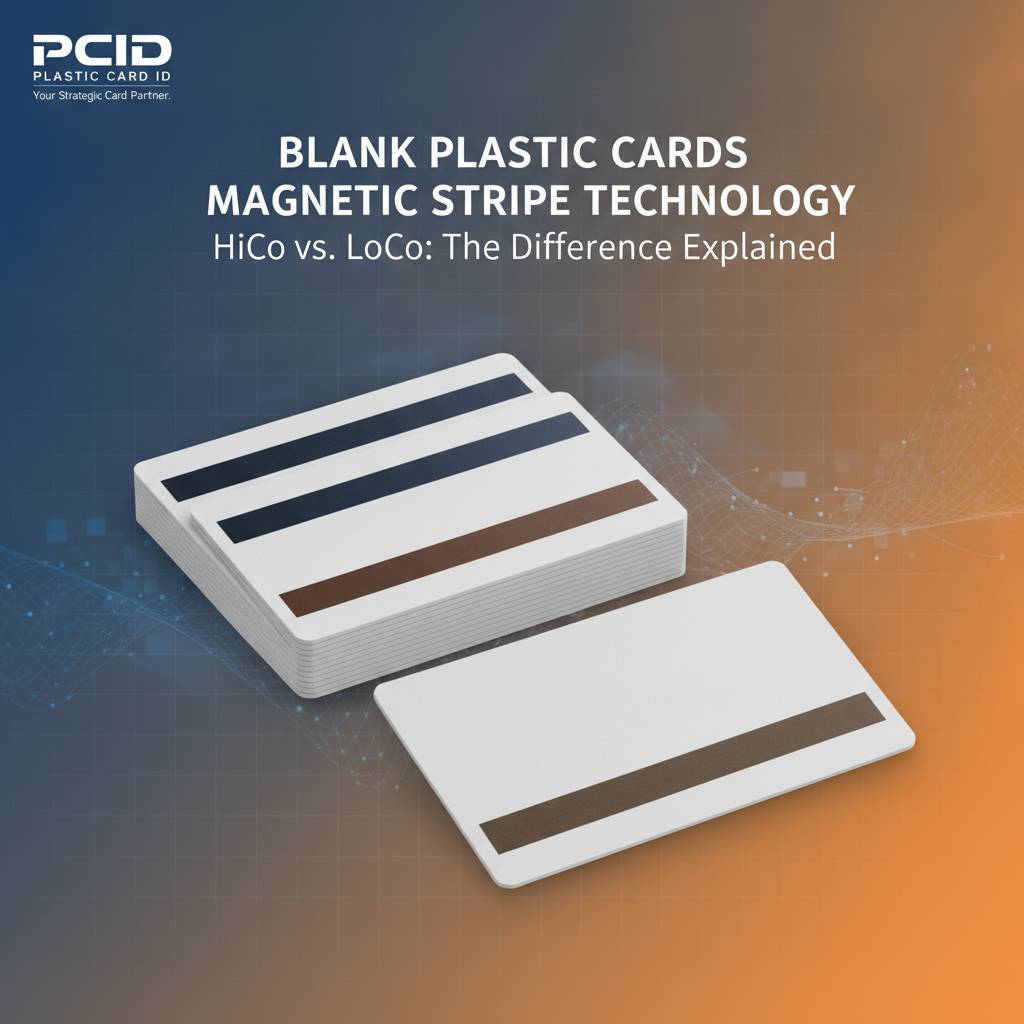 Not all magnetic stripes are created equal, and choosing the wrong one for your application can mean frustrating card failures in the field. High-coercivity (HiCo) stripes require a stronger magnetic field to encode data, which also means they are far more resistant to accidental erasure from everyday exposure to magnets, clasps, phones, and electronic equipment. LoCo cards encode more easily and at lower cost, but they are genuinely susceptible to data loss in certain environments.
The practical rule most card program managers learn, sometimes the hard way, is this: when in doubt, go HiCo. The small cost difference per card is negligible compared to the cost of reprinting and re-issuing cards that wiped themselves blank in someone's wallet next to a hotel key or a speaker phone. CPE stocks both formats in abundance, and can walk you through exactly which makes sense for your application.
HiCo Magnetic Stripe Cards: The Professional Default
HiCo cards are encoded at 2750 Oersteds, a measure of the magnetic field strength required to alter the stripe. That high threshold means the data stays put through normal daily life. Gift card programs, access control, hotel key systems, loyalty programs in retail environments -- these all benefit enormously from HiCo reliability.
A card that fails in a customer's hand is a brand event, not just a technical glitch. Businesses running serious card programs treat HiCo encoding as a baseline requirement, not an upgrade. The price difference is minimal; the operational difference is significant.
LoCo Magnetic Stripe Cards: Where They Shine
Low-coercivity cards, encoded at 300 Oersteds, are not inferior by design -- they are simply purpose-built for controlled environments. Parking garage tickets, short-term event passes, transit tokens, and temporary access cards all benefit from LoCo's lower encoding threshold, which allows cheaper encoding hardware to write the data quickly and efficiently.
If your card program operates in a clean, stable environment -- one where cards are not sharing pocket space with magnets or sitting near RF-heavy equipment -- LoCo cards are a cost-effective, practical choice. The key is matching stripe type to environment, not defaulting to one or the other blindly.
Track Configurations: Tracks 1, 2, and 3 Explained
Magnetic stripe cards carry data on up to three separate tracks. Track 1 holds alphanumeric data including the cardholder's name and additional discretionary information. Track 2 is numeric-only and widely used by financial and access systems. Track 3 is less commonly used in standard programs but available for applications requiring additional data storage on the stripe itself.
Most business loyalty, gift, and access card programs rely on Track 2 for its simplicity and broad compatibility with point-of-sale readers. Understanding which track your readers support is essential before you encode a single card -- and Plastic Card ID can help clarify exactly which configuration fits your existing hardware ecosystem.
The CR80 Standard: Why Blank Cards Start Here
CR80 is the industry term for the standard credit card size -- 3.375 inches by 2.125 inches, 30 mil thick. If you have ever held a credit card, a driver's license, or a hotel key, you have held a CR80 card. This is the format that wallets are built around, that card printers expect, and that card readers are calibrated for. Starting with a CR80 blank card means your program integrates seamlessly with every standard piece of hardware in the ecosystem.
Beyond dimensions, the 30 mil PVC construction provides durability that paper-based alternatives simply cannot replicate. These cards flex without breaking, resist moisture, and maintain print quality through repeated handling. Businesses that upgrade from paper loyalty punch cards to PVC magnetic stripe loyalty cards regularly report measurable increases in customer retention and repeat visits -- the card itself signals that the program is worth participating in.
Blank White CR80 Cards: The Workhorse Option
Plain white CR80 cards are the starting point for most in-house card programs. Print your design directly using a card printer, encode the stripe with your data, and you have a professional card at a fraction of the cost of ordering fully custom pre-printed stock every cycle. This model gives small and mid-size businesses enterprise-level flexibility.
Design changes -- new branding, seasonal promotions, updated membership tiers -- are handled in-house at minimal cost. No minimum order on design changes. No waiting weeks for new print runs. The blank card is the foundation of an agile card program.
Colored and Specialty Stock Cards
Not every program needs to start with white. CPE carries colored stock cards -- black, gold, silver, red, blue, and other options -- that provide instant visual differentiation without requiring full card printing. Color-coded cards work exceptionally well for department ID programs, event credentials distinguishing staff from attendees, or tiered membership programs where the card color itself communicates status.
Clear and frosted PVC cards take the visual dimension further. A frosted card with a printed logo and encoded magnetic stripe communicates premium positioning in a way a standard white card simply cannot. For VIP loyalty programs and high-value membership organizations, the physical card design is part of the value proposition itself.
Composite Cards for Demanding Applications
Standard PVC cards are excellent for most applications, but composite cards -- built from a blend of PVC and PET materials -- offer enhanced durability and better performance in high-throughput printers. Organizations running high-volume ID badge programs, access control systems with frequent card cycling, or any application where cards face heavy mechanical use will benefit from composite construction.
The encoding performance on composite cards matches or exceeds standard PVC, and the increased stiffness and scratch resistance mean the card looks professional longer. For programs where cards represent the organization to the outside world on a daily basis, longevity of appearance matters as much as functional reliability.
Card Printers and Encoding Hardware: Building a Complete In-House System
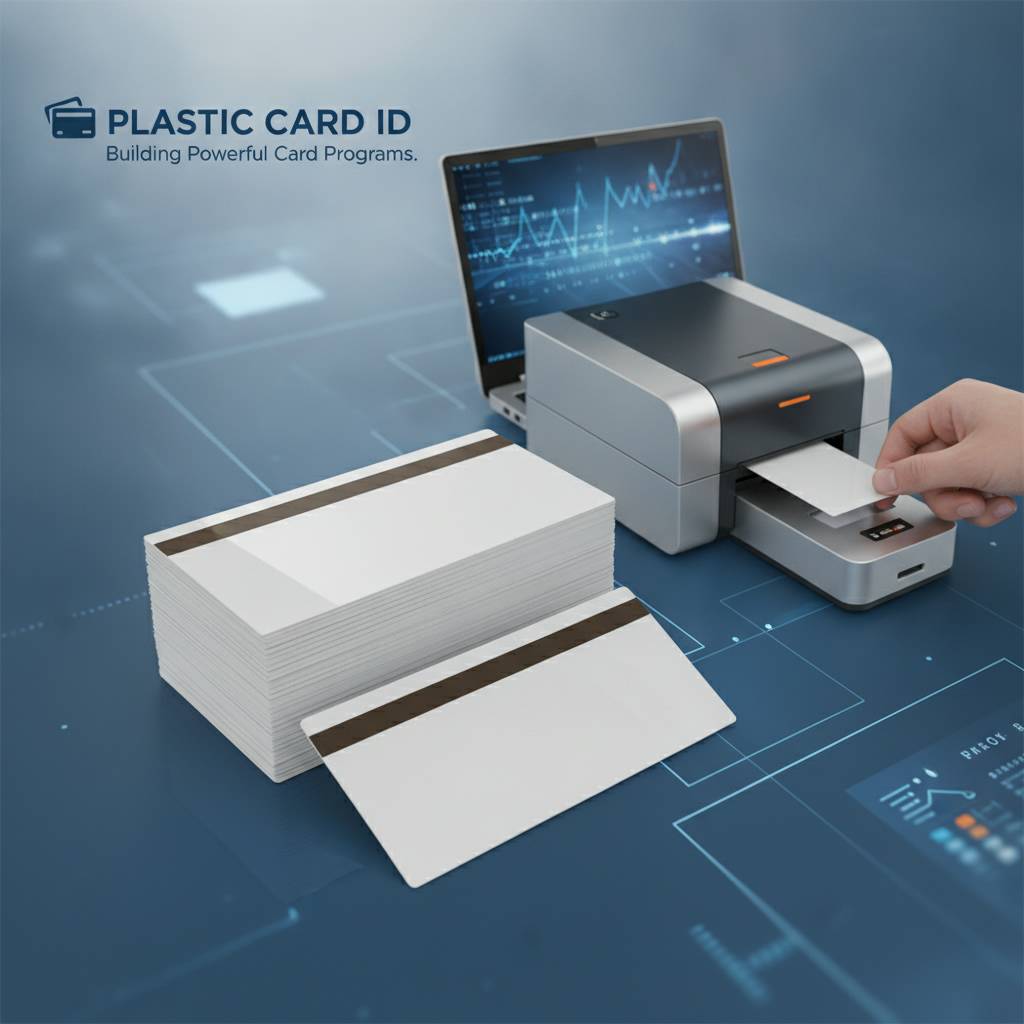 A blank magnetic stripe card is one half of the equation. The other half is the printer and encoder that transforms it into a finished, functional card. Plastic Card ID carries card printers from three of the industry's most trusted brands -- Evolis, Zebra, and Fargo -- each offering different capability levels suited to different program scales and budget ranges.
Choosing the right printer matters more than most buyers initially realize. Throughput speed, encoding capability, ribbon type, connectivity, and durability all vary significantly across models. Matching your printer to your actual volume and encoding requirements prevents costly over-specification or frustrating under-performance.
Evolis Card Printers: Elegant Performance
Evolis printers are widely regarded for their combination of compact design, reliable performance, and user-friendly operation. Models like the Evolis Primacy and Zenius series handle single and dual-sided printing with integrated magnetic stripe encoding in a desktop footprint that suits most office environments. They are popular with membership organizations, corporate HR departments, and retail loyalty programs operating at moderate volume.
Ribbon management on Evolis printers is notably straightforward, which reduces operator error and card waste. For organizations where card printing is one of several duties handled by office staff -- not a dedicated card production team -- ease of use translates directly into cost savings and program consistency.
Zebra and Fargo Printers: Volume and Versatility
For higher-volume programs, Zebra and Fargo printers bring added throughput and robustness. The Fargo HDP series, for example, uses a retransfer printing process that delivers edge-to-edge print quality and exceptional durability -- important for ID programs where card appearance reflects organizational professionalism. Zebra's ZC and ZXP series cover a broad range of speed and encoding capability levels.
Organizations running thousands of cards per month, managing large employee populations, or operating multi-location programs with centralized issuance will find these platforms scale reliably without quality degradation over time. Printer ribbons, cleaning kits, and maintenance supplies are all available through CPE to keep these systems performing at spec.
Ribbons, Supplies, and the Full Ecosystem
A card program is only as reliable as its supply chain. Running out of ribbons mid-print run, or using cleaning kits inconsistently, creates variability in card quality that undermines the entire program. Plastic Card ID supplies OEM and compatible ribbons for all major printer brands, along with cleaning kits calibrated to each printer model's maintenance schedule.
- YMCKO full-color ribbons for single-sided color printing with overlay protection
- KO monochrome ribbons for high-speed black text and barcode printing
- YMCKOK ribbons for dual-sided programs with color front and monochrome back
- Cleaning kits including cleaning cards and swabs for routine maintenance
- Card sleeves and carriers for protecting finished cards during mailing and distribution
Keeping these supplies stocked and current is part of running a professional card program. The per-unit cost of consistent maintenance is a fraction of the cost of printer repairs or reprints caused by neglect.
Industries and Applications: Where Magnetic Stripe Cards Do Real Work
Magnetic stripe technology has been declared obsolete many times over the past decade, yet it continues to power millions of card transactions and access events every single day across the United States. The reason is simple: it works, it is affordable, and the installed base of stripe readers is enormous. For the vast majority of business card applications, a well-encoded magnetic stripe is everything you need.
The range of industries actively running magnetic stripe card programs might surprise you. From casinos to gyms, from hotels to university campuses, the stripe remains a reliable workhorse for loyalty, access, membership, and gift card applications alike.
Retail Gift Card and Loyalty Programs
Retailers switching from paper punch cards or paper gift certificates to plastic magnetic stripe cards see average sales increases of 35-50% in their gift card programs. The physical card stays in the wallet. It gets seen every time the cardholder reaches for another card. It gets gifted because it looks and feels valuable. A plastic gift card is a brand ambassador that lives in your customer's pocket.
Loyalty programs backed by magnetic stripe cards outperform paper equivalents on virtually every measurable dimension -- redemption rates, repeat visit frequency, average transaction value. The card creates a sense of membership and belonging that a paper punch card simply cannot replicate at any price point.
Access Control and Employee ID Programs
Magnetic stripe access control remains in active deployment across thousands of facilities nationally, particularly in commercial office buildings, healthcare facilities, and educational institutions where the cost of migrating to RFID or smart card systems has not yet been justified. Blank HiCo cards encoded with access credentials serve these systems reliably and cost-effectively.
Employee ID programs using printed and encoded magnetic stripe cards deliver two functions in one card: visual identification through the printed design, and electronic access through the stripe. One card, one budget line, two operational functions -- that efficiency keeps magnetic stripe ID programs in active use even as newer technologies emerge.
Hotel Key Cards and Hospitality Applications
The hotel key card is perhaps the most universal example of magnetic stripe technology in daily life. Guests encode them at check-in and discard them at check-out. High volume, short lifecycle, and total reliability requirements make this application a permanent part of the hospitality industry's operational fabric. Blank LoCo cards are commonly used for short-stay applications; HiCo for extended stays and premium properties.
Beyond room keys, hospitality applications include spa and amenity access, loyalty program cards issued at the front desk, event credential cards for conference attendees, and employee access badges. The blank magnetic stripe card threads through the entire operational structure of a hotel, resort, or event venue without requiring custom print runs for every application.
Frequently Asked Questions About Blank Magnetic Stripe Cards
Buying blank cards for an in-house program raises practical questions that deserve direct answers. The following covers the questions most commonly asked by new and experienced buyers alike.

What Is the Difference Between Pre-Encoded and Blank Magnetic Stripe Cards?
Blank magnetic stripe cards arrive with the stripe attached and ready for encoding, but with no data written to the tracks. You encode them yourself using a card printer with a magnetic stripe encoder, or using a standalone encoding unit. Pre-encoded cards arrive with data already written -- useful for specific fixed-data applications, but limiting for programs that require unique data per card.
For most business card programs, blank is the right starting point. It gives you complete control over encoding, allows you to encode on demand, and eliminates the risk of receiving a batch of cards encoded with incorrect data. Blank cards are the foundation of a flexible, scalable, in-house card program.
How Many Cards Should I Order at Once?
Order quantities depend on your program's card lifecycle, storage capacity, and budget. Cards do not expire sitting in a box -- PVC is stable in normal storage conditions -- so ordering in higher quantities to capture per-card cost savings is a rational strategy for established programs with predictable volume. Contact CPE at 800.835.7919 to discuss volume pricing that fits your specific program scale.
New programs are often best served by starting with a moderate quantity -- enough to validate the program and work out any encoding or design details -- before committing to larger production runs. Plastic Card ID serves programs from 50 cards per month to tens of thousands, so scaling up as your program grows is straightforward.
Can I Use Any Card Printer with Any Magnetic Stripe Card?
Not all card printers include magnetic stripe encoding capability by default. Encoding is typically an add-on module or a feature of higher-tier printer models. Before purchasing blank magnetic stripe cards, confirm that your printer has an encoding module and that it supports the stripe type (HiCo or LoCo) you intend to use.
- Check your printer's spec sheet for magnetic stripe encoding listed as a feature or module
- Confirm whether the encoder supports HiCo, LoCo, or both
- Verify which tracks the encoder can write (Track 1, 2, and/or 3)
- Ensure your card software supports the encoding commands your printer requires
- Test with a small batch before committing to full production quantities
If you are unsure about printer compatibility, Plastic Card ID carries printers and can match the right model to your card type, volume, and encoding requirements in a single conversation.
Why Businesses Trust Plastic Card ID for Blank Plastic Cards
Twenty-five years is a long time to serve a market. The businesses that have been with CPE longest are not staying out of habit -- they are staying because the combination of product depth, consistent quality, and genuine operational expertise makes switching genuinely unappealing. Over 100,000 customers do not describe an accident; they describe a track record.
The catalog spans every card type a serious program might need -- blank white CR80, HiCo and LoCo magnetic stripe, RFID and smart chip, clear and frosted specialty cards, colored stock, luxury metal cards in stainless steel, brass, and gold -- and backs those products up with the printers, ribbons, supplies, and services that complete the program. Card affixing and mailing services mean you can outsource fulfillment entirely if your volume justifies it. This is not a parts catalog; it is a complete program solution.
A Strategic Partner, Not Just a Supplier
The distinction matters in practice. A supplier fills your order and moves on. A strategic partner asks what you are trying to accomplish and helps you get there efficiently. Plastic Card ID has built its 25-year reputation on the latter approach -- understanding that a business buying 500 blank HiCo cards is building something, and that helping them build it successfully creates a relationship worth having on both sides.
Whether your card program serves 50 members or 50,000 customers, the attention and expertise you receive scales with your needs, not just your order size. That orientation is what turns a card supply company into a genuine operational resource for the businesses it serves.
USA-Based Service for USA-Based Businesses
Every business CPE serves is based in the United States. That geographic focus means shorter lead times, domestic shipping reliability, and a team that understands the regulatory and operational environment American businesses actually operate in. No international shipping delays, no currency conversion complications, no time zone acrobatics for customer support.
For card programs that are operationally sensitive -- access control, ID badging, time-bound loyalty promotions -- the ability to get cards quickly and reliably is not a convenience. It is a business requirement. Domestic focus and operational depth make Plastic Card ID the practical choice for American organizations running serious card programs.
Advanced Card Options Beyond the Basics
When your program evolves beyond blank magnetic stripe cards, the catalog evolves with you. RFID smart cards with MIFARE DESFire technology, proximity access cards, casino player cards, hotel key card programs, custom die-cut shapes, and luxury metal cards in stainless steel, brass, and gold -- all of it is available from the same source you trust for your blank PVC stock.
Building your card program with a supplier who can grow with you eliminates the operational disruption of switching vendors as your needs expand. The blank magnetic stripe card you order today is the foundation of a program that Plastic Card ID can support at every level of sophistication your organization eventually requires.
Ready to build a card program that actually performs? Call Plastic Card ID today at 800.835.7919 and talk to a specialist who understands blank plastic cards for magnetic stripe encoding from every angle -- product selection, printer compatibility, volume pricing, and long-term program strategy.
Plastic Card ID has supplied over 50 million cards to over 100,000 customers across the United States. Your program deserves that same depth of experience behind it. Call 800.835.7919 now.
Previous Page