Blank Plastic Cards for Trade Show Badges: Stand Out
Table of Contents []
- Blank Plastic Cards for Trade Show Badges - Plastic Card ID
- Why Plastic Outperforms Paper at Every Trade Show
- The Full Range of Card Options for Event Credentialing
- In-House Printing vs. Pre-Printed Cards - Choosing the Right Model
- Scaling Your Trade Show Badge Program Across Multiple Events
- Buyer Tips - Getting the Most from Blank Plastic Cards for Trade Show Badges
- Ready to Build a Better Trade Show Badge Program with Plastic Card ID
Blank Plastic Cards for Trade Show Badges - Plastic Card ID
Trade shows are chaotic, fast-moving environments where first impressions happen in seconds. The badge hanging around your attendee's neck, your staff member's lanyard, or your exhibitor's credential is doing real work - quietly communicating professionalism, authority, and organization before a single word is spoken. Blank plastic cards for trade show badges give event organizers exactly the tool they need: a durable, print-ready canvas that handles everything from a simple name badge to a multi-access credential with encoded data.
Not all badge solutions are created equal. Paper stock tears, fades, and telegraphs impermanence. Plastic CR80 cards - the same standard size and thickness used in professional ID programs worldwide - hold up through multi-day conferences, badge scanners, lanyard clips, and the general punishment of a busy show floor. When you are coordinating hundreds or thousands of attendees, the card itself should be the last thing you worry about.
| Card Type | Best Use Case | Key Feature |
|---|---|---|
| Blank PVC CR80 | General attendee badges | ISO-standard, printable surface |
| HiCo Magnetic Stripe | Access control and check-in | High coercivity, data retention |
| RFID / Proximity | Contactless entry and tracking | Tap-and-go convenience |
| Clear / Frosted PVC | Premium VIP or exhibitor badges | Visual distinction, modern look |
| Colored Stock Cards | Category or tier color-coding | Instant visual sorting at a glance |
Why Plastic Outperforms Paper at Every Trade Show
 Paper badges seem cost-effective until they are not. Walk any large exhibition floor and you will spot curling, moisture-damaged paper cards within the first few hours. Plastic cards eliminate that failure point entirely. They resist humidity, accidental spills, and the constant handling that comes with scanning, networking handshakes, and badge flipping. That durability is not trivial when your event spans three days and involves thousands of people.
Beyond physical resilience, there is a credibility dimension. A well-printed plastic badge signals that an organization is serious - that this event is worth attending and that the people running it invest in details. That impression shapes how exhibitors, sponsors, and attendees perceive the event from the moment they register and receive their credential.
The CR80 Standard and Why It Matters
CR80 is the ISO 7810 international standard for card dimensions - 3.375 inches by 2.125 inches, 30 mil thick. Every standard badge holder, lanyard slot, and ID printer is built around this size. Using CR80 blank plastic cards means your badges will fit every accessory, work with every printer, and slot into every badge reel without modification or custom tooling.
That standardization also simplifies procurement. Because CR80 cards are universally compatible, CPE can supply them in volume with consistent quality across large orders - whether you need 200 cards for a regional industry meetup or 15,000 for a national conference. Consistency at scale is what separates a reliable badge program from a logistical headache.
Plastic Cards and the Attendee Experience
Attendees notice quality. A thick, smooth, cleanly printed plastic badge communicates that this event is well-run before the keynote begins. It clips neatly to a lanyard, scans cleanly at session entry points, and survives a full day in a bag pocket without degrading. The badge becomes a physical artifact of the event - something people often keep, which extends brand visibility well beyond the show floor.
Paper badges, by contrast, are frequently discarded at the venue or arrive crumpled before lunch on day one. The cumulative effect on attendee perception is real, even if subtle. When organizations invest in plastic badges, they are investing in how their event is remembered.
Multi-Day Events Demand a Durable Credential
Single-day events can sometimes tolerate lighter-weight badge solutions. Multi-day conferences, trade shows that span three to five days, and events with rotating staff shifts require something that genuinely holds up. Blank plastic cards can be printed in advance, handled repeatedly, and re-used as access tokens or keepsakes without structural degradation.
For shows with exhibitor and attendee tiers, colored stock cards make category management effortless. Security personnel can instantly identify a general attendee versus an exhibitor versus a VIP without reading fine print. That kind of operational efficiency is invisible when it works and very visible when it fails.
The Full Range of Card Options for Event Credentialing
Not every trade show has the same credentialing requirements. A small regional expo and a multi-track national conference have completely different needs - and CPE carries a catalog broad enough to serve both. From basic white PVC blanks to RFID-enabled smart cards, the right card type depends on what your event infrastructure demands and what experience you want to deliver.
Understanding the available options upfront prevents costly mid-event decisions. Choosing the wrong card type for a scanning-heavy check-in system, for example, creates bottlenecks that frustrate attendees and overwhelm staff. The smart approach is matching card technology to operational need before the first badge is printed.
Magnetic Stripe Cards for Automated Check-In
HiCo magnetic stripe cards store encoded data on a high-coercivity stripe that resists accidental erasure - critical in environments where badges pass near electronics, metal fixtures, or other magnetic fields that populate any busy trade show floor. The encoded stripe can carry attendee ID numbers, session registrations, or access tier data that scanners read instantly at entry points.
LoCo magnetic stripe cards serve well in controlled environments where proximity to strong magnetic fields is not a concern. Both options allow event organizers to integrate badge credentialing with registration software, turning each plastic card into a functional data carrier rather than just a printed name tag. That integration reduces check-in lines dramatically and gives organizers real-time attendance data.
RFID and Proximity Cards for Contactless Access
Contactless credentialing has become a standard expectation at large-scale events. RFID and proximity cards allow attendees to tap or wave near a reader to gain entry to sessions, exhibition areas, or VIP zones - no fumbling with badge orientations, no physical contact required. Throughput at entry points increases significantly, which matters when hundreds of people are arriving at the same time.
Advanced RFID options, including MIFARE DESFire technology, support encrypted data storage for events requiring higher security - industry conferences where competitor access to certain sessions is restricted, for example, or government and defense trade shows with strict credential verification requirements. Contactless technology elevates the entire event experience while giving organizers granular access control.
Clear, Frosted, and Custom Specialty Cards
VIP and exhibitor tiers deserve a visual distinction that standard white PVC cannot provide. Clear and frosted plastic cards create an immediately recognizable premium aesthetic - when a sponsor or keynote speaker pulls out a clear badge, it communicates status without a word. These cards print beautifully with the right ribbons and printers, producing sharp graphics and text on a distinctive translucent background.
Custom die-cut shapes and luxury metal cards in stainless steel, brass, and gold take event credentialing into truly memorable territory. These are not everyday badge options, but for high-end industry events, executive summits, or prestige brand activations, the card itself becomes a conversation piece and a lasting brand impression. CPE supports the full spectrum from workhorse blank PVC to luxury specialty formats.
| Event Scale | Recommended Card Type | Why It Works |
|---|---|---|
| 50-500 attendees | Blank PVC CR80 | Low cost, full design control, in-house printing |
| 500-5,000 attendees | HiCo Magnetic Stripe | Automated scanning, session tracking |
| 5,000 attendees | RFID / Proximity | High throughput, contactless access control |
| VIP / Executive tier | Clear, Frosted, or Metal | Premium distinction, lasting brand impression |
In-House Printing vs. Pre-Printed Cards - Choosing the Right Model
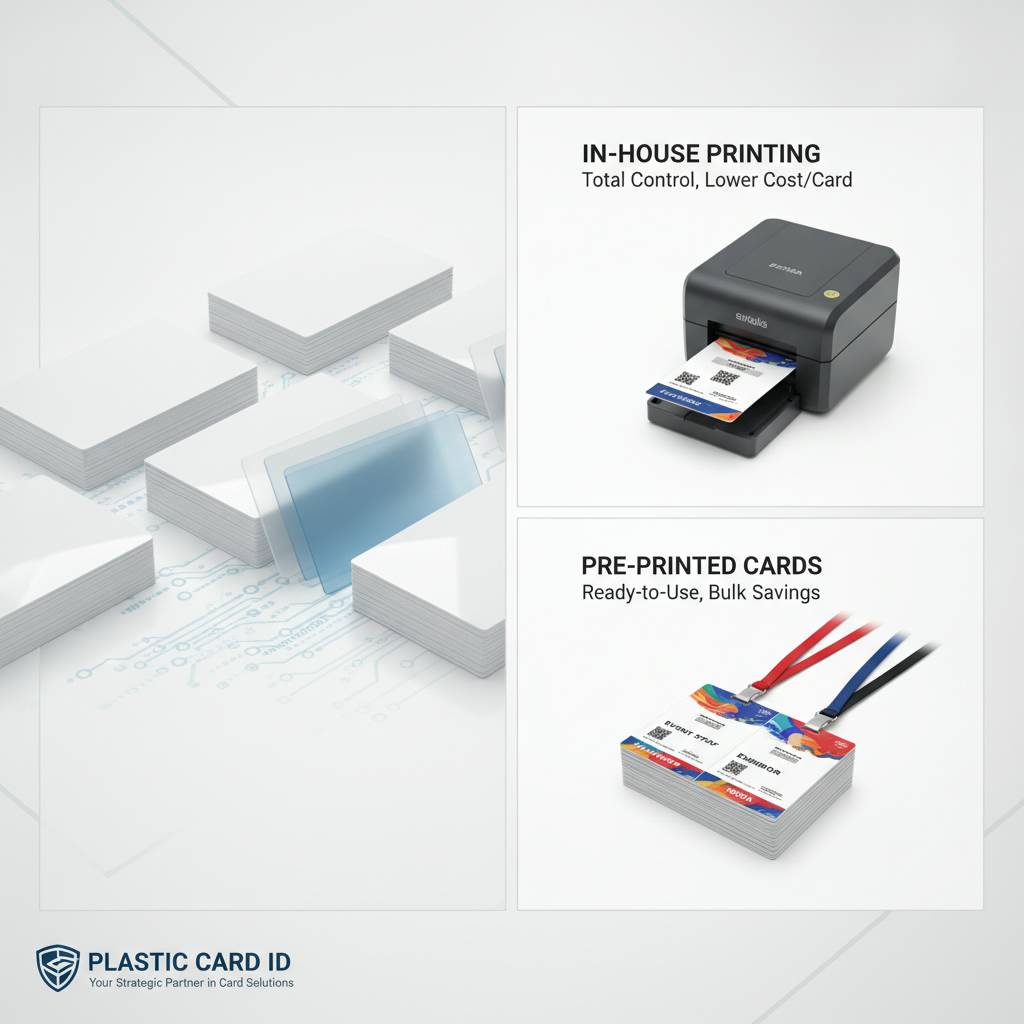 One of the most consequential decisions for any trade show badge program is whether to print badges in-house or order them pre-printed. Both approaches have legitimate advantages depending on how the event is structured, how far in advance attendee lists are finalized, and what technical resources the organizing team has available.
In-house printing with blank PVC cards offers maximum flexibility. Last-minute registrants, on-site walk-ins, and badge replacements are handled instantly without waiting on an external print run. Organizations that run recurring events find in-house printing particularly valuable because the per-card cost drops over time as the infrastructure investment is amortized.
Card Printers That Power In-House Badge Programs
CPE carries a curated lineup of card printers from Evolis, Zebra, and Fargo - three of the most trusted names in professional ID and badge printing. Each brand offers models suited to different volume levels and feature requirements, from compact desktop printers for small to mid-size events to high-throughput units capable of producing hundreds of cards per hour for large-scale shows.
Matching the right printer to your event volume and badge complexity is critical. A printer with a retransfer printing process delivers edge-to-edge, photographic-quality images ideal for full-color attendee photos and sponsor logos. Direct-to-card printers are faster and more cost-efficient for simpler designs. Getting the printer right means getting every badge right.
Ribbons, Supplies, and Keeping the Program Running
A badge program is only as reliable as its consumables. CPE supplies the full range of printer ribbons - full-color YMCKO, monochrome black, and specialty overlaminates - alongside cleaning kits that extend printer life and maintain print quality across long production runs. Running out of ribbon mid-event is an avoidable catastrophe, and having a reliable supply chain prevents it.
Card carriers and sleeves protect finished badges during transport and distribution, maintaining the clean, professional presentation that plastic cards deserve. These details matter at the point of registration when attendees receive their credentials and form their first impression of event organization quality.
Frequently Asked Questions - In-House Badge Printing
- How many cards can a desktop printer produce per hour? Most mid-range desktop printers handle 100-300 cards per hour depending on print complexity and single vs. double-sided printing.
- Can I print attendee photos on plastic badge cards? Yes - color card printers support full photographic quality output, including photos, logos, and custom graphics.
- Do blank PVC cards work with all card printers? CR80 30-mil PVC cards are compatible with virtually all standard card printers from major manufacturers.
- How early should I order cards before my event? Ordering two to three weeks ahead provides comfortable buffer for standard orders; bulk orders may warrant more lead time.
- What happens if I need replacement cards at the event? With an in-house printer and a blank card inventory, replacements are immediate - no waiting, no reprinting delays.
Call 800.835.7919 to speak with a specialist who can help match the right printer, ribbon, and card combination to your specific event needs.
Scaling Your Trade Show Badge Program Across Multiple Events
Organizations that exhibit at or host multiple trade shows annually quickly recognize the value of a consistent, scalable badge infrastructure. Ordering blank PVC cards in larger quantities reduces per-card cost significantly, and maintaining a standing inventory means your team is never scrambling for cards in the week before an event.
CPE works with clients running programs at every scale - from 50 cards a month for a small association's recurring events to tens of thousands for national trade organization conferences. The strategic partnership model means you get more than a product order - you get accumulated knowledge about what works at your event scale and how to optimize for quality and cost over time.
Volume Pricing and Smart Inventory Management
Blank PVC cards benefit meaningfully from volume ordering. The per-card price difference between a 100-card order and a 1,000-card order is substantial, and for organizations that run three to five events per year, consolidating orders makes strong financial sense. Building a modest standing inventory also provides insurance against last-minute attendee surges that would otherwise require rushed ordering.
Smart inventory management means knowing your average event size, building in a reasonable buffer, and reordering at a threshold that keeps you comfortable without tying up unnecessary capital in excess stock. CPE can help clients establish reorder cadences that align with their event calendar and eliminate procurement stress.
Branded Card Programs Across Exhibitor and Staff Tiers
Large trade shows typically involve multiple credential categories: general attendees, exhibitors, sponsors, press, staff, and VIPs. Each tier may need a distinct visual treatment - different colored stock, different card formats, or different encoded data. Managing that complexity becomes straightforward when all card types come from a single, reliable supplier with a broad enough catalog to cover every tier.
Color-coded blank stock cards are an elegant, low-cost solution for tier differentiation. Blue cards for general attendees, red for exhibitors, black for staff - security and volunteers can perform visual credential checks instantly without reading text or scanning devices. For access-controlled sessions, magnetic stripe or RFID encoding adds a data layer on top of the visual differentiation.
Card Affixing and Mailing for Pre-Event Distribution
Some event formats benefit from mailing badges in advance - registered attendees receive their credentials before arriving, eliminating registration queues and creating a pre-event brand touchpoint. CPE supports card affixing and mailing services, handling the physical fulfillment so your team focuses on event logistics rather than envelope stuffing.
Pre-event badge distribution works particularly well for invitation-only shows, industry conferences with a known attendee list, and premium events where the badge arrival itself is part of the brand experience. A well-designed plastic card arriving by mail before the show signals quality and builds anticipation in a way that an email confirmation simply cannot replicate.
Buyer Tips - Getting the Most from Blank Plastic Cards for Trade Show Badges
Experience across more than 100,000 customers and 50 million cards sold generates a clear picture of what separates successful badge programs from frustrating ones. The differences are usually in the planning details - card type selection, quantity buffers, printer compatibility, and supply management. Getting those decisions right upfront eliminates nearly every common trade show badge problem.
The following guidance reflects what works consistently across event types and scales. Whether you are launching a first-time badge program or refining a program you have run for years, these principles apply.
Match Card Technology to Your Check-In Infrastructure
Before selecting a card type, audit your check-in and access control setup. If you are scanning barcodes printed on cards, blank PVC works perfectly with any color printer. If you need encoded data at entry points, magnetic stripe or RFID cards must be specified before printing. Retrofitting technology after cards are already printed is expensive and time-consuming - confirm the full technical requirement first.
Talk to your registration software vendor about what card formats they support before placing your card order. Most major event management platforms integrate natively with magnetic stripe and barcode readers; RFID requires specific reader hardware that should be confirmed in advance. Alignment between card type and system capability is the foundational requirement of any functional credential program.
Order More Than You Think You Need
The single most common event badge problem is running short. Walk-in registrations, VIP last-minute adds, damaged cards needing replacement, and simple miscounting all eat into planned inventory faster than expected. A 15-20% overage on your estimated attendee count is a reasonable standard buffer for most events, and the incremental cost of extra blank cards is trivial compared to the operational disruption of running out.
Leftover blank cards from one event can be used at the next - they do not carry event-specific encoding or printing until you print them. Building a reusable inventory across events is a practical cost management strategy that also eliminates per-event rush ordering stress.
Test Your Printer Setup Before Event Day
A full printer test run - printing at least 20-30 cards with your actual badge design at the actual quality settings you plan to use - should happen no later than a week before the event. This catches ribbon loading issues, alignment problems, color calibration needs, and driver compatibility questions while there is still time to resolve them calmly.
Cleaning the printer head and card transport path before a long production run extends print quality throughout the run and protects the printer from premature wear. CPE supplies cleaning kits specifically designed for the Evolis, Zebra, and Fargo printers it carries - keeping your equipment in peak condition for every event. A ten-minute cleaning routine before a major print run is one of the highest-ROI maintenance habits in any badge program.
Ready to Build a Better Trade Show Badge Program with Plastic Card ID
Twenty-five years, over 100,000 customers, and more than 50 million cards shipped - that track record exists because CPE treats every client relationship as a long-term partnership, not a one-time transaction. Whether your next event needs 200 basic white PVC badges or a sophisticated multi-tier credential system with RFID access control, the catalog and the expertise to support it are right here.
Blank plastic cards for trade show badges are one of the highest-impact, most cost-efficient investments an event organizer can make. The difference between a paper badge and a plastic one shows up in attendee perception, operational efficiency, and the professional image your event projects from the moment credentials are distributed. That difference is worth getting right.
Explore the full catalog, compare card types, and configure your badge program with a team that has seen every event scenario imaginable. Plastic Card ID is ready to help you run a badge program that works flawlessly - call 800.835.7919 today and let's get your next event credentialed right.
Previous Page