What Questions to Ask Before Ordering Plastic Cards
Table of Contents []
- Smart Buyers Ask These Questions Before Ordering Plastic Cards - Plastic Card ID
- What Is This Card Actually Going to Do?
- Do You Understand the Technology Options Available?
- How Will You Print and Personalize These Cards?
- What Quantity Do You Really Need - And When?
- How Will Cards Be Distributed and Presented?
- Frequently Asked Questions Before Ordering Plastic Cards
- Partner With Plastic Card ID for Your Card Program
Smart Buyers Ask These Questions Before Ordering Plastic Cards - Plastic Card ID
Most people assume ordering plastic cards is straightforward. Pick a quantity, choose a finish, click buy. But the organizations that consistently run successful card programs - the ones that avoid costly reprints, card reader failures, and branding misfires - do something different first. They ask the right questions before a single card rolls off the press. This guide walks you through exactly what to ask, why it matters, and how to make sure your order lands exactly right.
Whether you are outfitting a hotel with key cards, launching a retail gift card program, building an employee ID system, or rolling out a loyalty program for thousands of members, the decisions you make before ordering determine everything that follows. CPE has worked with over 100,000 customers across the United States. The patterns are clear - informed buyers get better results, faster timelines, and stronger ROI.
| Question Category | Why It Matters | Risk of Skipping |
|---|---|---|
| Card purpose and use case | Determines card type, encoding, and format | Wrong card for the reader or system |
| Card technology needed | Matches card to access control or POS system | Incompatibility with existing hardware |
| Print method (in-house vs. pre-printed) | Affects cost, lead time, and flexibility | Overpaying or bottlenecked production |
| Quantity and timeline | Shapes pricing tiers and fulfillment speed | Stock shortages or rushed reprints |
| Distribution method | Determines need for carriers, sleeves, or mailing | Cards arrive damaged or improperly presented |
What Is This Card Actually Going to Do?
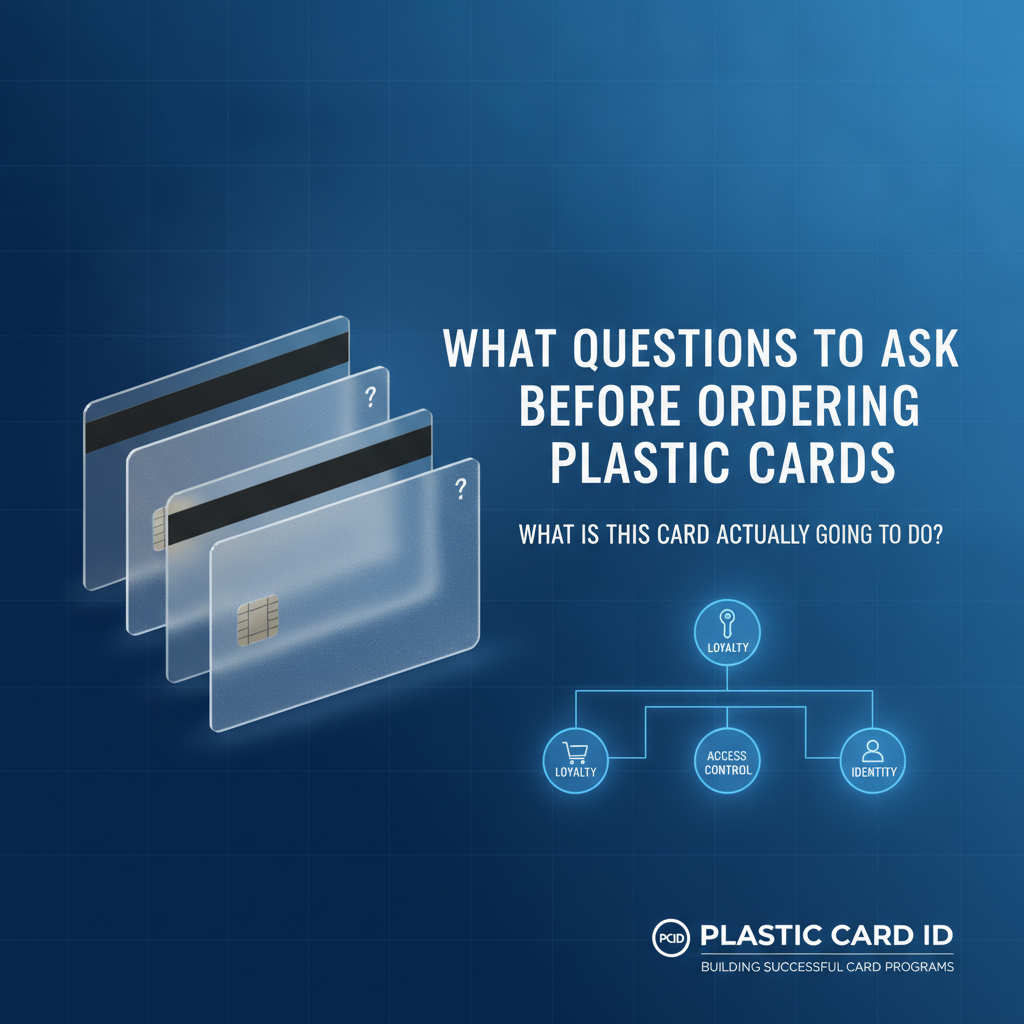 It sounds almost too obvious to say. But the number of organizations that skip a clear articulation of card function is genuinely surprising. Your card's intended job determines nearly every other specification downstream. A proximity access card for a secure facility has almost nothing in common with a paper-thin loyalty punch card replacement - yet both are "plastic cards" in casual conversation.
Before placing any order, define the card's primary function. Is it granting physical access? Storing loyalty points? Serving as a branded gift card for retail resale? Acting as an employee photo ID? Each answer funnels toward a specific card type, encoding method, and material specification. Skipping this step is how buyers end up with 5,000 LoCo magnetic stripe cards for a system that only reads HiCo encoding.
Identify Every Function the Card Must Serve
Some cards wear multiple hats. A hotel key card might need RFID encoding for room access AND a magnetic stripe for point-of-sale transactions at the hotel restaurant. A membership card might carry both a barcode and a printed photo ID. Listing every single function upfront prevents you from ordering a card that handles four out of five jobs.
Think through the full lifecycle of the card. Who receives it, where do they use it, what systems does it interact with, how long is it expected to last? Cards used daily in industrial environments need different durability specs than a promotional card handed out at a trade show. Document all of this before you request a quote.
Match the Card to the Reader or System It Must Work With
This is where technically uninformed orders go sideways fastest. Access control systems, hotel lock systems, and loyalty POS terminals all have specific read technology requirements. Some systems read only 125kHz proximity cards. Others require 13.56MHz MIFARE. Some magnetic stripe readers are HiCo only. The wrong frequency or coercivity means your cards literally do not work in your own system.
Contact your system vendor or check your hardware documentation before specifying card technology. If you already have cards that work, bring one to CPE for matching. Compatibility confirmation is a step that costs nothing and prevents reprints that cost everything.
Consider the Card's Shelf Life and Replacement Cycle
Organizations with high employee turnover or fast-rotating membership bases need a different stocking strategy than a private club issuing 200 lifetime member cards. Understanding replacement frequency shapes your order quantities and helps determine whether blank cards printed in-house or pre-printed card stock makes more financial sense over time.
Blank CR80 PVC cards at 30 mil thickness - the ISO 7810 standard - are the workhorse for organizations that print in-house, because the per-card cost stays low and the design stays flexible. If your roster changes monthly, in-house printing gives you speed and control that pre-printed orders simply cannot match.
Do You Understand the Technology Options Available?
The landscape of card technology is wider than most buyers realize. Magnetic stripes, RFID chips, contact smart chips, proximity encoding, and plain visual-only cards all exist for distinct reasons. Each has real-world strengths and limitations. Choosing the wrong one is not just inconvenient - it can require scrapping an entire order.
CPE offers the full spectrum: blank PVC cards, HiCo and LoCo magnetic stripe cards, RFID and proximity cards, MIFARE DESFire smart cards, contact chip cards, and specialty formats including clear, frosted, and custom die-cut options. Understanding the basic distinctions between these technologies is the single highest-value thing a first-time buyer can do before reaching out.
Magnetic Stripe Cards: HiCo vs. LoCo
Magnetic stripe cards encode data on a ferromagnetic stripe on the card's back. HiCo (High Coercivity) stripes require more magnetic force to encode and are significantly more resistant to accidental erasure from everyday magnetic sources like purse clasps or phone cases. LoCo (Low Coercivity) stripes encode at lower force and are typically used in short-term applications like hotel key cards.
If your card will be carried daily and swiped repeatedly over months or years, HiCo is almost always the right call. Gift cards, loyalty cards, employee ID cards with access data - these benefit from HiCo durability. Hotel key cards that are discarded after a few nights can typically use LoCo without issue. Know which your system supports before ordering.
RFID, Proximity, and Smart Chip Cards
Contactless card technology covers a broad category. Proximity cards (125kHz) are common in older access control systems and are simple, reliable, and widely supported. RFID smart cards operating at 13.56MHz - including MIFARE Classic, MIFARE DESFire, and ISO 14443-compliant formats - offer more data capacity and enhanced security features increasingly required by modern systems.
Smart chip cards with contact interfaces (the embedded gold chip) are used in high-security identity applications and certain healthcare or government credentialing scenarios. Casino player cards represent one of the more sophisticated use cases - combining player tracking data, tier status encoding, and branded aesthetics on a single card. Each technology demands exact specification before ordering.
When a Plain Blank PVC Card Is Exactly Right
Not every program needs encoding. Blank CR80 cards in white, colored stock, clear, or frosted finishes are the foundation of countless in-house ID programs, event credential systems, visitor badge programs, and promotional card initiatives. Blank cards give total design control to the issuing organization - print exactly what you need, exactly when you need it, using your own card printer.
The economics of blank cards compound favorably over time. The upfront investment in a card printer pays itself back quickly when you compare the per-card cost of blank stock against the per-card cost of reordering pre-printed cards every time your design or roster changes. For organizations printing 50 to several hundred cards per month, in-house blank card programs typically win on cost and flexibility both.
| Card Type | Common Use Cases | Key Consideration |
|---|---|---|
| Blank PVC (CR80) | ID, event, visitor, promo | In-house printer required |
| HiCo Magnetic Stripe | Loyalty, gift, employee ID | Confirm system coercivity support |
| LoCo Magnetic Stripe | Hotel keys, short-term access | Not for long-term daily use |
| Proximity (125kHz) | Building access, time tracking | Match frequency to reader spec |
| RFID / MIFARE Smart Card | Casino, hotel, high-security ID | Confirm chip type with system vendor |
How Will You Print and Personalize These Cards?
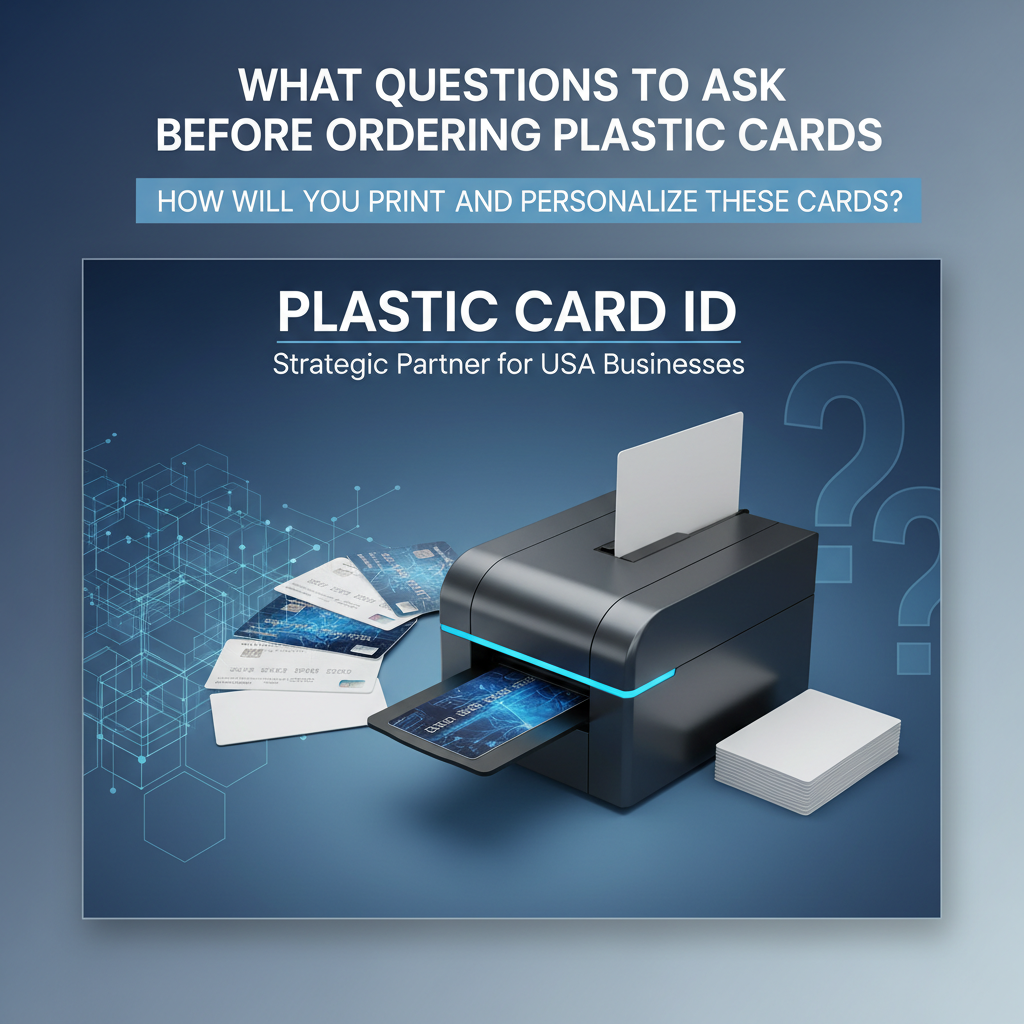 Printing strategy is one of the most consequential decisions in a card program - and one of the most underexamined. There are essentially two paths: order pre-printed or fully personalized cards from a supplier, or order blank stock and print in-house using a dedicated card printer. Both are valid. Both have sweet spots. The mistake is defaulting to one without evaluating whether the other fits your actual workflow better.
Organizations that issue cards with variable data - employee photos, unique member numbers, individualized barcodes - almost always benefit from in-house printing capability. Waiting for a supplier turnaround every time a new hire starts or a new member joins creates operational drag. In-house printing means a card is ready in minutes.
In-House Card Printing: What You Actually Need
Running an in-house card program requires three things: a quality card printer, the right ribbon consumables, and a reliable supply of blank card stock. CPE stocks printers from Evolis, Zebra, and Fargo - brands trusted in enterprise ID programs across industries. Matching your printer to your expected monthly volume is critical - a light-duty desktop printer will wear prematurely under heavy commercial workloads.
Ribbons are the consumable that most in-house programs underestimate. Full-color YMCKO ribbons, monochrome ribbons for single-color printing, and specialty ribbons for rewritable cards each have different yield rates and cost implications. Factor ribbon cost into your per-card calculation before committing to a printer model. A printer that looks affordable on sticker price can carry expensive ribbon costs that change the economics significantly.
Call 800.835.7919 to speak with a specialist who can help match your printer, ribbon, and blank card stock into a cohesive in-house program sized to your actual volume and budget.
Pre-Printed and Custom Card Orders
For organizations with stable card designs, large quantities, and programs that do not require frequent personalization, ordering pre-printed card stock can be the most efficient path. Custom die-cut shapes, luxury metal cards in stainless steel, brass, or gold, and specialty finishes like clear or frosted PVC are options that are not feasible with a desktop printer - these require commercial production.
Retailers who have made the switch from paper gift cards to professionally printed plastic see gift card sales increases of 35-50%. That uplift comes from the physical permanence and perceived value that plastic communicates at point of sale. A well-produced card looks like something worth keeping - and it typically is.
Variable Data and Encoding: Plan This Before Design
If your cards need sequential numbering, individual barcodes, unique magnetic stripe encoding, or personalized names, decide this before artwork is finalized. Variable data printing and encoding affect the entire production workflow. Pre-encoding magnetic stripes with sequential numbers, for example, must be coordinated with card design to ensure stripe position and print layout align correctly.
RFID and proximity card encoding similarly must be specified before production. Trying to add encoding to a card order as an afterthought typically means delays, retooling charges, or starting over entirely. Build the encoding specification into your initial brief - it costs nothing to include upfront and avoids significant expense later.
What Quantity Do You Really Need - And When?
Quantity and timeline decisions affect price, but they also affect program health in ways that go beyond the invoice. Ordering too few creates reorder friction and potential gaps in your program. Ordering too many ties up budget in cards sitting in storage. Getting quantity right is a discipline, not a guess - and it starts with understanding your actual consumption rate.
For organizations new to card programs, estimating consumption is admittedly harder. CPE serves programs from 50 cards per month all the way to mass production in the tens of thousands. If you are unsure where you fall, start with a conservative initial order, run the program for 60-90 days, then order based on actual data. Blank card stock has a long shelf life when stored properly, so moderate over-ordering on blanks is generally low-risk.
Understanding Price Breaks and Volume Tiers
Plastic card pricing follows volume curves - per-card cost drops as quantity increases. This creates a real incentive to consolidate orders. If you are ordering for multiple departments, multiple locations, or multiple programs simultaneously, combining them into a single order often yields meaningful per-card savings. Coordinate across your organization before placing separate orders.
Volume tiers vary by card type. RFID and smart chip cards carry higher base costs than blank PVC stock, so the savings from volume ordering are proportionally larger in those categories. Ask for a tiered pricing breakdown before committing to a quantity - the difference between 2,500 and 5,000 cards is sometimes surprisingly small in per-unit cost.
Timeline: Build in More Lead Time Than You Think You Need
Card programs that run into trouble almost always cite timeline as the culprit in retrospect. Launching a loyalty program for a holiday retail push? Plan backwards from your launch date, not forwards from your order date. Custom card production, encoding setup, quality review, and shipping all take time - and rush orders cost more. A well-planned timeline is free; a rush surcharge is not.
In-house printing programs have a significant advantage here: blank card stock ships quickly, and new cards print in minutes. Organizations that combine a stock of blank pre-printed base cards with an in-house printer for variable personalization essentially eliminate lead time for most production scenarios.
Reorder Planning and Safety Stock
The most reliable card programs build a reorder trigger into their workflow. When stock drops below a defined threshold - two weeks of supply is a common benchmark - an order is placed automatically. This prevents the scramble of running out mid-program and issuing temporary paper workarounds that undermine the professionalism plastic was meant to project.
For seasonal programs or event-based card issuance, order well ahead of the anticipated demand spike. Running out of membership cards at your annual enrollment event, or gift cards at peak holiday retail season, is a directly measurable revenue loss - and an avoidable one with basic planning discipline.
How Will Cards Be Distributed and Presented?
The card itself is only part of the program. How it reaches the recipient matters more than most buyers initially recognize. A professionally packaged card signals value, legitimacy, and intention. A card that arrives loose in a padded envelope signals the opposite - and first impressions in card programs are difficult to undo.
Card presentation options range from simple card carriers and envelopes to custom sleeves, packaging, and full mailing services. For organizations distributing cards by mail - membership renewal programs, gift card promotions, new employee onboarding kits - the complete fulfillment chain from card production through addressed mailing is available through CPE. Consolidating production and fulfillment with a single supplier eliminates handoff errors and simplifies accountability.
Card Carriers, Sleeves, and Packaging
Card carriers serve both functional and branding purposes. Functionally, they protect card surfaces during handling and mailing. Brand-wise, they create a moment of presentation that reinforces the card program's perceived value. A gift card dropped into a branded carrier with usage instructions converts better than the same card handed over bare.
Protective sleeves matter especially for cards that will be stored in wallets alongside other cards. A card sleeve reduces surface scratching and extends the visual life of printed cards significantly - important for any program where card aesthetics communicate ongoing brand quality.
Affixing and Mailing Services
Organizations mailing cards to member bases, loyalty program participants, or remote employees face a fulfillment logistics challenge. Card affixing - attaching cards to mailers or carrier documents - and addressed mailing services remove that burden from internal operations. For high-volume distributions, professional fulfillment is typically more cost-effective than staffing an in-house mailing operation.
Combining card production and mailing through a single supplier also means a single point of quality control. Cards are reviewed before they go out, addresses are verified against your provided list, and the program runs on a predictable schedule without internal coordination overhead.
Protecting Cards During Daily Use
Beyond initial distribution, consider how cards will be used and stored day-to-day. Employee ID cards worn daily benefit from badge holders, lanyards, or badge reels. Cards used for building access are often clipped to clothing and need holder systems that do not stress the card body. Hotel key cards cycle through guests and should be inspected for wear at regular intervals.
The physical longevity of your card program is a direct reflection of how well you anticipate the conditions cards will face in real use. A little attention to how the card will actually live in the world produces significantly better program outcomes than treating the card itself as the final product.
Frequently Asked Questions Before Ordering Plastic Cards
After years of serving over 100,000 customers, certain questions come up again and again - not because buyers are uninformed, but because card programs touch enough variables that uncertainty is natural. Here are the most useful answers to the questions buyers most commonly ask before placing their first or next order.
What Is the Difference Between CR80 and Other Card Sizes?
CR80 is the standard credit card size - 3.375 inches by 2.125 inches, at 30 mil thickness. It is the ISO 7810 standard and the format supported by virtually all card printers and most card holders, sleeves, and wallets. When in doubt, CR80 is the right default unless your program has a specific reason to deviate. Custom die-cut shapes and sizes are available for specialty applications but typically involve longer lead times and higher per-card costs.
Thicker cards (up to 40 mil) are available for applications where rigidity communicates premium value - luxury metal cards in stainless steel, brass, and gold are at the far end of this spectrum. Thinner overlaminates or card stock are sometimes used for paper-backed or specialty event credentials. For most business card programs, 30 mil CR80 is the correct and most economical specification.
Do I Need a Card Printer If I Order Blank Cards?
Yes - blank cards require a card printer to add any visual design, text, photo, or barcode. A standard document printer or even a photo printer will not produce results comparable to a dedicated card printer, which applies dye-sublimation or resin thermal printing directly to the card surface for sharp, durable output.
- Card printers from Evolis, Zebra, and Fargo are available through CPE to pair with blank card orders
- Printer ribbons, cleaning kits, and maintenance supplies are also stocked for ongoing program support
- Single-sided and dual-sided printing models are available depending on your card design needs
- Encoding modules for magnetic stripe, RFID, or smart chip cards can be integrated into many printer models
- Volume output capacity ranges from 50-100 cards per day on desktop models to thousands per day on high-throughput commercial units
What If I Am Not Sure Which Card Technology My System Uses?
Check with your system vendor or facilities manager first - your access control, loyalty POS, or hotel lock system documentation should specify the card frequency and format required. If that information is unavailable, bring an existing card that works in your system to identify the technology. Never order encoded cards by assumption when system documentation is obtainable.
When in genuine doubt, CPE specialists can walk through diagnostic questions to narrow the likely technology. With decades of experience across access control, hospitality, retail loyalty, and identity programs, the team has worked through nearly every compatibility scenario. A short conversation before ordering costs nothing and can prevent a costly incompatibility.
Partner With Plastic Card ID for Your Card Program
 The questions in this guide are not obstacles - they are the foundation of a card program that works well from day one and scales cleanly as your needs grow. Buyers who take 20 minutes to think through function, technology, quantity, and distribution before ordering consistently run better programs than buyers who order fast and fix problems later. The card landscape rewards preparation, and Plastic Card ID is structured to support exactly that kind of informed, strategic approach.
From blank CR80 stock to luxury metal cards, from simple in-house ID programs to complex RFID access systems, from 50-card monthly runs to mass production in the tens of thousands, CPE has the catalog depth, the technical knowledge, and the operational experience to be a genuine long-term partner - not just a supplier who ships boxes and moves on. More than 50 million cards supplied. More than 25 years in business. More than 100,000 customers who chose to come back.
Call Plastic Card ID today at 800.835.7919 to speak with a card program specialist who will ask the right questions alongside you - and make sure your next order is exactly right.
Previous Page