Blank Smart Chip Cards Overview: Types and Benefits
Table of Contents []
- Blank Smart Chip Cards: What Every Business Should Know Before Buying - Plastic Card ID
- Types of Blank Smart Chip Cards Available Through Plastic Card ID
- Building an In-House Card Program with Blank Smart Chip Cards
- Application Spotlight: Where Blank Smart Chip Cards Make the Biggest Impact
- Frequently Asked Questions About Blank Smart Chip Cards
- Buyer's Guide: Selecting the Right Blank Smart Chip Card for Your Program
- Why Over 100,000 U.S. Businesses Trust Plastic Card ID for Smart Card Solutions
Blank Smart Chip Cards: What Every Business Should Know Before Buying - Plastic Card ID
Smart chip cards aren't a novelty anymore. They're the backbone of access control systems, loyalty programs, campus ID infrastructure, hotel key management, and a dozen other applications that businesses run every single day. Yet for many purchasing managers and IT administrators, the landscape of blank smart chip card options feels unnecessarily complicated. Which chip standard do you actually need? What does "blank" mean when the card still has embedded technology? And how do you build a program that scales without locking yourself into the wrong format?
These are exactly the kinds of questions that CPE has been answering for businesses across the United States for more than 25 years. The goal of this page is simple: cut through the confusion, explain what blank smart chip cards actually are, how they work, and how to choose the right type for your specific program. Whether you're running 50 cards a month or ordering tens of thousands at a time, the foundational decisions you make at the start will define your program's success for years.
Defining "Blank" in the Context of Smart Chip Cards
When most people hear "blank card," they picture a plain white piece of PVC with nothing printed on it. That definition holds up in the context of smart chip cards too - but with an important distinction. A blank smart chip card has an embedded integrated circuit and antenna (in the case of contactless cards) already built into the card body. What's blank is the surface - no artwork, no personalization, no encoding of application data.
This distinction matters enormously for buyers. The chip itself is functional hardware. It can store data, execute cryptographic processes, and communicate with readers. What it doesn't have yet is your organization's data written to it, and that's where your card printer, encoder, or card management software comes in. Buying blank gives you maximum flexibility to personalize and encode at the pace your program demands.
In practical terms, a blank smart chip card is the raw material of a complete card program. You control the printing. You control the encoding. You control the timing. That kind of operational control is exactly why so many organizations prefer to buy blank over ordering pre-personalized cards from an outside vendor.
Why Smart Chip Cards Outperform Magnetic Stripe in Demanding Applications
Magnetic stripe cards remain a solid workhorse for many applications - and CPE sells plenty of them - but smart chip cards carry capabilities that magnetic stripe simply cannot replicate. The storage capacity difference alone is striking. A standard magnetic stripe holds roughly 226 characters of data across its three tracks. A typical smart chip card? Anywhere from 1KB to 64KB or more, depending on the chip specification.
More storage means richer data profiles, more complex access rules, and the ability to run multiple applications on a single card. A university campus, for example, might run library access, dining account balance, building entry, and student ID all on one card. That's a real-world scenario that plays out every day using smart chip technology. Magnetic stripe can't hold that much information reliably, and it certainly can't execute the cryptographic functions that protect it.
Security is the other major differentiator. Smart chips use mutual authentication protocols that verify both the card and the reader before any transaction proceeds. Cloning a smart chip card is orders of magnitude more difficult than duplicating a mag stripe. For organizations where access control is serious business - corporate campuses, healthcare facilities, government contractors - that gap in security is not minor. It's decisive.
The CR80 Standard and Card Dimensions
Blank smart chip cards are manufactured to the CR80 standard - 3.375 inches by 2.125 inches, 30 mil thick - the same ISO 7810 ID-1 format used by virtually every wallet-sized card in the world. This isn't an accident. Standardization means your cards work with standard card printers, fit standard cardholders and lanyards, and slot cleanly into standard readers. There's no custom tooling required, no reader modification, no surprises.
The 30 mil thickness is rigid enough to handle daily use without warping but thin enough to stack and store efficiently. When you're ordering in volume - hundreds or thousands of cards at a time - that dimensional consistency matters for production throughput. Cards that stack evenly feed through printers cleanly, reducing jams and waste. Dimensional precision isn't glamorous, but it's the quiet foundation of a reliable card program.
| Card Type | Chip / Technology | Typical Storage | Common Applications |
|---|---|---|---|
| Contact Smart Card | ISO 7816 chip | 8KB - 64KB | Logical access, PKI, government ID |
| MIFARE Classic | 13.56 MHz RFID | 1KB - 4KB | Access control, transit, loyalty |
| MIFARE DESFire EV2/EV3 | 13.56 MHz, AES-128 | 2KB - 32KB | High-security access, multi-app campus |
| MIFARE Ultralight | 13.56 MHz RFID | 48 - 512 bytes | Event credentials, limited-use passes |
| Proximity (125 kHz) | EM4100, HID Prox | Read-only UID | Basic door access, time and attendance |
Types of Blank Smart Chip Cards Available Through Plastic Card ID
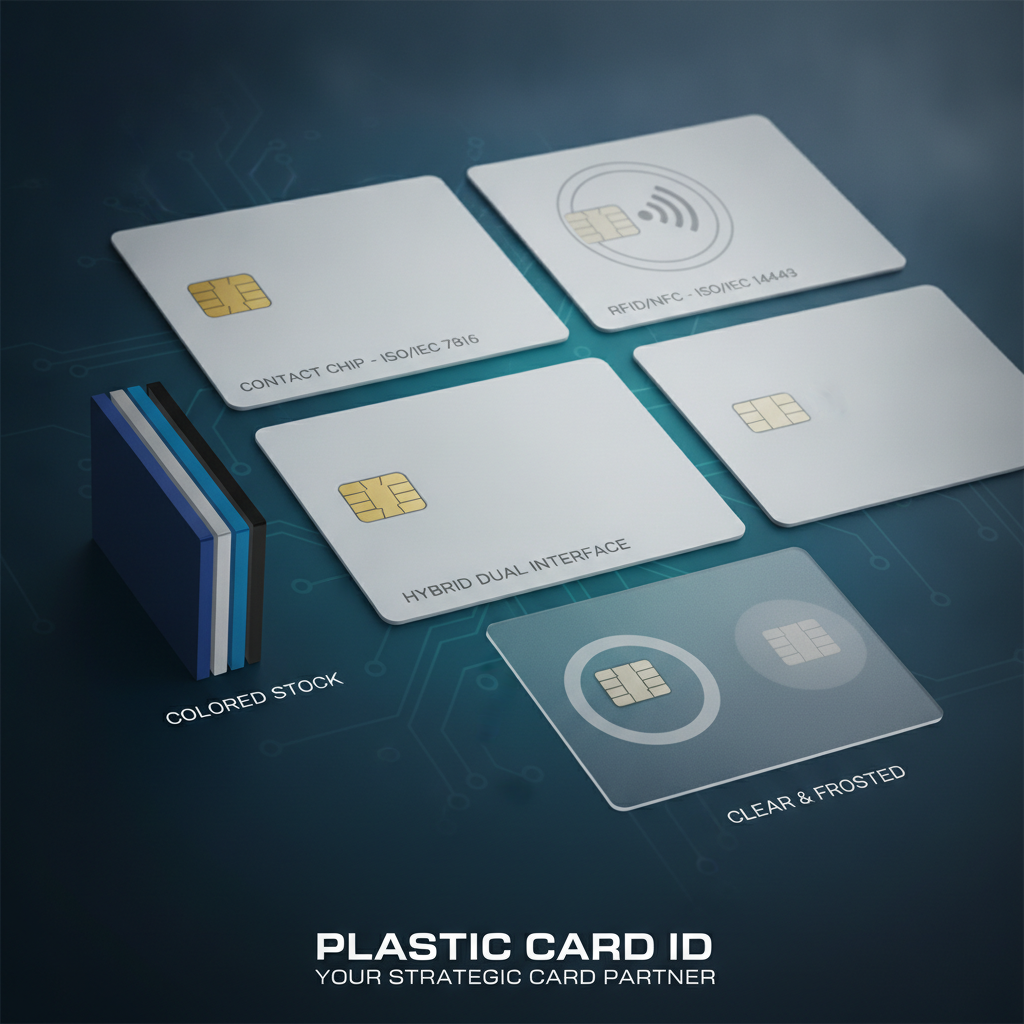 The catalog at CPE covers the full spectrum of smart card technologies, which is genuinely useful because not every program needs the same solution. A small office building running a simple door access system has very different requirements than a casino managing player tracking across a hundred gaming positions. Buying the right card type from the start saves significant money and avoids the frustration of mid-program technology swaps.
Understanding the distinctions between chip standards, communication protocols, and frequency ranges doesn't require an engineering degree - but it does require someone walking you through it clearly. That's precisely what the team at CPE does, day in and day out, for businesses of every size and industry. The right card for your program is out there; the key is knowing what questions to ask.
Contact Smart Cards (ISO 7816)
Contact smart cards require physical insertion into a reader - the gold contact pads on the card's surface connect directly to the reader's electrical contacts. This category is the workhorse of logical access programs, PIV (Personal Identity Verification) deployments, and any application where strong cryptographic authentication is non-negotiable. The ISO 7816 standard governs how the card and reader communicate, ensuring interoperability across compliant systems.
Storage capacity in contact smart cards ranges from 8KB on entry-level models up to 64KB or beyond on high-capacity variants. That's enough room to store digital certificates, biometric templates, and multi-application data simultaneously. Organizations running government-aligned security protocols will almost always find themselves in the contact smart card category. These are serious cards for serious security environments.
Contactless MIFARE Cards
MIFARE is the world's most widely deployed contactless smart card technology, operating at 13.56 MHz. The family covers a broad range - from MIFARE Ultralight for disposable event passes to MIFARE DESFire EV3 with AES-128 encryption for high-assurance access programs. CPE stocks multiple variants, and the differences between them are meaningful enough to warrant careful selection before purchase.
MIFARE Classic cards (1KB and 4KB) remain extremely common in access control systems built over the last decade. They're cost-effective, widely supported, and perfectly adequate for many applications. MIFARE DESFire, by contrast, uses a completely different, more robust security architecture - making it the preferred choice when IT security teams demand audit-ready, cryptographically sound credentials. If your existing reader infrastructure is MIFARE-compatible, there's a strong probability that blank MIFARE cards will slot directly into your program without system changes.
To reach the team and discuss which MIFARE variant suits your infrastructure, call 800.835.7919. Matching chip technology to your existing reader hardware before ordering prevents costly mismatches down the line.
Proximity Cards at 125 kHz
Proximity cards occupy a different frequency band - 125 kHz - and use a simpler read-only architecture. They transmit a fixed unique identifier (UID) to the reader, which then checks that number against an access control database. There's no on-card data storage in the traditional sense, and no cryptographic processing. What you get is fast, reliable, cost-effective door access that's been industry-standard for decades.
HID Proximity-compatible formats remain extremely common in commercial buildings across the United States. If your readers already accept 125 kHz proximity cards, buying compatible blank cards through CPE and printing your own badges on-site is often significantly cheaper than ordering pre-printed cards through an integrator. In-house printing of proximity cards combines low per-card cost with the convenience of on-demand issuance.
MIFARE DESFire for High-Security Programs
MIFARE DESFire deserves its own mention because it represents a meaningful step up in security architecture from Classic MIFARE. DESFire EV2 and EV3 variants support AES-128 encryption, mutual three-pass authentication, and a flexible file system that allows multiple independent applications to coexist on a single card. For organizations where security certifications, compliance requirements, or integration with enterprise identity platforms are in play, DESFire is typically the recommended path.
The casino industry is a strong user of DESFire technology for player tracking cards, where data integrity, tamper resistance, and the ability to update card data over the card's lifespan are operational requirements - not optional features. Campus environments with multi-building access, cashless payment, and library or transit integration benefit similarly. One card, multiple applications, enterprise-grade security: that's the DESFire value proposition in a sentence.
Building an In-House Card Program with Blank Smart Chip Cards
There's a reason so many organizations shift from outsourced card production to in-house programs once they understand the economics. Buying blank cards and printing on-site with a desktop card printer from Evolis, Zebra, or Fargo dramatically reduces per-card cost at any volume above a few hundred cards per year. You also gain immediate issuance capability - print a card in under a minute when a new employee starts, rather than waiting a week for an order to arrive.
The infrastructure investment is modest. A quality desktop card printer capable of encoding smart chip cards runs in a range that most organizations recoup within the first year of volume savings. CPE supplies the full stack: blank smart chip cards, compatible card printers, printer ribbons, cleaning kits, and card accessories like holders and lanyards. Everything you need to run a complete, professional card program comes from a single supplier - no coordination headaches.
Choosing a Card Printer for Smart Chip Encoding
Not every card printer encodes smart chips. Standard dye-sublimation printers handle printing only - which is fine for visual personalization of cards with pre-encoded chips, but insufficient when you need to write application data to the chip at the time of issuance. Smart chip encoding requires a printer model equipped with a contact station (for ISO 7816 cards) or a contactless encoding module (for MIFARE and similar).
Evolis, Zebra, and Fargo all offer printer models with optional smart card encoding modules. The Evolis Primacy 2 and the Zebra ZC300 series, for example, support both contact and contactless encoding in configurations designed for small to mid-size organizations. Enterprise-scale programs often migrate to laminating printers or dual-sided models that add an additional layer of card durability. Selecting a printer that matches both your encoding requirements and your monthly volume is a decision worth spending time on.
Ribbons, Supplies, and Maintenance Essentials
A blank card program is only as reliable as its consumables. Printer ribbons degrade over time, and using off-brand ribbons in brand-name printers is a reliable path to poor print quality and voided warranties. CPE stocks OEM ribbons for all the major printer brands it carries, alongside cleaning kits that extend printer life significantly. A cleaning kit used on schedule - typically every 500 cards - removes debris that causes print heads to streak and jam.
- YMCKO ribbons for full-color printing with overlay protection
- KO ribbons for monochrome card printing at lower cost per card
- KdO ribbons for black resin printing on dark card stock
- Cleaning cards and cleaning swabs for routine printer maintenance
- Laminate overlays for enhanced card durability in high-wear applications
Card accessories round out the program. Cardholders, lanyards, badge reels, and protective sleeves all extend the life of printed and encoded cards in daily use. A card that lives in a protective holder lasts measurably longer than one rattling loose in a pocket - a detail that sounds minor until you're reprinting hundreds of worn cards every quarter.
Volume Tiers and What to Expect at Each Scale
Programs starting at 50-100 cards per month are perfectly well-served by a single desktop card printer and a case of blank cards. At this scale, a desktop Evolis or Fargo printer encodes and prints at a pace that keeps up with demand without bottlenecks. The economics at this tier favor in-house production heavily over outsourced personalization.
Mid-volume programs in the 500-2,000 cards per month range typically benefit from a higher-throughput printer model or two units running in parallel, along with larger blank card orders that reduce per-unit card cost. High-volume programs - 5,000 cards per month and above - often incorporate automated card issuance systems, laminating printers for added durability, and dedicated IT integration for encoding workflows. CPE has experience supporting programs at every point on this spectrum. Scale your infrastructure at the pace your program demands, not before.
Ready to discuss your program's volume and technology requirements? The team at Plastic Card ID is ready to help - call 800.835.7919 today.
Application Spotlight: Where Blank Smart Chip Cards Make the Biggest Impact
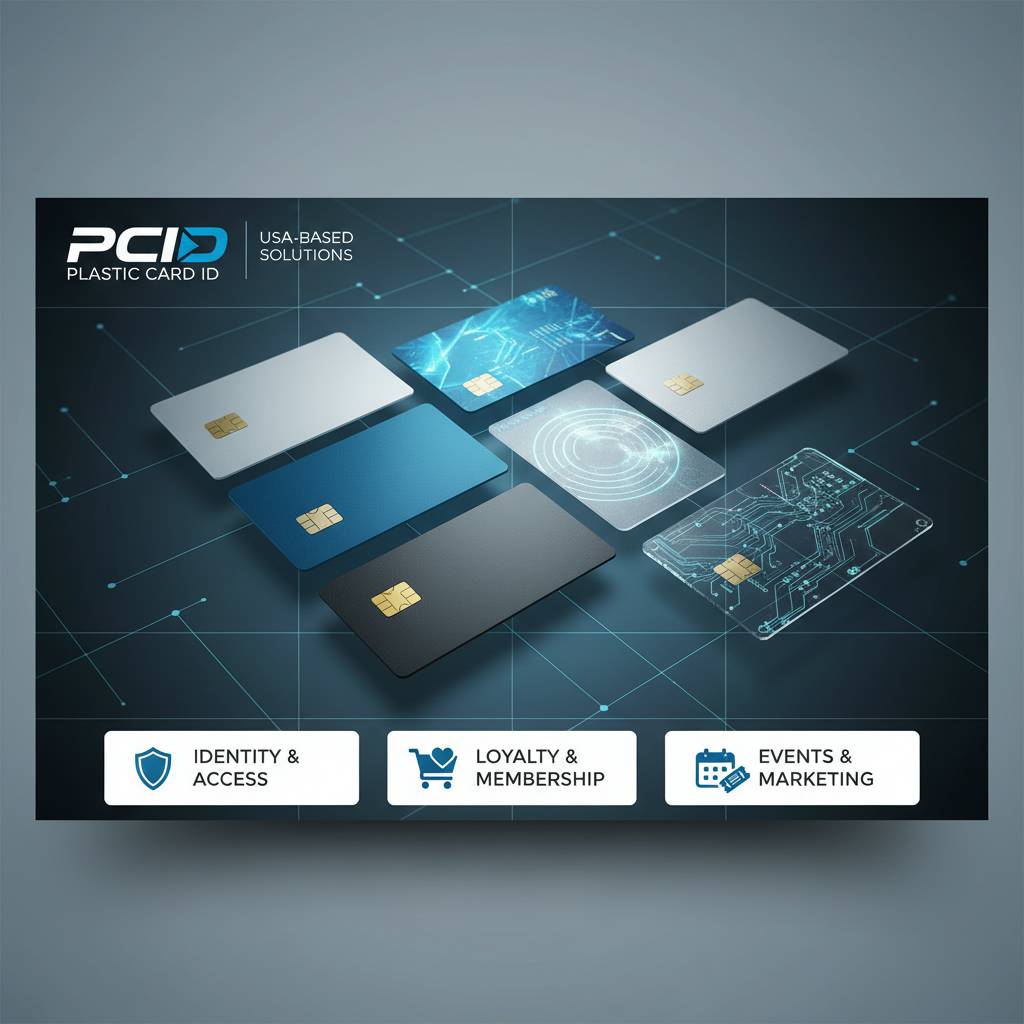 Smart chip cards aren't a one-industry solution. The technology spans sectors and use cases in ways that often surprise buyers who originally came looking for a straightforward access card. Understanding where smart chip technology delivers its strongest value helps organizations make a more confident buying decision - and often reveals application possibilities that weren't initially on the radar.
Corporate and Campus Access Control
Corporate campuses and university environments are perhaps the single largest market segment for blank smart chip cards. Multi-building access, role-based permissions, time-and-attendance tracking, and visitor management all converge on a single credential in mature programs. The ability to update card permissions without physically replacing the card - by rewriting data through an encoding station - is a major operational advantage in environments where access levels change frequently.
A corporate HR department issuing smart chip employee badges on-site gains the ability to activate, suspend, and reissue credentials in real time. That kind of agility in identity management is genuinely difficult to replicate with any other credential format. When an employee's access level changes or a badge is lost, response time goes from days to minutes.
Hospitality and Hotel Key Cards
Hotel key cards are one of the most familiar applications of contactless smart card technology. MIFARE-based hotel keys encode room access, checkout date, and service tier data onto the card at check-in. The card is blank when purchased - a standard white CR80 card with a MIFARE chip inside - and the property management system writes the relevant data at the front desk in seconds.
Hotels purchasing blank MIFARE cards in volume achieve dramatically lower per-key costs than buying through hardware integrators. With a compatible card encoder at the front desk, the operation is entirely self-contained. For smaller boutique properties especially, this self-managed model transforms key card economics significantly.
Casino Player Cards and Gaming Applications
Casino player tracking cards are a specialized and high-volume application for smart chip technology. Player cards encode a unique account identifier that ties to the casino's player management system, tracking gaming activity, points accumulation, and reward tier status. MIFARE DESFire is increasingly preferred in this space because of its superior security architecture and multi-application flexibility.
The card itself is blank at the point of purchase - the casino's system handles all encoding and printing at issuance. Because player cards are issued in high volumes and replaced frequently, buying blank in large quantities and printing on-site delivers substantial cost advantages. CPE serves casino clients across the United States and understands the volume and reliability requirements that gaming environments demand.
Healthcare and Institutional ID Programs
Hospitals, healthcare networks, and institutional environments use smart chip cards for logical access to electronic health records systems, physical access to restricted areas, and staff identification. The contact smart card format with ISO 7816 compatibility is often specified in healthcare environments where PKI (Public Key Infrastructure) authentication is required for compliance with security standards.
In-house card issuance is especially valuable in healthcare settings where new employees, contractors, and temporary staff need immediate, controlled access to systems. Issuing a credential on-demand at HR orientation rather than waiting for an outsourced batch eliminates security gaps that matter in regulated environments. Blank contact smart cards from CPE combined with the right card printer create exactly that kind of responsive program.
Frequently Asked Questions About Blank Smart Chip Cards
Buyers new to smart chip cards often arrive with similar questions, and getting clear answers early prevents program design mistakes that are difficult to undo. The following represents some of the most common questions the CPE team fields, answered directly and practically.
Can I print on a blank smart chip card with a standard card printer?
Yes - with one important clarification. The printing function and the encoding function are separate. A standard dye-sublimation card printer can print full-color graphics and text onto the surface of a blank smart chip card without any special hardware, as long as the chip module doesn't physically obstruct the print head path (and in standard CR80 smart cards, it doesn't). What a standard printer cannot do is write data to the chip. For encoding, you need a printer with an integrated smart card encoding module, or a standalone card encoder connected to your issuance workstation.
Many organizations print cards on one device and encode on another - a perfectly workable setup when the print volume and encoding volume are not tightly synchronized. For streamlined single-step issuance, a printer-encoder combination unit is typically more efficient.
What's the difference between RFID and NFC in smart cards?
NFC (Near Field Communication) is a subset of RFID operating at 13.56 MHz - the same frequency as MIFARE cards. The terms are sometimes used interchangeably in consumer contexts, but in professional card programs, "contactless smart card" or "MIFARE" is more precise terminology. NFC is more commonly referenced in the context of smartphone-to-card interaction, while the broader RFID/contactless smart card category encompasses the full range of ISO 14443 and ISO 15693 compliant cards.
For practical purchasing purposes: if your readers are specified as MIFARE, ISO 14443 Type A, or 13.56 MHz, your blank smart chip cards should match that specification. If your system uses 125 kHz proximity readers, you need proximity-format cards, not MIFARE. Frequency and protocol matching is the single most important compatibility check before any smart card purchase.
How do I know which smart card is compatible with my existing readers?
Check your reader documentation for the operating frequency (125 kHz or 13.56 MHz) and the card standard (ISO 14443 A/B, MIFARE Classic, DESFire, EM4100, HID Prox, etc.). Most access control systems list compatible card technologies in their product specifications. If you're uncertain, call 800.835.7919 and the CPE team can help you identify compatible blank smart chip cards based on your reader model.
When in doubt, buying a small sample quantity of candidate card types and testing compatibility before committing to a large order is always a reasonable approach. CPE supports sample orders for exactly this reason - testing before scaling is the professional approach to new card program deployments.
Buyer's Guide: Selecting the Right Blank Smart Chip Card for Your Program
Narrowing down the right blank smart chip card from the full catalog requires answering a few structured questions. This isn't complicated once you know what to ask - but skipping the evaluation process leads to the most common (and most avoidable) purchasing mistakes in card programs.
Key Questions Before You Order
- What frequency does your current reader infrastructure operate at - 125 kHz or 13.56 MHz?
- What specific card standard do your readers support (MIFARE Classic, DESFire, HID Prox, ISO 7816)?
- Do you need on-card data storage and read/write capability, or is a read-only UID sufficient?
- Are you printing on the cards, encoding them, or both - and in what order?
- What is your monthly card volume, and is that expected to grow?
- Do you have any compliance or security certification requirements that influence chip selection?
Working through these questions with a clear head - ideally in conversation with your IT or facilities team - typically narrows the field to one or two card types. From there, the choice often comes down to price per card at your target volume and availability. CPE maintains stock across the full range of smart card formats, so availability is rarely a bottleneck. The goal is matching technology to need precisely - neither under-specifying nor over-engineering the credential.
Understanding Price and Volume Economics
Blank smart chip cards are priced higher per unit than blank PVC or magnetic stripe cards, reflecting the cost of the embedded chip technology. However, the per-card cost drops meaningfully as order quantities increase. Organizations ordering in cases of 500-1,000 cards realize better unit economics than those ordering 50 at a time. For programs with predictable monthly consumption, ordering ahead in larger quantities is a straightforward way to reduce program cost over time.
The total cost of a smart chip card program includes not just the cards but the encoder, the printer ribbons, and ongoing maintenance supplies. Viewing total cost of ownership rather than just per-card purchase price gives a more accurate picture of program economics. CPE can help model this for programs of any scale - it's a conversation worth having before the first order.
Ordering Process and Lead Times
Blank smart chip cards are stocked items at CPE, which means standard orders ship quickly without the extended lead times associated with custom-printed cards. For programs that need to maintain a continuous inventory of blank cards for on-demand issuance, establishing a regular ordering cadence based on monthly consumption is straightforward. CPE serves as a consistent, reliable supply chain partner - not a one-time vendor.
For organizations new to smart chip card programs, the team at CPE is available to walk through the full ordering process, answer compatibility questions, and recommend the right quantities to start. Starting a new card program on solid footing - with the right cards, the right printer, and a clear understanding of the technology - sets the entire program up for long-term success.
Get started with your blank smart chip card program today. The experts at Plastic Card ID are standing by at 800.835.7919.
Why Over 100,000 U.S. Businesses Trust Plastic Card ID for Smart Card Solutions
Twenty-five years and more than 50 million cards sold is not a marketing figure - it's the record of an organization that has gotten card programs right, consistently, for a very long time. The breadth of CPE's catalog - spanning every major smart card format, every major card printer brand, and every category of card accessory - means buyers don't need to assemble a program from multiple vendors with misaligned product lines and inconsistent support quality.
The strategic partner model is what separates CPE from a commodity card supplier. Answering questions about reader compatibility, helping size a card printer to program volume, recommending the right ribbon for a specific application - these are services that make the difference between a program that works smoothly from day one and one that takes months of trial and error to stabilize. Expertise built over a quarter century of real program deployments is a resource that genuinely improves outcomes for buyers.
The Full Catalog Advantage
Access control programs, corporate badge programs, hotel key programs, casino player cards, campus multi-application deployments - the range of smart chip card applications that CPE supports is genuinely broad. Stocking blank cards across proximity, MIFARE Classic, MIFARE DESFire, MIFARE Ultralight, and ISO 7816 contact formats means that whatever technology standard your infrastructure demands, there's a compatible blank card available without special ordering or extended lead times.
Pairing those cards with the right printer - an Evolis, Zebra, or Fargo model with the appropriate encoding module - and supplying all the ribbons, cleaning supplies, and card accessories needed to keep the program running smoothly creates a genuinely complete solution. One supplier relationship for the entire card program simplifies procurement, streamlines invoicing, and eliminates the finger-pointing that happens when multiple vendors share responsibility for a system.
Responsive Support for Programs of Every Scale
A 50-card-per-month loyalty program at a regional gym and a 10,000-card-per-month corporate badge program at a national enterprise have very different support needs - but both deserve responsive, knowledgeable service. CPE works with organizations across that entire range, and the support model scales accordingly. New program setup questions, reorder logistics, compatibility troubleshooting, printer maintenance guidance - the team is equipped to handle it all.
For buyers who are new to smart chip card technology specifically, the learning curve is real but navigable. The right guidance at the beginning of a program eliminates 90% of the mistakes that cost money and time down the road. That guidance is available every time you call or place an order with CPE.
Plastic Card ID is your dedicated partner for blank smart chip cards, card printers, and complete card program solutions across the United States. Call 800.835.7919 now and put 25 years of card program expertise to work for your organization.