Cheap Blank Plastic Cards vs Quality: What to Look For
Table of Contents []
- Cheap Blank Plastic Cards vs Quality: What Smart Buyers Actually Need to Know - Plastic Card ID
- Understanding the CR80 Standard and Why It Exists
- Magnetic Stripe Cards: HiCo vs LoCo and Why It Matters
- RFID, Smart Cards, and the Advanced End of the Blank Card Spectrum
- Specialty Card Options: When Standard Blank Cards Aren't Enough
- Building a Complete Card Program: Beyond the Card Itself
- Buyer's Guide: Choosing Blank Plastic Cards Without Getting Burned
- Why Thousands of USA Businesses Trust Plastic Card ID for Their Card Programs
Cheap Blank Plastic Cards vs Quality: What Smart Buyers Actually Need to Know - Plastic Card ID
Not all blank plastic cards are created equal. Walk into any purchasing decision thinking a card is just a card, and you may find yourself reprinting batches, replacing broken stock, or dealing with magnetic stripes that fail at the worst possible moment. The real question isn't simply "cheap or quality" - it's about understanding exactly what you're buying and what it needs to do.
Whether you're running a loyalty program at a regional restaurant chain, issuing employee access credentials, or managing membership cards for a growing organization, the card stock you choose quietly determines how your brand is perceived every single time someone pulls that card out of their wallet. CPE has seen this play out across more than 100,000 customer relationships - the companies that treat card selection seriously tend to build programs that last.
| Feature | Cheap / Off-Brand Cards | Quality ISO-Standard Cards |
|---|---|---|
| Thickness (CR80) | Varies, often inconsistent | 30 mil, ISO 7810 compliant |
| Surface Finish | Uneven, may cause printer jams | Uniform, printer-tested |
| Magnetic Stripe Encoding | Inconsistent read/write rates | HiCo or LoCo, reliable encoding |
| Print Quality Output | Blotchy, faded over time | Sharp, durable print surface |
| Printer Compatibility | May void printer warranty | Designed for Evolis, Zebra, Fargo |
| Long-Term Cost | Higher due to reprints and damage | Lower per-card cost over program life |
Understanding the CR80 Standard and Why It Exists
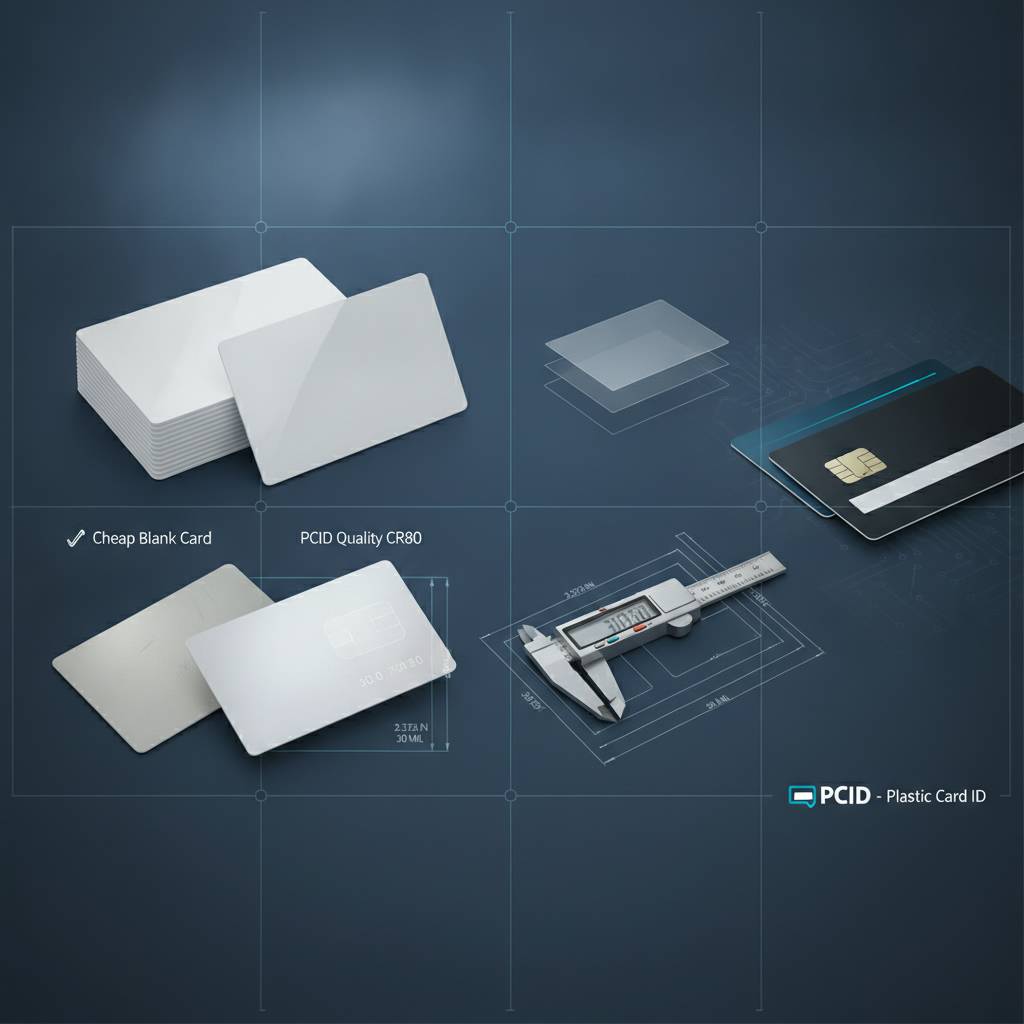 The CR80 card format - 3.375 inches by 2.125 inches at 30 mil thickness - isn't arbitrary. It's the ISO 7810 specification that makes a card fit predictably in wallets, card readers, printer hoppers, and lanyards. When a card deviates from this standard, even slightly, the cascade of small problems can add up fast: cards that skip through printers, credentials that don't seat properly in access readers, or loyalty cards that crack after a few weeks in a wallet.
Consistency in card dimensions is the foundation of a reliable card program. Cheap alternatives frequently cut corners on dimensional tolerances or material composition, which might not matter for a one-time event badge but absolutely matters for a high-volume operation printing thousands of cards through an Evolis Primacy or Zebra ZXP Series printer week after week.
What ISO 7810 Compliance Actually Means for Your Program
ISO compliance guarantees more than size. It sets standards for rigidity, dimensional tolerances, and surface flatness. A compliant blank card will feed reliably from a hopper without double-feeds, accept dye-sublimation printing without banding, and resist the kind of warping that makes cards look amateurish. That consistency is what separates a professional card program from one that constantly frustrates staff.
For organizations issuing employee IDs, student cards, or membership credentials, ISO 7810-compliant stock protects your printer investment just as much as it protects your brand. Card printer manufacturers including Fargo, Zebra, and Evolis design their equipment around this standard - using non-compliant stock can contribute to premature printhead wear and may actually affect warranty coverage.
Thickness Matters More Than You Think
At 30 mil (0.030 inches), a CR80 card has a specific feel - substantial, professional, and durable. Cards manufactured at 20 or 24 mil may be cheaper by the box, but they bend more easily, wear faster, and feel noticeably flimsy in hand. That tactile impression is not trivial: membership cards, VIP credentials, and loyalty cards are marketing touchpoints. A card that feels cheap communicates something about your organization that you probably didn't intend to say.
Retailers who switched from paper-based gift programs to quality plastic gift cards have reported sales increases in the range of 35-50%. That lift doesn't happen with flimsy stock - it happens because a well-made card earns a place in a customer's wallet and stays there. Longevity in the wallet means more impressions, more repeat engagement, and more value returned per dollar spent on card stock.
Material Composition: PVC vs Composite vs Bargain Blends
Standard blank PVC cards are made from polyvinyl chloride - a proven, widely compatible material that works well with most card printer ribbons and encoding systems. Some specialty applications call for composite cards (PVC-polyester blends) that offer greater rigidity and heat resistance, particularly important in environments where cards may be exposed to temperature extremes. What you want to avoid are cards made from unspecified blends that aren't disclosed by the seller.
Unknown material composition is one of the most overlooked risks in cheap card purchasing. Certain bargain-bin cards contain filler materials that interact poorly with dye-sublimation ribbons, resulting in patchy or undersaturated prints. Others may not accept retransfer printing cleanly. Before committing to a bulk order from any supplier, understanding exactly what material you're buying - and whether it's been tested with your specific printer model - is essential due diligence.
Magnetic Stripe Cards: HiCo vs LoCo and Why It Matters
If your blank cards need to carry data - gift card balances, loyalty points, access permissions, hotel room assignments - you're entering the world of magnetic stripe technology. And here, the cheap vs quality debate gets significantly more consequential. A magnetic stripe that fails mid-program isn't just an inconvenience; it's a customer service crisis and a logistical headache that costs far more than the savings on cheap stock ever delivered.
Two primary stripe types exist: High Coercivity (HiCo) and Low Coercivity (LoCo). Each has its purpose, and each requires the right encoder to write data reliably. CPE supplies both - but the key word is "reliably." Sourcing magnetic stripe cards from an unknown vendor can leave you with stripes that encode inconsistently, degrade faster than expected, or fail entirely in environments with mild magnetic interference.
HiCo Cards: The Workhorse for Demanding Environments
HiCo magnetic stripes operate at 2750 Oersteds of magnetic strength - significantly stronger than LoCo stripes. This makes them more resistant to accidental erasure from everyday sources of magnetic interference like bag clasps, phone cases, and speaker magnets. For hotel key cards, employee access badges, and any card that will be carried with other items in a purse or wallet, HiCo is generally the right choice.
The reliability difference between quality HiCo cards and bargain alternatives becomes obvious at scale. In a program issuing 5,000 hotel key cards monthly, even a 2% failure rate means 100 frustrated guests at the front desk every single month. That's a real operational cost that dwarfs any per-card savings from choosing inferior stock.
LoCo Cards: When the Application Fits
Low Coercivity stripes, running at around 300 Oersteds, are perfectly adequate for controlled environments where magnetic interference isn't a concern - certain indoor loyalty programs, short-duration event credentials, or applications where the encoding system is specifically designed for LoCo. They're typically less expensive, and when the application matches the technology, that savings is legitimate and sensible.
The mistake buyers make is defaulting to LoCo simply because it's cheaper without evaluating whether the use case actually supports it. A loyalty card that lives in a wallet next to a smartphone for two years is not an ideal LoCo application. An indoor event badge used for one weekend is. Matching the stripe technology to the actual use case is what separates informed purchasing from cost-cutting that backfires.
Encoding Compatibility and Your Printer Setup
To write data onto a magnetic stripe, your card printer needs an encoding module. Evolis, Zebra, and Fargo all offer printers with built-in magnetic stripe encoders, but they must be matched with compatible card stock. Quality cards from a reputable supplier come with defined encoding specifications - the stripe is positioned correctly, has consistent oxide coverage, and meets encoding density standards.
Call 800.835.7919 if you have questions about matching magnetic stripe card stock to your specific printer model - getting this right before you order hundreds or thousands of cards is far easier than troubleshooting encoding errors after the fact. The CPE team has over 25 years of experience helping businesses configure card programs that actually work.
RFID, Smart Cards, and the Advanced End of the Blank Card Spectrum
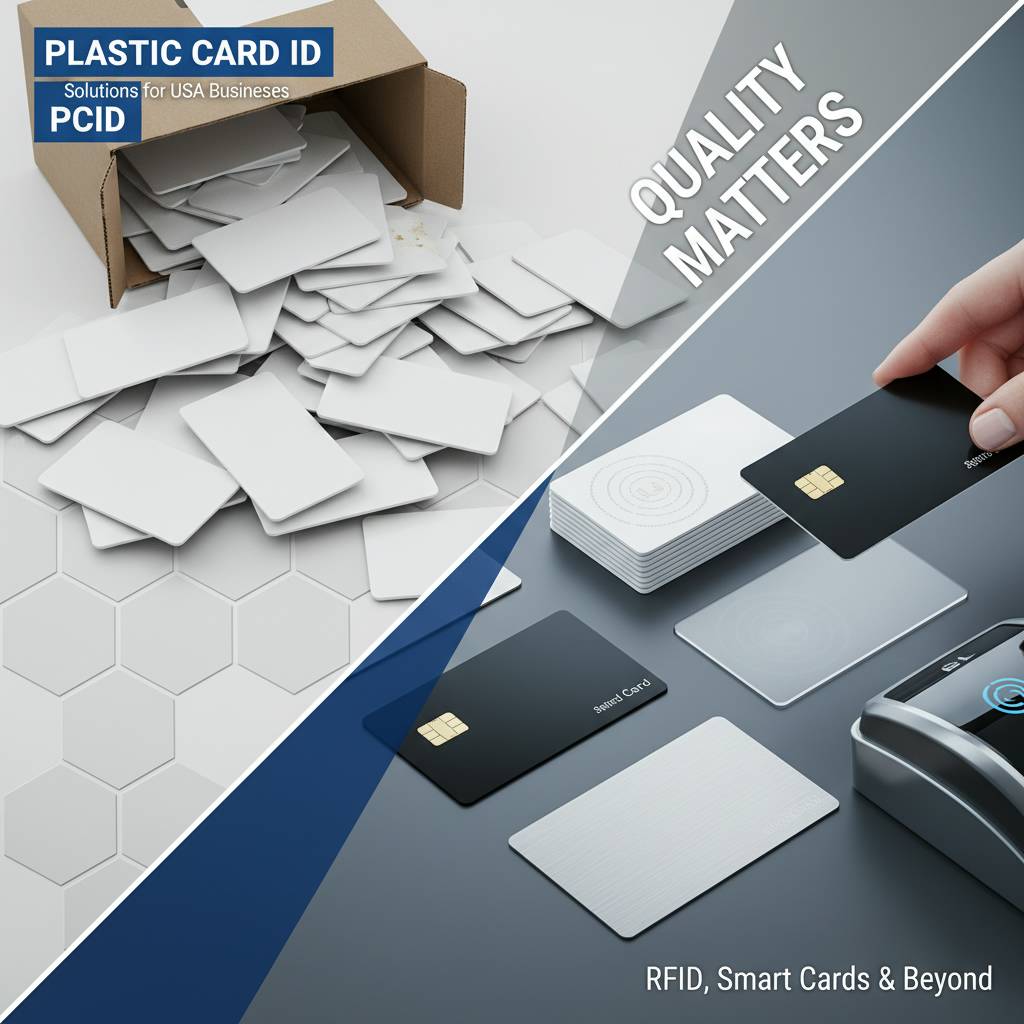 Beyond standard PVC and magnetic stripe options, the blank card category extends into contactless and smart card technology - proximity cards, RFID cards, and smart chip cards that carry embedded integrated circuits capable of storing and processing data. These aren't novelties; they're the backbone of modern access control systems, corporate security infrastructure, and contactless loyalty platforms.
Sourcing these from the wrong vendor creates problems that dwarf the issues associated with cheap PVC stock. A proximity card that doesn't meet the frequency specifications of your access control reader is functionally useless. A MIFARE DESFire card with substandard chip seating may pass initial testing and fail in the field. Advanced card technologies demand verified, quality-assured supply chains.
Proximity Cards and Access Control Applications
125 kHz proximity cards are the standard workhorse of building access control systems - compatible with HID-style readers and widely deployed across corporate campuses, healthcare facilities, schools, and government buildings. The card's performance depends on the quality and consistency of the embedded antenna and chip, which in cheap alternatives can be inconsistently manufactured, resulting in varying read ranges and reliability issues.
For organizations running access control at multiple entry points or managing hundreds of credentials, card-to-reader consistency isn't optional - it's a security requirement. A card that works 95% of the time at a door reader creates security gaps and staff frustration in equal measure. Quality proximity card stock delivers read consistency across the entire batch, not just the sample you tested before ordering.
RFID Smart Cards with MIFARE Technology
MIFARE DESFire and other MIFARE-family smart cards represent the higher end of contactless card technology - offering encrypted data storage, mutual authentication, and multi-application capability on a single card. These are used in sophisticated access control deployments, transit applications, and secure membership programs where data integrity and tamper resistance are non-negotiable.
Sourcing MIFARE-compliant cards requires verifiable chip specifications - the chip family, memory configuration, and OS version all matter for system compatibility. CPE supplies verified MIFARE technology because the consequences of incompatibility at this level are significant. A batch of misspecified smart cards can require a complete re-provisioning of an access control system - a cost far exceeding any savings from choosing a cheaper supplier.
Hotel Key Cards: Where Reliability Is Customer Experience
Hotel key cards sit at an interesting intersection: they must encode reliably at check-in, perform flawlessly at the door, survive being carried with phones and credit cards, and still look presentable when handed to a guest. Cheap card stock fails this test in multiple ways - inconsistent magnetic stripe performance, surface finishes that scratch easily, and dimensional variations that cause door lock readers to misread.
For hospitality operators, the blank card stock they choose directly affects guest satisfaction scores. A guest who returns to the front desk twice because their key doesn't work is a guest who may not return at all. Quality hotel key cards are an investment in the guest experience, not just an operating expense.
Specialty Card Options: When Standard Blank Cards Aren't Enough
Not every card program fits the standard white CR80 mold - and for organizations where the card itself needs to make a statement, specialty options deliver impact that standard stock simply cannot. Clear and frosted cards, custom die-cut shapes, and luxury metal cards in stainless steel, brass, and gold represent the premium tier of blank card offerings.
These aren't gimmicks. A transparent clear card with a minimalist printed design can be more visually striking and memorable than a traditionally printed white card at twice the design cost. A metal card in brushed stainless steel positions a membership or VIP credential in an entirely different perceptual category - the weight and feel communicate exclusivity before the recipient reads a single word on it.
Clear and Frosted Cards for Visual Impact
Clear PVC cards require a different approach to design - since the card's transparency is part of the visual effect, artwork must account for what shows through and what appears on the surface. Frosted cards diffuse light differently than glossy white stock, giving printed colors a softer, more sophisticated appearance that stands out in a wallet full of standard cards. Both formats require quality card stock to achieve the effect consistently.
Specialty card formats work hardest when they're matched to the right printer and ribbon combination. Dye-sublimation printing on clear stock requires printer calibration and ribbon selection that accounts for the card's optical properties. CPE can guide buyers through the right pairings to ensure specialty card orders deliver the visual results the application demands.
Metal Cards and Luxury Membership Credentials
Stainless steel, brass, and gold-finished metal cards occupy the luxury tier of card stock - used by premium membership clubs, executive programs, high-end retailers, and hospitality operators who want their credential to signal exclusivity and permanence. These cards are not printed in the traditional sense; they are typically laser-engraved or chemically etched, and the manufacturing process is fundamentally different from standard PVC card production.
The impact a metal card has on perceived value is well-documented in consumer psychology. The physical weight of a metal card triggers associations with quality and importance that no paper or even standard plastic card can replicate. For programs where the card itself is a brand experience - VIP lounges, executive clubs, premium loyalty tiers - metal cards deliver a return on investment that extends well beyond the per-card cost differential.
Custom Die-Cut Shapes and Branded Card Formats
Die-cut cards in non-standard shapes - key tags, rounded mini cards, custom outlines - serve specific program needs where the card's physical form is part of its function or appeal. Loyalty key tags that clip to a keychain are used more consistently than wallet cards because they're always accessible. Custom shapes for promotional campaigns attract attention precisely because they break the visual pattern of standard rectangles.
Quality matters in die-cut applications because the cutting process must be clean and precise - ragged edges, inconsistent cuts, or delamination at cut edges are signs of inferior manufacturing. When the card format is itself part of the brand presentation, quality control in production is not optional.
Building a Complete Card Program: Beyond the Card Itself
A blank card is the starting point, not the complete solution. A functioning card program needs printer hardware, consumable ribbons, cleaning kits, card carriers, and sometimes card mailing services to get credentials into the hands of members, employees, or customers. Treating the program holistically - rather than purchasing cards and printer supplies from disconnected sources - is how organizations build programs that run smoothly and cost-effectively over time.
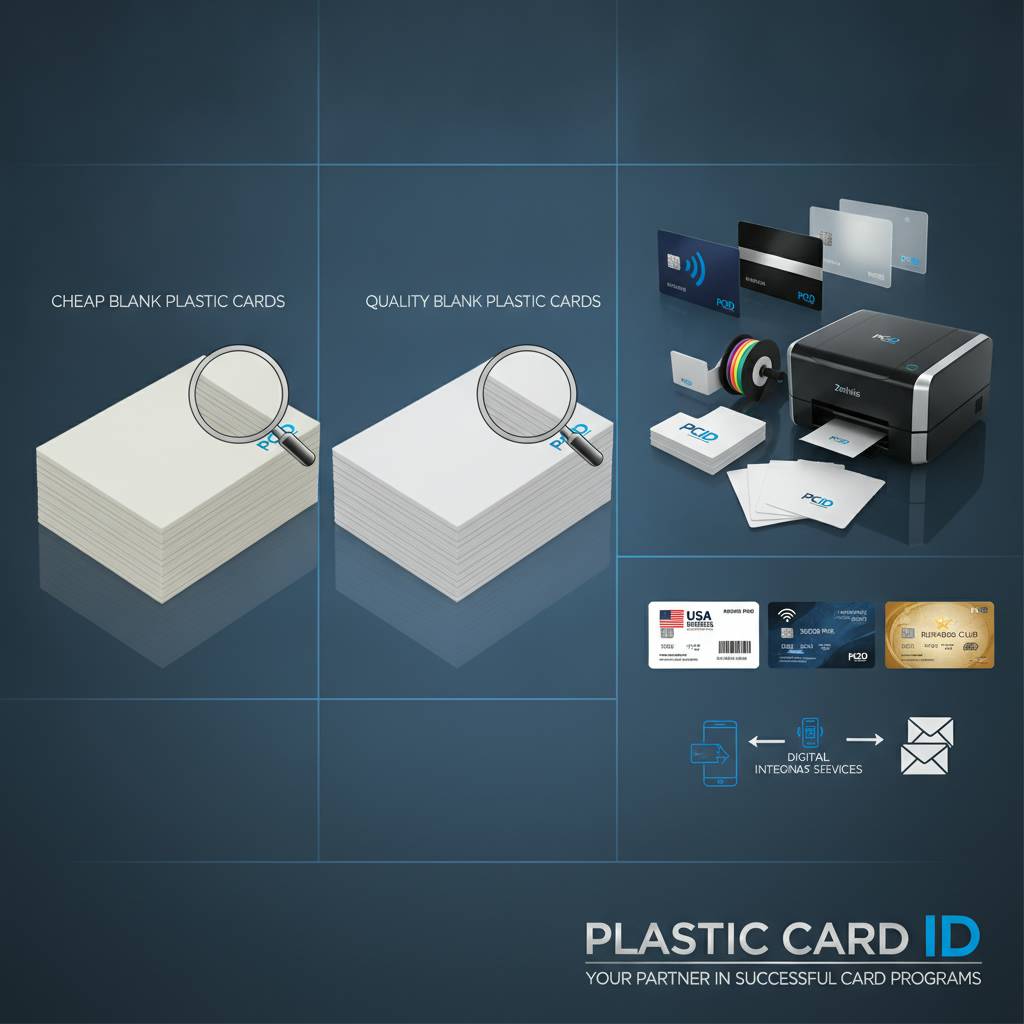
The full ecosystem matters in ways that aren't always obvious at the outset. A ribbon that isn't matched to the card stock will produce inferior prints. A printer that hasn't been cleaned according to schedule will wear faster and produce inconsistent output. Card sleeves and carriers protect printed cards during distribution - a detail that seems minor until a batch of freshly printed credentials arrives scratched.
Card Printers: Matching Hardware to Program Scale
The three dominant brands in professional card printing - Evolis, Zebra, and Fargo - each offer product lines designed for different program scales and requirements. A small nonprofit issuing 50 membership cards monthly has different hardware needs than a hospital system printing 2,000 employee badges per quarter. Selecting the right printer at the right tier is as important as selecting the right card stock.
Printer and card stock compatibility should be verified before committing to either purchase. Each printer manufacturer specifies card stock parameters - thickness tolerances, material types, and surface finishes that work reliably with their printhead technology. Buying cards and printers together from a supplier who knows both products eliminates the guesswork and the risk of a costly mismatch.
Ribbons, Cleaning Kits, and the Maintenance Factor
Dye-sublimation ribbons are consumables that directly affect print quality and per-card cost calculations. Genuine manufacturer ribbons - whether from Evolis, Zebra, or Fargo - are engineered to work with specific printer and card stock combinations. Third-party ribbons can work adequately in some cases, but inconsistent quality control in ribbon manufacturing translates directly to inconsistent print output.
Cleaning kits are not optional maintenance - they're the difference between a printer that runs reliably for years and one that develops roller contamination, feed issues, and printhead degradation ahead of its time. A cleaning regimen matched to print volume keeps the entire system performing at specification. CPE supplies complete cleaning kits alongside printer and card stock because the system only performs as well as its maintenance allows.
Card Carriers, Sleeves, and Mailing Services
Once cards are printed, they need to reach their recipients without damage and ideally with professional presentation. Card carriers provide context - a carrier that presents a loyalty card with instructions and a welcome message turns a card delivery into a brand touchpoint. Card sleeves protect surfaces from scratching during transit or storage.
For organizations without in-house mailing infrastructure, card affixing and mailing services eliminate a significant operational burden - cards are printed, mounted, and mailed as part of a single workflow rather than requiring a separate fulfillment step. For programs scaling up quickly or operating with lean administrative teams, this service is a practical solution that keeps programs moving efficiently.
Buyer's Guide: Choosing Blank Plastic Cards Without Getting Burned
After 25 years and more than 50 million cards sold, certain patterns emerge in how organizations make card purchasing decisions - the ones that work well and the ones that create problems down the line. The guidance here isn't theoretical; it reflects real purchasing scenarios played out across more than 100,000 customer relationships in the United States.
The single biggest mistake buyers make is optimizing purely for per-card price without accounting for total program cost. Reprints, printer damage, failed encodings, and staff time troubleshooting card issues all carry costs that don't show up on the original invoice. A card that costs 20% less but fails 5% of the time in a high-volume program is not a bargain - it's a liability.
Key Questions to Ask Before Ordering Blank Cards
- Is the card ISO 7810 compliant at 30 mil / CR80 standard? If a supplier can't confirm this, proceed with caution.
- What printer models has this card stock been tested with, and what were the results?
- For magnetic stripe cards: is the stripe HiCo or LoCo, and what is the coercivity rating?
- What is the material composition - pure PVC, composite, or blended stock?
- Does the supplier offer bulk pricing with consistent lot-to-lot quality assurance?
- For RFID or smart cards: what chip family, frequency, and memory specifications apply?
- Is technical support available if encoding or printing issues arise after the order ships?
Understanding Volume Pricing and Real Cost Per Card
Blank card pricing scales with volume - a box of 500 cards will cost more per card than an order of 5,000. Understanding your actual monthly volume and projecting it over a year often reveals that buying in appropriately larger quantities reduces per-card cost significantly without creating excess inventory risk. The threshold where bulk pricing meaningfully changes the economics varies by card type, but it's almost always worth calculating.
For a program running 500 cards per month, the difference between buying in monthly batches versus quarterly might be $75-$200 per order - real savings that compound over a year-long program. CPE works with clients at every scale to find the right order cadence that balances cash flow, storage, and per-unit cost efficiently.
Red Flags When Sourcing Blank Cards from Unknown Suppliers
Certain warning signs consistently precede card quality problems. Suppliers who cannot specify card material composition, who don't provide ISO compliance confirmation, or who list magnetic stripe cards without specifying coercivity ratings are selling on price alone - and price alone is rarely enough information to make a confident purchasing decision for a program that depends on card reliability.
- No specified material composition (just listed as "plastic card")
- Thickness listed as approximate or variable rather than a stated 30 mil
- Magnetic stripe coercivity not specified for HiCo or LoCo cards
- No stated printer compatibility testing or certifications
- No accessible technical support or account management contact
- Pricing dramatically below market with no quality differentiator explanation
Ready to source blank cards you can actually count on? Contact Plastic Card ID at 800.835.7919 and speak with a card program specialist today.
Why Thousands of USA Businesses Trust Plastic Card ID for Their Card Programs
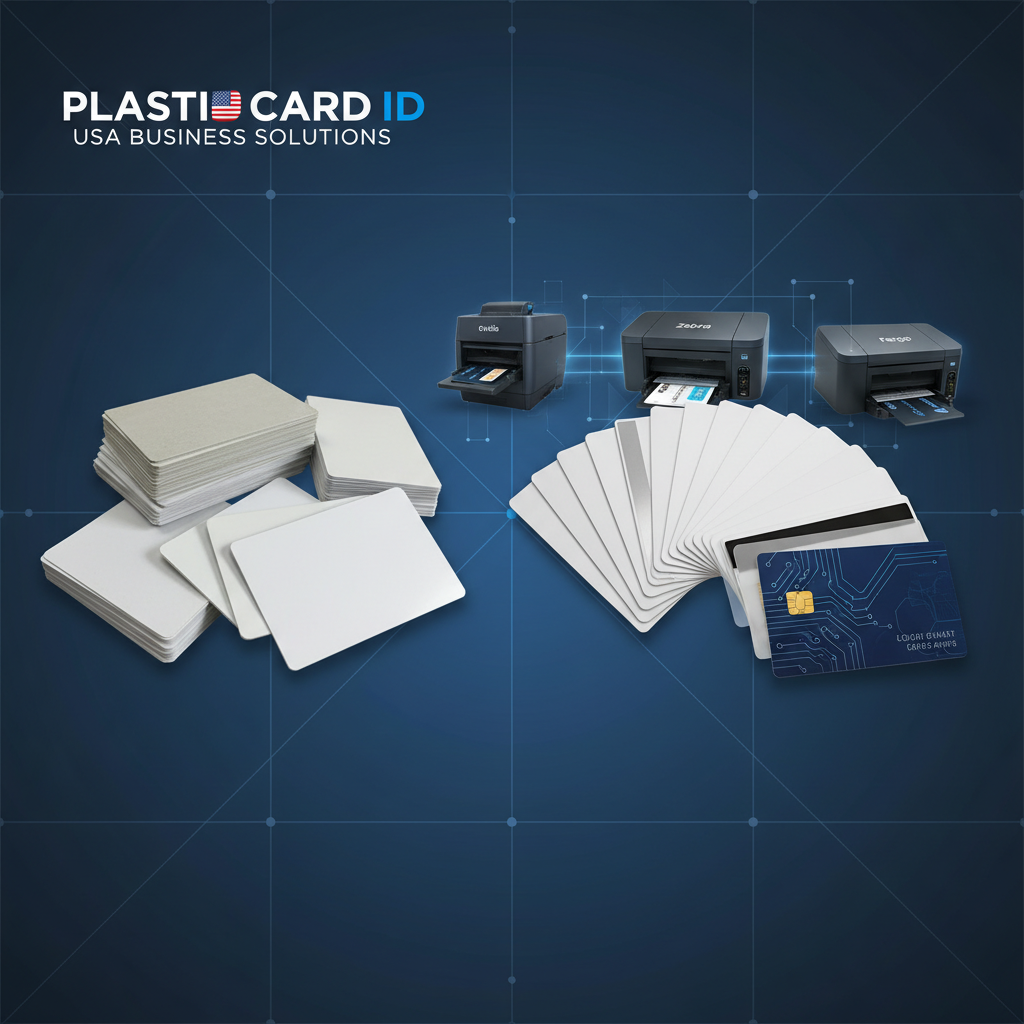 There's a difference between a card vendor and a card program partner. A vendor ships boxes of cards. A partner helps you think through what card format fits your application, which magnetic stripe technology suits your reader environment, which printer configuration handles your monthly volume, and how to structure ordering to keep costs predictable. CPE has built its reputation over 25 years by operating as the latter.
More than 50 million cards sold isn't just a number - it's a track record of programs that worked. Gift card programs that drove measurable retail sales increases. Loyalty programs where plastic cards outperformed paper punch cards in redemption rates and customer retention. Access control deployments where credential reliability was never a question. Employee badge programs that ran for years without the card-related headaches that come from inferior stock.
A Full Catalog Built for Serious Card Programs
The breadth of the CPE catalog reflects the actual diversity of card program requirements across U.S. businesses and organizations. Blank white CR80 PVC cards for straightforward in-house printing. Magnetic stripe cards in HiCo and LoCo. RFID proximity cards for access control. MIFARE DESFire smart cards for high-security applications. Clear and frosted specialty stock. Custom die-cut formats. Metal cards for luxury credentials. And the full range of printers, ribbons, cleaning supplies, card carriers, and mailing services to support the complete program lifecycle.
This is a deliberate design - not a catalog assembled opportunistically, but one built around the actual needs of organizations running card programs of every scale. Whether the program involves 50 cards a month for a local gym or tens of thousands for a regional retail chain, the catalog and the expertise behind it are there to support it.
Serving USA Businesses with Scale and Consistency
Operating exclusively in the United States market means CPE understands the specific compliance, compatibility, and operational contexts that U.S. businesses navigate. From healthcare organizations managing employee credential programs under security requirements to hospitality operators configuring hotel key systems, the applications are diverse - but the common thread is that reliability is non-negotiable and the card program needs to work every time.
Scale matters too. A supplier capable of supporting programs ranging from 50 cards monthly to mass production in the tens of thousands understands cost structures, lead times, and logistics at both ends of that spectrum. That range of capability means a program that starts small and grows doesn't need to find a new supplier when volume increases - the relationship and the infrastructure scale with it.
Long-Term Partnerships, Not One-Time Transactions
The most successful card programs CPE has supported aren't defined by a single purchase - they're built through ongoing relationships where the supplier understands the client's system, volumes, and requirements well enough to anticipate needs, flag compatibility issues before they become problems, and support program evolution as technology and business requirements change.
A long-term card program partner is worth more than the lowest per-card price on a given day. The savings in avoided reprints, troubleshooting time, and operational disruptions over a multi-year program typically exceed the cost differential between a committed supplier relationship and opportunistic bargain hunting. Twenty-five years of customer relationships at CPE are built on exactly this premise.
Don't settle for cards that create problems. Call 800.835.7919 and let CPE help you build a card program designed to succeed from the first card to the fifty-thousandth.
Plastic Card ID is ready to be the card program partner your organization deserves. Reach the team directly at 800.835.7919 - because when blank plastic cards need to perform, quality is the only standard that matters.
Previous Page