Blank Magnetic Stripe Cards Explained: HiCo vs LoCo
Table of Contents []
- What Every Business Should Know About Blank Magnetic Stripe Cards
- HiCo Magnetic Stripe Cards: Built for Demanding Environments
- LoCo Magnetic Stripe Cards: The Right Card for Short-Term Applications
- Choosing Between HiCo and LoCo: A Practical Decision Framework
- Blank Magnetic Stripe Cards in Real Business Applications
- Complete Your Card Program With the Right Supplies and Equipment
- Partner With Plastic Card ID for Your Magnetic Stripe Card Program
What Every Business Should Know About Blank Magnetic Stripe Cards
Magnetic stripe technology has been quietly powering card programs across the United States for decades - yet most business owners can't tell you the difference between a HiCo and a LoCo card. That gap in knowledge costs money, causes failed card reads, and sometimes derails entire programs before they get off the ground. Plastic Card ID has spent more than 25 years helping businesses close that gap, and this guide distills what we know into clear, actionable information.
Whether you're launching a loyalty program, issuing employee access badges, or running a membership organization, the magnetic stripe card is still one of the most reliable, cost-effective tools in the industry. But choosing the wrong stripe type for your application is a real and avoidable problem. Let's break it down properly.
The Anatomy of a Magnetic Stripe Card
A standard CR80 plastic card - the same size as a credit card at 3.375 x 2.125 inches - can be manufactured with a magnetic stripe running along the back surface. That stripe is a band of iron-based magnetic particles embedded in a resin binder. Data is encoded onto those particles by a card printer's encoding head, which magnetizes the particles in specific patterns to represent numbers and characters.
The stripe itself contains up to three distinct tracks: Track 1, Track 2, and Track 3. Each track holds different data types and is formatted to specific industry standards. Track 1 carries alphanumeric data. Track 2 is the most commonly used track for loyalty and access applications. Track 3 is read/write capable and used in more specialized scenarios. Understanding which tracks your card reader or software uses is the first step before ordering any blank magnetic stripe card.
Why the Stripe Type Matters More Than You Think
Here's where businesses get tripped up. Not all magnetic stripes are created equal. The term coercivity describes how resistant the magnetic particles are to being demagnetized. High coercivity cards - HiCo - require a stronger magnetic field to encode and erase data. Low coercivity cards - LoCo - use a weaker field. This distinction is not cosmetic. It determines whether your cards survive in real-world environments.
Put a LoCo card near a hotel room key programmer or a strong magnetic clasp on a purse, and the data can be wiped. Use a HiCo card with a printer that's only calibrated for LoCo, and the encoding will fail or produce inconsistent reads. The right match between card type and printer/reader hardware is absolutely fundamental to a successful card program.
Tracks, Encoding Standards, and Your Software
Most off-the-shelf loyalty, access control, and membership software is built around Track 2 encoding, which follows ISO/IEC 7813 standards. If your point-of-sale system, gym management platform, or badge reader documentation references Track 2, you're in the majority. CPE stocks blank magnetic stripe cards pre-configured with standard track layouts that integrate smoothly with the most common software platforms.
However, some enterprise applications and specialty card systems use Track 1 for its larger alphanumeric data capacity. Retail gift card programs managed through sophisticated POS systems, for example, sometimes utilize both Track 1 and Track 2 simultaneously for redundancy. Knowing your system's requirements before you order prevents costly reprints and program delays.
| Feature | HiCo (High Coercivity) | LoCo (Low Coercivity) |
|---|---|---|
| Coercivity Level | 2750 Oersteds | 300 Oersteds |
| Stripe Appearance | Dark brown/black | Brown |
| Durability | High - resists demagnetization | Moderate - more susceptible |
| Best Use Cases | Loyalty, ID badges, gift cards | Hotel keys, event passes |
| Typical Cost | Slightly higher | Slightly lower |
| Re-encoding | Requires HiCo encoder | Standard encoder works |
HiCo Magnetic Stripe Cards: Built for Demanding Environments
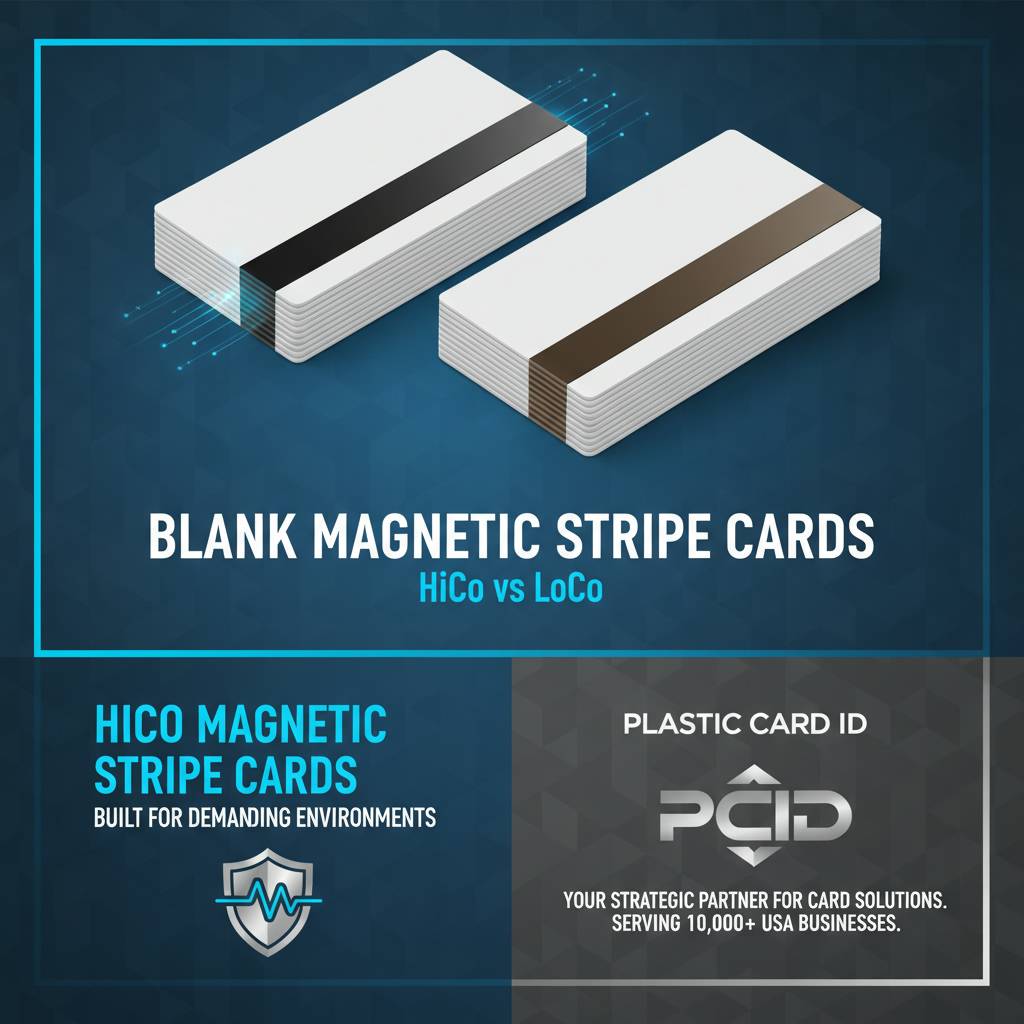 High coercivity magnetic stripe cards operate at approximately 2750 Oersteds - a measure of magnetic field strength. That elevated resistance to demagnetization makes HiCo cards the professional standard for programs where cards exchange hands frequently, get stored in wallets alongside other cards, or pass through environments with ambient magnetic fields. The vast majority of loyalty programs, employee ID card systems, and retail gift card programs run on HiCo stock for exactly this reason.
The visual tell is the stripe color: HiCo stripes are typically a darker brown or near-black, while LoCo stripes appear lighter. It's a subtle difference that matters at the point of reorder - if you mix HiCo and LoCo stock unknowingly, you'll get inconsistent encoding results that can be very difficult to diagnose without knowing what to look for.
HiCo Applications That Drive Real Business Results
Retailers who upgrade from paper punch cards or simple paper certificates to HiCo plastic loyalty cards see measurable sales lifts. Industry data consistently shows 35-50% increases in gift card sales when businesses switch from paper to plastic - and the durability of HiCo stock is a meaningful part of that equation. A card that lives in someone's wallet for two years without data degradation is a card that gets used.
Employee badge programs, library card systems, gym membership cards, and club credentials all benefit from HiCo encoding. These are cards with long intended lifespans. A card issued to an employee on their first day might be swiped at an access reader hundreds of times over several years. LoCo stock simply isn't built for that kind of repeated, long-term use. HiCo is the right tool for the job.
Printer Compatibility With HiCo Cards
CPE supplies HiCo blank cards designed for compatibility with the card printers we carry from Evolis, Zebra, and Fargo. Each of these printer lines includes models with optional magnetic stripe encoding modules - but the encoder must be the right type. Using a LoCo-only encoder on HiCo cards will produce failed or unreliable encodes, period. Always verify your printer's encoder specification before ordering HiCo stock, or call our team for a compatibility check.
The good news is that many modern desktop card printers offer dual coercivity encoding - they can handle both HiCo and LoCo cards by adjusting the encoding current. If your program might evolve to include multiple card types, a dual-coercivity printer is a smart investment that protects your flexibility. Call us at 800.835.7919 and we can walk you through compatible printer models for your specific use case.
Quantities, Lead Times, and Ordering HiCo Stock
Plastic Card ID serves card programs of all sizes - from a regional gym that needs 200 member cards to a multi-location retail chain ordering 50,000 loyalty cards. HiCo blank stock is available in standard CR80 size at 30 mil thickness, and pricing scales favorably with volume. Small organizations aren't penalized for modest order sizes, and large buyers benefit from competitive bulk pricing.
Lead times for standard HiCo blank card orders are typically fast, and we maintain inventory specifically to support businesses that need to replenish quickly. Having a reliable supply partner matters when your card program depends on continuous issuance - running out of blank stock halts badge printing, stalls onboarding, and frustrates members or customers waiting for cards.
LoCo Magnetic Stripe Cards: The Right Card for Short-Term Applications
Low coercivity magnetic stripe cards have a coercivity of approximately 300 Oersteds. That lower resistance to magnetic interference actually serves a purpose in specific applications - particularly where cards need to be quickly re-encoded between uses. Hotel key cards are the canonical example. A hotel needs to encode a card at check-in and erase or overwrite it at checkout, over and over, with minimal wear on the encoding hardware.
LoCo cards are also popular for event wristband alternatives, temporary visitor badges, day passes, and short-duration promotional programs. The expectation is not longevity - it's efficient, low-friction operation in a specific window of time. For these applications, the slightly lower price point of LoCo stock is a real budget advantage, especially at high volumes.
Where LoCo Outperforms Its Reputation
LoCo cards often get dismissed as the "inferior" option, and that framing misses the point. A card should be matched to its application, not evaluated in the abstract. For hotel key cards programmed by a dedicated key card encoder at the front desk and used for a two-night stay, LoCo is exactly right. The card doesn't need to survive years in a wallet - it needs to work for 48 hours and then be reprogrammed for the next guest.
Temporary access passes for vendors, contractors, or visitors follow the same logic. These cards are issued in the morning, returned at the end of the day, wiped, and reissued. LoCo stock handles this cycle efficiently, and the lower coercivity requirement extends the life of the encoding head in your printer - a secondary operational benefit that adds up over time.
Understanding Re-Encoding and Card Reuse With LoCo
One of the practical advantages of LoCo cards is how easily they can be re-encoded with standard hardware. Because the magnetic field required to write new data onto a LoCo stripe is lower, less expensive - and more widely available - encoders can do the job. This lowers the barrier to entry for organizations that want to run a card program without investing in specialized encoding equipment.
That said, re-encoding is not infinite. Magnetic stripe cards - HiCo or LoCo - do have a finite encoding cycle life, and the physical card surface will show wear before the stripe itself fails. For applications where cards are cycled through dozens of re-encodes per month, it's worth factoring replacement card costs into your program budget from the start. CPE can help you model those costs accurately.
LoCo Pricing and Volume Options
Blank LoCo magnetic stripe cards are among the most cost-effective card products available, particularly when ordered in volume. Organizations running high-throughput short-term programs - conference centers, resorts, exhibition halls, coworking spaces - can stock LoCo cards in bulk and achieve a very low per-card cost that makes even disposable-use economics work out favorably.
Volume discounts at Plastic Card ID kick in at quantities that are accessible to mid-size operations, not just enterprise buyers. If you're running a regional hotel property or a convention center with regular events, you can order at scale without the overhead of a corporate procurement process. Simple ordering, reliable fulfillment, and stock that works with your existing hardware.
Choosing Between HiCo and LoCo: A Practical Decision Framework
 After understanding the technical differences, most businesses find the decision comes down to three factors: how long the card needs to function reliably, what environment the card will be stored in, and what encoding hardware is already in place. Running through those three questions quickly narrows the field in almost every scenario.
Here's a structured way to think about it. Long-life cards in mixed environments almost always call for HiCo. Short-duration cards in controlled environments with dedicated encoders almost always point to LoCo. The edge cases - medium-duration use in uncertain environments - typically resolve toward HiCo because the incremental cost difference is modest and the downside of a failed card read is significant.
Decision Factors at a Glance
- Card lifespan over 6 months: Choose HiCo. The resistance to demagnetization pays for itself in reduced card failures and replacements.
- Card stored in wallet with other cards: Choose HiCo. Adjacent cards with magnetic stripes, phone cases, and everyday interference are real risks for LoCo stock.
- Card re-encoded between uses: LoCo may be the better fit, especially if your encoder is optimized for LoCo.
- Event, hotel, or temporary access use: LoCo is well-suited and cost-effective at volume.
- Employee badges, loyalty cards, membership cards: HiCo is the professional standard for a reason.
- Unknown or mixed environment: Default to HiCo for reliability insurance.
- Budget-constrained high-volume short-term programs: LoCo delivers excellent value when the application fits.
Common Mistakes and How to Avoid Them
The most common mistake is ordering cards without verifying the encoder specification of the printer in use. A business inherits a card printer, assumes it handles whatever cards are ordered, and gets frustrated when magnetic stripe reads fail or encoding is inconsistent. The fix is simple: check the printer manual or call the manufacturer's support line to confirm whether the encoding module is HiCo, LoCo, or dual-coercivity.
The second most common mistake is mixing card stock from different orders without tracking the coercivity specification. If your storage room has two boxes of blank magnetic stripe cards - one HiCo, one LoCo - and they get mixed, you'll spend considerable time diagnosing intermittent encoding failures. Label your stock clearly, order consistently, and maintain a simple inventory log. These small habits prevent surprisingly large headaches.
Getting Expert Guidance Before You Order
CPE has helped over 100,000 customers across the United States set up and scale card programs. The institutional knowledge accumulated over 25-plus years of selling more than 50 million cards translates into practical guidance that saves businesses time and money. We're not just processing orders - we're helping you make the right decision for your specific program.
If you're unsure which magnetic stripe specification is right for your application, hardware, or budget, reach out before ordering. A five-minute conversation can prevent a costly mistake and get your program running correctly from card one. Our team speaks the language of card programs, from small nonprofits issuing 50 member cards a month to regional chains managing tens of thousands of loyalty cards in continuous circulation.
Blank Magnetic Stripe Cards in Real Business Applications
Theory is useful, but seeing how other organizations have deployed magnetic stripe blank card stock in practice brings the decision framework to life. The following scenarios illustrate common applications Plastic Card ID supports across industries in the United States.
What stands out in each case is that the card type choice was deliberate, not default. Organizations that treat card specification as a meaningful decision - rather than an afterthought - consistently run smoother programs with lower failure rates and better cardholder experiences.
Retail and Hospitality: Loyalty and Gift Card Programs
A regional restaurant group with 12 locations wanted to launch a loyalty card program that replaced their paper stamp cards. They opted for HiCo blank CR80 cards printed in-house using an Evolis desktop card printer with an integrated magnetic stripe encoder. Cards are issued at each location, encoded at the point of sale, and tracked through their POS system via Track 2 data.
Within the first six months, they observed exactly the kind of repeat-visit behavior that well-executed loyalty card programs drive. Plastic cards in wallets outperform paper cards in drawers - that's not opinion, it's behavioral economics. The physical card is a persistent reminder and a signal of the brand's commitment to the customer relationship. HiCo stock ensured those cards remained readable through months of daily wallet use.
Access Control and Employee Badge Programs
A manufacturing facility needed to upgrade their visitor and employee access system. They were using paper badges - a common cost-cutting measure that introduces real security gaps. Switching to HiCo blank magnetic stripe cards printed and encoded in-house gave their security team encoded credentials that integrated with their access control software.
Employee cards are encoded with role-specific access data on Track 2, then printed with the employee's photo and name using a Zebra card printer. Visitor cards use a separate LoCo card stock, encoded at reception and wiped at the end of each visit. The two-track system - HiCo for permanent staff, LoCo for visitors - is a practical, cost-efficient approach that many facilities operations teams adopt once they understand the coercivity distinction.
Membership Organizations and Associations
Professional associations, clubs, libraries, and fitness centers all share a similar card program structure: a membership database tied to a physical card that provides access to benefits or facilities. For these programs, card longevity is critical. Members expect their card to work at every visit without friction, and a card failure at a front desk creates an experience that reflects poorly on the organization.
HiCo stock is the consistent choice for membership applications. A gym member's card might be swiped 300 times over the course of a year. A library patron's card might see regular use across multiple years. These use patterns require the magnetic resilience that only HiCo delivers reliably. CPE can supply blank HiCo membership card stock in quantities from 50 to 50,000 with fast turnaround.
Complete Your Card Program With the Right Supplies and Equipment
Blank magnetic stripe cards are just one component of a functioning card program. Getting the full picture means understanding what else you need to issue, encode, and distribute cards effectively. Plastic Card ID operates as a true one-stop shop precisely because card programs have multiple dependencies - and managing them all through a single supplier simplifies operations significantly.
Card printers from Evolis, Zebra, and Fargo cover the full range of program sizes and budgets. Printer ribbons, cleaning kits, and maintenance supplies keep those printers running reliably over time. Card carriers, sleeves, and mailing services support distribution programs that extend beyond walk-in issuance. Every element of your card program can be sourced through a single, experienced partner.
Card Printers With Magnetic Stripe Encoding
Not every card printer includes a magnetic stripe encoder - it's typically an optional module or a factory upgrade. When purchasing a printer for a magnetic stripe card program, confirm that the encoder is included and that it matches the coercivity of your card stock. Evolis, Zebra, and Fargo all offer models with HiCo, LoCo, or dual-coercivity encoding across their product lines.
For small-volume programs under 500 cards per month, a single-sided desktop printer with an integrated encoder is usually sufficient. For higher-volume operations or programs requiring dual-sided printing with encoding, mid-range and professional-grade printers offer the throughput and reliability to support continuous issuance without bottlenecks. Contact 800.835.7919 for a printer recommendation matched to your program volume and budget.
Accessories That Make Programs Run Smoothly
Printer ribbons are consumables that need to be matched to both the printer model and the card material. Using the wrong ribbon can produce faded prints, poor adhesion, or jamming. Plastic Card ID stocks genuine and compatible ribbons for all supported printer lines, so you're never hunting across multiple suppliers to keep your printer running. Cleaning kits extend printer life meaningfully and should be part of every printer maintenance routine.
Card sleeves and holders protect printed and encoded cards during distribution and storage. If your program involves mailing cards to members, customers, or employees, card carriers and affixing services can handle that step professionally. A card that arrives damaged or demagnetized in transit is a card that fails its purpose - proper packaging is not an afterthought.
Specialty Card Options Beyond Standard Magnetic Stripe
Some programs benefit from combining magnetic stripe functionality with other technologies. RFID smart cards with contactless capability - including MIFARE DESFire - can carry both a magnetic stripe and an embedded chip, giving card readers flexibility to use either interface. Proximity access cards operate on a different principle entirely, transmitting a unique ID number when held near a compatible reader without requiring physical contact.
For high-end applications, luxury metal cards in stainless steel, brass, or gold make a powerful impression while still functioning as credential or membership cards. Casino player cards, hotel key cards, and premium loyalty programs sometimes justify the upgrade in materials when the brand experience merits it. CPE can source these specialty options alongside standard PVC magnetic stripe stock, keeping your entire card program under one supplier relationship.
Partner With Plastic Card ID for Your Magnetic Stripe Card Program
Twenty-five years, more than 100,000 customers, over 50 million cards sold - those numbers represent something more than transactions. They represent card programs that launched, scaled, and kept running because the supplier relationship supported them at every step. That's the standard Plastic Card ID holds itself to with every order, every customer, every program of every size.
Whether you're ordering HiCo blank stock for a new loyalty launch, restocking LoCo cards for a hospitality operation, or figuring out which card type fits a program you're building from scratch, you deserve a supplier who engages with your situation rather than simply processing your SKU. That engagement is what separates a strategic partner from a commodity vendor - and it's what CPE has been for customers across the United States for over two decades.
Frequently Asked Questions About Magnetic Stripe Cards
Can I use HiCo cards in a printer set up for LoCo? Not reliably. The encoder must match the card's coercivity. Using a LoCo encoder on HiCo stock will produce inconsistent or failed encodes. Confirm your printer's encoder specification before ordering.
How many times can a magnetic stripe card be re-encoded? LoCo cards can typically handle several hundred re-encodes in controlled conditions. HiCo cards are less often re-encoded in practice but are physically capable of multiple re-encodes with the right hardware. Real-world cycling limits depend on the specific application and handling.
What's the difference between Track 1, Track 2, and Track 3? Track 1 holds alphanumeric data at higher density, Track 2 is the most common for loyalty and access applications with numeric data, and Track 3 is a read/write track used in specialized applications. Most standard programs use Track 2 exclusively.
How to Place Your Order
Ordering blank magnetic stripe cards from Plastic Card ID is straightforward. Know your coercivity requirement (HiCo or LoCo), your quantity, and whether you need any additional specifications like track configuration or card thickness. Standard CR80 cards at 30 mil thickness cover the vast majority of programs, but we stock variations for specific applications.
For first-time buyers and organizations setting up new programs, our team is available to walk through your requirements before you commit to an order. Getting it right the first time is always less expensive than correcting a mismatch after the fact. Reach out, describe your program, and we'll recommend exactly what you need.
Start Your Card Program the Right Way
The blank magnetic stripe card sitting in a box in our warehouse becomes something meaningful the moment it's printed, encoded, and handed to a customer, employee, or member. It becomes a loyalty card that drives repeat purchases, a badge that secures a facility, a membership credential that signals belonging. The right card stock, correctly specified and reliably supplied, is the foundation of all of that.
Ready to get your magnetic stripe card program running right? Contact Plastic Card ID today at 800.835.7919 - we'll help you choose the right cards, the right equipment, and the right quantities for a program that works from day one and scales as you grow.