Blank RFID Plastic Cards Guide: Everything You Need
Table of Contents []
- Your Complete Blank RFID Plastic Cards Guide - Plastic Card ID
- What Blank RFID Plastic Cards Actually Are
- The RFID Frequency Spectrum Explained
- Key Industries That Rely on Blank RFID Cards
- How to Buy Blank RFID Cards the Smart Way
- Advanced RFID Card Options and Specialty Products
- Frequently Asked Questions About Blank RFID Cards
- Partner with Plastic Card ID for Your RFID Card Program
Your Complete Blank RFID Plastic Cards Guide - Plastic Card ID
Walk into almost any modern office building, hotel, or event venue and you will brush past RFID technology dozens of times without thinking twice. Tap a badge, wave a card, unlock a door - it all happens in under a second, and the backbone of that seamless experience is a blank RFID plastic card. But what exactly makes these cards tick, and how do you choose the right one for your program? That is precisely what this guide unpacks.
Plastic Card ID has spent over 25 years supplying blank and custom plastic cards to businesses across the United States, moving more than 50 million cards to over 100,000 customers. We know this product category inside and out - and we built this resource so you can, too.
| Card Type | Frequency | Typical Use Case | Read Range |
|---|---|---|---|
| 125 kHz Proximity Card | Low Frequency (LF) | Building access, time and attendance | Up to 20 cm |
| 13.56 MHz Smart Card | High Frequency (HF) | Logical access, cashless payments, transit | Up to 10 cm |
| MIFARE Classic | 13.56 MHz HF | Campus cards, loyalty, event access | Up to 10 cm |
| MIFARE DESFire | 13.56 MHz HF | Secure enterprise access, multi-application | Up to 10 cm |
| UHF RFID Card | 860-960 MHz | Long-range vehicle access, asset tracking | Up to several meters |
What Blank RFID Plastic Cards Actually Are
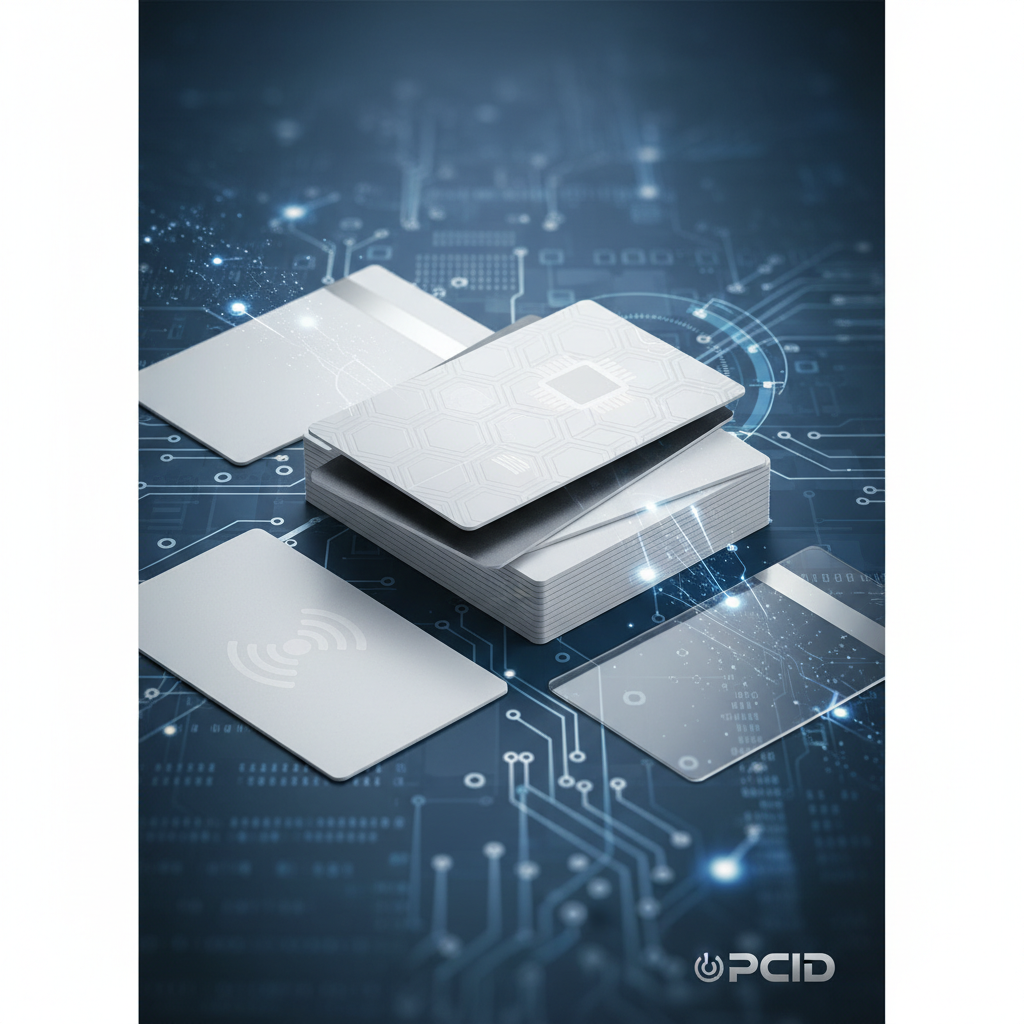 Strip away the jargon and a blank RFID plastic card is a standard CR80-sized piece of PVC - identical dimensions to a credit card at 3.375 x 2.125 inches and 30 mil thick - with one critical addition: an embedded antenna and microchip sealed invisibly inside the laminate layers. There is no slot, no connector, no visible technology whatsoever. It looks and feels like a plain white card. The magic is entirely internal.
The "blank" designation simply means the card has not yet been printed or personalized. That is deliberate. Blank cards give your organization complete design freedom to print logos, photos, barcodes, names, and variable data directly onto the card surface using a desktop card printer. You control the artwork, the sequencing, and the timing. No waiting on a print vendor for every reorder.
The CR80 Standard and Why It Matters
ISO 7810 defines the CR80 card format - the global standard for plastic identification cards. When your blank RFID card meets this specification, it will feed cleanly through any professional card printer, fit every standard card holder, and slot perfectly into every lanyard badge reel. Compatibility is baked in from the start.
Standardization is not a bureaucratic nicety; it is a genuine operational advantage. Mixed-spec cards create feed jams, printing misalignments, and reader errors that cost real money in reprints and downtime. Sourcing CR80-compliant blanks from a proven supplier eliminates that risk entirely.
How the Embedded Technology Works
Inside every RFID card, a copper or aluminum antenna coil loops around the card perimeter. When that card enters the electromagnetic field of a compatible reader, the antenna harvests enough energy to power the chip - no battery needed. The chip responds by transmitting its stored data back to the reader, typically within 100 milliseconds.
The chipset determines what data the card can store, how securely it can be read, and whether it supports read-write or read-only operation. Entry-level proximity cards often store a fixed ID number only. Advanced chips like MIFARE DESFire EV3 support encrypted multi-sector data, multiple simultaneous applications, and mutual authentication between card and reader. Choosing the right chip tier for your application is one of the most important purchasing decisions you will make.
Blank vs. Pre-Encoded Cards
Blank RFID cards ship with either a factory-default chip state or a unique serial number already written at manufacturing. Pre-encoded cards arrive with specific data already loaded - typically a proprietary format ID keyed to a particular access control platform. Most buyers purchasing blank RFID cards for in-house programs want the former: an unformatted chip they can encode through their own reader hardware or enrollment software.
If you manage your own access control software and enrollment station, blank cards give you maximum flexibility. You enroll each card as you issue it, assigning credentials, expiration dates, and access levels on demand. This is the model that scales most efficiently, whether you are issuing 50 cards a month or batching thousands for a large corporate deployment.
The RFID Frequency Spectrum Explained
Frequency is the single biggest technical differentiator among RFID card products, and the wrong choice can mean expensive rework. Low Frequency (LF) at 125 kHz and High Frequency (HF) at 13.56 MHz cover the vast majority of plastic card applications in the United States. Ultra High Frequency (UHF) cards operate in the 860-960 MHz band and are used in specialized scenarios where read distance is critical.
Each frequency band has physical characteristics that determine performance in real-world environments. LF signals penetrate water and human tissue better, making them resilient in harsh or wet conditions. HF cards operate faster and support more sophisticated security protocols. UHF enables long-range reads but is more susceptible to interference from metal surfaces and liquids. Matching frequency to environment is as important as matching it to the application.
Low Frequency 125 kHz Proximity Cards
The 125 kHz proximity card is the workhorse of corporate access control in the United States. Systems built on HID, EM4100, and similar low-frequency platforms have been installed in office buildings, manufacturing plants, universities, and government facilities for decades. Replacement card compatibility is a major procurement driver here - most organizations already have a reader infrastructure and simply need cards that match their existing system format.
CPE stocks a broad selection of 125 kHz blank proximity cards compatible with the most widely deployed platforms. These cards print beautifully with standard dye-sublimation card printers, so your access card can also function as a professional employee ID badge - no dual card carry required.
High Frequency 13.56 MHz Smart Cards
The 13.56 MHz frequency band is home to the NFC and MIFARE card families, representing the most versatile and security-capable options in the blank RFID card catalog. MIFARE Classic cards are widely used for campus ID programs, transit applications, loyalty card systems, and event credentials. MIFARE DESFire cards step up to AES-128 encryption, making them appropriate for government, healthcare, and high-security enterprise environments.
One compelling reason organizations choose HF smart cards is the multi-application potential. A single card can simultaneously serve as a building access credential, a cashless cafeteria account, a library card, and a time-and-attendance token - all on different chip sectors with independent security keys. That kind of card program consolidation delivers measurable cost savings and a dramatically better user experience.
Choosing Between LF and HF for Your Program
For most buyers, the decision comes down to existing infrastructure. If your readers are already installed and keyed to 125 kHz, buying HF cards will accomplish nothing - they simply will not communicate. Confirm your reader specifications before ordering. If you are building a new system from scratch, HF at 13.56 MHz is almost always the better long-term investment given its security capabilities and broader ecosystem support.
- Building or door access only: 125 kHz proximity cards are proven and cost-effective
- Multi-application programs: 13.56 MHz MIFARE or DESFire smart cards are the clear choice
- NFC smartphone interaction: Requires 13.56 MHz HF - LF cards will not tap with phones
- Long-range vehicle gates: Consider UHF technology for reads beyond one meter
- Highest security requirements: MIFARE DESFire EV3 with AES encryption is the benchmark
- Legacy system compatibility: Always verify chip format and site code with your IT or security team first
Key Industries That Rely on Blank RFID Cards
 The range of organizations that purchase blank RFID plastic cards spans virtually every sector of the American economy. What they share is a need for reliable, repeatable credential issuance that keeps people, assets, and spaces properly managed. The blank format is particularly popular because it eliminates vendor dependency for day-to-day card production.
From small regional businesses issuing a few dozen employee badges to national hospitality chains encoding tens of thousands of hotel key cards, the use cases are genuinely diverse. CPE works with all of them - and the scale of your program does not dictate the quality of service or product you receive.
Corporate and Enterprise Access Control
Large employers typically manage complex layered access requirements - different areas accessible to different employee classes, visitor credentials with time-limited validity, contractor badges with restricted zone access. Blank RFID cards issued through an in-house enrollment station give security administrators real-time control over every card in the system. Immediate issuance and immediate revocation are both possible when you own your encoding workflow.
Corporate programs benefit enormously from the blank card model. HR teams can print and encode a new employee badge on the first day of work, personalized with a photo, name, title, and department - all in a matter of minutes. The result is a professional, functional credential that makes a strong first impression without the lag of outsourced production.
Hospitality and Hotel Key Cards
Hotel key cards are among the highest-volume blank RFID card applications in the country. Properties running RFID-based door lock systems - which now represent the overwhelming majority of mid-scale and upscale hotel brands - need a steady, reliable supply of blank 13.56 MHz or 125 kHz cards compatible with their lock vendor's encoding specifications. Marriott, Hilton, Hyatt, and independent boutique properties all share this fundamental operational requirement.
The front desk team encodes each card at check-in with the guest's room number, floor access permissions, and checkout date. When the guest leaves, those permissions expire automatically. The card stock itself is a commodity that must be right every single time - a card that fails to encode or degasses mid-stay creates a guest service failure that no apology fully repairs.
Casino Player Cards and Gaming Applications
Casino loyalty and player tracking programs are sophisticated card applications that demand both technological reliability and visual impact. Player cards are presented repeatedly throughout a casino visit and double as a brand ambassador every time they come out of a wallet. The card must encode reliably, read consistently at high-traffic kiosks, and hold up to frequent handling.
CPE supplies blank RFID casino player cards that meet the demanding specifications of modern gaming management systems. For properties that want to elevate the experience further, luxury options including stainless steel, brass, and gold metal card formats are available - a premium card that signals premium status to your most valuable players.
How to Buy Blank RFID Cards the Smart Way
Buying RFID cards is not the same as buying blank PVC stock. There are several technical parameters that must be confirmed before placing an order, and getting them wrong means the cards will not work in your system regardless of how well they are printed. A methodical approach saves time, money, and significant frustration.
Start with your reader hardware. Locate the model number and manufacturer documentation for every reader in your facility. This will tell you the operating frequency and, critically, the card format or site code your system expects. That information is the foundation of every other card selection decision you make.
Verifying Compatibility Before You Order
RFID card compatibility involves more than frequency. Within the 125 kHz band, for example, different manufacturers use different data encoding formats - HID standard 26-bit Wiegand, EM4100, and others. A 125 kHz card that does not match your facility code structure will fail to authenticate even if it communicates at the right frequency. Always confirm chip type, format, and facility code requirements with your access control vendor or integrator.
For 13.56 MHz programs, confirm whether your system uses MIFARE Classic, DESFire, ICODE, or another chip family. Each is technically a 13.56 MHz HF card but they are not interchangeable. Your access control software must support the specific chip variant you are ordering. This verification step eliminates the most common source of buyer frustration in RFID card procurement.
Volume, Pricing, and Program Planning
Blank RFID cards are volume-sensitive in pricing. Smaller quantities carry a higher per-unit cost, while larger orders unlock progressively better pricing tiers. For established programs with predictable card consumption rates, periodic larger purchases often deliver better economics than frequent small reorders. CPE works with program managers to identify the ordering cadence that optimizes both price and inventory carrying cost.
Consider your full card program cost holistically. The card blank is one line item. Your card printer, ribbons, cleaning kits, and card carriers are others. Sourcing everything through a single trusted supplier simplifies procurement, reduces shipping costs, and creates one accountable point of contact for your entire program. That is the strategic partner model Plastic Card ID was built around.
Pairing Cards with the Right Card Printer
A blank RFID card is only as useful as the printer you use to personalize it. The most popular professional card printers for RFID-enabled programs include models from Evolis, Zebra, and Fargo - all available through Plastic Card ID. Each brand offers different throughput speeds, encoding module options, and lamination capabilities. For programs issuing a few cards per day, a single-sided Evolis Primacy handles the job elegantly. High-volume corporate operations may need a dual-sided Zebra ZXP Series 9 with inline encoding capability.
Encoding modules are add-on components that attach to the card printer and write data to the RFID chip during the print cycle. This means one pass through the printer produces a fully printed, fully encoded, ready-to-issue card. Call 800.835.7919 to speak with a product specialist who can match the right printer and encoder combination to your specific program requirements.
Advanced RFID Card Options and Specialty Products
Beyond standard white PVC RFID cards, the product catalog expands into specialty formats that serve programs with unique requirements. Clear and frosted RFID cards create a distinctive visual effect when printed - particularly striking for premium membership programs or branded access credentials. Colored stock cards eliminate the need to print a background color flood, reducing ribbon consumption and speeding up production.

Custom die-cut RFID cards take the format further still, departing from the rectangular CR80 shape into custom outlines - key fob shapes, rounded rectangles, or brand-specific silhouettes. The RFID antenna and chip are integrated regardless of card shape, and the result is a credential that stands out in any wallet or lanyard. Distinctive card design increases the perceived value of your program and drives higher engagement from cardholders.
MIFARE DESFire for High-Security Programs
For organizations operating in environments where credential security is non-negotiable - government contractors, healthcare systems, financial institutions, law enforcement facilities - MIFARE DESFire EV3 represents the current gold standard in contactless smart card security. AES-128 encryption, transaction MAC protection, and mutual authentication between card and reader create a security architecture that is dramatically harder to clone or compromise than legacy MIFARE Classic or proximity card formats.
DESFire cards also support multiple independent applications on a single chip, each protected by its own key set. This architecture is ideal for organizations that want a single card to function across physical access, logical computer access, and additional applications without those systems sharing security credentials. This level of card sophistication is no longer reserved for government programs - enterprise organizations are adopting DESFire in increasing numbers.
Proximity Cards for Legacy System Continuity
Millions of American buildings run on 125 kHz proximity access control infrastructure that was installed over the past two to three decades. These systems remain fully functional and the organizations that rely on them have no near-term plans or budget for a full technology migration. For these buyers, sourcing compatible proximity card blanks from a reliable supply chain is simply an ongoing operational need.
CPE maintains steady inventory of the most widely used 125 kHz proximity card formats, including HID-compatible cards in standard 26-bit Wiegand format. Cards are available in standard white PVC for printing with any professional card printer. Consistent supply with predictable lead times keeps your access program running without gaps - and that reliability is something our 100,000-plus customer base has counted on for over a quarter century.
Combo Cards: RFID Plus Magnetic Stripe
Many programs benefit from cards that carry both an RFID chip and a magnetic stripe. This configuration is particularly common in healthcare, higher education, and hospitality environments where different systems - some RFID-based, some legacy mag stripe - must all read the same card. Combo cards eliminate the need for dual card carry and reduce credential management complexity significantly.
Magnetic stripe options include HiCo (high coercivity) for durable encoding that resists accidental erasure, and LoCo (low coercivity) for applications requiring frequent re-encoding. Both stripe options are available in combination with RFID chip technology. When your program spans multiple reader types or system generations, a well-specified combo card is often the most practical long-term solution.
Frequently Asked Questions About Blank RFID Cards
Over 25 years and more than 50 million cards sold, certain questions surface reliably. The answers below reflect what buyers most commonly need to know before placing their first - or fiftieth - RFID card order.
Can I print on a blank RFID card with any card printer?
Most professional CR80 card printers will print on a standard blank RFID card without issue, provided the card meets the 30 mil thickness specification. However, printers equipped with magnetic stripe encoding heads should not attempt to encode an RFID card's data via the stripe head - these are separate functions. If you need RFID encoding during the print cycle, you need a printer equipped with a contactless encoding module matched to your card's chip type.
Not every RFID card requires in-printer encoding. Many organizations print their cards visually and handle RFID enrollment through a separate desktop reader at an enrollment station. This split-function workflow is common and perfectly effective for lower-volume programs. The right workflow depends on your volume, your space, and your existing equipment - all factors worth discussing with a specialist before committing to a printer configuration.
How many reads can an RFID card handle before it fails?
Quality RFID cards are engineered for tens of thousands of read cycles over their operational lifespan. The chip and antenna embedded within a properly manufactured PVC card will outlast the card's printed surface in nearly every case. Physical wear, bending, and exposure to extreme heat are more likely to end a card's useful life than chip failure from normal use.
For programs where cards are read multiple times per day - employee access at a high-traffic entry point, for example - specifying a card with a laminate overlay or a thicker construction adds meaningful durability. Choosing the right card construction for your usage intensity is a practical investment that reduces replacement card costs over time.
Are blank RFID cards compatible with NFC-enabled smartphones?
Only 13.56 MHz HF cards that follow the NFC Forum's specification standards will communicate with NFC-equipped smartphones. MIFARE Classic cards have partial NFC compatibility - most Android devices can read them, while iPhone compatibility is more limited. MIFARE DESFire, NTAG, and other fully NFC-compliant chips offer the broadest smartphone compatibility. Standard 125 kHz proximity cards have zero NFC compatibility with smartphones - they operate on an entirely different frequency that consumer devices do not support.
- MIFARE NTAG series: Full NFC Forum compliance, broadest smartphone compatibility
- MIFARE DESFire: NFC-capable with appropriate app support on both iOS and Android
- MIFARE Classic: Readable by most Android devices, limited iOS support
- 125 kHz Proximity: No smartphone NFC compatibility whatsoever
- UHF RFID: Not compatible with standard consumer NFC interfaces
Partner with Plastic Card ID for Your RFID Card Program
 Blank RFID plastic cards sit at the intersection of physical credential management and electronic access technology. Getting the specification right, sourcing consistently, and supporting the full card program ecosystem - printers, ribbons, readers, carriers, and accessories - requires a supplier who understands the entire picture. That is exactly what Plastic Card ID delivers, order after order, customer after customer, year after year.
Whether you are launching a new access control program from scratch, replacing an aging card stock supplier, or scaling an existing program to meet organizational growth, the experience and inventory depth at CPE make the process straightforward. Our team has guided card programs of every size and complexity - from a 50-card-per-month membership club to enterprise corporate deployments in the tens of thousands.
A True One-Stop Shop for Card Programs
The fully stocked catalog at Plastic Card ID covers blank RFID cards across the frequency spectrum, card printers from Evolis, Zebra, and Fargo, printer ribbons and cleaning kits, card carriers, sleeves, lanyards, badge reels, and card affixing and mailing services. Every component your card program requires is available from a single source with a single point of accountability. Consolidating your card supply chain with one expert partner is one of the smartest operational decisions a program manager can make.
Contact our team to discuss your specific program requirements, confirm compatibility with your existing reader infrastructure, and identify the right card specification and volume tier for your organization. The conversation costs nothing and the expertise our specialists bring to it is genuinely valuable. Call 800.835.7919 and speak directly with someone who knows blank RFID plastic cards inside and out.
Scalable Supply for Programs of Any Size
No program is too small to receive expert attention at CPE, and no program is too large to be handled efficiently. The same deep product knowledge, responsive service, and consistent card quality that serves a local gym running a 75-member key fob program also serves a national healthcare network issuing tens of thousands of smart card credentials annually. Scale is a logistics question; quality and expertise are constants.
Programs that grow appreciate having a supplier who grows with them. As your card issuance volume increases, pricing tiers improve, and Plastic Card ID can work with you on scheduled delivery programs that smooth inventory management and eliminate emergency reorder situations. Long-term relationships with clients are not just pleasant - they are operationally valuable for both parties.
Ready to Get Started
The right blank RFID plastic card for your program is a specific, technically defined product. Get it right and your program runs smoothly, your cardholders experience seamless access, and your organization projects the professionalism that plastic credentials uniquely deliver. Get it wrong and the consequences show up in IT support tickets, security incidents, and frustrated employees.
The team at Plastic Card ID makes getting it right straightforward. With over 25 years of expertise and a catalog that covers every major RFID card format in use across American businesses today, we are ready to be your strategic card program partner - not just a card vendor.
Contact Plastic Card ID today and call 800.835.7919 to speak with a blank RFID plastic card specialist. Your program deserves a partner with the experience, inventory, and commitment to keep it running at its best - every card, every order, every time.
Previous Page