Blank Plastic Card Pricing Guide: Costs Breakdown
Table of Contents []
- Your Complete Blank Plastic Card Pricing Guide from Plastic Card ID
- Understanding What Actually Drives Blank PVC Card Costs
- Blank CR80 Cards: The Backbone of In-House Card Programs
- Magnetic Stripe, RFID, and Smart Card Pricing Explained
- Specialty Cards: Clear, Frosted, Metal, and Custom Formats
- Card Printers and Supplies: The Other Half of Your Cost Model
- Frequently Asked Questions About Blank Plastic Card Pricing
- Why Plastic Card ID Is the Right Partner for Your Card Program
Your Complete Blank Plastic Card Pricing Guide from Plastic Card ID
Pricing a card program shouldn't feel like deciphering a foreign language. Yet for many buyers - first-timers and seasoned procurement managers alike - blank plastic card costs remain surprisingly murky. What drives the price? Why does one supplier quote $0.08 per card while another quotes $0.45? And how do you actually build a program budget that holds up in the real world? This guide cuts through the noise.
Plastic Card ID has been supplying blank and custom plastic cards to businesses across the United States for over 25 years, shipping more than 50 million cards to over 100,000 customers. That experience shows up here - in specific numbers, honest comparisons, and practical buying advice you can use today.
| Card Type | Typical Price Range (per card) | Best For |
|---|---|---|
| Blank White PVC CR80 | $0.08-$0.25 | ID cards, employee badges, memberships |
| Magnetic Stripe (HiCo/LoCo) | $0.18-$0.55 | Loyalty, gift cards, hotel keys |
| RFID / Proximity Cards | $0.85-$3.50 | Access control, attendance tracking |
| Smart Chip Cards | $1.20-$4.75 | Secure access, campus ID systems |
| Clear / Frosted PVC | $0.35-$0.90 | Premium VIP cards, marketing, events |
| Colored Stock PVC | $0.15-$0.45 | Color-coded departments, events |
| Metal Cards (Stainless/Brass/Gold) | $3.50-$12.00 | Luxury memberships, VIP programs |
Understanding What Actually Drives Blank PVC Card Costs
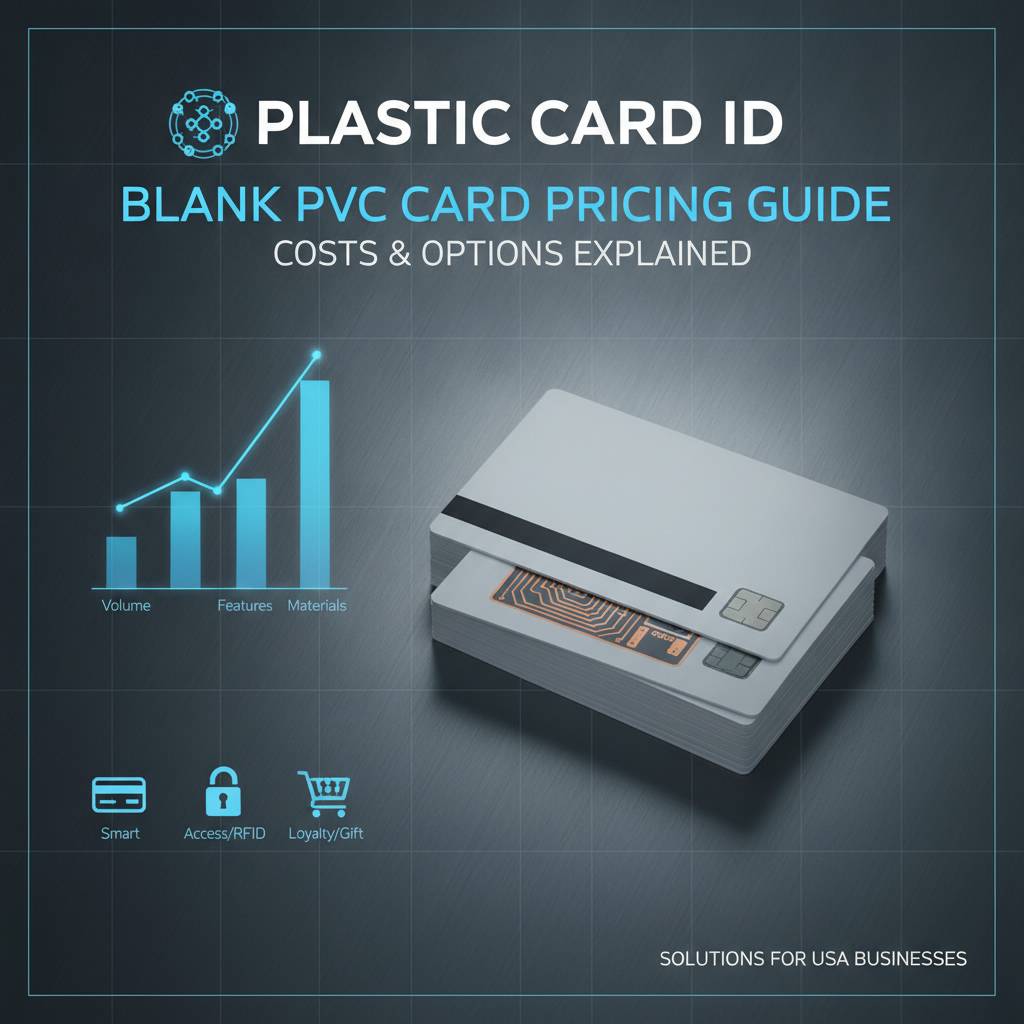 Here's something most buyers discover too late: card pricing isn't a single variable - it's a formula. The final per-card cost reflects a combination of card type, quantity, encoding features, and fulfillment requirements. Strip away the complexity and you'll find a handful of factors that reliably explain most of the price spread you'll see across vendors.
Volume is the single biggest lever. Order 100 cards and you'll pay a dramatically different per-unit rate than a buyer ordering 10,000 of the same card. This isn't padding - it reflects real fixed costs in packaging, order processing, and inventory. Understanding that dynamic is step one in building an accurate program budget.
Card Substrate and Material Grade
Standard blank CR80 PVC cards - 30 mil thick, conforming to ISO 7810 - are the most affordable option and also the most versatile. These workhorse cards handle dye-sublimation and direct-to-card printing without complaint, making them the default choice for employee badges, event credentials, and loyalty programs printed in-house.
Composite cards (PVC/polyester blends) cost more - sometimes 30-60% more per card - but they hold up to higher-temperature retransfer printing and last significantly longer in heavy daily-use environments. For high-security ID programs or campus systems with demanding print quality requirements, that premium often pays for itself.
Quantity Tiers and Volume Breaks
Pricing tiers aren't arbitrary. They exist because manufacturing, packaging, and shipping all have fixed cost components that get distributed across more cards as quantities increase. Buying in larger quantities remains one of the fastest ways to reduce your per-card cost without changing a single other variable.
A practical example: a buyer ordering 500 blank white PVC cards might pay $0.22 per card. That same buyer ordering 5,000 cards could see the price drop to $0.10-$0.12 per card. Over a year-long program that burns through 5,000 cards, that difference adds up to real money - often hundreds of dollars in savings for identical cards.
Encoding Features That Affect Pricing
A blank white PVC card is priced at one level. Add a magnetic stripe - HiCo (high coercivity) or LoCo (low coercivity) - and the price steps up. Add an embedded RFID chip or a contact smart chip, and the price steps up again. Each encoding layer adds both material cost and manufacturing complexity.
HiCo magnetic stripe cards are preferred for most loyalty and membership applications because the stripe resists accidental erasure from proximity to other magnets. LoCo cards cost slightly less and work fine for hotel key applications with shorter lifespans. Understanding which encoding you actually need prevents paying for features your system won't use.
Blank CR80 Cards: The Backbone of In-House Card Programs
If there's a single card type that deserves its own dedicated section, it's the standard blank CR80. This is the card that powers more ID programs, loyalty systems, and membership applications in the United States than any other format. At standard credit card dimensions - 3.375 x 2.125 inches - and 30 mil thickness, it works with every major card printer on the market.
The economic logic is compelling. Organizations that print cards in-house using blank stock gain complete design control, eliminate minimum order requirements for custom-printed cards, and drive down long-term per-card costs considerably. For any operation issuing 50 or more cards per month, the math almost always favors an in-house printing setup over ordering pre-printed cards.
White Gloss vs. Matte Finish Blanks
Standard blank PVC cards come in either glossy or matte finishes, and the choice matters more than many buyers expect. Glossy cards produce vivid, high-contrast prints with sharp photo reproduction - ideal for ID badges where portrait photos need to look professional. Matte-finish blanks reduce glare and fingerprint visibility, which is often preferred for cards that will be handled frequently throughout the day.
Pricing between gloss and matte is typically minimal - often within $0.01-$0.03 per card at comparable quantities. The decision should be driven purely by the intended use and the look of the finished card, not by cost considerations.
CR80 Thickness Options and Why 30 Mil Is Standard
While 30 mil is the ISO standard and by far the most widely used thickness, thinner cards (10 mil, 20 mil) do exist and serve specific purposes - primarily as overlaminates or insert cards for mailers. For any card that needs to live in a wallet or cardholder, 30 mil is the correct specification and what CPE stocks in bulk for fast turnaround.
Occasionally buyers ask about 40 mil cards for extra rigidity. These exist but are far less commonly stocked, typically require special orders, and add per-card cost without meaningful functional benefit for most standard card programs. Unless there's a specific application requirement, stick with 30 mil.
Blank Cards for Color-Coded Systems
Colored stock PVC cards - available in red, blue, green, yellow, black, and other common colors - serve a purpose that white blanks can't easily replicate: instant visual differentiation without printing a single character. Department color-coding, access tier identification, event day-pass systems - these all benefit from a card whose color itself carries information.
Colored blank cards typically price slightly above white blanks, generally in the $0.15-$0.45 range depending on color and quantity. They're fully compatible with card printers for overprinting names, codes, or barcodes on top of the colored substrate, giving programs a clean, organized look that staff can process at a glance.
Magnetic Stripe, RFID, and Smart Card Pricing Explained
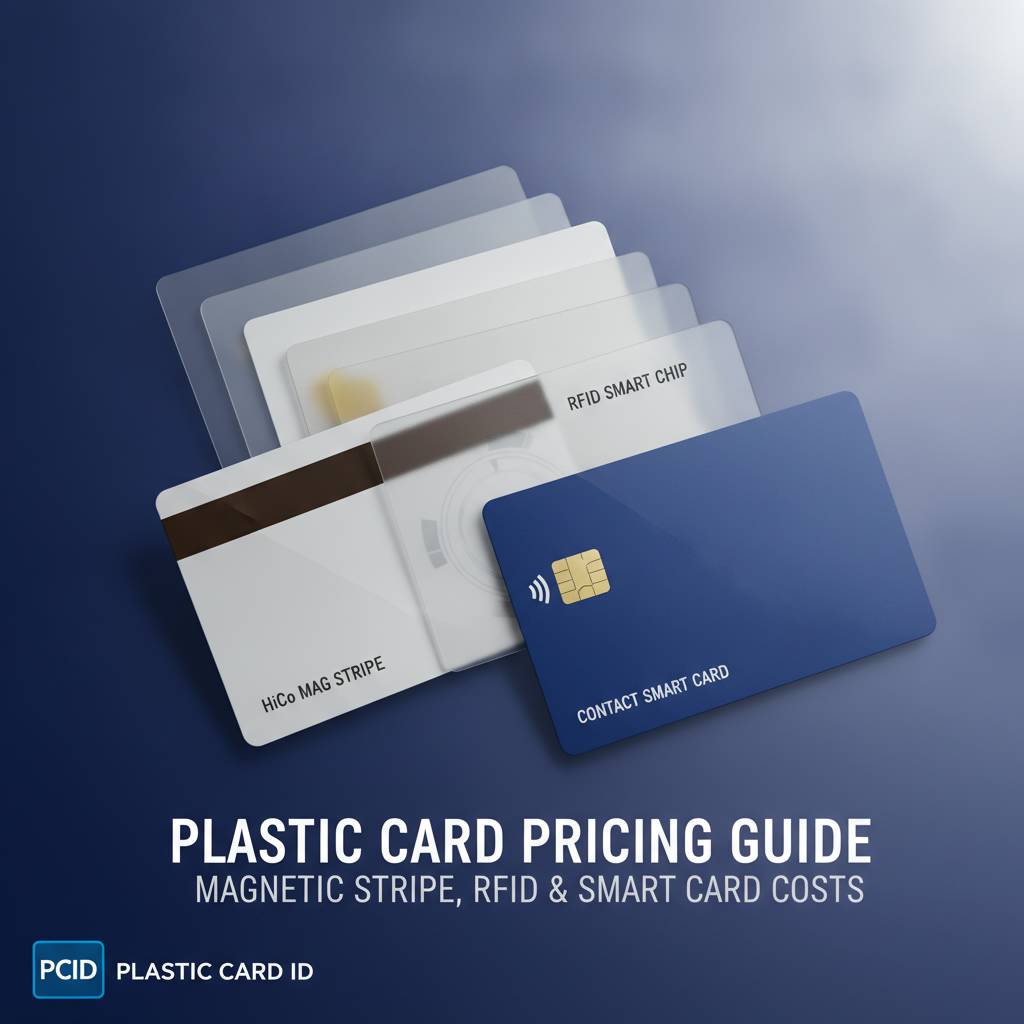 Once you move beyond the standard blank PVC card, pricing complexity grows - not because vendors are being obscure, but because these cards genuinely involve more sophisticated components. Magnetic stripe cards, proximity cards, RFID smart cards, and chip cards each represent a different tier of functionality and cost. Here's how to think about each one.
The key buying principle: match the card technology to the actual system requirements. Overpaying for MIFARE DESFire encryption on a basic employee time-clock application wastes budget. Underbying with LoCo mag stripe cards for a high-security access system creates problems. Right-spec the card and your pricing stays rational.
Magnetic Stripe Cards: HiCo vs. LoCo
HiCo magnetic stripe cards operate at 2750 Oersteds and resist accidental erasure from everyday magnetic fields - other cards, phone speakers, magnetic closures on bags. For loyalty cards, membership cards, gift card programs, and any card expected to survive a year or more of wallet life, HiCo is the appropriate specification.
LoCo cards operate at 300 Oersteds and cost slightly less - typically $0.05-$0.10 less per card depending on quantity. They're used primarily in hotel key card applications where the card lifespan is measured in days, not years. Choosing HiCo over LoCo for long-life programs prevents customer frustration from cards that demagnetize in normal use.
Proximity and RFID Cards
Proximity cards (125 kHz) are the classic contactless access card - affordable, widely compatible with legacy access control readers, and available in standard CR80 format. They price in the $0.85-$2.00 range at typical quantities and represent a solid, cost-effective solution for door access in office buildings, warehouses, and multi-tenant facilities.
RFID smart cards operating at 13.56 MHz - including MIFARE Classic, MIFARE DESFire EV1 and EV2 - offer higher security and greater data capacity. These are the cards used in sophisticated access control systems, campus ID programs, and casino player tracking applications. Pricing runs $1.50-$3.50 per card depending on chip type and quantity ordered.
Smart Chip and Combo Cards
Contact smart chip cards carry an embedded microprocessor that communicates via a gold contact pad visible on the card face. They're used in secure identification systems, transit applications, and campus programs requiring cryptographic authentication. Combo cards - combining a contact chip with a magnetic stripe or contactless chip - provide maximum compatibility but also carry the highest per-card costs in the non-metal card range.
For organizations evaluating smart card programs, the total cost of ownership equation must include reader hardware, software licensing, and card management systems - not just the per-card price. CPE can help buyers think through the full picture, not just the card purchase, to ensure program investments make sense at scale.
| Quantity Ordered | Est. Price/Card (Blank White PVC) | Est. Total Cost |
|---|---|---|
| 100 | $0.22-$0.25 | $22-$25 |
| 500 | $0.15-$0.20 | $75-$100 |
| 1,000 | $0.12-$0.16 | $120-$160 |
| 5,000 | $0.09-$0.12 | $450-$600 |
| 10,000 | $0.08-$0.10 | $800-$1,000 |
Specialty Cards: Clear, Frosted, Metal, and Custom Formats
Standard white PVC solves most problems. But there's a category of card programs where standard simply isn't enough - where the card itself needs to communicate premium value, exclusivity, or brand sophistication before a single word is printed on it. That's where specialty card formats earn their higher price points.
Clear plastic cards, frosted translucent cards, custom die-cut shapes, and luxury metal cards each serve distinct positioning purposes. They cost more. They're also memorable in ways that white PVC simply can't be - and for VIP programs, high-value loyalty tiers, and premium membership organizations, that memorability translates directly into perceived value and retention.
Clear and Frosted PVC Cards
Clear cards offer a see-through substrate that creates striking visual effects when printed - colors appear to float, logos gain dimension, and the overall impression is unmistakably premium. Frosted cards provide a soft, matte translucency that photographs beautifully and feels different in hand - a tactile signal of quality that recipients notice immediately.
Clear and frosted PVC cards price in the $0.35-$0.90 range per card at typical quantities. They're compatible with standard card printers but benefit from careful ink calibration - the transparent substrate behaves differently than opaque white stock. CPE stocks both formats and can advise on printer settings to achieve optimal results.
Luxury Metal Cards
Stainless steel, brass, and gold-plated metal cards occupy the premium tier of the card market and carry pricing to match - typically $3.50-$12.00 per card depending on material, finish, and customization. The weight alone communicates something that plastic cannot. A metal membership card handed to a new VIP member lands differently than any paper or plastic alternative - it signals permanence, exclusivity, and serious investment in the relationship.
Metal cards find their strongest use cases in luxury retail VIP programs, exclusive club memberships, high-net-worth financial advisory firms, and casino premium player programs. At per-card costs of $5.00-$10.00, they're not for mass distribution - but for the right program, the impact per card dollar spent is difficult to match with any other format.
Casino Player Cards and Hotel Key Cards
Casino player tracking cards represent a specialized category where card durability, encoding precision, and volume pricing all intersect. These cards must survive repeated handling, constant insertion into readers, and exposure to environments that stress standard PVC. Composite materials and carefully specified magnetic stripe coercivity ensure program continuity without card failure.
Hotel key cards operate on a different model - short lifespan by design, LoCo magnetic stripe or RFID, and high volume. Properties issuing thousands of keys per month benefit significantly from strategic volume purchasing and consistent card specifications that work reliably with their locking system hardware.
Card Printers and Supplies: The Other Half of Your Cost Model
Blank card pricing is only one component of the total program cost equation. For organizations printing cards in-house, the printer, ribbons, and consumables represent a parallel cost stream that deserves equal attention. Choosing the wrong printer or underestimating ribbon costs can erode the savings that blank card purchasing was supposed to deliver.

Plastic Card ID carries a full lineup of card printers from Evolis, Zebra, and Fargo - three of the most trusted names in the ID card printing industry. Each brand offers models suited to different volume requirements, print quality needs, and budget ranges, from compact desktop units handling 50-100 cards per month up to high-throughput systems built for mass production.
Printer Selection and Volume Matching
Matching printer capacity to actual monthly card volume is critical - and commonly overlooked. A printer rated for 200 cards per day operated at 10 cards per day is not a bargain; it's capital poorly deployed. Conversely, running a low-end printer at continuous high volume shortens its lifespan and increases per-card maintenance costs dramatically.
The right printer match considers monthly card volume, print resolution requirements, one-sided vs. dual-sided printing needs, and encoding requirements - magnetic stripe, smart card, or RFID encoding modules can be added to compatible printer models, avoiding the need to buy a separate encoder. Call 800.835.7919 to discuss which printer configuration matches your specific program requirements.
Ribbons, Cleaning Kits, and Consumable Costs
Ribbon cost per print is a figure that many new card program managers underestimate. A full-color YMCKO ribbon producing 200-250 prints costs roughly $0.10-$0.25 per card in consumables alone - which must be factored into total per-card program cost alongside the blank card price itself. Buying ribbons in multi-pack quantities reduces per-ribbon cost and ensures your program doesn't stall waiting on resupply.
Cleaning kits are not optional accessories - they're maintenance requirements. Dust contamination in card printers produces visible print defects and, over time, printhead damage that voids warranties and triggers expensive repairs. A $15-$25 cleaning kit used on schedule costs far less than a printhead replacement running $150-$400. CPE stocks cleaning kits for all supported printer brands.
Card Carriers, Sleeves, and Mailing Services
For organizations distributing cards by mail - membership renewals, loyalty program enrollments, ID card replacements - card carriers, sleeves, and professional card mailing services add real value. A bare card mailed in a plain envelope conveys none of the brand quality that a card in a branded carrier with a welcome insert delivers. First impressions of a card program happen at the mailbox, not just at the point of use.
Plastic Card ID offers card affixing and mailing services that handle the entire fulfillment chain - cards affixed to carriers, inserted into mailers, and dispatched to your member or customer list. This service eliminates the in-house labor burden of card mailing operations and ensures consistent, professional presentation at every distribution point.
Frequently Asked Questions About Blank Plastic Card Pricing
After working with over 100,000 customers across 25-plus years, certain questions come up with remarkable consistency. The answers below address the most common pricing concerns buyers raise before and during their first card program purchase.
What Is the Minimum Order Quantity?
CPE serves programs of all sizes - from small organizations ordering 50 cards per month to enterprises running tens of thousands. There is no prohibitive minimum that locks out smaller buyers, though volume pricing tiers do reward larger orders with meaningfully lower per-card costs as illustrated in the table above.
Small organizations just launching a card program often benefit from starting with a modest quantity to test printer performance and card design before committing to a large stock purchase. Plastic Card ID supports that approach and can help you scale quantities as your program grows.
How Do I Calculate My Total Program Cost?
- Blank card cost: Per-card price multiplied by monthly volume and projection period
- Printer amortization: Printer purchase price divided across expected card volume over printer lifespan
- Ribbon and consumable costs: Per-print ribbon cost plus cleaning supplies on a maintenance schedule
- Fulfillment costs: Card carriers, sleeves, postage, and mailing service fees if distributing by mail
- Encoding costs: If purchasing pre-encoded cards (mag stripe, RFID, smart chip), factor encoding service fees
- Replacement rate: Budget for a percentage of cards issued annually as replacements for lost, damaged, or expired cards
Adding these figures together produces a true total cost of ownership for your card program - one that supports accurate budget requests and honest ROI calculations. Programs that skip this full-cost analysis often underestimate their actual spend by 20-40% in the first year.
Does Switching from Paper to Plastic Really Pay Off?
The data on this question is consistent: retailers switching from paper gift certificates to plastic gift cards consistently report sales increases of 35-50%. Plastic loyalty cards that live in wallets produce stronger repeat purchase behavior than paper punch cards. Plastic membership and ID cards signal legitimacy and permanence that paper alternatives simply cannot replicate.
The payback period for a card program upgrade is often shorter than buyers expect. When a loyalty program generating $2,000 per month in repeat business increases by 35% after switching to plastic cards, the incremental $700 per month covers a typical card program's full annual cost in a matter of weeks - not months.
Why Plastic Card ID Is the Right Partner for Your Card Program
 Twenty-five years. Over 100,000 customers. More than 50 million cards shipped. Those numbers reflect something more meaningful than sales volume - they reflect a consistent track record of helping businesses build card programs that work, scale, and deliver measurable results. Plastic Card ID operates as a strategic partner, not just a card supplier.
The catalog spans every card type a USA-based business or organization needs - blank white PVC, colored stock, magnetic stripe in HiCo and LoCo, proximity cards, RFID smart cards including MIFARE DESFire, contact chip cards, clear and frosted PVC, custom die-cut formats, and luxury metal cards. The printer lineup from Evolis, Zebra, and Fargo ensures buyers can source cards and printing equipment from a single, accountable partner.
What Sets the Plastic Card ID Approach Apart
Most card suppliers will sell you cards. Far fewer will help you build a program. Plastic Card ID brings 25 years of program experience to every customer conversation - from first-time buyers trying to figure out where to start, to enterprise procurement managers optimizing costs on programs issuing tens of thousands of cards annually.
That experience shows up in specific, practical guidance: which card specification fits your reader hardware, which printer volume tier matches your monthly output, which ribbon yields the per-print cost your budget requires, and how to set up fulfillment so cards reach end users professionally. This is the kind of institutional knowledge that only comes from two and a half decades of real program experience - and it's available to every customer who calls or places an order.
Serving All 50 States for Card Programs of Every Scale
Plastic Card ID ships to businesses and organizations across all 50 states, supporting card programs ranging from small nonprofits issuing 50 member cards per month to large retailers operating loyalty programs in the thousands of locations. The same quality standards, product specifications, and service commitment apply regardless of order size.
Whether your program needs a single case of blank white CR80 cards or a recurring supply agreement for HiCo magnetic stripe cards at volume, CPE can configure a purchasing arrangement that delivers consistent product, reliable lead times, and pricing that improves as your volume grows.
Get an Accurate Quote for Your Card Program Today
Pricing on blank plastic cards, magnetic stripe cards, RFID cards, and specialty formats is straightforward when you have the right information in hand. Call Plastic Card ID at 800.835.7919 to discuss your card type, monthly volume, encoding requirements, and fulfillment needs - and receive a clear, itemized quote with no surprises.
The team at CPE has helped over 100,000 customers build successful card programs across every industry and organization type in the United States. Your program deserves that same level of expertise and commitment. Reach out today and put 25 years of card program knowledge to work for your organization.
Contact Plastic Card ID now at 800.835.7919 - your complete blank plastic card pricing guide starts with a conversation, and the right card program is closer than you think.
Previous Page