CR80 Card Size Standard Guide: Dimensions and Uses
Table of Contents []
- CR80 Card Size Standard Guide: Everything You Need to Know - Plastic Card ID
- What Is the CR80 Standard and Why Does It Matter
- Blank CR80 Cards: The Workhorse of In-House Card Programs
- Magnetic Stripe Cards in CR80 Format: HiCo vs. LoCo
- RFID, Proximity, and Smart Chip Cards in CR80 Format
- Card Printers That Work With CR80 Cards
- Specialty CR80 Card Options for Distinctive Programs
- Why Businesses Across the USA Choose Plastic Card ID
CR80 Card Size Standard Guide: Everything You Need to Know - Plastic Card ID
Pull a card out of your wallet right now. That rectangle of plastic you're holding - whether it's an ID badge, a loyalty card, or a membership credential - almost certainly follows one precise specification. The CR80 card size standard is the backbone of virtually every card program in existence, and understanding it unlocks your ability to design, print, and deploy cards that work seamlessly across printers, card readers, wallets, and cardholder systems worldwide.
This guide covers everything - dimensions, tolerances, material standards, printer compatibility, use cases, and buying decisions - so you walk away equipped to run a smarter card program. Whether you're sourcing 500 cards a month or scaling to tens of thousands, the specifications you'll learn here are the foundation everything else is built on.
| Specification | Measurement | Notes |
|---|---|---|
| Width | 3.375 inches / 85.6mm | ISO 7810 ID-1 compliant |
| Height | 2.125 inches / 53.98mm | ISO 7810 ID-1 compliant |
| Thickness | 30 mil / 0.76mm | Standard PVC thickness |
| Corner Radius | 3.18mm | Rounded per ISO standard |
| Material | PVC (standard) | Also available in composite PVC |
| Color | White, Clear, Frosted, Custom | Stock and custom options available |
What Is the CR80 Standard and Why Does It Matter
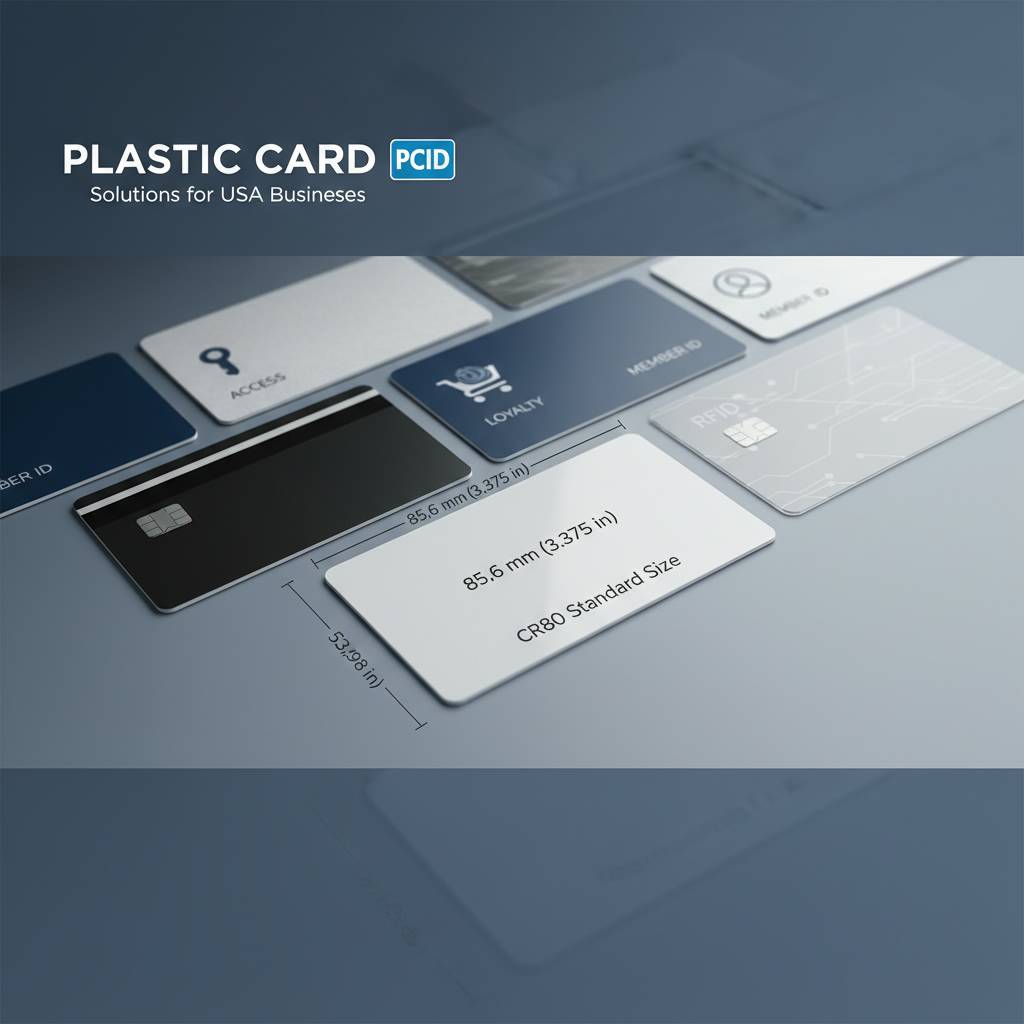 The CR80 designation refers to the card size defined by the ISO 7810 ID-1 specification - a globally recognized standard that sets exact dimensions for identification cards. At 3.375 inches wide by 2.125 inches tall and 30 mil thick, this format is deliberately engineered to fit standard wallets, card slots, and automatic processing equipment. When your card conforms to CR80, it fits everywhere it needs to fit.
That consistency is not a coincidence. Industries ranging from healthcare and hospitality to retail and corporate security all depend on the same card footprint to keep their card readers, printers, and badge holders compatible. Deviating from the standard - even slightly - can cause feeding errors, reading failures, or card jam issues in automated systems. Understanding the standard is not optional for serious card program managers; it is prerequisite knowledge.
The ISO 7810 Connection
ISO 7810 is the international standard that governs identification card physical characteristics. The CR80 form factor corresponds directly to the ISO 7810 ID-1 specification - the same format used globally for bank cards, driver's licenses, and corporate IDs. This alignment means a card produced to CR80 specifications in the United States is physically interchangeable with card systems designed in Europe or Asia.
For USA businesses, this global compatibility provides future-proofing. If your organization ever deploys international access control systems, integrates multinational software platforms, or sources card printers from global manufacturers, your CR80 cards slot in without modification. Compliance with ISO 7810 is not bureaucracy - it is practical engineering wisdom.
The 30 Mil Thickness Standard
Thirty mil - that is 0.76 millimeters - is the standard thickness for CR80 cards and is critically important for mechanical compatibility. Card printers from Evolis, Zebra, and Fargo are calibrated to accept 30 mil cards through their rollers and print heads. Feeding cards that are too thin or too thick results in mis-feeds, jams, and potential hardware damage.
Beyond printer compatibility, 30 mil thickness provides the rigid, premium feel that communicates professionalism. Handed a flimsy card versus a properly thick CR80, anyone can feel the difference. That tactile quality affects how recipients perceive your brand and your organization's credibility - and it matters more than many card program managers initially expect.
Tolerance Specifications You Should Know
Manufacturing tolerances for CR80 cards are tight - typically plus or minus 0.08mm on dimensions. This precision ensures consistent feeding through card printers and reliable reading by magnetic stripe and RFID readers. Cards that fall outside tolerance ranges can cause equipment problems that accumulate into costly downtime, especially in high-volume printing environments.
CPE supplies cards manufactured to these tight tolerances as a baseline quality expectation - not an upgrade. Every card in the catalog meets the dimensional specifications that your equipment was designed to accept, which is why organizations running continuous card production programs trust the consistency they receive with every order.
Blank CR80 Cards: The Workhorse of In-House Card Programs
A blank CR80 card is one of the most versatile raw materials a business can stock. It is a canvas waiting to become anything - an employee ID badge, an event credential, a loyalty reward card, a membership card, or an access token. The blank card gives your organization total design control, letting you update artwork, add personalization, or shift card purpose entirely without committing to a large pre-printed run.
Organizations that invest in a card printer and a supply of blank CR80 cards fundamentally change their card economics. The per-card cost drops significantly compared to outsourcing every print job. More importantly, the turnaround drops from days or weeks to minutes - critical when you need to badge a new hire on their first morning or issue replacement cards on the spot.
Card Stock Color and Finish Options
The standard blank CR80 comes in bright white - the most common choice because it provides the cleanest backdrop for full-color dye-sublimation printing. White cards reproduce vivid photography, sharp text, and accurate logo colors. If your card design includes a white background, printing on white stock is far more efficient than trying to print white ink on a colored card.
Beyond white, options include clear PVC, frosted translucent, and a range of pre-colored stock cards in yellow, red, blue, green, and other colors. CPE stocks these variations because different program types genuinely benefit from starting with a non-white card. A clear card, for instance, creates a distinctive premium look - you see through to the cardholder or lanyard behind it, which makes for memorable event credentials and VIP access cards.
Comparing 30 Mil vs. 20 Mil Card Thickness
Some applications call for thinner cards - typically 20 mil - which are used in specific printer models or for applications like paper-composite student IDs. However, 30 mil is the standard that most card printers are factory-set to handle, and it should be your default choice unless your printer manufacturer specifically recommends otherwise.
Thinner cards can flex, warp, or damage more easily in daily use. For any card that will be handled repeatedly - swiped through readers, slid in and out of badge holders, carried in wallets - the 30 mil standard provides the durability that keeps cards functional over their intended service life. The cost difference between 20 mil and 30 mil cards is minimal; the performance difference in practice is not.
How Blank Cards Reduce Program Cost Over Time
The math on blank cards becomes compelling once you factor in the full picture. Pre-printed custom cards require minimum order quantities, lead times, and up-front design costs. Every time your design changes - a new logo, an updated address, a different color scheme - you may be sitting on obsolete card inventory. Blank cards eliminate that waste entirely.
Organizations printing 50-500 cards per month typically find that an in-house card printer pays for itself within the first year. Ongoing costs shift almost entirely to consumables - ribbons, cleaning kits, and blank card stock - which are predictable and manageable. The economics of blank CR80 cards favor organizations that want control over both quality and cost.
| Card Type | Technology | Best For |
|---|---|---|
| Blank PVC | None | In-house printing, loyalty, membership |
| HiCo Magnetic Stripe | High coercivity mag stripe | Gift cards, access control, loyalty |
| LoCo Magnetic Stripe | Low coercivity mag stripe | Hotel keys, short-term access |
| Proximity / RFID | 125kHz contactless | Building access, time and attendance |
| Smart Chip / MIFARE | 13.56MHz contactless | Secure access, campus IDs, casino cards |
| Clear / Frosted | Visual / printed | VIP credentials, premium branding |
Magnetic Stripe Cards in CR80 Format: HiCo vs. LoCo
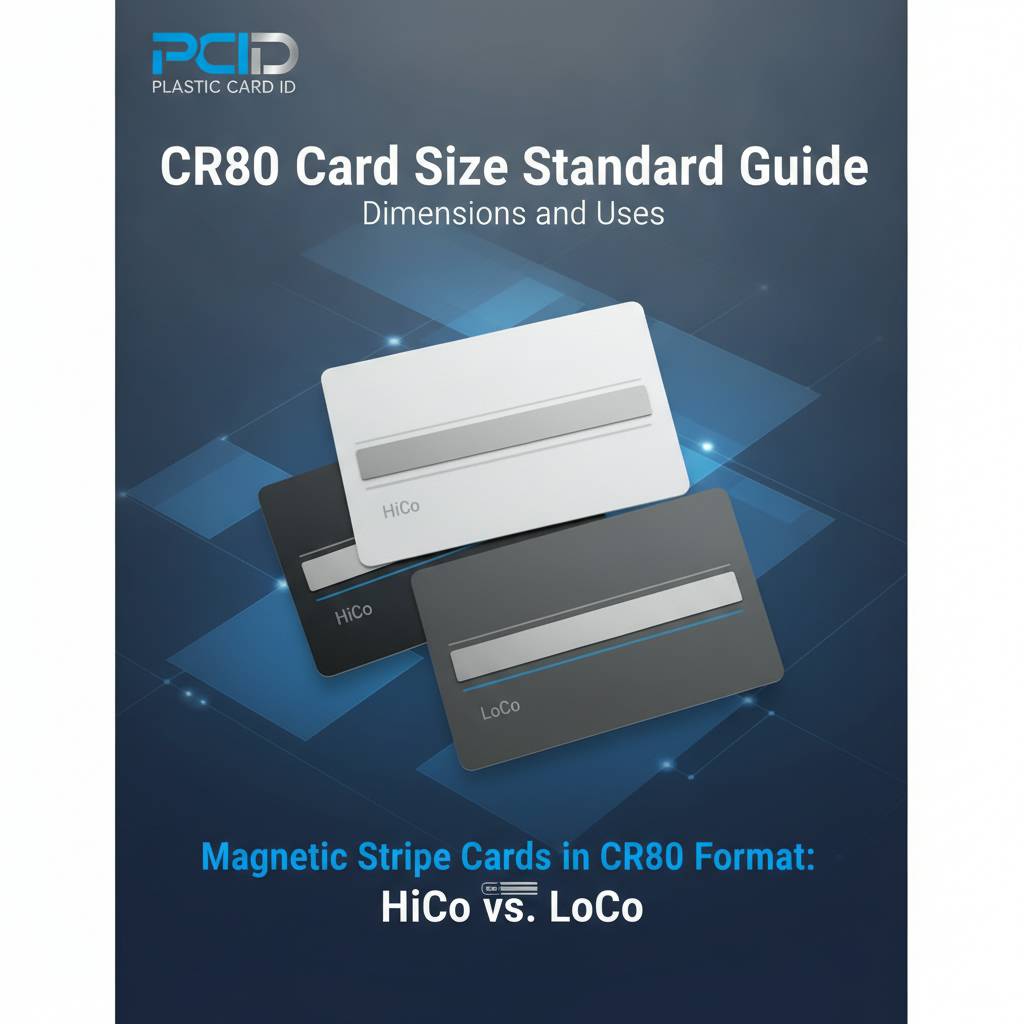 Adding a magnetic stripe to a CR80 card transforms it from a printed visual identifier into a functional data-carrying credential. The stripe - that dark band running across the back of the card - can store encoded information that card readers interpret in milliseconds. Magnetic stripe cards in CR80 format are used across gift card programs, access control systems, time-and-attendance tracking, and loyalty platforms throughout the USA.
The key decision when selecting magnetic stripe cards is coercivity - the measure of how resistant the stripe is to erasure by external magnetic fields. This single specification determines whether your cards maintain their encoded data reliably in real-world conditions, and choosing the wrong type can result in cards that demagnetize prematurely in the field.
High Coercivity (HiCo) Cards
High coercivity magnetic stripe cards - rated at 2750 oersteds - are significantly more resistant to accidental demagnetization than their LoCo counterparts. This makes them the correct choice for any card that will be used repeatedly over an extended period, carried alongside other magnetic items, or subjected to the magnetic fields found near electronics and security equipment.
Gift card programs, loyalty cards, employee access badges, and long-term membership cards should all use HiCo magnetic stripe cards as a baseline. The slight additional cost over LoCo cards is offset many times over by reduced card failure rates and the customer service headaches that come with having to replace demagnetized cards. HiCo is the professional standard for long-lived card programs.
Low Coercivity (LoCo) Cards and Their Role
Low coercivity magnetic stripe cards - rated at 300 oersteds - are easier to encode and perfectly adequate for short-duration applications where the card will be used briefly and then discarded or deactivated. The classic example is the hotel key card, which needs to function for a few nights and is then reprogrammed for the next guest. LoCo cards are also common for temporary event credentials and short-term locker access.
It is worth noting that LoCo cards are not inferior across all categories - they are purpose-built for short-term use cases where high resistance to demagnetization is unnecessary. Using expensive HiCo cards for hotel keys that get overwritten every few days is not better engineering; it is simply wasteful. Match the coercivity specification to the actual service life of the card in your specific program.
Encoding and Printer Compatibility
Not every card printer includes a magnetic stripe encoder. When building or upgrading a card program that relies on magnetic stripe technology, verifying that your printer model includes encoding capability - or can accept an encoding module - is critical. Evolis, Zebra, and Fargo all offer printer models with integrated HiCo/LoCo encoding options, but these are typically specified at time of purchase.
Contact 800.835.7919 to confirm which printer models in the current lineup include magnetic stripe encoding, and which blank CR80 magnetic stripe cards are compatible with your existing equipment. Matching the right card stock to the right printer ensures that every card you produce is encoded cleanly the first time, every time.
RFID, Proximity, and Smart Chip Cards in CR80 Format
The CR80 form factor does not just carry printed information and magnetic stripes - it houses sophisticated embedded technology that enables contactless communication between card and reader. Proximity cards, RFID smart cards, and chip-based credentials all share the familiar CR80 dimensions while containing embedded antennas and integrated circuits that communicate wirelessly. This technology combination - standard form factor with advanced internal functionality - is what powers modern access control and identification systems.
Understanding the differences between these technologies matters because they are not interchangeable. Deploying the wrong card technology for your reader infrastructure means your cards simply will not work - and discovering that after purchasing a large quantity is an expensive lesson. The following breakdowns clarify which technology fits which application.
Proximity Cards at 125kHz
Proximity cards operate at 125kHz and are the most widely deployed contactless card technology in commercial building access control systems across the United States. They communicate with compatible readers at distances of a few inches - typically by tapping or hovering the card near the reader panel. The communication is passive: no battery required, no user interaction beyond presenting the card.
Common proximity card formats include HID Prox and EM4100 - specifications that must match your reader infrastructure. These cards are used extensively in office buildings, parking facilities, manufacturing floors, and any environment requiring controlled access without the friction of key management. Proximity cards in CR80 format are durable, wallet-friendly, and work reliably for years in continuous access control applications.
Smart Chip Cards: MIFARE and DESFire
Smart chip cards operate at 13.56MHz and offer significantly higher data storage capacity and security compared to proximity cards. MIFARE Classic, MIFARE DESFire, and other smart card standards support encrypted communication, multi-application use, and advanced security features that 125kHz proximity technology cannot provide. These cards are the appropriate choice for campus ID programs, casino player cards, healthcare facility access, and any application where security depth matters.
MIFARE DESFire specifically is regarded as one of the most secure contactless card technologies available for commercial applications. Its AES encryption makes unauthorized data interception or card cloning extremely difficult. For organizations managing sensitive access environments - data centers, research facilities, financial institutions - MIFARE DESFire smart cards deliver enterprise-grade security in a standard CR80 package.
Choosing the Right Contactless Technology
- 125kHz Proximity: Best for standard building access, time and attendance, parking control - widely compatible with existing commercial readers.
- 13.56MHz MIFARE Classic: Higher storage, moderate security - good for campus programs, loyalty systems with stored value, and multi-application IDs.
- 13.56MHz MIFARE DESFire: Advanced encryption, highest security - appropriate for government, healthcare, financial, and casino environments.
- Dual-frequency cards: Contain both 125kHz and 13.56MHz technology - ideal for organizations transitioning between access control platforms without replacing reader infrastructure.
- Combo cards (mag stripe RFID): Combine magnetic stripe and contactless technology on a single CR80 card - reduce the number of cards employees must carry.
Ready to find the right contactless card technology for your program? Call CPE today and speak with someone who knows these specifications inside and out.
Card Printers That Work With CR80 Cards
A blank CR80 card only becomes a finished credential when it passes through a card printer. The printer you select determines print quality, throughput speed, encoding capabilities, and total cost of ownership over the life of the printer. Matching your printer to your card volume and feature requirements is as important as choosing the right card stock.
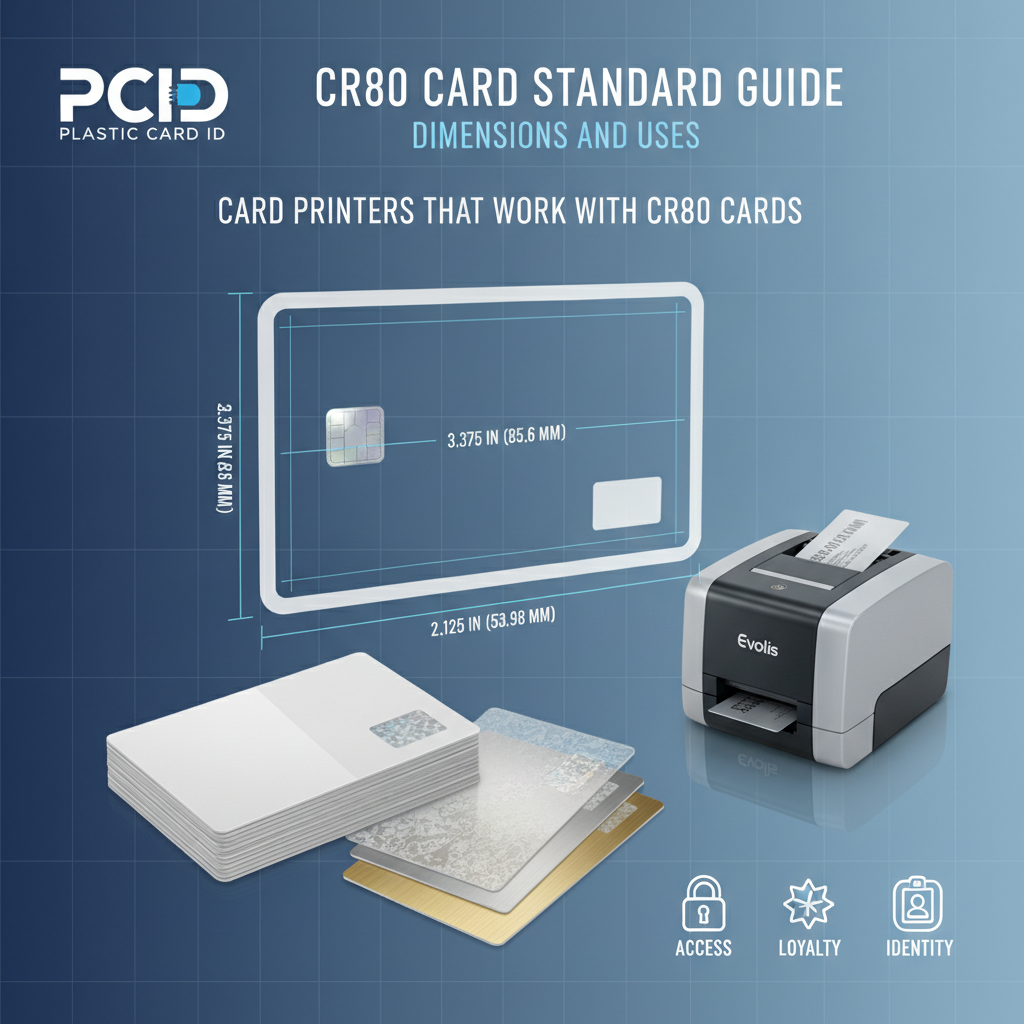
Three manufacturers dominate the commercial card printer market for USA businesses: Evolis, Zebra, and Fargo. Each offers a range of models targeting different volume tiers and feature sets - from compact desktop printers for low-volume in-house programs to high-throughput models designed for mass credential issuance. CPE carries models across all three brands, enabling customers to choose the right tool for their exact program scale.
Desktop Printers for Small to Mid-Volume Programs
Organizations printing 50-500 cards per month typically find a desktop single-sided or dual-sided printer fits their needs without overcapitalizing. Models like the Evolis Primacy and Zebra ZC300 series deliver professional-quality dye-sublimation printing on CR80 cards at speeds ranging from 150 to 500 cards per hour - more than adequate for daily batch printing or on-demand issuance.
Desktop printers occupy minimal counter space, connect via USB or network, and use ribbon cartridges that are straightforward to replace. For most small business, nonprofit, and mid-size organization card programs, a well-chosen desktop card printer is the only equipment investment needed to run a complete in-house credentialing operation.
High-Volume Printers for Large Programs
When card volumes climb into the thousands per week, high-throughput models with input hoppers holding 200 cards, automated duplex printing, and inline encoding modules become the appropriate tools. Fargo's HDP series and Zebra's ZXP Series 9 are examples of printers engineered for sustained high-volume output without sacrificing print quality or card encoding reliability.
High-volume printers also support lamination modules - an overlay that protects printed card surfaces from wear, UV fading, and tampering. For employee ID programs, student cards, or any credential that will see years of daily handling, lamination extends card lifespan considerably and maintains a professional appearance throughout the card's service life.
Printer Ribbons, Cleaning Kits, and Supplies
A card printer is only as good as the consumables feeding it. Using inferior or incompatible ribbon cartridges causes print quality issues, head wear, and potentially voids the printer warranty. CPE stocks OEM and compatible ribbon cartridges for every printer brand in its lineup - YMCKO full-color ribbons, monochrome black ribbons for text-only applications, and specialty overlaminates for enhanced card protection.
Cleaning kits - cards and swabs specifically designed to clean printer rollers and print heads - are a maintenance item many organizations overlook until problems arise. A regular cleaning cycle, typically every 1,000-2,000 cards printed, removes debris and adhesive buildup that degrades print quality and shortens print head life. Preventive maintenance through proper cleaning pays back in print consistency and reduced equipment repair costs.
Specialty CR80 Card Options for Distinctive Programs
Standard white PVC CR80 cards serve the vast majority of card programs effectively. But certain applications call for something that stands apart - visually, tactilely, or in terms of the statement a card makes when it is handed to someone. CPE catalogs a range of specialty card options that share the CR80 form factor but deliver distinctly different experiences.
Choosing a specialty card is not about aesthetics alone. The right specialty card can directly influence program outcomes. Retailers switching from paper gift cards to plastic CR80 gift cards - including clear or premium-finish options - have documented sales increases of 35-50%. That is not a coincidence; it is the psychology of perceived value at work. When a card feels substantial and looks exceptional, it gets kept, used, and shared.
Clear and Frosted Plastic Cards
Clear PVC cards are printed on transparent stock - any unprinted area of the card remains see-through. This creates a premium, distinctive appearance that immediately sets a card apart in a wallet or badge holder. Frosted cards offer a softer translucent effect - less stark than clear, with a matte quality that many brands find more sophisticated than either glossy white or fully transparent.
Both options work with standard CR80 card printers, though some print variables may need adjustment to account for the absence of a white base layer. Clear and frosted cards are particularly effective for VIP credentials, exclusive membership programs, event lanyards, and premium gift card programs where the card itself is part of the brand experience you are delivering.
Luxury Metal Cards in Stainless Steel, Brass, and Gold
At the apex of the card quality spectrum sit metal cards - stainless steel, brass, and gold-finish options that share the CR80 footprint but communicate a level of exclusivity that plastic cannot replicate. The weight and sound of a metal card landing on a table is unmistakable. These cards are used in elite loyalty programs, executive membership applications, and high-value customer recognition programs where the card itself is a statement of status.
Metal cards are not appropriate for every program - they are a deliberate choice for contexts where the card's impact on the recipient is a strategic objective. For casino high-roller programs, premium club memberships, and corporate executive credentials, the investment in metal cards delivers returns in member retention and perceived program value that standard plastic cannot match.
Custom Die-Cut Shapes and Special Formats
While the CR80 rectangle is universal, some programs benefit from custom die-cut card shapes that break the standard silhouette. Key fob cards, mini cards at half the CR80 footprint, and custom-shaped credentials cut to match a logo or brand icon are all options for organizations seeking maximum visual impact in their card programs. These formats retain standard PVC material and thickness while departing from the rectangular norm.
Key fob format cards are particularly popular for loyalty and membership programs targeting customers who prefer not to carry wallet cards. The fob attaches to a keyring, keeping your brand visible and your card scannable every time the cardholder uses their keys. Meeting your cardholders where they are - literally - improves card retention rates and keeps your program top of mind.
Why Businesses Across the USA Choose Plastic Card ID
 More than 100,000 customers and 50 million cards sold are not vanity metrics - they reflect the confidence that USA organizations place in a supplier that understands card programs at every scale. From the small nonprofit running a 50-card monthly membership program to the regional retailer deploying tens of thousands of gift cards seasonally, Plastic Card ID has built its reputation by treating every client as a strategic partner rather than a transaction.
That partnership orientation means clients receive guidance - not just product. When you call to discuss a card program, you are speaking with people who have helped solve card program challenges across industries, volumes, and technology platforms. The catalog depth, the in-stock reliability, and the fulfillment services including card affixing and mailing all exist because CPE understands that running a card program involves more than just choosing a card type.
One-Stop Card Program Supply
The full catalog spans every element a card program requires: blank and pre-encoded CR80 cards in every stock variation, card printers from three leading manufacturers, printer ribbons and cleaning supplies, card carriers, sleeves, and badge holders, and mailing fulfillment services for organizations that need cards delivered directly to cardholders. This breadth matters operationally - sourcing from a single supplier simplifies procurement, ensures compatibility across product categories, and consolidates customer service into one relationship.
Organizations that have previously managed three or four supplier relationships to cover their card program needs consistently report that consolidating with CPE reduces administrative overhead and simplifies reordering significantly. When your card stock, printer ribbons, and cleaning kits all arrive from the same trusted source, the operational friction of running a card program drops to nearly zero.
Serving Programs of Every Scale
Card program scale varies enormously across the customer base, and CPE has built its inventory and fulfillment model to serve the full range effectively. A boutique fitness studio ordering 100 membership cards per month and a regional hotel group ordering 50,000 key cards receive the same attention to specification accuracy and fulfillment reliability. Minimum order requirements are structured to allow smaller organizations to access quality card stock without being forced into unnecessarily large commitments.
For programs that grow - and well-run card programs do tend to grow - CPE scales with you. The same supplier relationship that serves you at 200 cards per month can accommodate you at 20,000 per month without requiring you to re-qualify, renegotiate, or rebuild a supplier relationship from scratch. Scalability within a trusted supplier relationship is one of the most underappreciated advantages of choosing the right card partner from the start.
Card Affixing, Mailing, and Fulfillment Services
Not every organization has the internal infrastructure to handle card fulfillment - affixing cards to mailers, personalizing carriers with member names, and mailing finished card packages to individual recipients. CPE offers these fulfillment services for organizations that need cards to arrive in their cardholders' hands without internal manual labor. This service is particularly valuable for loyalty program launches, membership card renewals, and gift card promotional distributions.
Card mailing fulfillment through CPE ensures that cards are handled properly throughout the process - protected from damage, correctly matched to carrier letters or mailers, and dispatched accurately. Outsourcing fulfillment to specialists who handle cards every day eliminates the errors and delays that come with improvised in-house mailing operations, and it frees your team to focus on running the program rather than stuffing envelopes.
Your card program deserves a partner who has spent over 25 years mastering every dimension of it - literally and figuratively. Reach out today and discover what Plastic Card ID can do for your organization.
Plastic Card ID is ready to help you source the right CR80 cards, printers, and supplies for your exact program needs. Call 800.835.7919 now and speak with a card program specialist who understands the specifications, the equipment, and the outcomes you are working toward. Let's build something that works.
Previous Page