Blank Clear Plastic Cards Uses: Top Applications
Table of Contents []
- What Plastic Card ID Knows About Blank Clear Plastic Cards That Most Buyers Don't
- Understanding the Blank Clear Plastic Card Format
- The Real-World Uses of Blank Clear Plastic Cards
- Blank Clear Cards in an In-House Card Program
- Industries That Rely on Blank Clear Plastic Cards
- Common Questions About Blank Clear Plastic Cards
- Why Plastic Card ID Is the Right Partner for Your Clear Card Program
What Plastic Card ID Knows About Blank Clear Plastic Cards That Most Buyers Don't
There's a moment - familiar to anyone who's ever held a truly clear plastic card up to the light - where the material does something paper simply cannot. It disappears. The design floats. Whatever is printed on it seems to exist on its own, without a substrate getting in the way. That visual effect isn't a gimmick. It's a deliberate, functional choice with real business consequences.
Blank clear plastic cards are one of the more underutilized tools in the card program world, and the reasons for that are mostly historical. Most buyers default to white PVC stock because it's familiar. But once organizations discover what a clear or frosted card base actually does for their brand - and how versatile the blank format is for in-house printing - the conversation changes fast. CPE has helped thousands of businesses make that discovery over the past 25 years.
This page is built for buyers who want to understand the full picture: what blank clear cards are, where they work, how they compare to other stock, and when they're the smartest choice in your card program. Real decisions benefit from real information.
| Feature | Clear PVC Cards | White PVC Cards | Frosted PVC Cards |
|---|---|---|---|
| Visual Transparency | Full transparency | Opaque | Semi-translucent |
| Print Compatibility | Specialized ribbon required | Standard ribbons | Specialized ribbon recommended |
| Design Impact | Floating, premium aesthetic | Classic, versatile | Soft, elegant look |
| Best Use Cases | VIP, membership, events | ID, loyalty, access | Luxury, hospitality, spa |
| CR80 Standard Compliant | Yes (30 mil) | Yes (30 mil) | Yes (30 mil) |
| Wallet-Ready Durability | High | High | High |
Understanding the Blank Clear Plastic Card Format
 A blank clear plastic card is exactly what it sounds like: a CR80-sized (3.375 x 2.125 inches), 30 mil thick card made from transparent PVC, carrying no pre-printed graphics, text, or encoding of any kind. The blank format is the starting point - the raw material that your printer, your design, and your program turn into something functional. It's a platform, not a finished product.
The transparency element is what separates this stock from standard white or colored PVC. Because the base material is see-through, any design printed on it appears without a background. Text floats. Logos pop. Color blocks become windows. This is a fundamentally different visual experience from anything achievable on opaque card stock, and for certain applications, it's not just aesthetic preference - it's a strategic differentiator.
The CR80 Standard and Why It Matters
Every blank clear card in a serious supplier's inventory conforms to the ISO 7810 ID-1 standard - commonly called CR80. This isn't incidental. CR80 compliance means the card fits standard cardholders, lanyards, badge reels, card printers, and wallets without modification. The 30 mil thickness is the global standard for plastic cards and is required for compatibility with virtually all desktop card printers.
When you buy blank clear cards, you're not buying a novelty item. You're buying a substrate engineered to the same dimensional tolerances as every other serious card on the market. That matters when you're feeding hundreds of cards through a Zebra ZC300 or an Evolis Primacy 2 and need consistent, jam-free throughput. Precision engineering is built into the blank itself.
Clear vs. Frosted: Choosing the Right Transparency Level
Many buyers conflate clear and frosted cards, but they behave quite differently under a printer and in a holder's hand. Clear cards are optically transparent - you can read text through them, and the printed design has that distinctive floating quality. Frosted cards are translucent, diffusing light rather than transmitting it, which creates a softer, more matte appearance that reads as refined and understated.
The right choice depends heavily on your printing setup and brand voice. Full transparency demands precise color placement since there's no white background to anchor the design. Frosted stock is more forgiving, behaving somewhat closer to white PVC in terms of how colors render. Many premium hospitality brands prefer frosted for member cards because it conveys luxury without the starkness of full transparency.
Compatibility with Card Printers and Ribbons
Printing on clear PVC requires attention to ribbon selection. Standard YMCKO ribbons used on white stock will technically work, but because the white (W or O panels) on those ribbons are designed to lay down an opaque background, using them on clear stock defeats the purpose. For true transparent printing, you need a ribbon configured without the white panel - typically a YMCK or KO ribbon - so only the color and resin black layers are applied.
CPE stocks the right ribbons for this application and can match them to your specific printer model, whether you're running an Evolis, Zebra, or Fargo machine. Getting the ribbon wrong is the single most common mistake clear card users make, and it's entirely avoidable with the right guidance from a supplier who has done this for decades.
The Real-World Uses of Blank Clear Plastic Cards
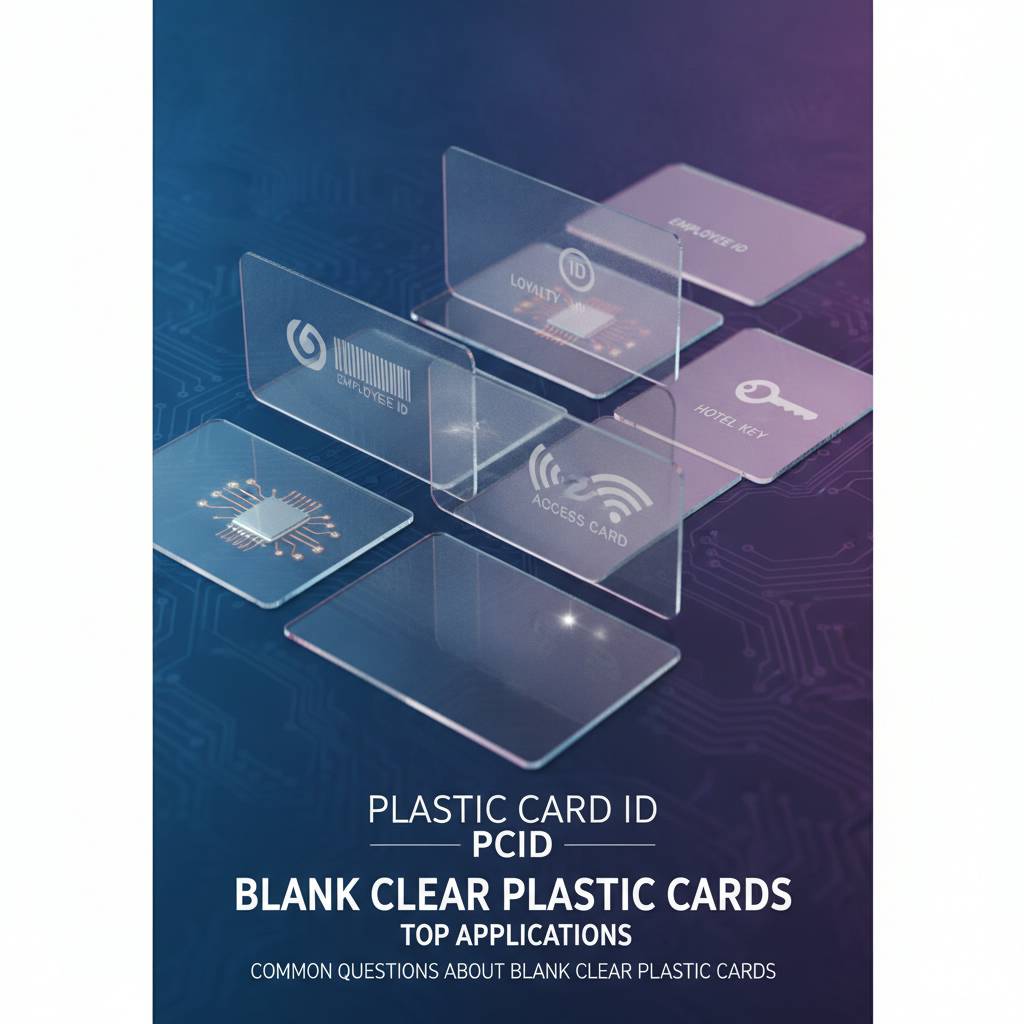
The applications for blank clear plastic cards are broader than most buyers initially assume. The visual properties that make them distinctive translate into specific functional advantages across industries. From high-end retail loyalty programs to corporate access credentials, clear cards show up in contexts where standing out is part of the job description.
What's equally important is the blank format specifically. Organizations that print in-house - which now includes businesses of all sizes, thanks to affordable desktop card printers - benefit enormously from blank stock. You control the design, the timing, the quantity, and the encoding. You're not waiting on a print run or paying for minimums that don't match your program's pace.
VIP Membership and Loyalty Cards
Loyalty programs live or die by how much the card gets used. A card that stays in a wallet beats a card sitting in a drawer every time. Transparent cards have a proven advantage here: they're unusual enough that holders notice them, comment on them, and remember which program they belong to. Memorability drives engagement, and clear PVC stock delivers it without a complicated design.
Retailers, restaurants, and entertainment venues have used clear loyalty cards to signal tier status - a clear card for mid-tier members, a frosted card for premium, a metal card for top-tier. The visual distinction is immediate and tangible. Customers understand instantly that not everyone carries the same card, and that psychology reinforces loyalty behavior better than most points mechanics ever will.
Event Credentials and Temporary Access Passes
Conferences, trade shows, festivals, and corporate events need credentials that feel intentional. A clear plastic card worn on a lanyard or slid into a badge holder reads as professional in a way that laminated paper simply does not. First impressions at registration shape how attendees perceive the entire event. That's not hyperbole - it's basic brand experience management.
Because the blank format allows on-demand printing, event organizers can produce clear cards the day before an event if necessary, encoding specific access levels, names, or barcodes as needed. The turnaround flexibility that comes with in-house card printing is a genuine operational advantage, especially for events where the guest list changes up until the last minute.
Hotel Key Cards and Hospitality Applications
The hotel industry pioneered premium card aesthetics for good reason: the key card is often the first physical object a guest interacts with after check-in. A clear or frosted key card communicates that the property pays attention to details. It's a small signal with disproportionate impact on the guest's overall quality perception.
Clear cards compatible with RFID encoding can serve as hotel key cards when combined with the appropriate chip technology. CPE carries clear RFID cards as well as clear blank cards for use with magnetic stripe encoders, covering the full range of access control formats in use across the hospitality sector. Call 800.835.7919 to discuss the right clear card configuration for your property's system.
Corporate ID Badges and Access Control
Corporate environments benefit from clear cards in ways that are more functional than aesthetic. Overlay printing on clear stock can create an ID badge where the employee photo appears without a colored background, integrating more cleanly with the badge template. Security teams also use clear overlays and transparent card components to add tamper-evidence features visible only at an angle.
For access control specifically, clear cards are available with embedded proximity technology and RFID chips, making them directly compatible with existing reader infrastructure. The clear format simply means the access card also serves a secondary purpose: it looks distinctive enough that an employee wearing an expired or unauthorized badge is instantly noticeable by comparison.
Blank Clear Cards in an In-House Card Program
 The strategic argument for running an in-house card program is straightforward: lower per-card cost, faster turnaround, and total design control. Blank cards are the foundation of that model. When you buy blank clear stock in volume, your cost per card drops substantially compared to ordering pre-printed cards from a commercial print vendor - and you're not locked into a design that might need updating in six months.
In-house card programs scale gracefully. Whether you're printing 50 cards for a small spa loyalty program or 5,000 event credentials for a regional conference, the per-unit economics improve as your printer amortizes over time. The blank card cost stays consistent, and your total program cost becomes predictable in a way that outsourced printing never quite is.
Selecting the Right Printer for Clear Card Stock
Not every card printer handles clear stock with equal results. The best performers for transparent cards are printers with precise ribbon tension control and adjustable print head pressure settings, since the absence of a white background makes any variation in ink density immediately visible. Evolis Primacy 2 and Zebra ZC300 are strong options in the mid-range; the Fargo HDP5000 is a workhorse for high-volume clear card printing.
The key variable is whether the printer supports the ribbon types appropriate for clear stock. Retransfer printers - which lay ink on a film before transferring it to the card - typically produce the cleanest results on clear PVC because the film provides a consistent intermediate layer. Direct-to-card printers can work well with the right ribbon selection, but the margin for error is narrower.
Volume Planning and Inventory Management
One practical advantage of buying blank clear cards is that unsold or unused stock doesn't become obsolete. A box of blank cards stays usable indefinitely, whereas pre-printed cards with a specific design, date, or logo become waste the moment that information changes. Buying blank stock in larger quantities to lower your per-card cost is a straightforward business decision with no downside risk.
For programs running 500-2,000 cards per month, buying in cases of 500 is typically the sweet spot for cost versus storage. Programs scaling past 5,000 cards per month should explore pallet pricing and discuss volume tiers directly with CPE - those conversations regularly surface pricing structures that aren't visible in a standard catalog view.
Accessories That Complete the Clear Card Program
- Card sleeves and holders: Clear cards in clear sleeves create a fully transparent credential that's visually striking in lanyard applications.
- Clear overlaminates: Add UV protection and scratch resistance without affecting the card's transparency.
- Card carriers: Essential for mailing card programs, especially for loyalty and membership cards mailed to new enrollees.
- Cleaning kits: Regular printer cleaning is especially important when printing on clear stock, as debris shows up more visibly.
- Ribbon storage solutions: Proper storage prevents ribbon degradation, which directly affects print quality on transparent substrates.
Each of these accessories is available from CPE as part of a complete card program package. The goal is never to sell a card and move on - it's to make sure every component of your program is set up to perform reliably from day one.
Industries That Rely on Blank Clear Plastic Cards
The clearest way to understand the value of blank clear plastic cards is to look at where they've already proven themselves. Across a wide range of industries, organizations have discovered that the material communicates something that white PVC cannot: a willingness to invest in presentation, and a recognition that the card itself is part of the brand experience.
Retail and Gift Card Programs
Retailers who have switched from paper to plastic gift cards consistently report sales lifts in the 35-50% range - and that number improves further when the card design is distinctive enough to function as an advertisement in someone's wallet. Clear PVC gift cards have that quality. They're unusual, they're elegant, and they're more likely to be shown to a friend than a plain white card ever would be.
Blank clear cards give small and mid-sized retailers the ability to run gift card programs without large pre-print minimums. Print a batch of 100 for the holiday season, add a sleeve and carrier, and you have a professional gift card program that competes visually with major retail chains. The blank format is what makes that accessible.
Health, Wellness, and Spa Membership Cards
Spas, yoga studios, fitness clubs, and wellness centers have a particular affinity for frosted and clear card stock because the aesthetic aligns with their brand positioning. A frosted membership card handed to a new member at a premium spa conveys the same intentional quality as the decor, the service, and the retail products. It's all one coherent signal.
Clear cards in this context also support tiered membership programs visually. A clear card for standard members and a frosted card for premium members, or vice versa, creates an immediately recognizable distinction that motivates upgrades without requiring any verbal sales pitch at the front desk. The card itself does the work.
Education, Nonprofits, and Associations
Universities, professional associations, and nonprofit organizations often want member cards that signal institutional credibility without the cost of fully custom printed runs. Blank clear cards printed in-house allow these organizations to produce professional-quality credentials on a program-by-program basis, adapting the design for each membership year or event cycle without waste.
Student ID programs, alumni membership cards, and volunteer credentials all benefit from the in-house clear card model. The per-card cost is low enough that even a small nonprofit with 200 members can run a credible card program, and the visual quality of a clear PVC card - versus a laminated paper ID - communicates organizational seriousness that matters for member retention and public-facing legitimacy.
Common Questions About Blank Clear Plastic Cards
Buyers new to clear card stock tend to have similar questions, and most of them come down to the same concern: will this actually work with my current setup? The answer is almost always yes, with the right ribbon and a few minutes of printer configuration. Here are the questions CPE hears most often.
Can I encode a magnetic stripe on a clear card?
Yes. Blank clear cards are available with HiCo and LoCo magnetic stripes. The stripe itself is applied during manufacturing and is fully visible on the clear card - which, for some applications, becomes part of the design rather than something to hide. HiCo stripes are recommended for most access and loyalty programs due to their resistance to demagnetization from everyday handling.
Encoding happens at the point of printing with a printer equipped with a magnetic encoding module. This is a standard feature on most mid-range and professional card printers, and CPE carries compatible models at multiple price points. The clear card format doesn't affect encoding performance in any meaningful way.
Are clear cards as durable as white PVC cards?
Clear PVC cards manufactured to CR80 standard are equally durable to their white counterparts. The transparency is a property of the PVC compound, not an indicator of reduced material quality. Durability is determined by thickness and material grade, both of which are identical across clear, white, and colored PVC stock at the 30 mil specification.
The practical durability consideration with clear cards is surface visibility. Scratches that are less noticeable on a white card may be more visible on a clear or frosted surface, especially if the card is handled frequently without a protective sleeve. For programs where cards are swiped or scanned multiple times daily, adding a clear overlam is a worthwhile investment.
What quantities are available, and what should I order for my program?
Blank clear cards are available from CPE in quantities ranging from small starter packs suitable for testing a printer or proofing a design to full cases and bulk orders appropriate for large-scale programs. Minimum order quantities are program-friendly - you're not forced into a 10,000-card commitment to access quality stock.
- Small programs (under 200 cards per month): Starter packs or single cases work well; maintain a two-month buffer inventory.
- Mid-size programs (200-1,000 cards per month): Case pricing provides meaningful per-card savings; consider a standing order.
- Large programs (1,000 cards per month): Volume tiers and dedicated account support are available; contact CPE directly for pricing.
- Testing and proofing: Sample packs allow you to validate print quality and ribbon configuration before committing to a full order.
For questions about which quantity tier fits your program's current pace and anticipated growth, the team at Plastic Card ID is genuinely helpful on these calls - not just order-taking, but advising on what makes economic sense for your specific situation.
Why Plastic Card ID Is the Right Partner for Your Clear Card Program
Buying blank cards sounds like a commodity decision. It isn't. The quality of the card substrate, the consistency of the lot-to-lot manufacturing, the accuracy of the CR80 tolerances, and the availability of matching ribbons and accessories all vary significantly between suppliers. Working with a supplier who has shipped more than 50 million cards and supported over 100,000 customers means you're drawing on a depth of practical experience that shows up in small but important ways.
CPE has been in this business long enough to have seen what goes wrong when card programs are built on the wrong foundation - wrong stock, wrong ribbon, wrong printer for the volume - and the guidance they provide is shaped by those lessons. The goal is to set your program up correctly from the beginning, not to sell you a replacement order when something fails.
A Genuine One-Stop Card Program Resource
Beyond blank clear cards, Plastic Card ID carries the full ecosystem your card program needs: card printers from Evolis, Zebra, and Fargo; HiCo and LoCo magnetic stripe cards; RFID and proximity cards; smart chip cards; card sleeves, carriers, and lanyards; printer ribbons and cleaning kits; and card affixing and mailing services for programs that need to reach cardholders by mail.
That breadth matters because card programs don't exist in isolation. When your printer ribbon runs low, when you need to add a magnetic stripe option to an existing clear card program, or when you're ready to scale up volume - you want a single point of contact who knows your program and can respond quickly. That's what a 25-year relationship with this industry actually produces.
Serving USA-Based Businesses at Every Scale
Plastic Card ID serves businesses and organizations across the United States, from small independent retailers running loyalty programs with 50 cards a month to enterprises managing tens of thousands of cards across multiple locations. The program support scales with you, and the pricing reflects your actual volume rather than forcing you into tiers that don't fit your reality.
Whatever your organization does - retail, hospitality, healthcare, education, events, corporate security, fitness, or something entirely specific to your market - if a plastic card is part of how you operate, there's a configuration in this catalog that fits. Clear cards are just one particularly compelling option in a deep and practical product line.
Getting Started Is Straightforward
The fastest way to get the right clear card solution is a direct conversation. Card programs have enough variables - printer compatibility, encoding requirements, volume, ribbon selection - that a five-minute call often surfaces information that saves time and money upstream. The team at Plastic Card ID has handled questions at every level of sophistication, from first-time buyers setting up a loyalty program to procurement managers sourcing for enterprise-scale access control rollouts.
Reach out today and let Plastic Card ID help you build a clear card program that performs from the first print run. Call 800.835.7919 and talk to someone who has been doing this for a very long time.
Whether you need 100 blank clear cards to test a new loyalty concept or 50,000 for a national rollout, Plastic Card ID has the stock, the expertise, and the supporting products to make it work. Don't build your card program on guesswork when decades of experience are a phone call away at 800.835.7919.
Previous Page