Blank Plastic Card Materials Compared: Find the Right Fit
Table of Contents []
- Blank Plastic Card Materials Compared - Plastic Card ID Breaks It Down
- The Standard PVC Card: Why It Remains the Industry Workhorse
- Magnetic Stripe Cards: HiCo vs. LoCo and When Each One Wins
- RFID and Proximity Cards: Contactless Technology for Access and Beyond
- Clear, Frosted, and Colored PVC: When Visual Impact Drives Program Success
- Card Printers, Ribbons, and Supplies: Completing Your In-House Program
- Frequently Asked Questions About Blank Plastic Card Materials
- Partner With Plastic Card ID for Every Card Program Need
Blank Plastic Card Materials Compared - Plastic Card ID Breaks It Down
Walk into any office, gym, hotel, or retail store and you will find plastic cards doing serious work - employee badges clipped to lanyards, loyalty cards tucked into wallets, access cards waved at readers, and membership cards slid across counters. What most people never think about is the material underneath the print. The card stock you choose shapes everything - print quality, encoding capability, lifespan, and the impression it makes on the person holding it.
This guide cuts through the confusion. Whether you are launching a new employee ID program, scaling up a retail gift card campaign, or sourcing access control credentials for a multi-site facility, understanding blank plastic card materials is the foundation of a smart purchasing decision. CPE has helped over 100,000 businesses and organizations navigate exactly these choices - and the lessons learned across 50 million cards sold are packed into the sections below.
| Material Type | Primary Use Cases | Print Compatibility | Encoding Options |
|---|---|---|---|
| Standard White PVC (30 mil) | ID, loyalty, membership, gift | All card printers | Mag stripe, smart chip, RFID |
| Magnetic Stripe (HiCo/LoCo) | Gift, hotel key, access, loyalty | All card printers | HiCo or LoCo mag encoding |
| RFID / Proximity | Access control, timekeeping | Most card printers | Contactless chip encoding |
| Smart Chip (Contact) | Secure ID, healthcare, campus | Smart card-capable printers | ISO contact chip |
| Clear / Frosted PVC | VIP, premium membership, promo | Select card printers | Optional mag stripe |
| Colored PVC Stock | Color-coded ID, department cards | All card printers | Optional mag stripe or RFID |
| Metal Cards (Steel/Brass/Gold) | Luxury membership, VIP, executive | Custom production | Optional mag stripe |
The Standard PVC Card: Why It Remains the Industry Workhorse
 Decades of card program experience point to one undeniable truth - the standard white PVC CR80 card at 30 mil thickness is the foundation of nearly every successful card program in America. It is not glamorous. It does not have a gimmick. What it has is consistency - a perfectly flat, receptive surface that works with every major card printer brand, accepts crisp full-color dye-sublimation prints, and holds up under daily handling year after year.
CR80 is the ISO 7810 standard format - the same dimensions as a credit card at 3.375 by 2.125 inches. That universality matters enormously when your cards need to fit badge holders, wallets, cardholders, and readers that were all designed around that one standard. Straying from CR80 without a specific reason adds cost without adding value for most programs.
What 30 Mil Thickness Actually Means for Durability
Thirty mil - 0.030 inches - is the sweet spot of rigidity and flexibility that makes a card feel premium without becoming brittle. Cards thinner than 30 mil flex noticeably and feel cheap in hand. Cards thicker than 30 mil can jam card printers not designed for them. The 30 mil standard delivers the tactile experience that signals quality to every person who receives your card.
In practical terms, a properly produced 30 mil PVC card can withstand thousands of swipes, repeated handling in a wallet environment, and exposure to everyday moisture without delaminating or warping. That kind of resilience is what separates a plastic loyalty or membership card from a paper punch card - and it is a significant reason retailers who switch to plastic gift cards routinely see sales increases of 35-50%.
Print Quality Differences Between PVC Grades
Not all white PVC blanks are created equal. Lower-grade cards can have surface inconsistencies - micro-texture variations, slight warping from inconsistent laminate bonding, or a slightly off-white base tone that muddles color accuracy when printing. Premium CR80 PVC blanks produce noticeably sharper, more vibrant prints because the surface is engineered to receive dye-sublimation ribbons uniformly across the entire card face.
When sourcing blank cards in quantity, the difference between budget stock and quality stock becomes visible at scale. A run of 500 cards on inferior stock will show color banding, edge printing inconsistencies, and variation from card to card. Quality PVC stock, like what CPE supplies, keeps print output consistent whether you are printing 50 cards or 5,000.
Blank PVC as a Cost-Control Strategy
Buying blank cards and printing in-house puts design control where it belongs - with the organization. Need to update a template because staff turnover happened? Print new cards today. Launching a seasonal promotion? Design and print without waiting for an outside vendor. Blank PVC cards give organizations the agility to respond to real-world changes without minimum order constraints or turnaround delays.
Per-card cost decreases significantly when you own your card printer and supply chain. Over a multi-year program, the investment in a quality card printer and a bulk supply of blank cards routinely delivers lower total program costs than ordering pre-printed cards for every change or update.
Magnetic Stripe Cards: HiCo vs. LoCo and When Each One Wins
A magnetic stripe card looks simple - a dark band across the back of an otherwise standard PVC card. But inside that stripe lives a world of technical decisions that can mean the difference between a card program that runs flawlessly and one that generates constant reader errors. Understanding the HiCo versus LoCo distinction is non-negotiable for anyone running a card program that depends on encoded data.
Magnetic stripes store data in tiny magnetized particles along three tracks. The density of those particles - specifically, how resistant they are to accidental demagnetization - is what separates High Coercivity (HiCo) from Low Coercivity (LoCo) cards. HiCo stripes require a stronger magnetic field to write and erase, which makes them dramatically more resistant to everyday demagnetization from proximity to phones, bag closures, and other magnetic fields.
HiCo Cards: The Right Choice for Most Programs
At 2750 Oersteds of coercivity, HiCo cards are the standard choice for gift card programs, employee access cards, loyalty programs, and any application where the card will live in a wallet alongside smartphones, transit cards, or other magnetic-field-generating items. HiCo stripes hold their data reliably through the kind of real-world abuse that wallets deliver daily.
Hotel key cards are among the most commonly cited examples of HiCo versus LoCo confusion. Many hotel chains switched to HiCo specifically because guests were reporting demagnetized keys after a single night - a problem almost entirely attributable to phone proximity in pockets and purses. HiCo cards eliminated the complaint almost entirely.
LoCo Cards: Niche Applications Where They Still Make Sense
Low Coercivity cards at 300 Oersteds have a narrower appropriate use case - short-term applications where the card will be used a handful of times in a controlled environment and then discarded or returned. Event access cards used over a single weekend, transit tickets, or temporary visitor badges in a secured facility represent legitimate LoCo applications. The lower cost of LoCo stock makes it attractive for truly disposable applications.
The critical mistake to avoid is substituting LoCo cards for HiCo applications to save a small amount per card. The resulting increase in card read failures and customer complaints will cost far more in lost goodwill than the savings on card stock. When in doubt, specify HiCo - it is the safer and usually the smarter call.
Three-Track Encoding and What Gets Stored Where
- Track 1: Alphanumeric data, up to 79 characters - commonly used for cardholder name and account number in loyalty and membership programs.
- Track 2: Numeric data only, up to 40 characters - the most widely read track, used for primary account identification in gift cards and access systems.
- Track 3: Numeric data, up to 107 characters - less commonly used in general card programs but available for proprietary data storage in specialized applications.
Most gift card and loyalty card systems only require Track 2 encoding. Employee access systems may use Track 1 or a combination of tracks depending on the access control software. Knowing which tracks your system reads before purchasing encoded cards prevents costly mismatches between card stock and reader capability.
| Feature | HiCo (2750 Oe) | LoCo (300 Oe) |
|---|---|---|
| Demagnetization Resistance | High | Low |
| Best For | Gift, loyalty, hotel key, access | Short-term event, transit, temp badges |
| Wallet Durability | Excellent | Poor |
| Relative Cost | Slightly higher | Slightly lower |
RFID and Proximity Cards: Contactless Technology for Access and Beyond
 Proximity cards and RFID smart cards represent the most significant technological leap in the blank card category - moving from passive magnetic stripe storage to active wireless communication between card and reader. For access control, time and attendance, cashless vending, and contactless loyalty programs, RFID technology delivers a user experience that is faster, more reliable, and significantly harder to clone than magnetic stripe alternatives.
The practical difference is immediately visible in any facility that uses proximity access control. A cardholder approaches a door, holds their credential near the reader without removing it from a badge holder, and the door unlocks in under a second. No swiping, no alignment, no card wear at the stripe. The technology embedded in the card communicates via radio frequency - the card does not need to make physical contact with any reader surface.
125 kHz Proximity Cards vs. 13.56 MHz Smart Cards
Proximity cards operating at 125 kHz - brands like HID and EM4100-compatible formats - are the most widely deployed access control credential in commercial facilities across the United States. They are simple, reliable, and compatible with an enormous installed base of readers. For organizations already running a 125 kHz access control system, proximity card blanks are the natural and cost-effective credential choice.
At 13.56 MHz, contactless smart cards like MIFARE Classic and MIFARE DESFire EV2 operate at higher speeds with substantially greater memory capacity and encryption capability. DESFire EV2 in particular is the preferred credential for applications demanding strong security - multi-site corporate campuses, healthcare facilities requiring HIPAA-conscious access logging, and casino player card programs where data integrity is paramount.
MIFARE DESFire and High-Security Applications
MIFARE DESFire EV2 cards support 3DES and AES-128 encryption, mutual authentication between card and reader, and application isolation that allows a single card to serve multiple independent systems - access control, time and attendance, cashless vending - without those applications interfering with each other. That multi-application capability is a genuine game-changer for large organizations managing complex credentialing needs across multiple departments.
Casino player cards represent one of the most demanding RFID applications in any industry. Player tracking requires accurate read speeds at table-side, resistance to the physical abuse of a casino floor environment, and data security sufficient to protect both the patron's account and the casino's systems. MIFARE DESFire-based casino cards check every one of those boxes - which is why they have become the preferred platform for modern player tracking programs.
Choosing the Right RFID Frequency for Your Existing System
The single most important question before ordering any RFID blank card is: what frequency and format does your existing reader infrastructure use? Ordering 13.56 MHz cards for a 125 kHz system - or vice versa - produces cards that are completely incompatible with your readers. Frequency mismatches are one of the most common and entirely preventable card program mistakes.
Contact CPE at 800.835.7919 with the make and model of your access control readers before placing a large RFID card order. A quick verification call ensures that the blank cards you receive will work flawlessly in your existing infrastructure - saving the time, cost, and frustration of a return and reorder.
Clear, Frosted, and Colored PVC: When Visual Impact Drives Program Success
Not every card program is a utilitarian exercise in data storage. VIP memberships, premium loyalty tiers, event credentials for upscale gatherings, and promotional cards for luxury brands carry a message the moment someone holds them in their hands. Clear and frosted PVC cards deliver a visual and tactile experience that standard white cards simply cannot replicate - and that experience is a meaningful part of what the card communicates about the organization issuing it.
A clear PVC card printed with a white ink underlay creates a striking translucent effect - portions of the design appear to float while transparent areas reveal the card's see-through quality. Frosted cards take a different approach, diffusing light across a matte surface that gives the card a premium, understated elegance particularly well-suited to high-end membership clubs, spas, and luxury retail programs.
Clear PVC: Design Possibilities and Print Considerations
Printing on clear PVC requires a printer capable of white ink printing or a deliberate design approach that uses the transparency as a design element rather than fighting against it. Full-color printing on clear stock without white ink underneath appears washed out and translucent - which can be exactly the intended effect when executed deliberately, but is a common unintended result when a standard design intended for white stock is simply transferred to clear cards. Designing specifically for clear stock unlocks effects that are impossible on any other material.
Clear cards with optional magnetic stripes are a popular choice for hotel key card programs at boutique properties, VIP event passes, and premium gift card programs where the visual distinction of the card itself reinforces a brand message of exclusivity and quality.
Colored Stock for Department and Access Level Differentiation
Colored PVC stock - available in a range of pre-colored base tones - gives organizations a fast visual differentiation system that works even before a badge is close enough to read. Color-coded credentials are a proven method for instant visual security verification in facilities where staff, contractors, and visitors all need distinguishable credentials at a glance.
A hospital might issue blue badges to staff, yellow to contractors, and red to vendors - allowing security personnel and employees to visually verify access level without any technology. Schools, manufacturing plants, event facilities, and corporate campuses all benefit from this simple and surprisingly effective approach to access differentiation.
Metal Cards: The Premium Tier That Commands Attention
Stainless steel, brass, and gold-tone metal cards occupy an entirely separate category - not just visually, but in the physical experience of receiving and holding one. The weight alone communicates something no plastic card can. Metal cards issued to top-tier loyalty members, executive cardholders, or VIP club members create a moment of genuine delight that cardholders remember, share, and talk about.
Metal card programs require custom production rather than in-house printing, but the investment is targeted - these cards go to the top percentage of a membership base, where the retention value of an exceptional physical credential justifies the premium per-card cost many times over. For programs where the card itself is part of the value proposition, metal is the logical destination.
Card Printers, Ribbons, and Supplies: Completing Your In-House Program
Blank cards are only half of an in-house card program. The other half is the printing infrastructure - and CPE supplies the complete lineup. Evolis, Zebra, and Fargo card printers cover the full spectrum from compact desktop models suited for organizations printing 50-200 cards per month to high-throughput production units capable of printing and encoding thousands of cards per shift without breaking pace.
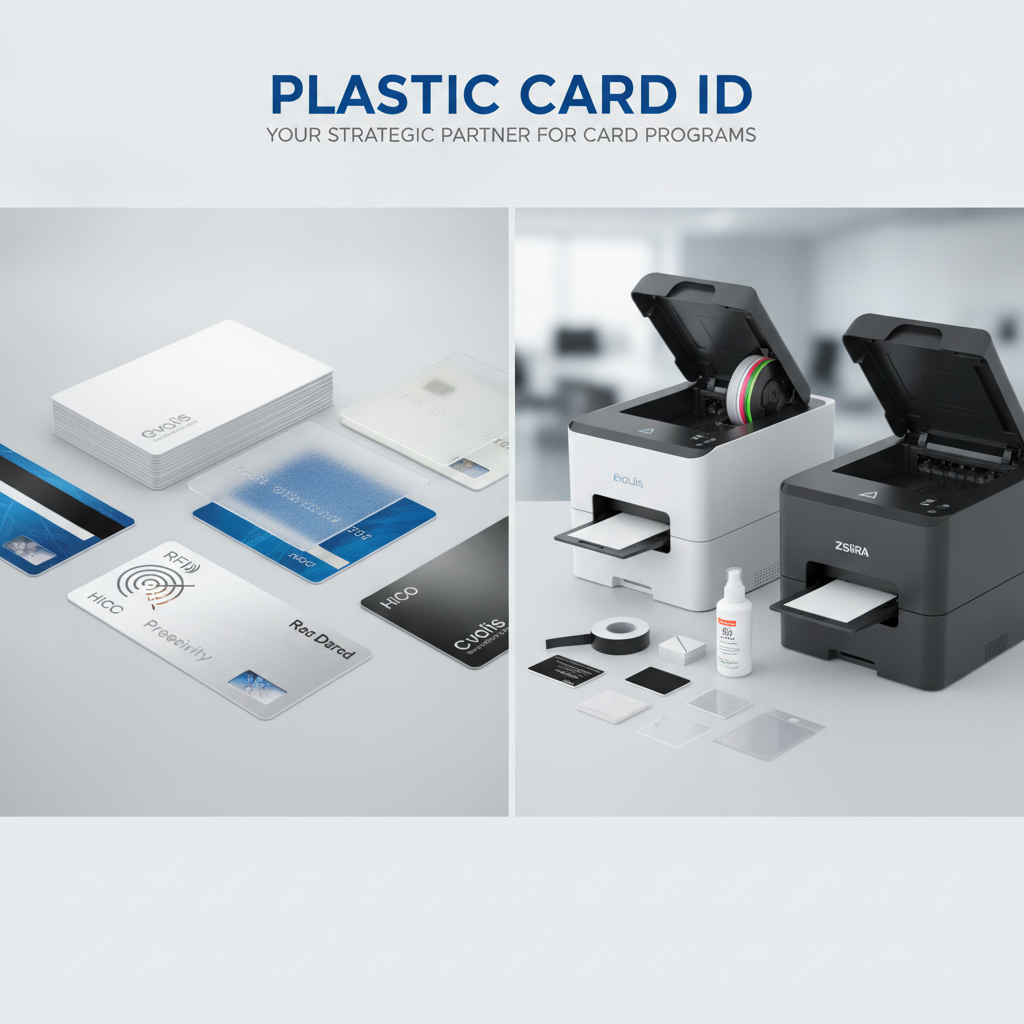
Matching the right printer to the right blank card stock is not automatic. Single-sided versus dual-sided printing, retransfer versus direct-to-card technology, and the specific ribbon chemistry all factor into which blank card specification delivers the best results on a given printer. Getting the printer-card-ribbon combination right on the front end prevents wasted cards and inconsistent print quality throughout the life of the program.
Ribbon Chemistry and Its Impact on Print Quality
YMCKO ribbons - yellow, magenta, cyan, black, overlay - are the standard for full-color card printing with a protective topcoat. KO ribbons handle monochrome or two-color applications at lower cost per card. Resin ribbons print crisp black text and barcodes specifically, making them the right choice for applications where color is not required. Using the correct ribbon type for each application directly controls per-card printing cost while maintaining the quality the application demands.
Cleaning ribbons and cleaning kits are not optional accessories - they are maintenance necessities. Dust, card debris, and ribbon residue accumulate inside card printers and cause print defects, roller slippage, and eventually mechanical failures that interrupt card production at the worst possible times. A regular cleaning schedule keeps printers producing at specification for years longer than neglected units.
Accessories That Complete a Card Program
- Card carriers and sleeves: Protect finished cards during mailing or distribution and present them professionally to recipients.
- Card affixing and mailing services: For programs distributing cards at scale, professional card affixing and mailing fulfillment eliminates internal labor costs and ensures reliable delivery.
- Badge holders and lanyards: Employee ID and event credential programs need display solutions that keep cards visible and accessible throughout the day.
- Card printers with encoding modules: Mag stripe, smart chip, and RFID encoding modules integrated into printers allow simultaneous printing and encoding in a single pass - a significant workflow efficiency for programs requiring encoded cards.
The goal of a true card program partner is to make sure nothing falls through the gaps. Blank cards arrive, printer and ribbons are in stock, cleaning supplies are on hand, and distribution accessories are ready. When every component of the program comes from a single trusted supplier, the logistics stay manageable and the program runs without interruption.
Printer Support and Long-Term Program Planning
Card printer technology evolves, and so do card program requirements. An organization printing simple staff ID badges today may need to add mag stripe encoding next year and RFID capability the year after. Selecting a printer platform with upgrade path options protects the initial investment and avoids the cost of replacing the entire print system every time a new capability is needed.
Contact CPE at 800.835.7919 to discuss your current volume, your anticipated growth, and any encoding requirements before selecting a printer. A conversation upfront saves significant cost over the life of the program - and it is exactly the kind of strategic guidance that differentiates a true program partner from a box-shipping vendor.
Frequently Asked Questions About Blank Plastic Card Materials
After 25 years and more than 100,000 customers, certain questions come up consistently. The answers below address the most common points of confusion when comparing blank plastic card materials - and they reflect the real-world experience of programs ranging from small nonprofits printing 50 cards a month to multi-location retailers managing tens of thousands of cards in circulation.
What Is the Difference Between CR80 and CR79 Card Sizes?
CR80 at 3.375 by 2.125 inches is the universal standard - credit card size, compatible with every wallet, badge holder, and card reader designed to that specification. CR79 is slightly smaller at 3.303 by 2.051 inches and is typically used as an overlay card adhered to the surface of a passport or booklet for access control applications in specialized federal or institutional environments. For virtually every standard card program, CR80 is the correct choice.
Deviating from CR80 requires specific justification - a reader that only accepts a non-standard size, a carrier format that requires a different card dimension, or a specialty application like the passport overlay described above. Without a specific technical reason, CR80 is the default answer for blank card sizing.
Can I Print on Both Sides of Every Blank Card?
Standard white PVC blank cards are printable on both sides with a dual-sided card printer. However, cards with a magnetic stripe, RFID inlay, or smart chip have restrictions on print area - the stripe on a mag stripe card cannot be overprinted, and the inlay location in an RFID card may create minor surface variations. Understanding where print-safe zones exist on encoded cards prevents production errors and ensures both print quality and encoding reliability.
Clear and frosted cards have specific printer compatibility requirements for double-sided printing - not all printers handle non-opaque card stock equally. Confirming compatibility between card type and printer model before scaling a clear card program avoids costly trial and error at volume.
How Many Cards Can I Expect Per Ribbon?
Ribbon yield varies significantly by ribbon type and print coverage. A standard YMCKO ribbon in a desktop Evolis or Fargo printer typically yields 200-500 cards per ribbon depending on model and print coverage. High-coverage full-bleed designs consume more ribbon per card than designs with significant white space. Accurately estimating ribbon consumption keeps per-card cost calculations realistic when building program budgets.
Monochrome ribbons yield considerably more cards - often 1,000-3,000 per ribbon - making them dramatically more cost-effective for applications requiring only black text or a single-color print such as basic employee ID badges with photo, name, and title in a simple layout.
Ready to find the right blank card material for your program? The right choice depends on your application, volume, encoding needs, and distribution method - and CPE has the experience to guide you through every variable.
Partner With Plastic Card ID for Every Card Program Need
 The material under a card's surface shapes its performance, its longevity, and the message it sends to every person who holds it. Standard white PVC delivers the reliability and print quality that millions of successful card programs depend on. Magnetic stripe cards - HiCo for durability, LoCo for short-term applications - bring encoded data capability to programs of every scale. RFID and smart chip cards push access control and security to a level that magnetic stripes cannot reach. Clear, frosted, colored, and metal cards let the card itself become a brand statement.
No single material fits every application - but every application has a material that fits it perfectly. With 25 years of program experience, a catalog spanning every major blank card format, and a full lineup of card printers and supplies from Evolis, Zebra, and Fargo, Plastic Card ID is positioned to support your card program from the first blank card order through years of growth and evolution. From 50 cards a month to tens of thousands, the infrastructure, expertise, and inventory are in place to keep your program running without interruption.
Call Plastic Card ID today at 800.835.7919 - let the team that has helped over 100,000 businesses build better card programs put that experience to work for yours.
Previous Page