Plastic Card Dimensions and Sizing Guide for Every Need
Table of Contents []
- The Complete Plastic Card Dimensions and Sizing Guide from Plastic Card ID
- CR80: The Universal Standard Every Card Program Relies On
- Specialty Card Sizes: When Standard Is Not Enough
- Magnetic Stripe, RFID, and Smart Chip: How Encoding Affects Sizing Choices
- Choosing the Right Card Thickness for Your Program
- Buyer's Guide: Matching Card Dimensions to Your Specific Application
- Your Next Step Starts with Plastic Card ID
The Complete Plastic Card Dimensions and Sizing Guide from Plastic Card ID
Walk into any business that issues cards - a gym, a hotel, a corporate office, a retail store - and you will almost certainly encounter a card built to the same invisible standard. Most people never think about it. The card fits in a wallet, slides into a reader, snaps into a badge holder, and does its job. But behind that seamless experience is a precise set of specifications that have been refined over decades of international standards work. Getting those dimensions right is not optional. It is the foundation of every card program that actually works.
Whether you are launching a loyalty program, issuing employee ID badges, distributing membership cards, or setting up access control at a facility, the physical size of your card determines compatibility with every printer, reader, laminator, and wallet sleeve in your supply chain. A card that is even slightly off-spec can jam a printer, misread on a swipe terminal, or simply look unprofessional next to the cards your customers already carry. This guide walks through everything you need to know - from standard CR80 dimensions to specialty sizes - so you can make confident, informed purchasing decisions.
Why Card Sizing Standards Exist
The ISO 7810 standard was developed to create a globally consistent card format, ensuring that a card produced in one country works reliably in equipment manufactured in another. This international framework defines the physical characteristics of identification cards, including size, thickness, and flexibility. It is not an arbitrary guideline - it is the backbone of interoperability across the entire card industry.
Without standardization, every card printer manufacturer, badge holder supplier, and wallet maker would operate on different assumptions. The result would be chaos: cards that fit some readers but not others, printers optimized for one thickness but not another, badge accessories sized for an entirely different card. The ISO 7810 standard eliminates all of that uncertainty, and CPE builds its entire product catalog around these proven specifications.
The Relationship Between Size, Format, and Function
Card size does not exist in isolation. It is deeply connected to the card's intended function. A proximity access card needs to house an antenna coil of sufficient diameter to communicate reliably with a reader. A magnetic stripe card requires a specific track width and placement. A smart chip card must position its contact pads in an exact location. All of these functional requirements are designed around standardized card dimensions.
Understanding the relationship between physical size and card function helps organizations choose the right format from the start - rather than discovering incompatibilities after thousands of cards have been printed and distributed. Plastic Card ID has spent more than 25 years helping businesses navigate exactly these decisions, serving over 100,000 customers and moving more than 50 million cards through its supply chain in the process.
How This Guide Will Help You Choose Correctly
This guide is organized to give you practical, actionable information at every stage of your card program planning. You will find dimension tables, thickness comparisons, use-case breakdowns, and buyer tips drawn from decades of real-world card program experience. By the end, you will understand not just the numbers, but what those numbers mean for your specific application.
The goal is simple: give you the knowledge to order with confidence. Whether you are a first-time buyer ordering 50 cards or a procurement manager sourcing tens of thousands, the same dimensional principles apply. The difference is scale - and CPE is built to serve both ends of that spectrum.
| Card Format | Width | Height | Thickness | Common Uses |
|---|---|---|---|---|
| CR80 (ID-1) | 3.375 in (85.6 mm) | 2.125 in (54 mm) | 30 mil (0.76 mm) | ID, loyalty, membership, gift |
| CR79 | 3.303 in (83.9 mm) | 2.051 in (52.1 mm) | 30 mil (0.76 mm) | Slot-punch ID badges |
| CR100 | 3.88 in (98.5 mm) | 2.63 in (66.8 mm) | 30 mil (0.76 mm) | Driver licenses, specialty ID |
| CR90 | 3.625 in (92 mm) | 2.375 in (60 mm) | 30 mil (0.76 mm) | Specialty card programs |
| Thin (10 mil) | 3.375 in (85.6 mm) | 2.125 in (54 mm) | 10 mil (0.25 mm) | Mailers, inserts, paper-thin IDs |
CR80: The Universal Standard Every Card Program Relies On
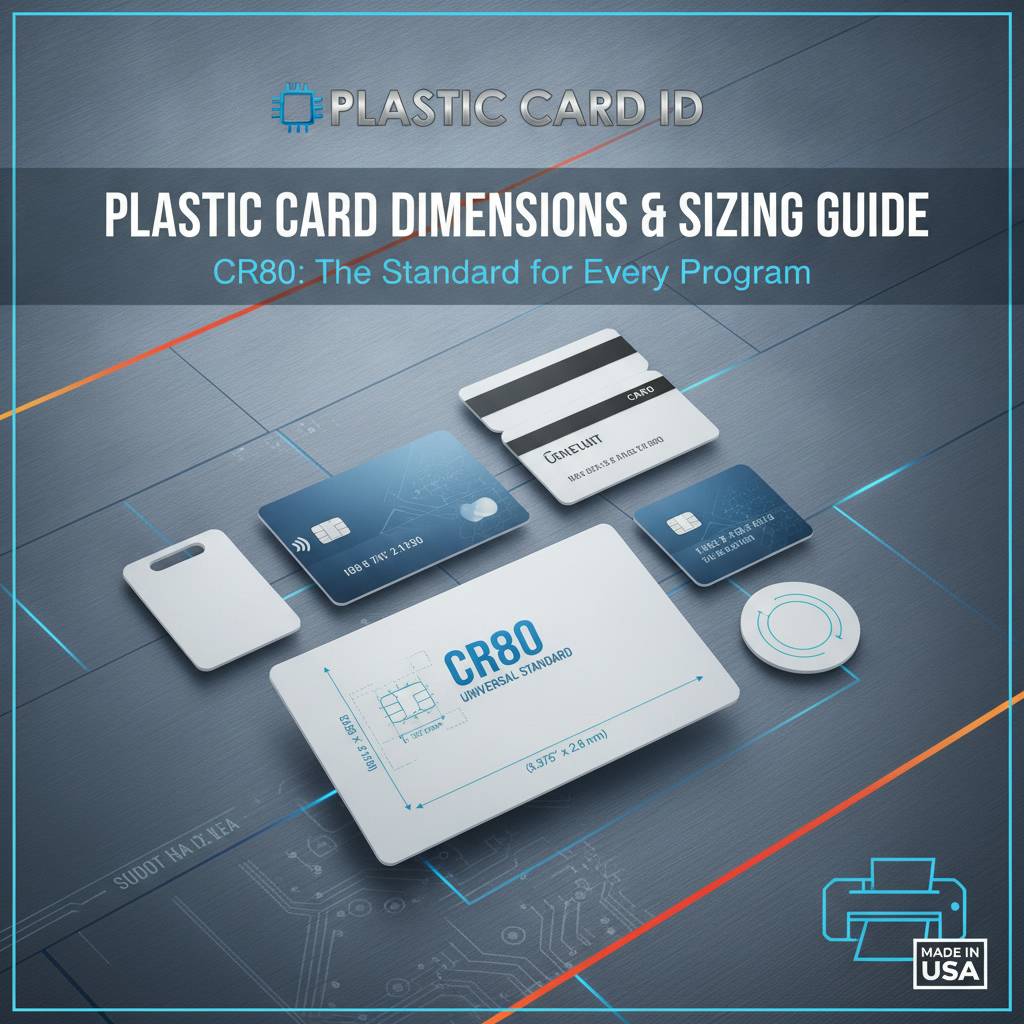 The CR80 is the undisputed workhorse of the plastic card industry. At 3.375 inches wide and 2.125 inches tall with a thickness of 30 mil, it matches the dimensions of a standard credit card precisely. This is not a coincidence - it is the result of the ISO 7810 ID-1 specification, which defines exactly these measurements to ensure universal compatibility. Every card printer in Plastic Card ID's lineup - whether from Evolis, Zebra, or Fargo - is designed to accept CR80 cards as the default format.
For businesses that are just launching a card program, the CR80 format is the natural starting point. It fits into virtually every wallet, badge holder, lanyard clip, card reader, and mailer accessory on the market. There is no compatibility guesswork. You order CR80 cards, load them into a compatible printer, and your card program is running. The simplicity of standardization is genuinely powerful, and it is why the CR80 format has dominated the industry for decades without any serious challenger to its position.
Blank CR80 Cards: Maximum Flexibility at Minimum Cost
Blank CR80 PVC cards give organizations total design control and the ability to print exactly what they need, when they need it. Rather than ordering pre-printed cards that must be discarded if information changes, blank cards allow on-demand personalization. An employee card printed in-house today can include that employee's photo, name, title, and department - information that would be impossible to pre-print on a large order of custom cards.
The economics are compelling as well. Blank cards carry a lower per-unit cost than pre-printed cards, and when combined with an in-house card printer, the total cost per card over the life of a program is consistently lower than outsourced printing. Organizations that issue even a few hundred cards per year typically find that an in-house setup pays for itself within the first year or two of operation.
30 Mil Thickness: Why It Matters for Printers and Readers
Thirty mil (0.76 mm) is the standard thickness for CR80 cards, and it is the dimension that most directly affects printer compatibility. Card printers are calibrated to feed, transport, and eject cards of this specific thickness. Using cards that are too thin can cause feed errors or misalignment. Using cards that are too thick can jam the printer or damage the print head. Always verify thickness specifications before ordering in bulk.
The 30 mil standard also affects magnetic stripe performance. The stripe must sit at the correct height relative to the card surface and at the correct distance from the card edge to align with the read heads in standard swipe and dip readers. When you order CR80 cards from CPE, these specifications are already built in - no guesswork, no field-calibration surprises.
CR80 and Badge Accessories: A Perfect Match
One of the underappreciated advantages of the CR80 format is its universal compatibility with badge accessories. Slot punches, badge holders, lanyards, badge reels, card sleeves, and card carriers are all manufactured to CR80 dimensions as the default. This means that when you build a card program around the CR80 standard, every accessory in the ecosystem simply works.
Plastic Card ID stocks a full range of card accessories including carriers, sleeves, and affixing and mailing services - making it genuinely possible to run your entire card program through a single supplier. Call 800.835.7919 to discuss bundling card orders with accessories for your program. The time savings alone are worth the conversation.
Specialty Card Sizes: When Standard Is Not Enough
Most programs run beautifully on CR80. But there are legitimate reasons to go outside the standard dimensions, and understanding when and why to do so can give your card program a meaningful edge. Specialty sizes communicate intentionality - they tell the recipient that this card was designed thoughtfully for a specific purpose, not just pulled from a generic pile of blanks.
From oversized cards used in driver license programs to compact cards designed for specific badge holders, the card industry has developed a range of formats that serve niche but important functions. Plastic Card ID offers multiple specialty formats, and the team can help you identify which size makes sense for your specific application based on the readers, printers, and accessories already in your environment.
CR79: The Slot-Punch Specialist
The CR79 card measures 3.303 inches by 2.051 inches - slightly smaller than the CR80 on all sides. This reduction is deliberate. CR79 cards are designed to be used with adhesive overlaminates that add a thin protective layer to both card faces, bringing the final dimensions up to approximately CR80 size. For programs that require durable laminated cards, the CR79 format is the technically correct starting point.
These cards are also popular for slot-punch applications, where the smaller dimensions allow more precise punch placement relative to the card edge. Organizations running high-volume badge programs with specific slot requirements sometimes find the CR79 format gives them better consistency in badge holder fit. It is a subtle difference, but in high-volume operations, subtlety becomes significant at scale.
CR100: Driver License Dimensions and Oversized Specialty Cards
At 3.88 inches by 2.63 inches, the CR100 format is noticeably larger than a standard credit card. This is the format used in US driver license programs, which is why it is sometimes called the "driver license size." For organizations issuing state-style ID cards or specialty credentials that need to carry more printed information than a CR80 allows, the CR100 offers that additional real estate.
The tradeoff is that CR100 cards require printers specifically configured to handle the larger format, and they will not fit in standard CR80 badge holders or card sleeves. If you are considering a CR100 program, it is worth auditing your entire accessory and reader ecosystem before committing to the format. The CPE team can walk you through compatibility questions before your first order.
Thin Cards: 10 Mil and What They Are Actually Used For
Ten mil cards carry the same CR80 width and height dimensions but are only 0.25 mm thick - roughly one-third the thickness of a standard card. These are not meant for card readers or printers in the conventional sense. Instead, they are used for direct mail insert programs, card carrier attachments, and applications where the card needs to be lightweight enough to qualify for standard postage rates.
Retailers and financial marketers have used 10 mil cards for decades as a cost-effective way to send plastic to customers through the mail. The card looks and feels like a real card, communicates the permanence and legitimacy of plastic, but arrives without triggering oversized postage charges. It is a clever format that serves a specific niche exceptionally well.
Magnetic Stripe, RFID, and Smart Chip: How Encoding Affects Sizing Choices
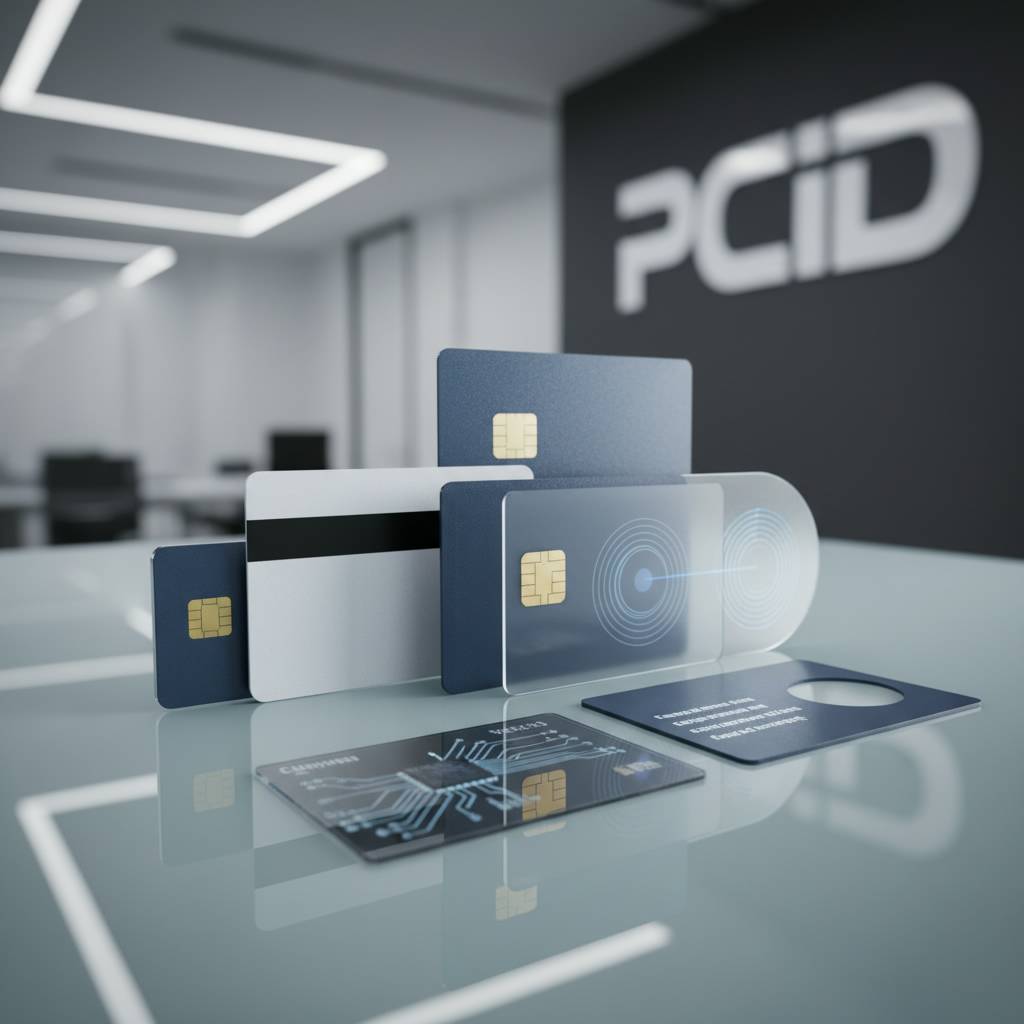 The physical dimensions of a card are only part of the sizing story. What is embedded or encoded into a card affects its internal construction - and in some cases, its thickness and rigidity. Understanding how different encoding technologies interact with card dimensions helps buyers choose the right card specification from the very beginning, rather than discovering compatibility issues after production.
Plastic Card ID offers the full spectrum of encoded card types: magnetic stripe cards in both HiCo and LoCo formulations, RFID and proximity cards, and smart chip cards including contactless options with MIFARE DESFire technology. Each has specific dimensional considerations that are worth understanding before you commit to a format.
Magnetic Stripe Cards: Track Placement and Card Dimensions
Magnetic stripe cards follow ISO standards that define not just the card's outer dimensions, but the exact placement, width, and position of each magnetic track. There are three standard tracks, and the stripe itself must be positioned within a specific distance from the card's long edge. These measurements ensure compatibility with the millions of magnetic read heads deployed in card readers across the country.
HiCo (high coercivity) stripes offer greater resistance to accidental erasure and are the standard choice for most business card programs - gift cards, loyalty cards, hotel keys, and membership cards. LoCo (low coercivity) stripes are used in applications where the card will not be exposed to strong magnetic fields. Both options are available in standard CR80 dimensions, and the choice between them is a functional one, not a dimensional one.
RFID and Proximity Cards: The Hidden Antenna
RFID and proximity cards look identical to a standard CR80 from the outside, but they contain an embedded antenna coil and a microchip sealed within the card's laminate layers. The antenna must be sized to fit within the card's physical dimensions while still providing adequate read range for the target reader. This internal architecture is why RFID cards are typically slightly stiffer than blank PVC cards.
Proximity cards operate at 125 kHz and are widely used in access control applications across corporate campuses, apartment buildings, and government facilities. RFID smart cards, including those using MIFARE DESFire technology, operate at 13.56 MHz and offer significantly more data capacity and security. Both formats fit into standard CR80 badge holders and accessories - the technology is invisible, but the compatibility is built in.
Smart Chip Cards: Contact Pad Positioning
Smart chip cards feature an exposed gold contact pad on the card face, positioned according to ISO 7816 specifications. The pad location is standardized to align with contact readers in specific equipment types. Any deviation from the specified position would render the card incompatible with the readers it is designed to serve. This is another dimension where the ISO standards framework quietly does enormous work.
For organizations running sophisticated access control, casino player tracking programs, or hotel key card systems, smart chip cards offer security and data capacity that magnetic stripe cards simply cannot match. Plastic Card ID supplies smart chip cards to programs of all scales - from boutique hotels managing a few hundred rooms to casino operations tracking thousands of active players simultaneously.
Choosing the Right Card Thickness for Your Program
Thickness might be the most underappreciated dimension in card specification. Everyone thinks about width and height because those are the dimensions you can see when a card is lying flat on a table. But thickness determines how a card feels in the hand, how it performs in a printer, and how long it survives in a wallet or badge holder under real-world use conditions. Getting thickness right is not optional - it is foundational.
The card industry uses "mil" as its standard unit of thickness measurement, where one mil equals one-thousandth of an inch. The 30 mil standard (0.030 inches, or approximately 0.76 mm) is the ISO 7810 specification for ID cards and is the default thickness for the vast majority of card programs. Other thicknesses exist and serve legitimate purposes, but 30 mil is the starting point for most buyers.
Understanding Mil Measurements: A Quick Reference
- 10 mil (0.25 mm): Thin, flexible cards used primarily for direct mail insert programs and card carrier applications. Not suitable for standard card printers or readers.
- 20 mil (0.50 mm): Intermediate thickness used in some specialty applications. Less common than 30 mil but occasionally specified for specific printer models.
- 30 mil (0.76 mm): The ISO 7810 standard and the most widely supported thickness across printers, readers, badge holders, and accessories. The correct choice for the vast majority of card programs.
- 40 mil (1.02 mm): Thicker than standard, used in some specialty keytag and heavy-duty badge applications. Requires printer models specifically rated for the thicker format.
When in doubt, 30 mil is the answer. It is the specification that all standard equipment is calibrated to accept, and it delivers the professional heft and feel that recipients associate with a credible, well-run card program. Lighter cards feel cheaper; heavier non-standard cards cause equipment headaches. The standard exists for good reason.
Luxury and Metal Cards: When Thickness Becomes a Feature
At the premium end of the spectrum, luxury metal cards in stainless steel, brass, and gold represent a category where thickness is not just a technical specification but a deliberate design statement. Metal cards are substantially heavier and thicker than standard PVC cards, and they are not designed to be printed on standard ID card printers. They are produced to order as finished products, typically for premium membership programs, VIP customer recognition, or executive ID applications.
The weight of a metal card is a sensory experience in itself. When a customer pulls a metal membership card from their wallet, the tactile difference from every other card they carry is immediate and unmistakable. For programs where brand differentiation and perceived value are primary objectives, the premium cost of metal cards is frequently justified by the impact they create at the point of presentation.
Clear and Frosted Cards: Specialty Finishes with Standard Dimensions
Clear and frosted PVC cards maintain the standard CR80 dimensions and 30 mil thickness, but their visual properties are dramatically different from opaque white stock. Clear cards allow background imagery to show through the card itself, creating layered visual effects that standard white cards cannot achieve. Frosted cards offer a translucent, premium matte appearance that photographs beautifully and feels distinctive in the hand.
Both formats are compatible with standard card printers and work with the same ribbons, badge holders, and accessories as standard white cards. The specialty finish does not require any special handling or equipment adjustments. For loyalty programs, membership cards, and event credentials where visual impact is a priority, clear and frosted formats offer a meaningful upgrade over standard white stock at a modest incremental cost.
Buyer's Guide: Matching Card Dimensions to Your Specific Application
Knowing the dimensions is one thing. Knowing which dimensions to specify for your specific application is another challenge entirely. The following breakdown maps common card program types to their optimal dimensional specifications, drawing on Plastic Card ID's experience serving more than 100,000 customers across every industry that uses plastic cards. This is the practical translation of technical specifications into real-world decisions.

Every organization is different, and the right card specification depends on your existing equipment, your distribution method, your encoding requirements, and your budget. But for the most common card program types, the optimal specifications have been well established by years of field experience. Use this section as a starting point, then call CPE to confirm the details for your specific situation.
Loyalty and Gift Card Programs
Loyalty and gift card programs are among the most common applications for plastic cards in retail and hospitality. Retailers who switch from paper punch cards to plastic loyalty cards consistently see measurable increases in program participation and customer retention. The permanence of a plastic card - its ability to live in a wallet alongside credit cards - means it stays in front of the customer every time they reach for their wallet.
For most loyalty and gift card programs, the optimal specification is CR80, 30 mil, white PVC with a HiCo magnetic stripe. This configuration is compatible with virtually every point-of-sale card reader on the market, can be printed in-house on any standard card printer, and delivers the professional look that reinforces brand credibility. Blank cards can be ordered in quantity and personalized as needed, or ordered pre-printed in custom designs.
Employee ID and Access Control Cards
Employee ID programs have unique requirements because they frequently need to serve dual purposes: visual identification and physical access control. A card that displays a photo, name, and department is a visual ID. A card that also unlocks a door is an access control credential. When one card must do both jobs, the specification typically combines CR80 30 mil dimensions with either a proximity chip for access control or a magnetic stripe for time-and-attendance systems.
Contact 800.835.7919 to discuss combination card specifications that meet both visual ID and access control requirements in a single CR80 format. The team can also advise on the right card printers and ribbons for in-house personalization of combination cards, including which printer models handle encoding and printing in a single pass for maximum efficiency.
Event Credentials, Membership Cards, and Specialty Applications
Event credentials have a short use life but a high visibility requirement. Convention badges, concert credentials, and conference access cards are seen by many people during a single day. For these applications, the CR80 format in standard 30 mil delivers the professional look appropriate for the setting, and the relatively low per-card cost makes large event runs economically feasible.
Membership cards for clubs, associations, gyms, and professional organizations benefit from the permanence that plastic conveys. A plastic membership card signals that the organization is serious, established, and invested in its members' experience. For specialty applications like casino player cards, hotel key cards, or custom die-cut shapes, Plastic Card ID offers formats and options well beyond the standard catalog - including consultation on which specifications are compatible with the specific reader infrastructure already in place at a facility.
Your Next Step Starts with Plastic Card ID
Understanding plastic card dimensions is the foundation of every successful card program. From the CR80 standard that powers millions of ID, loyalty, and membership programs nationwide, to specialty formats like CR79 for laminated badges, CR100 for oversized credentials, and metal cards for premium applications, every dimension serves a purpose and every specification has a reason. The right choice is the one that matches your equipment, your readers, your accessories, and your program goals.
Plastic Card ID has spent more than 25 years in this industry for exactly this reason: to be the knowledgeable, reliable partner that helps organizations make the right call the first time. With a catalog spanning blank PVC cards, magnetic stripe cards, RFID and proximity cards, smart chip cards, clear and frosted stock, custom die-cut formats, and luxury metal cards - plus every printer, ribbon, cleaning kit, and accessory needed to run a complete program - there is genuinely no reason to shop around.
Call Plastic Card ID today at 800.835.7919 and speak with a card program specialist who will help you identify the exact dimensions, formats, and quantities that make your program work from day one. The right card, the right size, the right spec - let's get your program built correctly from the start.
Previous Page