Blank Plastic Cards for Healthcare Worker IDs: Reliable Options
Table of Contents []
- Why Plastic Card ID Is the Trusted Source for Healthcare ID Cards
- Types of Blank Plastic Cards Available for Healthcare Worker IDs
- Choosing the Right Card Printer for Your Healthcare Facility
- Value-Added Supplies That Complete Your Healthcare ID Program
- Frequently Asked Questions About Blank Plastic Cards for Healthcare Worker IDs
- Real-World Applications of Blank Plastic Cards in Healthcare Settings
- Plastic Card ID Is Ready to Support Your Healthcare ID Program Today
Blank Plastic Cards for Healthcare Worker IDs
| Card Type | Best Use | Common Encoding |
|---|---|---|
| Blank CR80 PVC Cards | Staff photo ID, printed badges | None (print-ready) |
| HiCo Magnetic Stripe Cards | Time and attendance, cafeteria | High-coercivity mag stripe |
| Proximity / RFID Cards | Door access, secure zones | 125 kHz or 13.56 MHz |
| Smart Chip Cards | High-security credentialing | MIFARE, contact chip |
| Clear / Frosted PVC Cards | Specialty overlay ID badges | None or mag stripe |
Why Plastic Card ID Is the Trusted Source for Healthcare ID Cards
Healthcare environments demand something most industries simply don't: an ID card that works correctly every single time. Whether it's a nurse walking into a secure medication room or a lab technician swiping into a restricted corridor, the card in their badge holder has to perform. That's where blank plastic cards for healthcare worker IDs become far more than a purchasing decision - they become an operational cornerstone.
Plastic Card ID has spent over 25 years supplying blank and custom plastic cards to healthcare organizations, clinics, hospital networks, and medical offices across the United States. With more than 100,000 customers served and over 50 million cards sold, the depth of experience here is not theoretical - it's earned through real-world programs at every scale imaginable.
What separates CPE from an ordinary vendor is the strategic perspective. Rather than simply shipping a box of cards, the team here helps you think through your program - card type, encoding, printer compatibility, quantities, and reorder strategy. That kind of partnership matters enormously when you're running a credential program for 200 nurses across three shifts.
The Case for Plastic Over Paper in Healthcare Settings
Paper badges fall apart. Plastic cards don't. In high-traffic healthcare environments - laundries, break rooms, sterile corridors, outdoor loading docks - a paper credential degrades fast. A CR80 PVC card at 30 mil thickness, built to ISO 7810 standard, holds its shape, holds its print, and holds its magnetic or RFID encoding through daily abuse.
Beyond durability, there is a professionalism signal that plastic cards send to patients and visitors. When a staff member presents a crisp, laminated-quality ID card, it communicates legitimacy. That matters in environments where patient trust is earned, not assumed. A flimsy paper badge with a typed name does the opposite.
Serving Healthcare Programs at Every Scale
A small urgent care clinic printing 50 employee IDs per month has very different needs than a regional hospital network credentialing 3,000 staff annually. Plastic Card ID is built to serve both - and every point in between. Low minimum orders mean small facilities aren't forced into buying more than they need. High-volume pricing tiers make large programs cost-efficient without requiring a custom contract negotiation.
Scalability without complexity is one of the most underrated features of working with a supplier who truly specializes in plastic card programs. When your facility expands, you simply order more cards. Same SKU, same quality, same fast turnaround. That consistency is invaluable for healthcare HR and security departments managing ongoing onboarding.
What "Blank" Actually Means for Your Program
The word "blank" can mislead people into thinking these cards are somehow incomplete. They're not. A blank CR80 PVC card is a fully finished, professionally manufactured credential substrate - ready to receive whatever your in-house card printer outputs. Your design, your employee photo, your department color code, your logo. Total control.
This is exactly why so many healthcare facilities choose blank cards over pre-printed stock. Onboarding a new hire? Print their card on-site the same day. Terminating an employee? Invalidate and reissue without waiting on an outside printer. In-house printing powered by blank cards gives healthcare organizations speed and control that pre-printed programs simply cannot match.
Types of Blank Plastic Cards Available for Healthcare Worker IDs
 Not every healthcare worker ID is the same card. A volunteer at the front desk needs something different from a surgeon entering an operating theater. Understanding the card landscape helps you build a smarter, layered credentialing program - and CPE carries the full range.
The selection spans blank PVC, magnetic stripe options in both HiCo and LoCo configurations, proximity and RFID cards, smart chip cards, and specialty options like clear and frosted PVC. Each category serves a distinct function within a healthcare ID program, and many facilities combine two or three card types across different staff tiers.
Blank CR80 PVC Cards: The Foundation of Any ID Program
Standard blank CR80 cards at 30 mil are the backbone of most healthcare worker ID programs. They're the same dimensions as a credit card, they load cleanly into virtually every card printer on the market, and they deliver crisp, vivid print results using dye-sublimation or direct-to-card printers. Quantities typically run from small packs to thousands of cards, with per-card cost dropping significantly at volume.
These cards accept full-color printing, UV-protective overlaminates applied in-printer, and optional magnetic stripes or RFID technology if you upgrade to encoded versions. For facilities that only need a printed photo ID for visual verification purposes, standard blank PVC is the most economical and versatile starting point.
Magnetic Stripe Cards for Time, Attendance, and Cafeteria Systems
Hospitals and large medical campuses often need cards that do more than display a photo. Magnetic stripe cards encode staff data directly onto the card, enabling swipe-based time and attendance tracking, cafeteria account access, library check-out systems, and basic door access in lower-security zones. Plastic Card ID carries both HiCo (high-coercivity) and LoCo (low-coercivity) options.
HiCo cards are the right choice for healthcare environments - they're far more resistant to demagnetization from everyday sources like cell phones, magnetic clasps on bags, and the general electromagnetic environment of a modern medical facility. LoCo cards work fine for short-term or lower-security applications where data integrity over years of use isn't a priority.
For assistance choosing between HiCo and LoCo magnetic stripe cards for your healthcare program, reach out directly at 800.835.7919 - the team can walk through your specific use case.
RFID and Proximity Cards for Access Control
When healthcare facilities implement controlled access - medication rooms, server rooms, pediatric wards, surgical suites - proximity and RFID cards become essential. These contactless cards communicate with readers without ever needing to be inserted or swiped. A quick tap or wave within range is all it takes, which is ideal in environments where staff may have gloved hands or be carrying equipment.
Proximity cards operating at 125 kHz are the most common in existing healthcare access control systems. RFID smart cards at 13.56 MHz, including options with MIFARE DESFire technology, offer higher security encryption for facilities with more demanding credentialing requirements. Plastic Card ID stocks both frequency ranges, so compatibility with your existing reader infrastructure is straightforward to achieve.
Choosing the Right Card Printer for Your Healthcare Facility
Blank cards are only half the equation. The printer you use to produce your healthcare worker IDs determines print quality, throughput speed, encoding capability, and total cost per card over time. Plastic Card ID carries a full lineup of professional card printers from three of the most respected brands in the industry: Evolis, Zebra, and Fargo.
Selecting a printer is not just about upfront price. A single-sided printer at $500-$800 might seem budget-friendly, but if your program requires dual-sided ID cards with encoded magnetic stripes, you'll outgrow it quickly. The right conversation is about volume, features, and five-year total cost of ownership - and that's exactly the kind of conversation CPE is built for.
Evolis Printers: Reliable Performance at Every Level
Evolis printers are a go-to for healthcare facilities that value reliability and user-friendly operation. Models like the Evolis Primacy and Badgy series print high-definition, photo-quality cards with minimal operator training. For a clinic onboarding staff periodically rather than continuously, Evolis delivers consistent results without demanding a dedicated operator.
Evolis printers support optional magnetic stripe encoding modules, making them versatile as your program evolves. Ribbons, cleaning kits, and replacement parts are all stocked by Plastic Card ID, so you're never left waiting on a supplier to source a consumable when your printer needs maintenance.
Zebra Printers: Built for High-Volume Healthcare Programs
Zebra card printers are the workhorses of high-throughput environments. Hospital networks printing hundreds of cards per month trust Zebra for consistent, durable output and robust encoding support. Zebra's ZC and ZXP series handle magnetic stripe encoding, RFID encoding, and dual-sided printing in a single pass - a critical efficiency advantage when processing large onboarding classes.
Zebra printers also integrate readily with most healthcare HR and access control software platforms, minimizing setup friction. When your facility's IT team is already managing complex systems, a printer that plays well with existing infrastructure is worth every dollar of its slightly higher price point.
Fargo Printers: Security-Focused Credentialing
For healthcare organizations where credential security is paramount - academic medical centers, government-affiliated hospitals, facilities with sensitive research programs - Fargo printers offer advanced features like holographic overlaminates, custom watermarks, and dual-sided simultaneous printing. The Fargo HDP series uses retransfer printing technology to produce edge-to-edge, highly durable cards that are extremely difficult to counterfeit.
Fargo printers sit at the higher end of the price range, typically $1,200-$4,500 depending on configuration, but the per-card quality and security features justify the investment for organizations where ID integrity is non-negotiable. Plastic Card ID supplies Fargo ribbons, overlaminates, and cleaning supplies to keep these systems running at specification.
Value-Added Supplies That Complete Your Healthcare ID Program
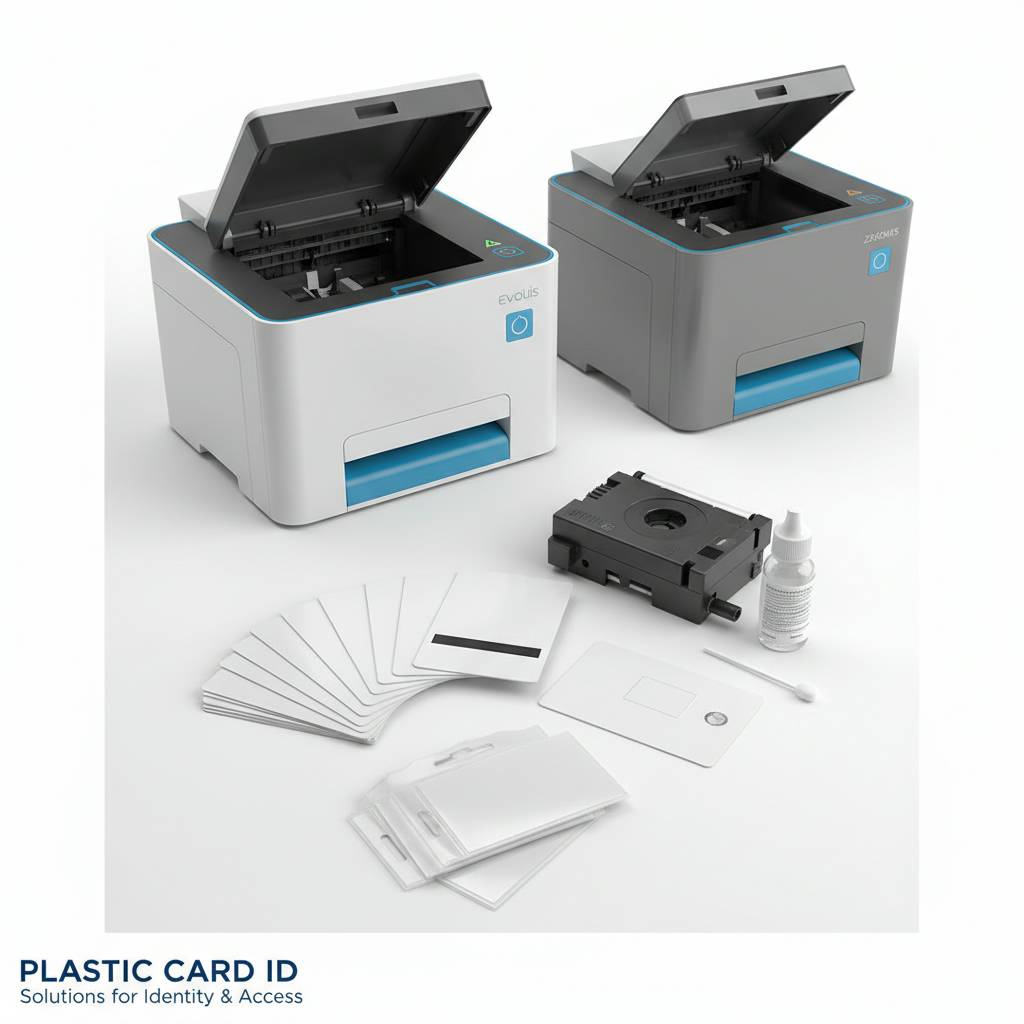 Cards and printers are the core of any ID program, but the supporting supplies determine how smoothly the whole operation runs day to day. Plastic Card ID functions as a true one-stop shop, carrying every accessory and consumable your healthcare facility needs to manage a complete card program without chasing down multiple vendors.
Printer Ribbons and Cleaning Kits
Using the wrong ribbon for your printer is one of the most common and costly mistakes organizations make. Off-brand or incompatible ribbons produce faded prints, damage print heads, and void warranties. Plastic Card ID stocks manufacturer-matched ribbons for Evolis, Zebra, and Fargo printers, so you're always using the right consumable for your specific model.
Cleaning kits are equally important and frequently overlooked. A printer that isn't cleaned on schedule produces degraded image quality and experiences premature mechanical failures. Cleaning cards and swabs, used at manufacturer-recommended intervals, extend the life of your printer significantly - protecting what is often a $1,000 or more capital investment.
Card Carriers, Sleeves, and Badge Holders
Once your healthcare worker IDs are printed, they need to be presented and protected properly. Card sleeves protect cards from scratching and moisture during daily wear. Badge holders and lanyards allow staff to display their ID cards per facility requirements, whether that means front-facing photo display, clip attachment, or retractable reel for swipe access.
For facilities that mail ID cards to remote staff, travelers, or home-health workers, CPE also offers card carriers designed specifically for mailing - protecting cards in transit and presenting them professionally upon arrival. These small details matter when your ID program is the first impression a new hire gets of their organization's standards.
Card Affixing and Mailing Services
Some healthcare organizations - particularly those with distributed staff across multiple locations or large onboarding waves - need cards produced and mailed rather than picked up on-site. Plastic Card ID offers card affixing and mailing services that take the logistical burden off your HR or security team completely. Cards arrive ready to use, professionally packaged, and delivered to the right person at the right address.
This service is particularly valuable for traveling nurses, home health aides, and telehealth support staff who may never set foot in a central office but still require a professional, valid healthcare worker ID. Combining blank card production with mailing fulfillment is the kind of end-to-end solution that separates a strategic supplier from a simple card seller.
Frequently Asked Questions About Blank Plastic Cards for Healthcare Worker IDs
Healthcare HR managers, security directors, and operations teams come to Plastic Card ID with consistent questions when building or scaling a card program. Below are the most common questions and straightforward answers to help you make confident purchasing decisions.
What quantity should I order to start?
There's no universal right answer, but a good rule of thumb is to order enough cards to cover 3-6 months of projected usage, plus a 10-15% buffer for reprints, replacements, and new hires. For a clinic issuing 50 cards per month, a starting order of 300-400 cards makes sense. For a hospital system onboarding hundreds of staff, larger volume orders capture better per-card pricing.
Plastic Card ID accommodates orders at all sizes, with no inflated minimums designed to force overbuying. If you're not sure where to start, a quick conversation at 800.835.7919 will help you calculate the right quantity for your specific situation and budget.
Common Questions at a Glance
- Are blank CR80 cards compatible with all card printers? Yes - standard CR80 30 mil cards work in virtually all desktop card printers from major brands.
- What's the difference between HiCo and LoCo magnetic stripe cards? HiCo cards resist demagnetization far better and are recommended for most healthcare environments.
- Can I print on proximity or RFID cards? Yes - RFID cards have a printable surface just like standard PVC cards, so you get both visual ID and contactless function.
- How long do PVC cards last under daily healthcare use? Properly printed CR80 PVC cards typically last 3-5 years under normal daily wear, depending on handling.
- Do you offer bulk pricing for large healthcare networks? Yes - volume pricing is available and scales meaningfully at higher quantities.
- What if I need cards in multiple configurations for different staff tiers? CPE can supply different card types in a single order to support tiered credentialing programs.
Can Small Clinics Benefit from In-House Card Printing?
Absolutely - and often more dramatically than large facilities. A small clinic that previously outsourced ID printing to a third party typically waited days or even weeks for cards to arrive, paid per-card design fees, and had no flexibility to update information quickly. Switching to an in-house setup with blank PVC cards and a desktop printer like an Evolis Badgy eliminates all of those friction points.
The upfront cost of a starter card printer ($300-$700 for an entry-level model) pays for itself quickly when you factor in eliminated rush fees, per-card vendor markups, and the value of being able to print a badge on the spot for a new hire starting that morning. In-house printing gives small healthcare facilities enterprise-level credential agility at a fraction of the outsourced cost.
Real-World Applications of Blank Plastic Cards in Healthcare Settings
The versatility of blank PVC cards means they're not just for photo IDs. Across healthcare environments, these same cards serve multiple operational functions - often within the same facility running separate programs for different departments or staff categories.
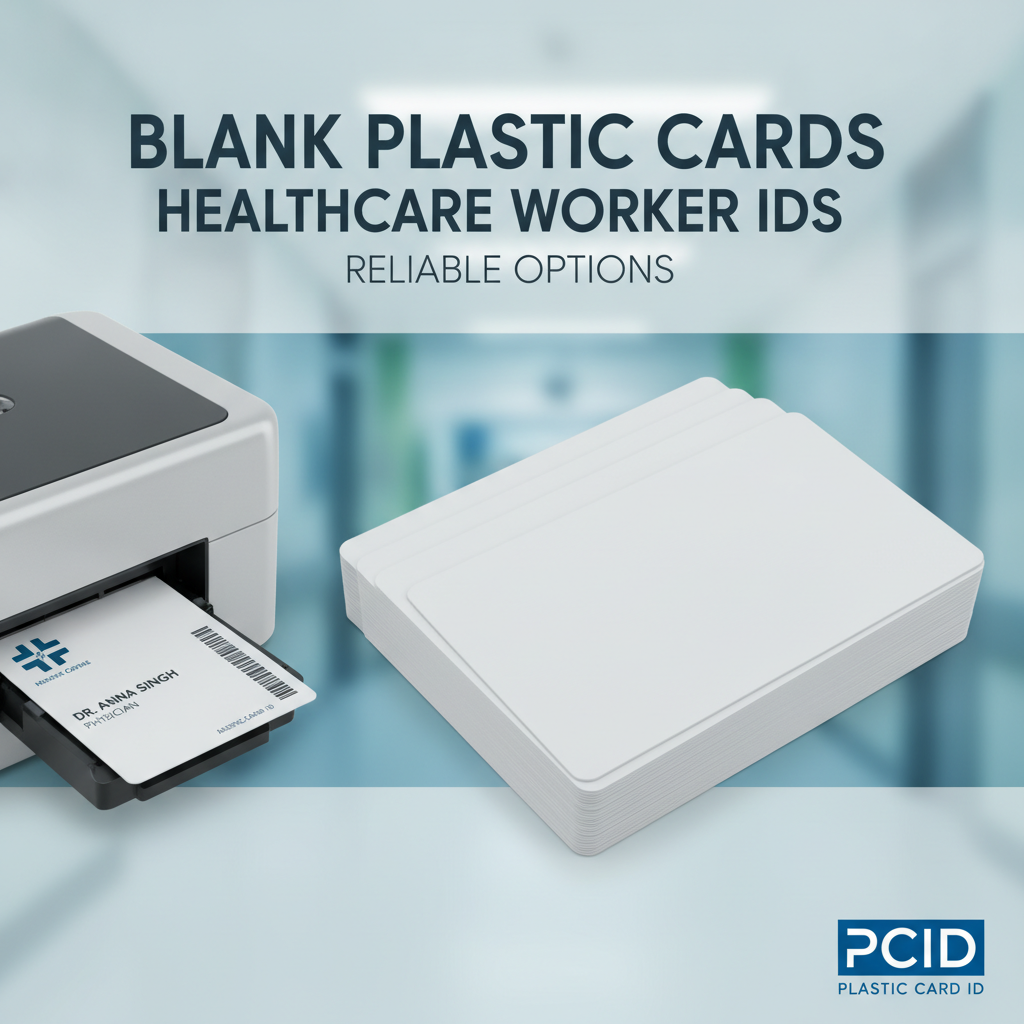
Understanding the full range of what a blank card program can accomplish helps healthcare administrators see the complete return on their investment, not just the cost-per-card figure on an invoice.
Employee Photo ID Badges
The most fundamental application: a printed, laminated-quality photo ID that identifies the cardholder by name, role, department, and sometimes employee number. Printed in-house on blank CR80 PVC using a dye-sublimation printer, these cards produce hospital-grade quality that holds up through months of daily wear, washing machine accidents, and badge-holder friction.
Color-coding by department - blue for nursing, red for administration, green for facilities - is a common approach that adds a visual layer of access identification at a glance. Blank cards in colored stock options make this even easier, with the card color itself serving as the department indicator before any printing takes place.
Access Control Credentials
Proximity and RFID cards printed with staff photos and names serve double duty - they're both a visual identification credential and a functional access control token in a single card. This combination is standard practice in modern hospital security programs, eliminating the need for staff to carry separate access fobs and ID badges.
Layered access control using encoded cards is one of the most impactful investments a healthcare facility can make in staff and patient safety. Restricting medication rooms, pediatric units, data centers, and executive areas to only credentialed personnel becomes manageable and auditable when access is card-based rather than key-based.
Temporary and Contractor Credentials
Hospitals routinely host contract workers, agency nurses, visiting physicians, equipment service technicians, and construction crews during facility expansion. Managing temporary credentials with blank PVC cards is fast and economical. Print a limited-access card on-site, assign it a credential profile in your access control system with an expiration date, and reclaim it when the contractor's engagement ends.
This approach gives security teams full control over who is in the building without the cost or complexity of a separate credential platform for temporary staff. CPE supplies blank cards at quantities that accommodate both permanent staff programs and supplemental temporary credential stock without requiring separate SKUs for each application.
Plastic Card ID Is Ready to Support Your Healthcare ID Program Today
From a 50-card-per-month urgent care clinic to a multi-campus hospital network credentialing thousands of staff annually, Plastic Card ID has the card inventory, printer lineup, and program expertise to build exactly what your healthcare organization needs. Over 25 years of experience, 100,000-plus customers, and 50 million cards shipped are not just statistics - they are the track record of a supplier that understands what serious card programs require.
Blank plastic cards for healthcare worker IDs are not a commodity purchase. They are a foundational investment in staff identification, patient safety, access security, and operational continuity. Choosing the right supplier - one who treats your program as a partnership rather than a transaction - makes the difference between a card program that runs smoothly for years and one that creates constant headaches for your HR and security teams.
Whether you need standard blank CR80 PVC cards to get started, magnetic stripe cards for time-and-attendance integration, RFID smart cards for high-security access control, or a full printer and supplies package that launches your in-house program from day one, CPE has it in stock and ready to ship.
Contact Plastic Card ID today and let's build a healthcare worker ID program that performs as well as your staff does. Call 800.835.7919 now - your team deserves credentials as professional as the care they deliver.
Previous Page