Blank Plastic Cards for School ID Cards: Safe Choices
Table of Contents []
- Blank Plastic Cards for School ID Cards - Your Complete Guide from Plastic Card ID
- Why Schools Choose Blank PVC Cards for In-House ID Programs
- Choosing the Right Blank Card for Your School's Specific Needs
- Card Printers, Ribbons, and Accessories for School ID Offices
- FAQ: Blank Plastic Cards for School ID Programs
- What Sets Plastic Card ID Apart as a School ID Card Supplier
- Get Started with Plastic Card ID for Your School ID Card Program Today
Blank Plastic Cards for School ID Cards - Your Complete Guide from Plastic Card ID
School ID programs are deceptively complex. What looks like a simple laminated card is actually the intersection of security, student welfare, operational efficiency, and institutional identity - all compressed into a wallet-sized piece of plastic. Getting that card right matters. A lot.
Plastic Card ID has supplied blank plastic cards to educational institutions across the United States for over 25 years, working with schools ranging from small private academies to sprawling university systems. With more than 100,000 customers served and 50 million cards shipped, the team understands what school administrators actually need - not just what sounds good in a product description.
Whether your district prints 200 cards at the start of each academic year or your university ID office processes thousands each semester, the foundation of every successful in-house card program is the same: a reliable, high-quality blank plastic card that works consistently with your printer, your encoder, and your workflow.
| Card Type | Best Use | Key Feature | Typical Users |
|---|---|---|---|
| Blank CR80 PVC Cards | Student ID, Staff Badge | Standard credit card size, 30 mil | K-12, Colleges, Universities |
| Magnetic Stripe Cards (HiCo) | Library access, meal plans | High-coercivity, durable encoding | K-12, Community Colleges |
| Proximity / RFID Cards | Building access, attendance | Contactless, fast transaction | Universities, Private Schools |
| Smart Chip Cards | Secure access, multi-function | Encrypted data storage | Universities, Large Districts |
| Colored Stock PVC Cards | Department color-coding | Visual differentiation | K-12, Event Credentials |
Why Schools Choose Blank PVC Cards for In-House ID Programs
 There is a quiet revolution happening in school administration offices. More and more districts and institutions are pulling card production in-house - printing, encoding, and issuing student IDs themselves rather than outsourcing the entire process. The economics alone make a compelling case. Blank CR80 PVC cards cost a fraction of fully printed cards, and when you control the printer and the workflow, per-card costs drop dramatically over time.
Beyond cost, in-house printing means speed. A new student enrolls on a Tuesday - they have a functional ID before lunch. A card is lost or damaged - replacement takes minutes, not days. That responsiveness is genuinely difficult to achieve when production is handled by an outside vendor. Schools that have made the switch consistently report operational improvements that go well beyond what the initial cost savings suggested.
The CR80 Standard - Why Size Matters
Every blank card in the standard school ID category adheres to the CR80 format - 3.375 inches by 2.125 inches, 30 mil thick. That is the same footprint as a standard credit card, and it matters because the entire ecosystem of cardholders, lanyards, badge reels, printers, and encoding equipment is built around this size. Deviating from it creates friction at every downstream step.
The 30 mil thickness is the sweet spot for durability without rigidity. Cards at this thickness resist cracking under normal use, survive trips through the laundry cycle better than thinner alternatives, and feed cleanly through virtually every major card printer on the market. For student ID programs where cards endure daily handling by young people who are - to put it diplomatically - not always gentle with their belongings, that durability is not a nice-to-have. It is essential.
ISO 7810 compliance, which all standard CR80 cards carry, ensures that your blank cards meet an internationally recognized dimensional standard. That matters when you are integrating with access control systems, library management software, or cafeteria point-of-sale systems that expect a card of precise dimensions and consistent thickness to function properly.
Magnetic Stripe Options for School Applications
Many school ID programs require more than just a printed photo and name. Magnetic stripe cards bring functional depth to student IDs - enabling library checkouts, cafeteria meal plan debits, building access logging, and attendance tracking, all from a single card that students already carry every day. The integration potential here is significant and often underutilized.
HiCo (high-coercivity) magnetic stripe cards are the preferred choice for school applications where cards will be used repeatedly at swipe terminals. HiCo stripes encode at 2750 Oe and resist accidental demagnetization from contact with common magnetic sources - locker doors, backpack clasps, other cards. LoCo cards are available for lower-frequency applications, but for an ID that students will swipe dozens of times a week, HiCo is the right call.
RFID and Proximity Cards for Campus Access
Contactless technology has become increasingly standard in university and larger K-12 settings. Proximity cards allow students and staff to tap or wave their ID near a reader to unlock doors, log attendance, or access secure areas - without the wear-and-tear associated with repeated swiping. The transaction is faster, the card lasts longer, and the access control data is more reliable.
CPE carries a full range of proximity and RFID cards, including smart chip options with MIFARE DESFire technology - one of the more sophisticated contactless standards available. For institutions building out or upgrading campus access control infrastructure, starting with the right blank card specification prevents expensive compatibility headaches down the road. The card choice drives the system choice, and getting expert guidance early saves both money and frustration.
Choosing the Right Blank Card for Your School's Specific Needs
Not all school ID programs are the same. A rural K-12 district printing 400 student IDs once a year has fundamentally different needs than a state university ID office processing new and replacement cards continuously throughout the academic year. Matching card type to institutional context is the work that separates a functional program from a great one.
The good news is that the decisions are not as complicated as they might first appear. Once you understand a few key variables - volume, functionality required, printer compatibility, and budget - the right card choice becomes reasonably clear. What Plastic Card ID brings to the conversation is 25 years of pattern recognition across thousands of school programs of every size and configuration.
Volume Considerations and Bulk Purchasing
Blank plastic cards are one of those products where volume purchasing delivers real, tangible savings. Schools that project their annual card needs and order accordingly rather than buying in reactive small batches consistently achieve better per-card economics. For a district printing 500 student IDs annually plus replacement cards throughout the year, the difference between reactive purchasing and strategic bulk ordering can be meaningful at the budget level.
Even modest-scale school programs benefit from thinking about cards as an annual supply item rather than an on-demand purchase. Storage requirements are minimal - a case of 500 CR80 blank cards occupies less space than a ream of copy paper. There is essentially no downside to having adequate stock on hand and real operational upside in terms of being able to respond to card needs immediately rather than waiting on shipment.
- Order based on annual enrollment plus a 15-20% buffer for replacements and new students
- Store blank cards in a cool, dry location away from direct sunlight to maintain print quality
- Consider ordering magnetic stripe and plain blank cards in the appropriate ratio for your program
- Check printer ribbon stock at the same time - running out of ribbon mid-semester is a common avoidable disruption
- Establish a reorder trigger point (e.g., when stock drops below 100 cards) to avoid last-minute rush orders
Compatibility with Card Printers
Blank plastic cards must be compatible with your card printer to produce quality results. Not all blank cards are created equal - variations in PVC composition, surface coating, and dimensional tolerances affect how ink adheres, how cleanly cards feed through print rollers, and how consistently encoding occurs. Using low-quality blank cards in a quality printer is a common source of frustration that is entirely avoidable.
CPE supplies blank cards confirmed compatible with the major card printer brands - Evolis, Zebra, and Fargo - which together cover the vast majority of card printers in use at educational institutions across the country. If your school is also considering a new or replacement printer, bundling the printer and card selection decision is the smartest approach - ensuring the whole system is optimized rather than just the individual components.
Specialty Card Options for Educational Settings
Beyond the standard white CR80, educational institutions have access to a broader range of blank card options that serve specific programmatic needs. Colored stock cards - available in a range of solid colors - are popular for department or role differentiation. A university might issue white cards for students, blue for faculty, and red for visitors, enabling instant visual verification of card holder category without needing to read the card.
Clear and frosted cards offer a distinctive aesthetic that some institutions use for premium applications - staff recognition cards, VIP event credentials, or specialized program identifiers. The visual differentiation that specialty card stock provides can be a genuine operational tool, not just an aesthetic choice. When security staff can identify card categories at a glance, access control becomes faster and more reliable.
Card Printers, Ribbons, and Accessories for School ID Offices
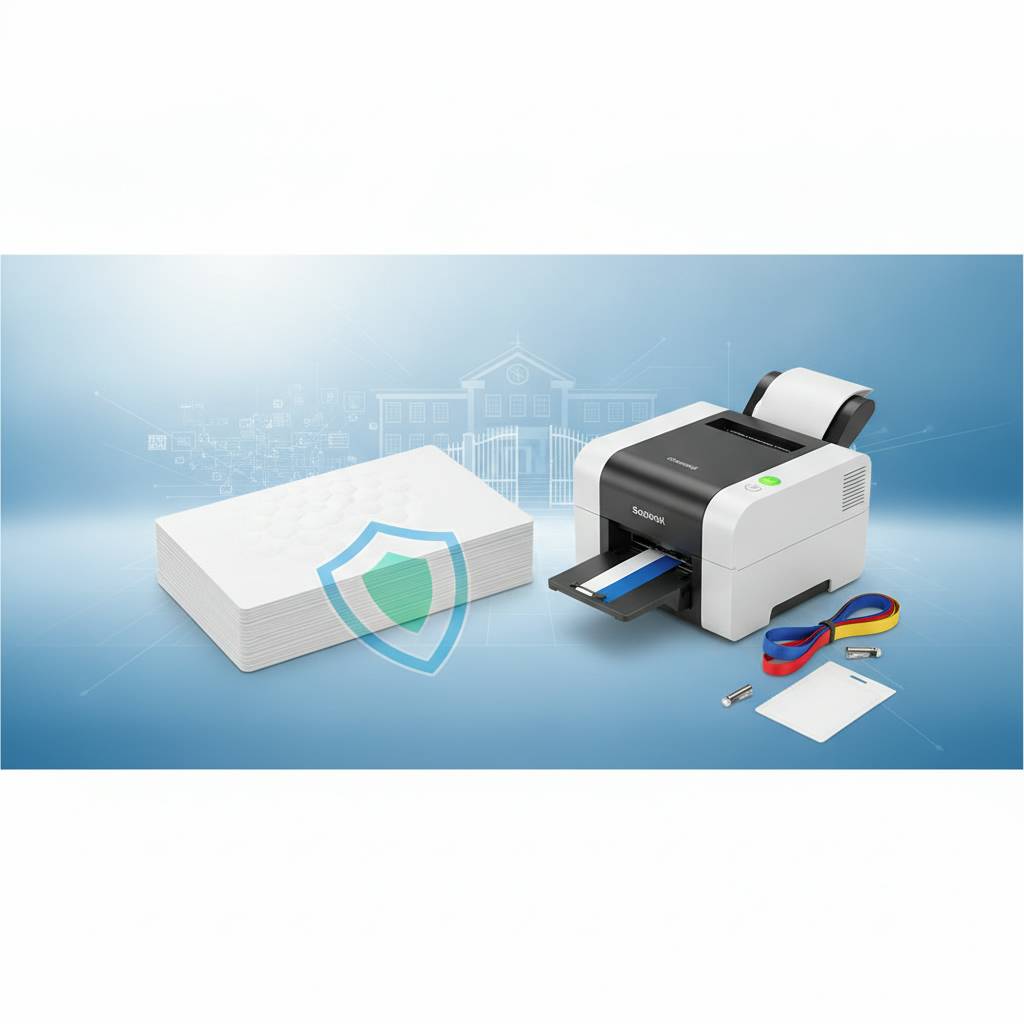 A blank plastic card is the starting point, but the full in-house ID program requires a functional ecosystem around it. The card printer is obviously central - but ribbon selection, cleaning kit maintenance, and card carrier accessories all contribute to whether the program runs smoothly or generates constant small headaches for already-stretched administrative staff.
Plastic Card ID operates as a genuine one-stop shop for school ID programs - not just the blank cards, but the printers, ribbons, cleaning kits, card sleeves, and card carriers that complete the operational picture. That means one vendor relationship, one purchasing process, and one point of contact when questions or issues arise. For administrators managing complex institutional responsibilities, that consolidation has real value.
Selecting the Right Card Printer for Your School
Card printers from Evolis, Zebra, and Fargo span a wide range of capabilities and price points. For a small K-12 school printing a few hundred cards annually, a reliable single-sided entry-level printer from Evolis may be the perfect fit. For a university ID office running high volumes with dual-sided printing, encoding, and lamination requirements, a more capable Zebra or Fargo model is appropriate. The printer decision should be matched to realistic volume and functionality projections, not to aspirational future needs that may never materialize.
Speak with CPE at 800.835.7919 to get guidance on printer selection based on your specific situation. The team has placed card printers in educational institutions of every size and configuration - that hands-on experience translates into advice that is genuinely useful rather than generically product-catalog-derived.
Printer Ribbons and Maintenance Supplies
Printer ribbons are the consumable that keeps the card program running. Using ribbons that are matched to your specific printer model and intended card stock ensures consistent print quality and protects the print head from premature wear. Mismatched ribbons are a surprisingly common cause of print quality issues and printer maintenance problems in school ID offices.
Cleaning kits are the maintenance item most often overlooked until something goes wrong. Card printers have rollers, print heads, and transport paths that accumulate debris over time - dust, card particles, and residue from the printing process. Regular cleaning cycles, using manufacturer-recommended cleaning cards and swabs, extend printer life meaningfully and prevent the kind of intermittent print quality issues that are difficult to diagnose and frustrating to live with.
Card Carriers, Sleeves, and Accessories
Once printed and encoded, school ID cards need to be distributed to students and staff in a way that protects the card during delivery and sets up good habits for ongoing care. Card carriers - the folded paper or cardstock mailers used to distribute cards - protect card surfaces from scratching during handling and provide a space for printing card use instructions or program information.
Card sleeves offer ongoing protection for cards in use - particularly useful for staff and faculty IDs that live in wallets or badge holders and accumulate surface wear over time. For schools that mail cards to students or families, Plastic Card ID also offers card affixing and mailing services - a genuinely useful option for institutions that need to distribute cards to addresses rather than collecting them in person.
FAQ: Blank Plastic Cards for School ID Programs
Over 25 years of working with educational institutions, certain questions come up again and again. The answers below reflect real-world experience with school ID programs across the United States.
What quantity should my school start with?
For most K-12 schools, starting with a quantity that covers full enrollment plus a 20% buffer for replacements and new students during the year is a sound approach. A school of 500 students might start with 600 blank cards. If you have magnetic stripe requirements, assess what percentage of cards need that feature - often not every student card requires encoding functionality.
It is almost always more cost-effective to order in larger quantities from the outset than to make multiple smaller orders throughout the year. The per-card cost difference can be significant, and having adequate stock on hand eliminates the operational disruption of running out mid-semester. Talk through your specific enrollment numbers with the team at CPE to identify the right starting quantity for your program.
Can I use blank cards from one supplier in my existing card printer?
In most cases, yes - standard CR80 PVC blank cards from a reputable supplier will work in any major card printer. However, surface coating variations can affect print quality, and very thin or off-spec cards can cause feed issues. Sourcing blank cards from a supplier with genuine expertise in card-printer compatibility reduces the risk of quality issues significantly.
If you are experiencing print quality issues with your current blank card stock, it is worth testing cards from Plastic Card ID before assuming the printer is the problem. Blank card quality variation is a more common cause of print problems than most administrators initially suspect, and it is an easy variable to test and resolve.
What is the difference between HiCo and LoCo magnetic stripe cards for school use?
HiCo (high-coercivity) cards encode data at higher magnetic strength, making the encoded data more resistant to accidental erasure from everyday magnetic sources. For school applications where cards are swiped regularly at library terminals, cafeteria systems, or door access readers, HiCo is almost always the right choice. The modest additional cost of HiCo over LoCo is easily justified by the reduced rate of card failures.
LoCo cards are appropriate for lower-frequency, shorter-duration applications where cards see minimal use and the encoding environment is controlled. Hotel key cards are a classic LoCo application - school ID cards generally are not. When in doubt, default to HiCo and you will rarely encounter a situation where you chose incorrectly.
What Sets Plastic Card ID Apart as a School ID Card Supplier
There are a lot of plastic card suppliers. What distinguishes Plastic Card ID is not simply the product range - though that range is genuinely comprehensive - but the depth of operational experience brought to bear on every customer relationship. Serving over 100,000 customers and shipping more than 50 million cards across 25-plus years creates a knowledge base that simply cannot be replicated by newer entrants to the market.
Educational institutions in particular benefit from this experience because school ID programs involve a specific set of requirements - durability for young users, compatibility with diverse access and management systems, budget constraints, and the need for reliable in-house production capability - that an experienced partner understands without needing to be walked through the basics. When you call CPE, you reach people who have helped schools exactly like yours build and sustain successful card programs.
Strategic Partnership, Not Transactional Supply
The distinction between a supplier and a strategic partner is real and it shows up in the details. A transactional supplier fulfills orders. A strategic partner asks questions about your program, your volumes, your existing equipment, your access control systems, and your administrative workflow - and then makes recommendations that reflect the full picture. That is how Plastic Card ID approaches every school account, whether it represents 50 cards a month or tens of thousands.
Long-term relationships produce better outcomes than repeated one-time transactions. Schools that work with Plastic Card ID over multiple years benefit from accumulated knowledge of their program specifics - the kind of institutional familiarity that means less explaining, faster problem resolution, and a supplier who can proactively flag when a new product or technology might benefit the program. That relationship value compounds over time.
Coverage Across the Full Card Program Ecosystem
What truly makes Plastic Card ID a one-stop shop for school ID programs is the genuine breadth of the product and service catalog. Blank cards of every relevant type. Card printers from the three major brands. Ribbons matched to every printer model. Cleaning kits and maintenance supplies. Card carriers, sleeves, and badge accessories. Card affixing and mailing services for distribution programs. Every element of a complete in-house card program, from one supplier with deep expertise in all of it.
For school administrators who are managing complex institutional responsibilities alongside their card program duties, that consolidation is not a minor convenience - it is a meaningful operational simplification. One purchase order, one vendor relationship, one source of expertise for every element of the card program. That is a real advantage in a role where every hour matters.
Serving Schools Across the United States
Plastic Card ID serves educational institutions across the entire continental United States - from small rural district schools in the Midwest to large urban university systems on both coasts. The programs vary enormously in scale, complexity, and configuration. What they share is a need for reliable blank card stock, compatible printing supplies, and a supplier who understands the specific demands of educational card programs.
Whether your school is building a card program from scratch, upgrading an existing program, or simply looking for a more reliable source for blank cards and printing supplies, CPE has the experience and the product range to serve your needs well. The best time to establish that supplier relationship is before you need it urgently - when there is time to think carefully about card type, volume, and printer compatibility rather than making rushed decisions under the pressure of a depleted card stock.
Get Started with Plastic Card ID for Your School ID Card Program Today
School ID programs are too important - for student safety, institutional security, and administrative efficiency - to run on unreliable card stock from an uninformed supplier. The cards you issue represent your institution, your students, and your commitment to a well-run program. They deserve to be sourced from a partner with the depth of experience and product knowledge to get every detail right.
Plastic Card ID has spent over 25 years building exactly that kind of expertise, serving educational institutions of every size across the United States. From the first blank CR80 card to the fully operational in-house card printing program, the team brings genuine knowledge and long-term partnership thinking to every school account they serve.
Call Plastic Card ID today at 800.835.7919 to speak with a card program specialist about your school's specific blank card needs. Whether you are starting fresh or optimizing an established program, the right expertise - and the right cards - make all the difference.
Previous Page